
50 Salesforce Architect Interview Questions & Answers (2026 Edition)
Solution versus technical versus enterprise, large data volumes, integration patterns, sharing at scale, identity, Hyperforce, and architecting Agentforce for the enterprise.
The org has 60 million Cases, the nightly sharing recalculation now finishes past 9am, and the VP of Service wants to know why a list view takes thirty seconds to load. The previous architect put one integration user as the owner of almost everything and pointed a lookup at a single "Default" Account. You're in the interview because someone has to prevent the next version of this.
That's the Salesforce architect job in 2026. Anyone can build something that works at ten thousand records. The architect designs the thing that survives at fifty million, across three releases a year, with an integration moving two million records a night and an Agentforce agent now grounding its answers in the same data model. The interview tests for scale instincts, trade-off judgment, and whether you've felt the platform's limits with your own hands or only read the marketing.
Each question has a short answer on its own line, the textbook version, then a what to actually say answer, the fuller version that shows you've architected at scale, beyond passing the exam. Many add a concrete example or the follow-up an interviewer pushes on next. The answers vary in length on purpose: a definition gets a sentence, a design trade-off gets a paragraph or two.
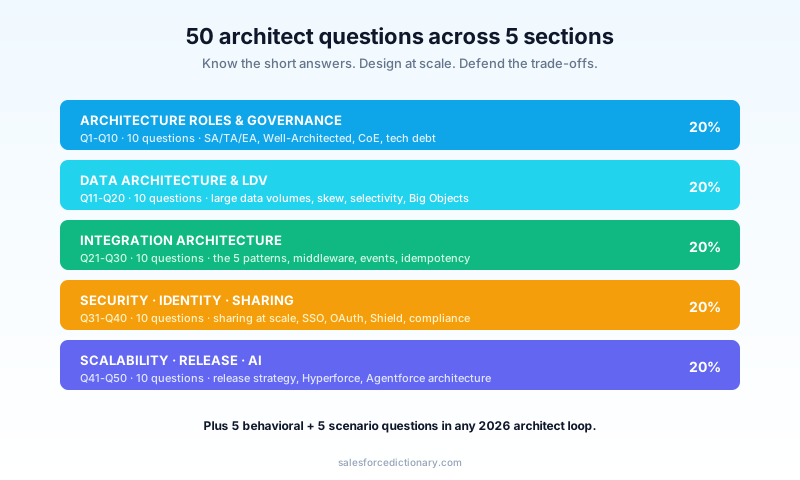
Section 1 - Architecture roles & governance (Q1-Q10)
This section establishes altitude. Interviewers want to know you can hold the whole landscape in your head and govern it, not merely build well in one corner of it.
Q1. What's the difference between a Solution, Technical, and Enterprise Architect?
Short: Solution architects own a single project's design, technical architects own the deep platform build, enterprise architects own the multi-system, multi-year landscape.
What to actually say: "Solution architect designs the answer to one business problem on the platform. Technical architect goes deep on the Salesforce build itself: data model, integration, performance, security. Enterprise architect zooms out to how Salesforce fits the entire technology estate over a multi-year horizon. They overlap heavily, and on a smaller program one person wears all three hats, which is worth saying so you don't sound like you think they're rigidly separate roles. The role breakdown maps where each one's accountability actually sits."
The signal an interviewer listens for is whether you understand the altitude shift: a technical architect optimizes the build, an enterprise architect makes the call about whether Salesforce is even the right system for a given capability, and conflating the two suggests you've only operated at one level.
Q2. What is the Salesforce Well-Architected framework?
Short: Salesforce's published guidance for building solutions that are trusted, easy, and adaptable.
What to actually say: "It's the platform's own opinion on good architecture, organized around three pillars: trusted (secure, compliant, reliable), easy (intentional, automated, resilient), and adaptable (composable, evolvable). I use it as a shared vocabulary in design reviews, because it turns 'I don't like this design' into a specific principle the team can discuss objectively. The Well-Architected guide covers how it now extends to Agentforce, which matters because the same principles apply to agents."
In practice I cite it when I'm pushing back on a design that's clever but fragile: naming the 'resilient' or 'evolvable' principle reframes the conversation from personal preference to a standard the whole team has agreed to respect, which is far more persuasive than my opinion.
Q3. What does a Center of Excellence do?
Short: A central team that sets standards, governs the platform, and shares practices across the organization.
What to actually say: "A CoE owns the standards, the release process, the reusable patterns, and the decision rights, so a large organization doesn't fragment into a dozen conflicting builds in the same org. The trap is making it a bureaucratic gate that slows everyone down, at which point teams route around it and you have governance in name only. A good CoE ships paved roads, reusable components, templates, clear guidance, so doing the right thing is the easy thing. A bad one just puts up toll booths."
Q4. How do you document architecture decisions?
Short: Architecture Decision Records: the context, the options, the choice, and the consequences.
What to actually say: "I keep short decision records that capture why we chose a path and what we traded away, because in two years nobody remembers, and someone will want to reverse a decision without knowing what it was protecting against. The consequences section matters most: a decision recorded with no downside usually means the downside wasn't thought through. ADRs are cheap to write and repeatedly save the team from relitigating settled questions or unknowingly undoing a deliberate trade-off."
A concrete payoff: when a new lead joins and asks "why don't we just use a single integration user for everything," the ADR that records the data-skew and auditability reasons answers in thirty seconds what would otherwise be a half-day debate that reaches the same conclusion.
Q5. How do you manage technical debt?
Short: Make it visible, track it, and pay it down deliberately alongside feature work.
What to actually say: "I keep a debt register with the cost and the risk of each item, so it's a business conversation rather than an engineering complaint nobody acts on. I budget a slice of each release for paydown and I block the avoidable debt before it lands. The orgs that fail are the ones where debt is invisible until a release can't ship or a simple change takes a month, so naming it and quantifying it is most of the battle. You manage debt by making it a line item, not a feeling."
The framing that actually wins budget is risk, not cleanliness. "This unbulkified trigger will fail the next time marketing loads more than 100 leads at once" gets funded; "the code is messy" does not. So I translate each debt item into a business consequence and its likelihood, and I let the highest-risk items compete for the paydown budget on equal terms with new features. Debt framed as engineering taste loses every prioritization meeting; debt framed as a quantified business risk wins its fair share."
Q6. What's your approach to governance on a large program?
Short: Clear decision rights, a design authority, change control, and an architecture review for significant changes.
What to actually say: "I set up a design authority that reviews anything touching the shared data model, security, or integrations, and I keep the bar proportionate so small, low-risk changes aren't strangled by process. Governance exists to keep the org coherent while many teams build in parallel, because without it you get five teams independently solving the same problem five incompatible ways in one org. The art is making the review fast and valuable enough that teams want it, not heavy enough that they avoid it."
Q7. How do you decide single-org versus multi-org?
Short: Default to single-org for the unified view; choose multi-org when autonomy, compliance, or scale genuinely demand separation.
What to actually say: "Single-org gives you the unified customer view and shared automation, which is usually the entire point of standardizing on Salesforce, so it's my default. I split to multi-org when business units are genuinely independent, when data residency or regulatory isolation requires it, or when one unit's customization would constantly collide with another's. It's effectively a one-way door, merging orgs later is a major program, so I make a client prove they need the separation rather than defaulting to it for political comfort."
The nuance worth raising: 'one company, one org' is a fine aspiration but not a law, and a forced single org across truly independent business units with incompatible processes can be worse than a clean multi-org with a shared analytics layer on top. The right answer depends on how independent the units genuinely are, and I probe that before recommending either.
Q8. How do you balance declarative versus programmatic at the architecture level?
Short: Configuration for maintainability, code for genuine complexity, with clear standards for when each applies.
What to actually say: "I set org-wide standards so the choice isn't made ad hoc by whoever happens to pick up the story. Declarative for the bulk of automation, because admins maintain it and it survives upgrades. Code where there's real complexity, volume, or orchestration that declarative can't express cleanly. The architecture risk isn't picking wrong once, it's having no standard, so the org drifts into a half-Flow, half-Apex mess where nobody can predict which tool handles a given behavior or where to look when it breaks."
Q9. How does architecting for an ISV or managed package differ from internal work?
Short: Packaged code runs in subscriber orgs you don't control, so you design for isolation, namespaces, and limits you can't see.
What to actually say: "For a managed package I can't assume anything about the subscriber org: their limits, their other installed packages, their data volume, their customizations. I design defensively, respect namespaces, avoid hard dependencies on org-specific state, and test against deliberately hostile orgs. Internal work lets me know and control the environment. ISV work means engineering for thousands of environments I'll never log into, which raises the bar on configurability, backward compatibility, and not consuming limits the subscriber needs for their own code."
A concrete discipline: I never assume my package is the only thing in the org, so I design my triggers and automation to coexist with whatever the subscriber and other installed packages are doing, and I expose configuration rather than hard-coding behavior a subscriber might need to change. Backward compatibility becomes a contract the moment customers are live, because an upgrade that breaks a subscriber's customization is a support crisis replicated across every org that installed the package, not a single rollback I can quietly fix."
Q10. How do you evaluate an AppExchange package architecturally?
Short: Assess its security review status, data model impact, limit consumption, and how it behaves on upgrade.
What to actually say: "I look past the demo at how it's actually built: does it bring a sane data model, how much of my governor limits does it consume per transaction, does it use supported APIs, and what happens to my org on its upgrades. A package that hijacks page layouts, adds triggers with SOQL in loops, or burns through limits becomes my problem at scale, regardless of how good the sales deck was. The security review is the entry ticket, not the whole evaluation, and I weigh the vendor's stability and support as part of the architecture decision, because an abandoned package is a liability I inherit."
Section 2 - Data architecture & large data volumes (Q11-Q20)
Large data volumes are where most architecture interviews probe hardest, because LDV is where naive designs fail and experience shows. This is the section that separates people who've operated at scale from people who've read about it.
Q11. What are Large Data Volumes, and why do they matter?
Short: Data volumes high enough (millions of rows) that ordinary designs start to degrade query, sharing, and load performance.
What to actually say: "LDV is the point where 'it works' stops being automatically true and you have to design for the database, not the object model alone. Queries go non-selective, sharing recalculation drags, list views and reports time out, and data loads slow to a crawl. The architect's job is to anticipate it before the org gets there: indexing, selective queries, archiving, and avoiding skew designed in from the start, because retrofitting all of that at fifty million rows is brutal, slow, and risky compared to designing for it early."
Q12. What is a skinny table?
Short: A Salesforce-maintained table with a subset of frequently used fields, created by Support to speed queries on LDV objects.
What to actually say: "It's a performance feature for objects with millions of rows: a narrow copy of the hot fields that avoids the join between the base table and the custom-field table, which speeds up reads. You request it through Salesforce Support, and it's a targeted remedy, not a first move. I reach for it after I've exhausted indexing and query design, because it's a specific fix for a specific LDV symptom, and it comes with maintenance considerations, like staying in sync, that mean you don't sprinkle it around casually."
It's worth being clear in an interview that a skinny table isn't a self-service feature: you work with Salesforce Support to create one, it holds only non-formula fields up to a limit, and it stays in sync automatically once established. Because it's a managed remedy with real overhead, I treat needing one as evidence the underlying object is genuinely large, and I make sure I've already done the cheaper work, custom indexes and selective query redesign, before requesting it, so it's the right tool rather than a shortcut around a query I could have fixed myself."
Q13. What is data skew, and how do you avoid it?
Short: When too many child records point at one parent or owner, causing lock contention and sharing performance problems.
What to actually say: "There are three flavors I watch for. Ownership skew is thousands of records owned by one user, which slows sharing recalculation when that user's role changes. Account skew is thousands of child records under one Account, which causes record-lock contention on updates. Lookup skew is everyone pointing at one 'Default' or 'Unknown' record, same contention problem. I avoid all three by distributing ownership, capping children per parent, and never building a single catch-all record that the whole org references, because that record becomes a lock-contention hotspot under any concurrent load."
The story that makes this concrete is the opening of this article: a single integration user owning almost everything creates massive ownership skew, so every role-hierarchy or sharing change triggers a recalculation across millions of records, which is why the nightly job runs past 9am. Distributing ownership across many users fixes it, and recognizing the symptom from the description is exactly what an interviewer is testing.
Q14. What makes a query selective, and how do custom indexes help?
Short: A selective query filters on an indexed field returning a small fraction of rows; custom indexes make more fields selective.
What to actually say: "Past a few hundred thousand rows, a filter on a non-indexed field forces a full table scan, and the platform throws a non-selective query error to protect itself. Salesforce treats a filter as selective when it returns under roughly 10% of the first million rows against an indexed field. So I design filters around standard or custom indexes, avoid the things that defeat indexes, leading wildcards, negation, nulls, non-deterministic formula fields, and request custom indexes on high-cardinality fields we filter on heavily. At LDV, selectivity isn't an optimization, it's the line between a working feature and a timeout."
Q15. When do you use Big Objects?
Short: For billions of rows of historical or archive data that you need to store and query but not transact on.
What to actually say: "Big Objects hold massive volumes, event logs, historical transactions, archived records, with a different access model, no sharing, and no triggers in the usual sense. They're append-and-query, not for daily CRUD. I use them to keep the live org lean by moving cold data out while keeping it queryable for the rare audit or lookup. The constraint is the limited query model: you query on the index you defined, so I design that composite index up front against the access patterns I expect, because changing it later is painful."
Q16. How do you design a data archiving strategy?
Short: Define what's active versus cold, move cold data to Big Objects or external storage, and keep the live org lean.
What to actually say: "I work with the business to define retention tiers: what's actively used, what's needed for reference, what exists purely for compliance. Active data stays in the live objects, reference data may move to Big Objects, and pure compliance data can go to cheaper external storage queried via Salesforce Connect when needed. The driver is that a lean live org performs better, costs less in storage, and recalculates sharing faster. Archiving is a first-class architecture concern, not a cleanup task you do once and forget, because data keeps accumulating."
I design archiving to run continuously rather than as a one-time purge, because a single cleanup just delays the same problem by a year. That usually means a scheduled process moving records past a retention threshold into Big Objects or external storage on a rolling basis, plus a clear path for users to still reach archived data on the rare occasions they need it. Designing the retrieval path matters as much as the archive itself, because data nobody can find when they need it is functionally lost, even when it's technically retained somewhere."
Q17. How does sharing recalculation behave at scale?
Short: Changes to roles, ownership, or sharing rules trigger recalculation that, on LDV objects, can run for hours.
What to actually say: "When you change a sharing rule, move a role in the hierarchy, or transfer ownership in bulk, the platform recalculates access for all affected records, and on millions of rows that's expensive and slow. I minimize churn to the role hierarchy, prefer a broad organization-wide default plus targeted rules over thousands of narrow ones, distribute ownership to avoid skew, and use deferred sharing calculation during large bulk loads so the recalculation happens once at the end rather than per record. A sharing model that recalculates for six hours is a design problem I own, not a platform limitation I'm stuck with."
Q18. How do you design the data model for scale?
Short: Right-size relationships, avoid skew, lean on standard objects, and model for query selectivity.
What to actually say: "I model for how the data will actually be queried and shared, not merely how it's structured on an entity diagram. That means distributing ownership, avoiding mega-parents with too many children, choosing master-detail versus lookup deliberately because of the sharing inheritance and rollup implications, and keeping an eye on field counts and the resulting page and query performance. A clean ER diagram that causes lock contention or non-selective queries at volume is a failed design, however elegant it looks on the whiteboard."
Q19. What's the impact of LDV on reports and list views, and how do you mitigate?
Short: They slow down or time out; mitigate with selective filters, indexed fields, scoped list views, and archiving.
What to actually say: "Reports and list views run queries under the hood, so the same selectivity rules apply: an unfiltered report on a ten-million-row object will crawl or time out. I add indexed date or status filters, scope list views narrowly, avoid 'view all' on huge objects, and push heavy aggregation to scheduled reporting snapshots or a dedicated analytics layer like CRM Analytics that's built for it. Part of the job is also managing the expectation that an instant, unfiltered list of every record is reasonable, because at LDV it simply isn't, and the fix is better-scoped questions, not a faster query."
When an executive genuinely needs a broad cross-section of a huge object, I move that workload off the transactional database entirely, into CRM Analytics or a scheduled reporting snapshot built for aggregation, so the live org isn't running analytical scans during business hours. The principle is matching the tool to the workload: transactional queries stay selective and narrow, analytical workloads go to a layer designed for them. Forcing the operational database to answer analytical questions at volume is how you end up with both slow reports and a slow everything-else."
Q20. How do you load large data volumes efficiently?
Short: Bulk API with parallel batches, PK chunking for extracts, deferred sharing, and disabling unneeded automation during load.
What to actually say: "I use the Bulk API, order the loads to respect object relationships so parents exist before children, and PK-chunk large extracts to avoid timeouts. For the big initial load I defer sharing calculation, switch off non-essential triggers, validation rules, and workflow during the load, then re-enable and let everything recompute once at the end. Loading fifty million rows with every trigger, sharing rule, and validation firing per record is how a migration runs for a week instead of a weekend, and sequencing plus deferral is what makes the difference."
Section 3 - Integration architecture (Q21-Q30)
Integration is where Salesforce meets the rest of the enterprise, and where architecture decisions have the longest reach. The integration patterns reference is the deep version of this section.
Q21. What are the Salesforce integration patterns?
Short: Request and Reply, Fire and Forget, Batch Data Synchronization, Remote Call-In, and UI Data Virtualization.
What to actually say: "Those five cover almost every real need: synchronous call-and-wait, asynchronous publish-and-move-on, scheduled bulk synchronization, external systems writing into Salesforce, and displaying external data without storing it. I choose by three axes: timing (real-time versus batch), direction (outbound versus inbound), and volume. Naming the pattern first, then the API that implements it, shows I think in patterns rather than reaching for whatever API I used last time."
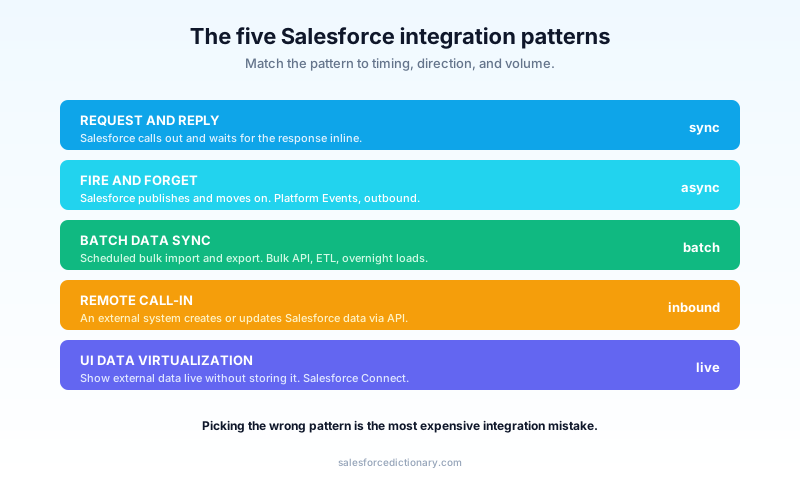
The mistake I watch for in candidates is jumping straight to "we'll use REST," because REST is a technology, not a pattern. The pattern decision, whether the caller waits, whether it's one record or a million, who initiates, comes first, and the API choice follows from it.
Q22. Request-reply versus fire-and-forget versus batch sync?
Short: Request-reply when the user needs an answer now, fire-and-forget when you don't need to wait, batch when volume is high and latency is acceptable.
What to actually say: "Request-reply blocks the user or the process until the remote system responds, so I use it only when the answer is genuinely needed in the moment and the callee is fast and reliable, like a real-time credit check at checkout. Fire-and-forget decouples through an event when I just need to notify another system and don't care to wait. Batch handles volume overnight where a few hours of latency is fine. Choosing request-reply for something that should have been an event is how one slow partner API ends up freezing your users, and that's a design error I've seen take down a sales floor."
Q23. When do you use middleware like MuleSoft versus point-to-point?
Short: Point-to-point for a few simple connections; middleware when integrations multiply or need orchestration, transformation, and monitoring.
What to actually say: "Two or three simple, stable connections can be point-to-point without guilt. Once you have many systems, complex transformations, orchestration across multiple endpoints, or a need for centralized monitoring, retry, and reuse, middleware earns its cost. The anti-pattern is a spaghetti of direct connections that nobody can change safely because every system knows every other system's schema. The architect's real job is spotting the inflection point and introducing middleware before the spaghetti forms, because untangling it afterward is far more expensive than building it right when the third integration appears."
Q24. Synchronous versus asynchronous integration trade-offs?
Short: Synchronous is simpler and immediate but couples systems and risks timeouts; asynchronous is resilient but adds complexity.
What to actually say: "Synchronous gives an immediate result and simpler logic, at the cost of tight coupling: if the other system is slow or down, you are too, and you inherit its reliability. Asynchronous decouples and absorbs spikes, so a slow partner doesn't take you down, but you take on eventual consistency, message ordering, and more complex error handling. I default to asynchronous for anything high-volume or cross-system, and reserve synchronous for genuine real-time needs where the user truly cannot proceed without the answer."
A concrete test I apply: if the external system being down should stop the user, synchronous is defensible; if the user's work should continue regardless, it has to be asynchronous. A real-time fraud check at payment is the rare case where blocking is correct, because proceeding without it defeats the purpose. Sending an order confirmation to the warehouse is not, because the warehouse being briefly unreachable should never stop a customer from placing an order, so that path has to be an event the warehouse consumes when it comes back."
Q25. Platform Events versus Change Data Capture versus Streaming?
Short: Platform Events for custom messages you publish, CDC for automatic record-change events, Streaming for query-based notifications.
What to actually say: "Platform Events when I control the payload and publish deliberately, like an OrderApproved business event that several systems subscribe to. CDC when I just need to react to any insert, update, delete, or undelete on an object without writing publish code, which is ideal for replicating data to an external store or data lake. Both decouple producer from consumer and keep the synchronous transaction fast. I choose Platform Events when the message carries business meaning and CDC when I need raw data-change replication, and I design idempotent consumers either way because delivery isn't strictly once-only."
Q26. How do you handle API limits at scale?
Short: Monitor consumption, batch and bulk where possible, cache, and use events instead of polling.
What to actually say: "I treat the daily API request limit as a budget I architect within. I use composite and bulk calls to do more per request, replace polling with Platform Events or CDC so I'm not burning calls checking for changes that rarely happen, cache reference data instead of refetching it, and monitor usage so we see the cliff coming rather than hitting it during a peak. An integration that polls every minute per record will exhaust the org's limits, and the fix is architectural, redesign to event-driven, not a support ticket asking for a higher limit."
I also instrument the consumption so the org has visibility into which integrations spend the budget, because "we're near the API limit" is unactionable without knowing who's spending it. Often a single chatty integration polling for changes accounts for most of the spend, and converting just that one to event-driven frees enough headroom that the limit stops being a concern. The architecture answer is almost always to spend fewer calls by design, not to negotiate a bigger number from Salesforce."
Q27. How do you design for idempotency and error handling in integrations?
Short: Make operations safe to retry, use external IDs for upserts, and design dead-letter and retry handling.
What to actually say: "Networks fail mid-flight, so every integration has to assume a message might arrive twice or not at all. I use upsert on an external ID so a replayed message updates rather than duplicates, build retry with exponential backoff for transient failures, and route messages that can't be processed to a dead-letter queue for inspection rather than silently dropping them. Idempotency isn't optional at volume, it's the difference between a transient network hiccup and a data-integrity incident where you've created ten thousand duplicate orders because the partner retried."
Q28. What is a canonical data model, and when do you use it?
Short: A system-neutral data format that each system maps to, decoupling integrations from each other's schemas.
What to actually say: "Instead of every system needing to know every other system's schema, they all map to one shared canonical format, usually defined in the middleware layer. It's worth the overhead when you have many systems and changing one shouldn't ripple through all the others, because the canonical model absorbs the change. For two systems it's over-engineering that adds a translation layer nobody needs. For a complex landscape with systems coming and going over years, it's what keeps the integration estate maintainable instead of brittle."
Q29. How do you secure integrations?
Short: Named Credentials for managed auth, the right OAuth flow per scenario, least-privilege integration users, and encryption in transit.
What to actually say: "I use Named Credentials so secrets live in managed configuration rather than in Apex, pick the OAuth flow that fits the scenario, client credentials or JWT bearer for system-to-system, and give integration users least-privilege access rather than a System Administrator profile out of laziness. The breach I've seen most often is an over-permissioned integration user with a password hardcoded in an Apex class, so I design that out by default: scoped permissions, managed credentials, and rotation. Security in integration is mostly about not granting more access than the integration actually needs."
Q30. How do you handle a high-volume outbound integration without hitting limits?
Short: Batch the work, publish events instead of synchronous callouts, and move processing async.
What to actually say: "I never fire a synchronous callout per record from a trigger at volume, because that blocks the transaction and burns limits. Instead I capture the change, publish a Platform Event or enqueue the work, and let an asynchronous process batch the callouts while respecting both my governor limits and the partner's rate limits. Designing the outbound flow around the partner's throughput and our limits together is the architect's job, because the developer building one callout doesn't see the system-wide picture of ten thousand of them firing during a nightly batch."
Section 4 - Security, identity & sharing at scale (Q31-Q40)
Security and sharing are where Salesforce architecture is most distinctive and most unforgiving. A mistake here is the kind that surfaces in an audit, which is the worst possible time.
Q31. How do you design a sharing architecture?
Short: Start restrictive with OWD, open up through the role hierarchy and sharing rules, and use programmatic sharing for the edge cases.
What to actually say: "I set the floor with org-wide defaults as tight as the business can tolerate, then open access deliberately and in layers: role hierarchy for vertical visibility up the management chain, sharing rules for lateral access, teams and manual sharing for exceptions, and Apex managed sharing for logic too dynamic to declare. The governing principle is least privilege by default, open up only where there's a real need. The sharing and visibility guide is the model I design against, and getting the OWD right is the foundation everything else sits on."
Q32. How do you set OWDs for a complex org?
Short: Most restrictive the business can tolerate, per object, then open up. Private by default for sensitive data.
What to actually say: "I set each object's OWD to the tightest setting that still lets the business function, per object, because you can always open access later but tightening it after the fact means a painful recalculation across all existing records and an awkward conversation about why people are suddenly losing access. Sensitive objects go Private. Getting OWDs wrong is the most expensive sharing mistake because everything else, every rule, every role-based access path, is built on top of that floor, and changing the floor moves everything above it."
Q33. What causes sharing performance problems at scale?
Short: Excessive sharing rules, large role hierarchies, ownership skew, and frequent recalculation triggers.
What to actually say: "Too many sharing rules, a deep or frequently-churning role hierarchy, and ownership or account skew all force expensive recalculation on LDV objects. I keep the role hierarchy as stable and shallow as the business allows, prefer a broad OWD with a handful of targeted rules over thousands of narrow ones, distribute ownership to kill skew, and use deferred sharing during bulk operations. A sharing model that's logically correct but recalculates for hours after any change is still a failed design at scale, because the business can't make a routine org change without an overnight job, and that operational drag is real."
Q34. How do you design identity and single sign-on?
Short: Federated identity via SAML or OpenID Connect, with Salesforce as service provider or identity provider depending on the landscape.
What to actually say: "For workforce single sign-on, I federate to the corporate identity provider via SAML or OpenID Connect, so users have one login and deprovisioning happens centrally when someone leaves, which is as much a security control as a convenience. Salesforce can also act as the identity provider for downstream apps, or handle customer identity through Experience Cloud with social or passwordless login. The core design question is who is the single source of truth for identity, and I make sure that's one system, because identity scattered across three places is a security gap and a support headache."
Q35. Which OAuth flow for which scenario?
Short: Web server flow for user-context apps, JWT bearer for server-to-server, client credentials for system integrations, device flow for limited-input devices.
What to actually say: "I match the flow to the actor and the context. A user-facing app uses the web server flow with a refresh token, so it acts as the user. A backend integration with no human in the loop uses JWT bearer or client credentials, so it authenticates as a service. I deliberately avoid the username-password flow, which is being retired and which encourages storing a password you shouldn't hold. Picking the wrong flow almost always means someone is storing a credential they have no business storing, so the flow choice is really a credential-handling decision."
Q36. What is Salesforce Shield, and when do you recommend it?
Short: An add-on with Platform Encryption, Event Monitoring, and Field Audit Trail for regulated or high-sensitivity orgs.
What to actually say: "Shield is the answer when standard security isn't enough: regulated industries, sensitive data at scale, or strict audit requirements. Event Monitoring is the most broadly useful piece for understanding who did what, Field Audit Trail covers long-retention audit of field changes, and Platform Encryption encrypts data at rest with customer-controlled keys. I recommend it based on a specific compliance or risk requirement, not as a default upsell, because it carries cost and, in the case of encryption, real functional trade-offs that have to be weighed against the actual risk being mitigated."
Q37. How do you handle the trade-offs of Platform Encryption?
Short: Encryption protects data at rest but breaks some filtering, sorting, and functionality on encrypted fields.
What to actually say: "Encrypting a field has genuine costs: you lose or degrade filtering, sorting, and certain features on that field, and SOQL behaves differently against encrypted data. So I encrypt selectively, the genuinely sensitive fields that a compliance requirement names, rather than encrypting everything to feel secure. Before I commit, I check the functional impact on reports, list views, and integrations that touch those fields. Treating encryption as a free checkbox is how a team discovers at UAT that a critical report can no longer filter on the field they encrypted."
Q38. How do you architect for compliance like GDPR or HIPAA?
Short: Design data handling, retention, access, encryption, and auditability to the specific regulation from the start.
What to actually say: "Compliance is a first-class requirement that shapes the data model, sharing, encryption, retention, and audit design from day one. For GDPR I plan for data subject access requests and the right to erasure, which means knowing where personal data lives and being able to find and remove it. For HIPAA I design access and audit around protected health information, usually with Shield. I get these constraints into discovery, because retrofitting compliance after the build is painful, sometimes impossible, and always more expensive than designing for it upfront."
A concrete example of why it has to be upfront: GDPR's right to erasure means I must be able to find and delete every piece of a person's data on request, which is straightforward if I designed for it and a nightmare if personal data is scattered across custom objects, attachments, and an integration's logs nobody mapped. So compliance shapes the data model itself, where personal data is allowed to live and how it's tagged, and that's a design decision made at the start, not a deletion script written under deadline the week the first erasure request lands."
Q39. How do you design external user access at scale?
Short: Experience Cloud with sharing sets and sharing groups, designed to avoid the role explosion of high-volume external users.
What to actually say: "High-volume external users don't fit the internal role hierarchy, and trying to force them in breaks the platform, so I use sharing sets and the external account hierarchy to grant access efficiently based on the user's account. The scale trap is treating a million customer-community users like internal users with roles, which the platform genuinely can't sustain. I design external sharing on its own model from the start, because converting a community from the wrong access model to the right one after launch is a major re-architecture, not a tweak."
Q40. How do you handle least privilege at scale?
Short: Permission set groups for role-based access, minimal profiles, and delegated administration where appropriate.
What to actually say: "I use the minimum-access profile pattern: near-empty profiles plus permission set groups that grant capability by role, so access is composable, auditable, and easy to reason about even with tens of thousands of users. Delegated administration lets business units manage their own users within guardrails so the central team isn't a bottleneck. The goal is that what any given user can do is explainable and demonstrably least-privilege, which is exactly what an auditor will ask me to prove, so I design the access model to make that proof straightforward."
Section 5 - Scalability, release & AI architecture (Q41-Q50)
The final section blends the operational discipline of release management with the genuinely new architecture problem of building Agentforce at enterprise scale. Strong candidates have a real answer for the AI questions, because the data and governance, not the agent, are the hard part.
Q41. What's your environment and release management strategy?
Short: Source-driven development with Salesforce DX, version control, CI/CD, and a sandbox path to production.
What to actually say: "Metadata lives in git as the source of truth, not in any single long-lived org, and that inversion is the whole modern model. Feature work flows through a branch-per-feature approach with automated test runs on every pull request, into integration, then UAT, then production, promoted by a CI/CD pipeline. The strategy has to support many teams shipping safely in parallel, which means automated testing and a clear, repeatable path, not change sets and hope. I'd rather invest in the pipeline early than spend every release weekend doing manual deployments and praying."
Q42. How do you design a sandbox strategy?
Short: Match sandbox types to stages: Developer for build, Partial Copy for QA, Full for UAT and performance, with a refresh cadence.
What to actually say: "Developers work in Developer or Developer Pro sandboxes, QA runs in Partial Copy with representative sample data, and UAT plus performance testing happen in a Full sandbox that mirrors production volume. I plan the refresh cadence deliberately so environments don't drift away from production, and I make sure there's a Full sandbox specifically for the large-data-volume and performance testing you genuinely cannot do anywhere else. Skimping on the sandbox tier is how a performance bug that only appears at scale sails through testing and surfaces in production."
The refresh-cadence detail matters at the architect level: a Full sandbox refreshes at most every 29 days, so I plan the testing calendar around that constraint rather than assuming I can refresh on demand the morning of a test. I also seed the lower environments with enough representative data that functional testing isn't done against a near-empty org, because a Flow that works on five records and breaks on five thousand is exactly the defect a too-clean sandbox hides right up until go-live."
Q43. What is Hyperforce, and why does it matter architecturally?
Short: Salesforce's public-cloud infrastructure, which enables data residency control and elastic scale.
What to actually say: "Hyperforce is Salesforce re-platformed onto public cloud infrastructure, and it matters to me as an architect for two concrete reasons: data residency, because I can keep an org's data in a specific region to meet a regulatory requirement, and scalability, because capacity is more elastic. For most designs it's transparent, the org works the same, but when a client has a hard data-residency requirement, Hyperforce is the answer to a question that used to be 'you can't do that on this platform,' so knowing it exists changes what I can promise."
Q44. How do you design for performance at scale?
Short: Selective queries, bulkified automation, asynchronous processing, caching, and disciplined governor-limit management.
What to actually say: "Performance is designed in from the start, not tuned in at the end. That means selective indexed queries, bulk-safe automation that handles a 200-record batch the same as one record, heavy work moved to asynchronous Apex, the platform cache for hot reference data, and lean page and Lightning component design. I treat governor limits as a design constraint from day one rather than an error to fix later. At scale, the difference between a fast org and a slow one is a hundred small architecture decisions made early, not a heroic optimization sprint after users start complaining."
Q45. How do you handle multi-tenant constraints in architecture?
Short: Design within governor limits and shared-resource fairness, because you don't get a dedicated server.
What to actually say: "Multitenancy means the governor limits exist to protect every tenant on the instance, so I architect within them rather than fighting them: bulk patterns, asynchronous processing for heavy lifting, efficient selective queries. I can't buy my way to a bigger heap or more CPU time the way I could provision a bigger server on-premise. Accepting that the platform's constraints define the design space, and building elegantly within them, is exactly what separates a Salesforce architect from someone porting on-premise habits onto a platform that won't tolerate them."
Q46. How do you architect an Agentforce solution at enterprise scale?
Short: Bounded topics and actions, grounded in unified data, governed by the Trust Layer, with evaluation and observability.
What to actually say: "I decompose the use case into narrow, well-bounded topics with clearly-described actions, ground the agent in unified and permissioned data, and build evaluation and observability in from the start so we can measure quality and debug failures rather than guessing. At enterprise scale the genuinely hard parts are the data grounding and the governance, not wiring up an agent, which is comparatively easy. So I architect the data foundation and the guardrails first and treat the agent itself as the layer that sits on top of solid foundations, because an agent on top of fragmented data and weak governance fails in ways that are public and embarrassing."
Q47. How does the Atlas Reasoning Engine factor into agent architecture?
Short: It's the plan-retrieve-act loop that routes a request to topics and actions, so action design and descriptions drive behavior.
What to actually say: "Atlas evaluates the user's request, retrieves relevant context, plans which actions to call, executes them, and re-plans if one fails. Architecturally, that means my topic boundaries and action descriptions are the control surface, because Atlas reads those descriptions to decide what to invoke. Vague topics or sloppy action descriptions cause wrong tool selection, so I design those interfaces with the same care I'd give an API contract. The reasoning engine is doing the routing I used to hard-code, so the quality of my metadata, the descriptions and boundaries, is what determines whether it routes correctly."
Q48. How do you architect Data Cloud grounding for AI?
Short: Unify and resolve data into a single profile, then expose the right slices to agents as grounding.
What to actually say: "Agents are only as good as what they're grounded in, so I architect Data Cloud to ingest data from across systems, map it to a common model, and resolve identity so the same customer from three systems becomes one unified profile. Then I ground agents in the relevant, permissioned slice of that profile. The unglamorous truth I tell stakeholders is that most of an enterprise AI project is this data-unification work, and the agent is the easy part once the foundation is solid. An agent grounded in fragmented or duplicated data gives confident, wrong answers, which is worse than no answer."
Q49. How do you architect the Trust Layer and AI governance?
Short: Use the Einstein Trust Layer for masking, grounding gates, and zero retention, and add your own access and audit controls.
What to actually say: "The Trust Layer handles the model-boundary protections: masking PII before prompts leave the org, enforcing access on retrieved data, and preventing the foundation-model providers from training on our data. On top of that I design the governance the platform doesn't do for me: who is allowed to build and deploy agents, how each action enforces CRUD and field-level security so the agent can't act beyond the running user's rights, and how we audit and review agent decisions. The platform secures the boundary; I'm responsible for governing what the agent is actually allowed to do once it's inside that boundary."
Q50. How do you future-proof an architecture for AI you can't fully predict?
Short: Invest in clean, unified, well-governed data and composable design, because those pay off regardless of which AI wins.
What to actually say: "I don't bet the architecture on a specific feature that might change next release, because chasing each AI announcement with bespoke architecture just builds debt. Instead I invest in the things that hold their value no matter how the AI evolves: clean and unified data, least-privilege security, composable services with clear contracts, and documented decisions. Good data and good governance make the org ready for whatever Agentforce becomes, because every credible AI direction depends on exactly those foundations. Future-proofing is less about predicting the future and more about building on the things that are valuable in every version of it."
Behavioral questions (5 patterns)
Behavioral rounds at the architect level probe humility, influence, and the ability to make hard trade-offs and own them. Use real decisions with specifics and scars.
B1. "Tell me about an architecture decision you got wrong."
What they want: senior-level humility and the ability to learn from a real mistake.
What to say: pick a genuine one, a data model that didn't scale, an integration pattern that coupled two systems too tightly, an org-strategy call you'd now make differently. Explain how you discovered it, what it cost, and how you corrected it and changed your decision process afterward. Senior architects have scars and discuss them plainly, because pretending you've never been wrong signals either inexperience or a lack of self-awareness, both of which are worse than the original mistake.
B2. "Describe defending an architecture to a skeptical executive."
What they want: influence and the ability to speak the business's language.
What to say: show how you translated the technical design into cost, risk, and business outcomes, brought options rather than a single take-it-or-leave-it edict, and earned the decision rather than demanding it. The strongest versions show you changed your design in response to a fair challenge, because that proves you defend ideas on their merits rather than out of ego, which is exactly what an executive wants in an architect they'll trust with big decisions.
B3. "Tell me about reducing technical debt at scale."
What they want: pragmatism and the ability to prioritize without halting delivery.
What to say: describe how you made the debt visible and quantified the risk, then paid it down in a way that didn't stop the business from getting features. Mention how you prevented new debt from accumulating. Avoid the purist story where you rewrote everything, because at enterprise scale that's neither possible nor wise; show business-aware sequencing where you fixed the highest-risk debt first and lived with the rest deliberately.
B4. "Describe a trade-off you made between cost, time, and quality."
What they want: judgment under real constraints, where you can't have all three.
What to say: pick a decision where the constraints were genuine, explain what you chose, what you protected, and what you knowingly deferred with a documented plan to revisit. Show that you decided deliberately rather than letting the trade-off happen by default, because architecture is largely the discipline of making these trade-offs consciously and recording why.
B5. "How do you keep current with the platform's architectural direction?"
What they want: evidence you track where Salesforce is heading, not merely where it's been.
What to say: the Architects site and Well-Architected updates, release notes read with an eye for new limits and deprecations, genuine hands-on time with Data Cloud and Agentforce rather than just reading about them, and the architect community. Name a recent shift, Hyperforce, agentic AI, the move to source-driven development, and explain how it changed your thinking, because the specific example proves the habit is real.
Scenario questions (5 patterns)
Scenario questions are where architecture judgment shows live. Think out loud, state your assumptions, and reach for scale instincts first.
S1. "An org with 50 million Cases has slow list views and sharing recalc running for hours. Diagnose it."
What they want: large-data-volume instincts applied to a real symptom. Steps: check for non-selective queries behind the list views and add indexed filters or scope them, look hard for ownership and lookup skew, which is the usual culprit behind multi-hour recalculation, audit the number of sharing rules and the role-hierarchy churn, consider a skinny table for the hot fields and archiving cold Cases to Big Objects, and use deferred sharing for bulk changes. Frame the whole thing as a data-architecture problem, not a tuning exercise, because the fix is structural.
S2. "Design an integration moving 2 million records a day between Salesforce and an ERP."
What they want: integration architecture at volume. Steps: choose batch data synchronization over per-record callouts, use the Bulk API with upsert on an external ID for idempotency so retries don't duplicate, run it asynchronously during off-peak hours, put middleware in between for transformation, orchestration, and monitoring, and design retry and dead-letter handling for the records that fail. Confirm first whether any slice of it genuinely needs to be real-time before defaulting everything to batch, because mixing a small real-time path with a large batch path is often the right answer.
S3. "A company wants to merge five regional orgs into one. How do you approach it?"
What they want: org-strategy judgment and program thinking. Steps: first understand why they're separate today, autonomy, compliance, history, because the reason determines whether merging is even wise. Then model the unified data and sharing design, plan identity consolidation and deduplication, sequence the migration org by org with reconciliation at each step, and address the change management and governance needed to keep one org coherent afterward. Be honest that org consolidation is a major multi-quarter program, not a data load, and that the hardest parts are people and process, not metadata.
S4. "Design an Agentforce architecture for a bank's service org with strict compliance."
What they want: AI architecture plus governance under real constraints. Steps: scope narrow, well-bounded topics and actions, ground the agent in permissioned Data Cloud data, enforce the Trust Layer for masking and zero retention, enforce CRUD and field-level security on every action so the agent can't exceed the user's rights, add human-in-the-loop review for sensitive operations like anything touching money, and build evaluation and audit logging from the start. Lead with the data foundation and the guardrails, because in a regulated bank those are the architecture, and the agent is the visible tip of a much larger compliance iceberg.
S5. "Reports time out and key SOQL hits non-selective query errors. Architect a fix."
What they want: selectivity and scale design. Steps: identify the non-indexed filters causing the full scans, add custom indexes or redesign the filters around indexed fields, scope the reports with selective date or status filters, move heavy aggregation to scheduled reporting snapshots or CRM Analytics built for it, and archive cold data to shrink the working set the queries run against. Frame it as designing for selectivity across the org, not optimizing one query in isolation, because the same root cause is almost certainly affecting more than the one report that happened to get reported.
Red flags interviewers watch for
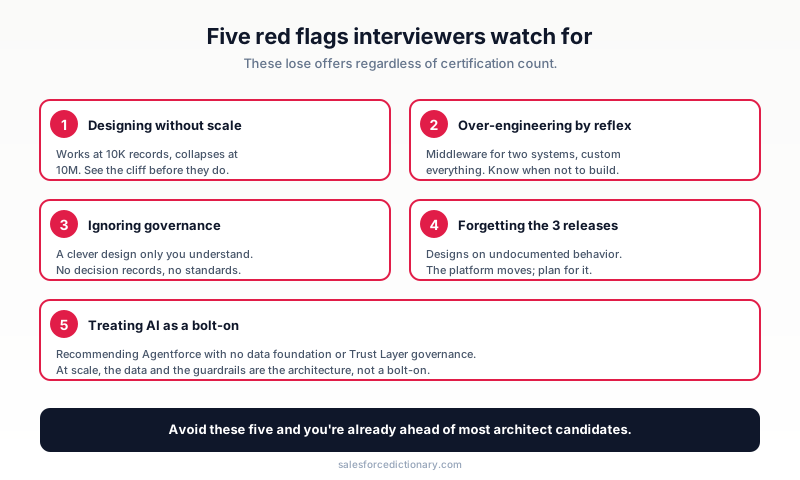
The patterns that lose architect offers, regardless of certification count:
-
Designing without scale in mind. A model that works at ten thousand records and collapses at ten million. The entire point of an architect is to see the cliff before the org drives off it, so a design that ignores volume is disqualifying for the role.
-
Over-engineering by reflex. Custom-everything, middleware for two simple systems, a canonical model for a basic sync. Senior judgment is as much about knowing when not to build the complex thing as knowing how to build it.
-
Ignoring governance and maintainability. A clever design only the author understands, with no decision records and no standards. Architecture that can't be maintained or explained is a liability dressed up as elegance, and it becomes someone else's nightmare the day you leave.
-
Forgetting the platform updates three times a year. Designing on undocumented behavior, no preview-sandbox habit, no upgrade-safety thinking. The platform moves on its own schedule, and an architect who doesn't plan for that ships designs with a hidden expiry date.
-
Treating AI as a bolt-on. Recommending Agentforce without a data foundation or Trust Layer governance. At scale, the data and the guardrails are the architecture, and skipping them produces confident, wrong, ungoverned agents that damage trust faster than no AI at all would have.
How to prep
-
Day 1: read this list cover to cover and mark your weakest section. For most architects it's large data volumes or AI architecture.
-
Day 2: sketch a sharing architecture and a data model for a sample LDV org, and name out loud exactly where skew and non-selective queries would bite and how you'd prevent them.
-
Day 3: design one integration end to end on paper: the pattern, the middleware decision, the auth flow, idempotency, error handling, and limit management, so you can walk it fluently.
-
Day 4: rehearse five behavioral answers and two architecture-defense scenarios out loud, in business language, because at the architect level the verbal influence is half the job.
-
Day 5: review AI architecture: design an enterprise Agentforce solution end to end, leading with Data Cloud grounding and Trust Layer governance, so the question most candidates fumble becomes your strongest answer.
What to read next
- Technical vs Solution vs Enterprise Architect - the role boundaries behind Section 1.
- Salesforce Integration Patterns - the APIs behind Section 3.
- Sharing & Visibility Complete Guide - the model behind Section 4.
- Well-Architected for Agentforce - the framework Section 5 builds on.
- 50 Salesforce Developer Interview Questions - the build layer your designs hand to engineering.
- The full 2026 interview series: Admin, Developer, QA, and Consultant.
Take the section you were weakest on, find a real org you've worked on, and redesign one piece of it for ten times the volume out loud. Architect interviews reward the person who has watched a design buckle at scale and rebuilt it, not the one who can only quote the Well-Architected principles.
About the Author
Dipojjal Chakrabarti is a B2C Solution Architect with 29 Salesforce certifications and over 13 years in the Salesforce ecosystem. He writes and edits salesforcedictionary.com, published by KineticBit Inc., to help admins, developers, architects, and cert/interview candidates sharpen their fundamentals. More about Dipojjal.
Share this article
Sources
Related dictionary terms
Agentforce
AI
Atlas Reasoning Engine
AI
Big Objects
Administration
Change Data Capture
Development
Data Cloud
Platform
Einstein Trust Layer
AI
Field-Level Security
Administration
Governor Limits
Development
Hyperforce
Platform
MuleSoft
Platform
OAuth
Core CRM
Organization-Wide Defaults
Administration
Role Hierarchy
Administration
Salesforce DX
Development
Salesforce Shield
Administration
Sharing Rule
Administration
Practise it
Five questions on Agentforce Specialist
Exam-style questions with an explanation after each one. No account needed, and your answers build a weak-topic map once you have one.
Keep reading

Salesforce Integration Patterns: REST vs SOAP vs Bulk vs Composite vs GraphQL (2026 Reference)
The complete 2026 reference for Salesforce APIs - REST, SOAP, Bulk 2.0, Composite, GraphQL, Pub/Sub, Streaming, Metadata, Tooling. When to use each, rate limits, OAuth flows, and patterns.
Salesforce Sharing & Visibility: The Complete 2026 Guide (OWD, Roles, Sharing Rules, Apex Sharing)
The complete 2026 guide to Salesforce sharing - OWD, role hierarchy, sharing rules, manual + Apex managed sharing, teams, territories, public groups, performance considerations, and pitfalls.
Salesforce Technical Architect vs Solution Architect vs Enterprise Architect
Your program has three people with "architect" in their title and you cannot tell who decides what. This is the difference between a Technical, Solution, and Enterprise Architect on a Salesforce program.

Salesforce Well-Architected for Agentforce
TDX 2026 unveiled the next chapter of Salesforce's Well-Architected Framework, evolving the Trusted, Easy, and Adaptable pillars specifically for Agentforce. Here's what changed and how to apply it to every agent you build.
Comments
No comments yet. Start the conversation.
Sign in to join the discussion. Your account works across every page.