
50 Salesforce Consultant Interview Questions & Answers (2026 Edition)
Discovery, declarative-first design, build-versus-buy, Agile delivery, stakeholder management, data migration, and advising clients on Agentforce readiness.
The client's VP of Sales leans forward in the kickoff and says, "We want it to work exactly like our old system, just in Salesforce." Everyone around the table nods. You write one word on your notepad: why.
That gap, between what a client asks for and what they actually need, is the entire consultant job. The 2026 Salesforce consultant interview tests whether you can sit in that gap without flinching. Can you run a discovery that surfaces the real requirement? Can you say no to a custom build that fights the platform? Can you tell a client their data isn't ready for the Agentforce agent they saw in a keynote? The technical questions matter, but the ones that decide the offer are about judgment under pressure from a paying client.
Each question has a short answer on its own line, the textbook version, then a what to actually say answer, the fuller version that shows you've delivered a project rather than memorized a methodology. Many add a concrete example or the follow-up an interviewer asks next. The answers vary in length on purpose: a definition gets a sentence, a judgment call gets a paragraph or two.
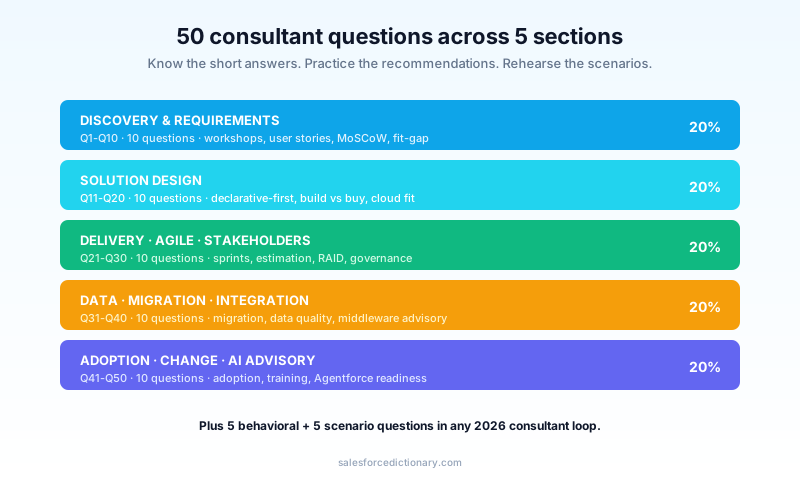
Section 1 - Discovery & requirements (Q1-Q10)
Discovery is where consulting projects are won or lost, long before anyone builds anything. This section tests whether you can get past what a client says they want to what they actually need.
Q1. How do you run a discovery workshop?
Short: Get the right people in the room, map the current process, find the pain, and agree on the future-state goals before discussing features.
What to actually say: "I prepare with stakeholder research so I'm not learning the basics in the room, then I facilitate around outcomes, not screens. I ask what a good day looks like, where work stalls today, and what success would actually measure. I keep the conversation on the problem until I genuinely understand it, because the first solution a client names is almost always a symptom of a deeper need, and if I build the symptom I've solved nothing."
The detail that separates a consultant from an order-taker: I watch for the requirement behind the requirement. A client asking for "a button that emails the contract" usually has a real need around speed and consistency of sending contracts, and once I understand that, I might propose something better than a button. Discovery is listening for the goal underneath the request.
Q2. How do you write a good user story?
Short: "As a [role], I want [capability], so that [outcome]," with clear, testable acceptance criteria.
What to actually say: "The 'so that' clause is the part people skip and the part that matters most, because it tells me the real intent and lets me propose a cleaner solution than the literal ask. Acceptance criteria are where the value lives: they're what QA tests against and what the client signs off on, so I write them as specific, checkable conditions rather than vague intentions. A story without testable criteria is a wish, and a wish can't be verified, estimated, or closed."
I keep stories small enough to deliver in a sprint and independent enough to reprioritize. When a story is too big to estimate confidently, that's a signal it hides multiple requirements, and I split it, because a vague epic disguised as a story is how scope quietly balloons.
Q3. What is MoSCoW prioritization, and how do you use it?
Short: Must have, Should have, Could have, Won't have (this time). A way to rank scope against value and time.
What to actually say: "I use it to force an honest conversation about trade-offs, because in a client's mind everything is a 'must' until you ask them to defend it against the deadline and the budget. The 'Won't have this time' column is the most useful one, because naming what's explicitly out of scope in writing is how I prevent a fight about it in week six. MoSCoW turns a wish list into a sequenced plan the client has agreed to."
The practical move is doing the prioritization with the client, not for them, so the cuts are their decision. A consultant who unilaterally decides what's a 'must' owns the blame when something they cut turns out to matter; a consultant who facilitates the client's own prioritization shares the ownership.
Q4. What is a fit-gap analysis?
Short: Comparing requirements against standard Salesforce capability to find what fits out of the box and what needs work.
What to actually say: "I map each requirement to one of three buckets: standard, configuration, or custom. The fits are essentially free and upgrade-safe, so I push hard to use them and to bend requirements toward them where reasonable. The gaps are where budget, timeline, and risk concentrate, so I size them carefully and flag them early. A good fit-gap stops a client from paying to rebuild something the platform already does, which happens more often than anyone likes to admit."
A worked example: a client insists they need a custom Renewals object with bespoke automation. The fit-gap reveals that Opportunities with a renewal record type and a renewal stage cover ninety percent of it, using the standard reporting and forecasting they'd otherwise rebuild from scratch. The genuine gap, an automated renewal-date calculation, becomes one small Flow instead of a custom object with its own layouts, reports, and sharing. Naming the fit and the gap separately is what turns a six-figure custom request into a two-week configuration.
Q5. How do you map a business process?
Short: Document the current state end to end, identify pain and waste, then design the future state against the target outcome.
What to actually say: "I walk the process with the people who actually do the work, not their managers alone, because the documented process and the real process are rarely the same, and the workarounds are where the insight is. Current-state mapping earns trust and surfaces edge cases nobody mentioned in the kickoff. Future-state is where I apply platform thinking instead of paving the old path in a new tool, because the goal is a better process, not a faithful reproduction of a broken one."
A concrete trap: a client's current process has a manual approval step that exists only because their old system couldn't enforce a rule. Mapping the current state reveals it; designing the future state replaces it with a validation rule and a Flow, and removes a daily annoyance the client had stopped noticing.
Q6. How do you handle conflicting requirements from different stakeholders?
Short: Surface the conflict early, trace each back to its business outcome, and escalate to a decision-maker with options.
What to actually say: "I don't try to quietly satisfy both, because that builds a contradictory solution that serves neither. I name the conflict openly, trace each requirement back to the business outcome it's protecting, and bring it to the sponsor with a clear recommendation and the trade-offs of each path. My job is to make the decision easy and visible, not to absorb the conflict silently and let it explode during UAT when both stakeholders see what got built."
The framing that lands: most stakeholder conflicts dissolve when you get past the proposed solutions to the underlying goals, because two people asking for opposite features often want the same outcome by different means. When they genuinely conflict, it's a business decision, and a business decision belongs to the business, made with my analysis in front of them.
Q7. How do you control scope creep?
Short: A clear baseline, a change-request process, and visible trade-offs against time and budget.
What to actually say: "Scope creep isn't stopped by saying no, it's managed by making the cost of yes visible. Every new request goes through change control: here's the impact on timeline and budget, you choose what gives. The damage happens when small additions slip in unlogged, each one reasonable on its own, until the project has quietly absorbed three weeks of unplanned work and missed a deadline nobody renegotiated."
I'm careful to frame change control as enabling, not obstructive, because a process that feels like a wall makes clients route around it. Done well, it's the mechanism that lets the client add the thing they need by trading away something they need less, with both decisions made consciously.
Q8. A client says 'just make it like the old system.' What do you do?
Short: Dig into why each old-system behavior exists before replicating it.
What to actually say: "I treat that statement as a starting point, not a specification. A large fraction of what a client is attached to in the old system is workarounds for limitations that Salesforce doesn't have, so faithfully reproducing them means paying to rebuild someone else's twenty-year-old compromise. I ask what each feature is for, design for the underlying outcome, and show the client where the platform does it better. Replicating a legacy system one-to-one is the single most expensive mistake a client can make, and part of my value is talking them out of it gently."
The way I make this concrete for a nervous client is to pick one painful old-system behavior and show the Salesforce-native alternative side by side, so the abstract argument becomes a tangible improvement they can see. Trust earned on one example buys permission to rethink the rest.
Q9. How do you document requirements so they survive to build and test?
Short: Clear user stories with acceptance criteria, linked to process maps and a traceability matrix.
What to actually say: "I write so the developer, the tester, and the client all read the same words and reach the same understanding of what done means. Acceptance criteria are the contract between intent and implementation. I keep everything traceable, requirement to story to test, so nothing falls through the gap between what was asked and what shipped, and so that when a stakeholder asks 'did we build the thing I asked for,' I can answer with evidence rather than a shrug."
The format I lean on is the user story with acceptance criteria as the unit of record, linked to a process diagram for context and a traceability matrix for coverage. I deliberately write acceptance criteria the client can read without me in the room, because a requirement that needs me to interpret it is a single point of failure. When I roll off the project, the documentation has to carry the intent forward to whoever maintains it next, or the build slowly drifts from what was meant."
Q10. How do you confirm you understood a requirement correctly?
Short: Play it back, prototype it, and validate against acceptance criteria with the stakeholder.
What to actually say: "I restate the requirement in my own words and watch the stakeholder's face, because a flicker of hesitation tells me I've misunderstood something. Then I show something early, a mockup or a configured prototype, because people react far more accurately to what they can see than to what they read in a document. Misunderstandings are cheap to fix in a workshop and expensive to fix in UAT, so I front-load the confirmation."
The cheapest prototype is often a few clicks in a sandbox: I configure the object and a sample layout live in the session, and the client immediately says "no, the status should come before the amount," which is feedback I'd never have gotten from a requirements document.
Section 2 - Solution design & declarative-first (Q11-Q20)
Solution design is where consulting judgment shows most clearly. The recurring test is whether you reach for the platform's strengths or default to custom code that a client will pay to maintain forever.
Q11. What does 'declarative-first' mean, and why does it matter?
Short: Solve with configuration (Flow, validation, page layouts) before writing code.
What to actually say: "Clicks before code, because declarative solutions are upgrade-safe, maintainable by the client's own admins, and faster to change when the business changes. Code is the right tool for genuine complexity, but every line of custom Apex is a maintenance liability that someone owns long after I've left the engagement. I reach for code deliberately, when the requirement genuinely needs it, not by reflex. The Flow vs Apex guide is the conversation I end up having on most projects."
The client-facing version of this argument is about cost of ownership, not elegance. I explain that a Flow their admin can adjust next quarter is cheaper over five years than an Apex class that needs a developer every time the business shifts, and that framing usually wins the room because it speaks to their budget, not my preferences.
Q12. How do you decide build versus configure versus buy?
Short: Configure if standard covers it, buy from AppExchange if a proven package fits, build only when the need is genuinely unique.
What to actually say: "I start from standard, because it's free and Salesforce maintains it. For common needs outside standard, like document generation, complex scheduling, or advanced rollups, a mature AppExchange package usually beats a custom build on cost and risk because someone else maintains it through releases. Custom build is for the genuinely differentiating, org-specific logic that is the reason the client is unique in their market. The expensive mistake is building what you could have configured or bought."
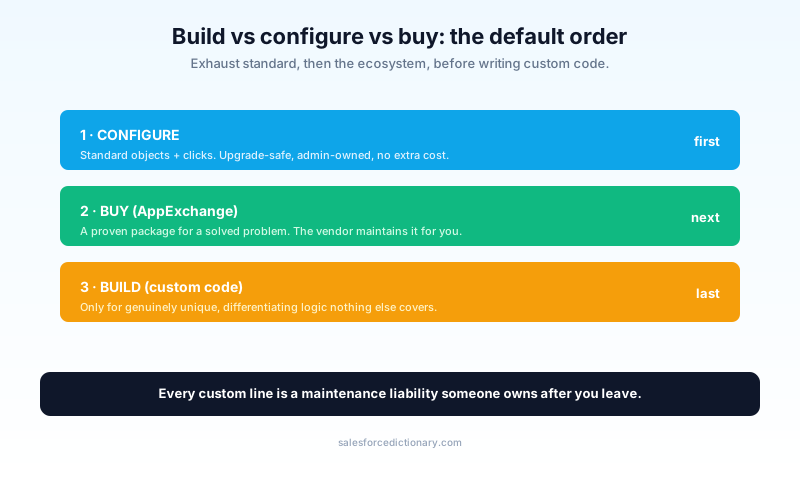
When I evaluate an AppExchange package as the 'buy' option, I look past the demo at its security review status, how much of the org's limits it consumes, and what happens on upgrade, because a cheap package that hijacks page layouts or burns through SOQL becomes the client's problem at scale. Buy is only cheaper than build if the package is actually well built.
Q13. When do you recommend Flow versus Apex to a client?
Short: Flow for declarative automation an admin can own. Apex for complex logic, high volume, or callouts.
What to actually say: "I frame it as a maintenance and capability question, not a technical preference. Flow keeps the client's own admins in control after I leave, which lowers their long-term cost. I move to Apex when the requirement hits real complexity: heavy data volume, recursion, a mid-transaction integration, or logic that genuinely needs unit tests. And I'm honest that choosing Apex means they need a developer on hand to maintain it, which is a real cost they should weigh, not a detail I hide to make the solution look cleaner."
A concrete way I frame it: a Flow is something their admin can adjust over a coffee break next quarter, while an Apex class needs a developer, a sandbox, and a deployment every time the rule changes. For a rule that will evolve with the business, that difference compounds into real money over the org's life. So I lean toward Flow unless the requirement genuinely exceeds what it can do, and when it does, I say so plainly rather than reaching for code because it feels more substantial."
Q14. How do you choose between Sales Cloud, Service Cloud, and Experience Cloud?
Short: Match the cloud to the core job: selling, supporting, or extending to external users.
What to actually say: "Sales Cloud for pipeline and revenue, Service Cloud for cases and support, Experience Cloud for partner and customer portals. Most real clients need a blend, so I map their actual processes to capabilities rather than to product names, because the names are marketing and the capabilities are what they'll use. The Sales versus Service breakdown is how I explain the overlap to a buyer who's been told they need one of each."
A licensing nuance I raise early: the cloud choice has cost implications per user, and a design that quietly assumes a license tier the client hasn't bought is a design that collapses at the budget conversation. So I confirm what they're licensed for before I commit to an architecture that depends on it.
Q15. A client wants heavy customization that fights the platform. How do you respond?
Short: Show the long-term cost of fighting the platform and offer a platform-aligned alternative.
What to actually say: "I explain, in their terms, what fighting the platform actually costs them: broken upgrades, higher maintenance, and a solution only the original developer understands. Then I offer the platform-aligned path and let them choose with full information. Sometimes the answer is genuinely custom, and that's fine, but the client should choose it knowing the trade-off, not because no one was willing to push back. My job is to make sure the expensive decision is an informed one."
The way I keep this from becoming a standoff is to agree on the goal first, then disagree only on the means. Once the client and I both say out loud what we're trying to achieve, the conversation shifts from "your idea versus mine" to "which path gets us there cheaper," which is a much easier conversation to win.
Q16. How do you factor licensing and cost into a design?
Short: Design within the client's license model, and flag when a requirement needs a license they don't have.
What to actually say: "A technically elegant design that requires licenses the client won't buy is a bad design, full stop. I know which capabilities sit behind which editions and add-ons, so I can flag cost implications while there's still time to choose, rather than at go-live. Surprising a client with a license bill late in the project destroys trust faster than almost anything else, so I treat licensing as a design constraint I work within, not a detail for procurement to sort out later."
The practical habit is keeping a working map of which capabilities sit behind which edition and add-on, and checking the client's actual entitlements early rather than assuming. A design that quietly depends on a feature in a higher edition, or on a per-user add-on the client hasn't bought, looks elegant on a slide and falls apart the moment finance reviews the cost. I'd rather design within the real constraint than design something polished the client can't afford to run."
Q17. When do you use standard objects versus custom objects?
Short: Use standard objects wherever the data fits, because they come with built-in functionality.
What to actually say: "Standard objects bring reports, automation hooks, and platform features for free, so I bend the data model toward them wherever it's reasonable. I create custom objects when the data genuinely doesn't fit a standard one, not as a first move. Modeling a custom 'Account 2.0' because I didn't take the time to explore the standard Account is a classic mistake that throws away years of platform investment and creates a maintenance burden the client carries forever."
Q18. When do you recommend an AppExchange package over a custom build?
Short: When a proven package covers the need at lower total cost and risk than building and maintaining it yourself.
What to actually say: "For solved problems, document generation, contract management, complex rollups, a mature package is faster to implement and someone else maintains it through every release, which is a real and recurring saving. I evaluate the vendor's stability, security review status, support quality, and how cleanly it upgrades. The trade-off is fit and ongoing license cost, which I weigh honestly against the true, fully-loaded cost of building the same thing and owning it for the life of the org."
The number clients forget is the maintenance cost of a custom build. A package has a visible annual license fee, so it feels expensive, while a custom build's cost is hidden in the developer hours it will quietly consume every year. Part of my job is making the hidden cost visible so the comparison is fair.
Q19. How do you keep a solution upgrade-safe across the three annual releases?
Short: Favor declarative and supported features, avoid undocumented hacks, and test on the preview sandbox.
What to actually say: "I stay on supported, documented functionality and avoid clever workarounds that depend on current platform behavior, because those are exactly what breaks on upgrade. Declarative configuration rarely breaks across releases. I also tell clients plainly that Salesforce ships three times a year and they need a habit of testing the preview release, because the platform moves on Salesforce's schedule whether they're watching or not, and a client who never looks at preview is a client who gets surprised in production."
Q20. How do you document a solution design for sign-off?
Short: A solution design document mapping requirements to the chosen approach, with diagrams and trade-offs.
What to actually say: "I document the why, not the what alone: which requirement each design decision serves, what alternatives I considered, and why I chose this path. Diagrams for the data model and the key processes, a clear statement of what's standard versus configured versus custom, and the explicit assumptions I'm relying on. A sign-off on a design that records its trade-offs protects both the client and me when priorities shift later, because we can both see what we agreed to and why."
I keep the document at the right altitude for its audience: enough detail that a developer can build from it, but framed around requirements and decisions rather than implementation minutiae, so the client can actually review and sign it. The assumptions section earns its place repeatedly, because half the disputes late in a project trace back to an assumption one side made and the other never saw. Writing them down turns a future argument into a quick reference."
Section 3 - Delivery, Agile & stakeholders (Q21-Q30)
Delivery is where good design either ships or dies. This section tests whether you can run an Agile Salesforce project and manage the humans who fund and use it.
Q21. How does Agile work on a Salesforce project?
Short: Iterative sprints delivering working configuration, with regular demos and a prioritized backlog.
What to actually say: "Salesforce suits Agile well because you can configure and demonstrate working software fast, often within the same sprint a requirement was discussed. I run sprints against a prioritized backlog, demo real functionality each sprint, and let the feedback shape the next sprint's priorities. The discipline that actually matters is a groomed backlog and a product owner with the authority to make decisions, because without a decisive product owner, 'Agile' degrades into chaos with stand-up meetings attached."
Q22. How do you estimate Salesforce work?
Short: Break work into stories, size by complexity (story points or t-shirt sizes), and account for config, test, and rework.
What to actually say: "I estimate complexity rather than hours, and I deliberately include the work people forget: testing, data migration, deployment, and rework from feedback. I'm skeptical of any estimate that quietly assumes everything goes right the first time, because it never does. Padding isn't dishonest when the unknowns are real, but I make the assumptions visible so the client understands what's driving the number and can challenge the assumptions rather than just the total."
A useful habit: I separate the estimate for the configuration from the estimate for the data migration, because clients consistently underestimate migration, and burying it inside a feature estimate hides the risk. Calling it out as its own line item is how I avoid the go-live that slips because nobody costed the data work.
Q23. How do you run a sprint demo for business stakeholders?
Short: Show working functionality against the stories, in business language, and capture feedback.
What to actually say: "I demo in the client's language, walking through the business scenario rather than clicking through admin setup, because stakeholders care about their process, not my configuration screens. I show what's done against the acceptance criteria and I'm honest about what isn't ready. The demo is where I catch misunderstandings early, while they're cheap, and where I keep the client feeling ownership of the solution, so it's worth preparing properly rather than improvising."
A small discipline that pays off: I demo on data the client recognizes, their accounts, their products, their terminology, rather than "Test Account 1" and "Foo Product," because realistic data lets stakeholders react to the actual workflow instead of being distracted by placeholders. The demo is also where I quietly keep expectations accurate, showing what's done and naming what's coming next, so the client's mental model of progress stays in step with reality sprint by sprint."
Q24. How do you manage a difficult or non-responsive stakeholder?
Short: Understand their motivation, communicate in their preferred channel, and escalate through governance when needed.
What to actually say: "First I work out why: are they too busy, skeptical of the project, or quietly worried about what it means for their role or their team. Each cause needs a different response, so I adjust how I engage, make giving input as low-effort as possible for them, and document decisions so that silence doesn't stall the build. If a needed decision keeps slipping, I escalate through the steering committee with the cost of the delay attached, because an unmade decision has a price and the sponsor should see it."
A stakeholder who's resisting because they fear the project threatens them is a different problem from one who's just busy, and the fix is usually to involve them in shaping the solution so they have ownership rather than something done to them. People support what they help build.
Q25. What is a RAID log, and how do you use it?
Short: A register of Risks, Assumptions, Issues, and Dependencies that you review regularly.
What to actually say: "It's how I keep the project honest about what could go wrong and what we're depending on. I review it in governance meetings so risks get owners and assumptions get validated before they quietly become issues. A RAID log nobody reads is theater, but an actively-managed one is how I avoid being blindsided by something I'd already written down weeks earlier, which is a uniquely frustrating way for a project to fail."
Q26. How do you handle a change request mid-project?
Short: Log it, assess the impact on scope, time, and cost, and get a decision before building.
What to actually say: "Change isn't the enemy, unmanaged change is. I welcome the request, assess what it costs in timeline and budget, and present the trade-off to the sponsor so they can decide what gives. The failure mode I actively avoid is the well-meaning consultant who quietly absorbs changes to keep the client happy, then misses the deadline they never renegotiated and takes the blame for a slip the client actually caused. Visible trade-offs protect the relationship."
Q27. What is project governance?
Short: The decision-making structure, a steering committee, regular checkpoints, and clear escalation paths.
What to actually say: "Governance is the structure for who decides what and how issues escalate. A steering committee with real authority lets me resolve cross-functional conflicts and scope decisions quickly, instead of watching them stall at the working level while the project drifts. Setting up governance in the first week is unglamorous and feels like overhead, but it's what saves the project when the inevitable hard decision arrives and there's a clear group with the authority to make it."
Q28. How do you manage client expectations when something can't be done?
Short: Be honest early, explain why, and offer the closest viable alternative.
What to actually say: "I'd far rather deliver a hard truth in week two than a missed expectation at go-live. I explain the constraint in the client's terms, offer the nearest alternative that meets the underlying need, and document the conversation. Clients respect a consultant who says 'not that way, but here's how' far more than one who says yes to everything and disappoints them later. Managing expectations is mostly about timing: the same news is a manageable adjustment early and a crisis late."
Q29. How do you handle a project that's slipping?
Short: Diagnose the cause honestly, re-prioritize with MoSCoW, and present options to the sponsor.
What to actually say: "I surface the slip early, with the sponsor, the moment I'm confident it's real, rather than hoping to recover quietly and only confessing when the deadline arrives. I separate the genuine must-haves from the rest, look honestly at where the time is actually going, and present real options: move the date, cut scope, or add capacity, each with its consequences. Hiding a slip until it's unrecoverable is the fastest way to permanently lose a client's trust, and trust is the only thing that gets a project through a hard moment."
Q30. Waterfall or Agile for a Salesforce implementation?
Short: Agile or hybrid for most, with more upfront planning where integrations or compliance demand it.
What to actually say: "Pure waterfall fights the platform's main strength, which is fast iteration and early demos. But pure Agile struggles when there's a fixed regulatory deadline or heavy integration work that needs upfront architecture. Most real projects are hybrid: enough upfront design to de-risk the genuinely hard parts, like data migration and integrations, and iterative delivery for the configuration. I match the method to the project's actual risks, not to a methodology I'm loyal to."
Where I insist on upfront work even in an Agile project is the data model and the integrations, because those are expensive to change once other things depend on them, and iterating a data model mid-build ripples through every Flow and report built on top of it. The configuration and the UI, by contrast, are cheap to iterate, so that's where I let Agile run freely. Matching the amount of upfront design to the cost of changing each piece later is the judgment this question is really probing."
Section 4 - Data, migration & integration advisory (Q31-Q40)
Data and integration are where go-lives die. This section tests whether you treat migration as a first-class workstream and can advise on integration at the right altitude.
Q31. How do you plan a data migration?
Short: Profile the source, map fields, cleanse, load in the right order, validate, and reconcile.
What to actually say: "I treat migration as its own workstream with its own plan, not an afterthought tacked onto the last sprint, because it's where go-lives most often die. I profile the legacy data early to learn how bad it genuinely is, map and cleanse it, load respecting object relationships so parents exist before children, then reconcile counts and spot-check fields. Starting migration late is the single most common reason a go-live slips, so I start it early and treat the first trial load as a milestone, not a formality."
The trial load is the part inexperienced teams skip. Running the full migration into a sandbox weeks before go-live surfaces the field-mapping errors, the data-quality surprises, and the timing problems while there's still room to fix them, so the real cutover is a rehearsed routine rather than a tense improvisation at midnight.
Q32. How do you handle data quality and deduplication?
Short: Profile early, define matching rules, cleanse before load, and use duplicate rules to keep it clean after.
What to actually say: "I assess quality at the very start so the client has no illusions, because legacy data is always worse than they believe, and the optimism of 'our data is pretty clean' rarely survives contact with the actual export. I cleanse before migration, set up duplicate and matching rules to prevent re-pollution after go-live, and assign clear ownership for ongoing data quality. Migrating dirty data just moves the problem into a more expensive system and then blames Salesforce for it."
Q33. What tools do you use for data migration?
Short: Data Loader for moderate volumes, an ETL tool for complex transformations or ongoing syncs.
What to actually say: "Data Loader handles a great many one-time migrations perfectly well. When there are heavy transformations, multiple source systems, or a need for a repeatable sync rather than a one-off load, I move to a dedicated ETL tool. I choose based on volume, transformation complexity, and whether it's a single migration or an ongoing integration, but I'm clear that the tool matters far less than the mapping and reconciliation discipline wrapped around it. A great tool with a sloppy mapping still produces bad data, just faster."
Q34. How do you advise on integration approach at a solution level?
Short: Match the pattern to the need: real-time versus batch, and point-to-point versus middleware.
What to actually say: "I start by asking two questions: how fresh does the data need to be, and how many systems are involved. A couple of simple connections can be point-to-point. Several systems, or complex orchestration and transformation, justify middleware like MuleSoft. I keep my advice at the pattern level for the client and let a technical architect detail the build, but I flag the cost and complexity early, because integration is where budgets and timelines quietly expand when nobody scoped it properly."
The advisory judgment that matters is spotting when a client is about to build a tangle of point-to-point connections that will become unmaintainable, and steering them toward middleware before the tangle forms, not after they've already wired five systems together directly and can't change any of them safely.
Q35. How do you scope reporting and dashboard requirements?
Short: Start from the decisions the reports need to drive, then design the data model to support them.
What to actually say: "I ask what decisions each report is meant to inform and who acts on it, because 'we want a dashboard' is a wish, not a requirement. Reporting needs shape the data model, so I gather them during discovery rather than after the build, when changing the model is expensive. The classic and painful miss is designing the objects without checking whether they can actually produce the numbers the executives expect to see, and discovering at UAT that the data needed for a key metric was never captured."
So I ask executives specifically what numbers they expect to see on day one. If they need average time-to-close by segment, the data model has to capture the segment and the relevant dates from the start, which is a design decision, not a reporting afterthought. Discovering at UAT that a flagship dashboard is impossible because a field was never captured is a painful conversation, and it's avoided entirely by asking the reporting question during design rather than after build."
Q36. How do you handle data residency and compliance concerns?
Short: Identify the regulatory requirements early and design data handling, access, and storage to meet them.
What to actually say: "For regulated clients I get the compliance constraints on the table during discovery: where data can physically live, who can see it, what must be audited and retained. Those constraints shape architecture, sharing, and sometimes the need for Shield or specific infrastructure. Retrofitting compliance after the build is painful and occasionally impossible, so it has to be a first-class requirement from day one, not a checkbox someone remembers near go-live when the legal team finally reviews the design."
Q37. How do you decide what data to migrate versus archive?
Short: Migrate what the business actively needs; archive the rest to keep the org lean.
What to actually say: "Not all history belongs in the live org, and loading ten years of dead records just to feel complete slows the org and inflates storage cost for data nobody opens. I work with the client to define what's actively used, usually recent and open records, and migrate that. Older data goes to an archive or a read-only store where it's still accessible for the rare audit or lookup. A lean live org performs better and costs less, and most clients are relieved to learn they don't have to drag everything across."
Q38. How do you advise on middleware versus point-to-point integration?
Short: Point-to-point for a few simple links; middleware when integrations multiply or need orchestration.
What to actually say: "Two systems with a simple, stable sync don't need an integration platform, and over-engineering that with middleware is a waste of the client's money. But once you have several systems, retries, transformation logic, and monitoring needs, point-to-point connections become a tangle that nobody can maintain or change safely. My value is helping the client see that inflection point before they build the tangle, because the cost of untangling it later is far higher than the cost of doing it right when the second or third integration appears."
Q39. How do you handle a client with messy legacy data?
Short: Be honest about the state, quantify the cleanup effort, and make data quality a funded workstream.
What to actually say: "I profile the data, show the client the real numbers, and gently resist the universal optimism that 'we'll just clean it up during migration.' Cleanup is a sized, owned, and usually funded piece of work, often requiring business input on the matching and merge rules because only the business knows which of two duplicate accounts is the real one. Pretending the data is better than it is just guarantees a painful go-live and a trust problem when the reports come out wrong and the client blames the new system."
Q40. How do you plan data cutover for go-live?
Short: A rehearsed cutover plan: final load sequence, validation checkpoints, and a rollback option.
What to actually say: "I rehearse the cutover in a Full sandbox so go-live isn't the first time anyone has run it end to end. The plan covers the freeze on the legacy system, the exact load order, the validation gates at each step, and what we do if something fails partway through. A cutover you've practiced is a routine you execute calmly; a cutover you're improvising at midnight under pressure is how data gets lost and how a go-live becomes a horror story people tell for years."
Section 5 - Adoption, change management & AI advisory (Q41-Q50)
A technically perfect org that nobody uses is a failed project. This section tests whether you understand the people side and can advise honestly on the AI features every client now asks about.
Q41. How do you drive user adoption?
Short: Involve users early, design for their real workflow, train well, and measure usage after go-live.
What to actually say: "Adoption is designed in from discovery, not bolted on at the end with a training session and hope. If users helped shape the solution and it genuinely makes their day easier, they use it without being forced. I pair that with role-based training and post-go-live usage metrics, so I can spot the teams that are struggling and intervene with targeted help rather than blanket nagging. A technically perfect org that nobody uses is the most common and most avoidable form of project failure."
Q42. What is organizational change management on a Salesforce project?
Short: The people side: communication, training, sponsorship, and managing the transition to new ways of working.
What to actually say: "The technology is genuinely the easy part. Change management is getting people to actually work differently: visible executive sponsorship, clear communication about why the change is happening and what's in it for them, role-based training, and support through the dip when the new system feels slower than the old habit they've had for years. Projects fail on the people side far more often than the technical side, and a consultant who only thinks about configuration is solving half the problem."
Q43. How do you plan training?
Short: Role-based, hands-on, timed close to go-live, with reference material and ongoing support.
What to actually say: "I train by role on the real scenarios people actually perform, not a generic feature tour that's forgotten by lunch, and I time it close to go-live so it sticks rather than fading before they need it. I leave behind quick-reference guides and make sure there's a clear support path for the first weeks. Training everyone on everything six weeks early is a way to feel thorough while changing nothing, because people don't retain training for tasks they won't do for over a month."
I also tailor the depth to the role: a daily power user needs hands-on practice in a training sandbox, while an occasional approver needs a one-page guide and little else. Over-training the occasional user wastes everyone's time, and over-simplifying for the power user leaves them stuck on day one. Matching the training investment to how heavily each role actually uses the system is what makes training land instead of wash over people who tuned out in the first ten minutes."
Q44. How do you measure adoption and project success?
Short: Define success metrics upfront, then track usage, data quality, and business outcomes after go-live.
What to actually say: "Success has to be defined before the build, because a project with no agreed measure of success can only be called finished, never successful. I track login and feature-usage rates, but more importantly the business outcomes the project was funded to move: cycle time, case resolution, conversion rate, whatever the original case promised. Then I feed the gaps back into enablement, because the point of measuring adoption is to act on it, not to produce a chart for a steering committee."
Q45. How do you run go-live and hypercare?
Short: A planned cutover, heightened support immediately after, and a path to steady-state.
What to actually say: "Go-live is a planned event with a checklist and a rollback option, not a hopeful Friday afternoon deploy. Hypercare is the intense support window right after, where I'm close to users, fixing issues fast and watching adoption closely while everything is still fragile and impressions are forming. Then I transition to steady-state support deliberately, with a clear handover, so the client isn't suddenly left without a safety net the moment the consultants roll off."
I plan that handover as carefully as the go-live itself: documentation, a known escalation path, and ideally a few of the client's own people who were close enough to the build to support it. The worst outcome is a clean go-live followed by a support vacuum, where small issues fester because nobody owns them and the client's early enthusiasm curdles into frustration. Hypercare is the bridge from launch to a sustainable steady state, and a bridge needs a far bank to land on."
Q46. How do you advise a client on whether they're ready for Agentforce?
Short: Assess their data, processes, and a concrete use case before recommending an agent.
What to actually say: "I check three things before I'll recommend an agent: is there a real, bounded use case with measurable value, is the underlying process stable enough to automate, and is the data clean and accessible enough to ground the agent. Agentforce on top of a messy process and dirty data fails expensively and publicly. Readiness is mostly a data and process question, not a technology question, and a big part of my advisory value in 2026 is telling an excited client the honest answer, which is sometimes 'not yet, and here's what we'd fix first.'"
Q47. How do you scope an Agentforce use case for a client?
Short: Pick a bounded, high-volume, well-defined task with clear data and a measurable outcome.
What to actually say: "I look for high-volume, repetitive work with a reasonably clear right answer and accessible data: order-status questions, case triage, appointment scheduling. I scope it narrow to start, define explicitly what good behavior looks like, and plan for ongoing evaluation rather than a launch-and-forget. The failure pattern is the broad, vague agent that tries to do everything for everyone and does nothing reliably, so I deliberately constrain the first use case to something we can get genuinely right and build trust on."
Q48. How do you set expectations on AI accuracy and the Trust Layer with a client?
Short: Explain that agents are probabilistic, that the Trust Layer protects data, and that testing and guardrails are required.
What to actually say: "I'm honest upfront that an agent isn't deterministic software, so it needs evaluation, guardrails, and a human fallback for the cases it shouldn't handle alone. I explain what the Einstein Trust Layer does, masking PII, enforcing access on retrieved data, preventing the model provider from training on their data, and just as importantly what it doesn't do, which is guarantee a correct answer. Setting this expectation early prevents the 'but it got one wrong' panic that otherwise erupts the first time the agent makes a mistake after launch."
Q49. A client wants AI because it's trendy. How do you advise?
Short: Redirect from the technology to a real problem worth solving, and qualify the use case honestly.
What to actually say: "I don't dismiss the interest, I channel it toward value. I ask what problem we're actually solving and whether AI is genuinely the best tool for it, because sometimes a well-built Flow beats an agent for a fraction of the cost and complexity. A good consultant protects the client from spending real budget on a keynote demo that doesn't survive contact with their actual data and processes. The trust I earn by talking a client out of a bad AI project is worth more than the revenue from building it."
Q50. How do you advise on data readiness for AI (Data Cloud)?
Short: AI is only as good as its grounding, so unify and clean the data before expecting good agent answers.
What to actually say: "Agents ground their answers in the org's data, so fragmented or dirty data produces confident, wrong answers, which are worse than no answer because the user believes them. I assess whether the relevant data is unified, accessible, and clean, and often Data Cloud is the foundation that makes agents genuinely useful by bringing data together from across systems into a single profile. I tell clients the unglamorous truth that the data work is usually most of the AI project, and the agent is the easy part on top once the foundation is solid."
Behavioral questions (5 patterns)
Behavioral rounds for consultants probe judgment, backbone, and the ability to influence without authority. Use real engagements with specifics.
B1. "Tell me about a project that went sideways and how you recovered it."
What they want: ownership and structured problem-solving under pressure.
What to say: pick a real project, name the root cause honestly, whether it was scope, stakeholders, data, or estimation, and walk through how you diagnosed it, re-prioritized, and communicated with the sponsor. Lead with what you changed and the outcome, not with who was to blame. The recovery is the story; the failure is just the setup that makes it credible.
B2. "Describe managing a stakeholder who kept changing requirements."
What they want: change discipline plus diplomacy, in balance.
What to say: show how you used change control to make the cost of each change visible, kept the relationship intact, and protected the timeline without becoming the person who says no to everything. Avoid both extremes: "I just built it all and we slipped" signals no backbone, and "I refused their changes" signals no partnership.
B3. "Tell me about a time you said no to a client."
What they want: backbone paired with a constructive alternative.
What to say: pick a case where you pushed back on a custom build, an unrealistic timeline, or a bad-fit AI project, explained the cost in the client's own terms, and offered a better path. The strongest version ends with the client thanking you later, because it proves your no was in their interest, not your convenience.
B4. "Describe presenting a recommendation the client didn't want to hear."
What they want: honesty and the ability to influence.
What to say: show how you brought data rather than opinion, framed the recommendation around the client's own goals, and gave them a clear decision to make. Whether they ultimately took your advice or not, demonstrate that you'd rather be respected for honesty than liked for agreeableness, because a consultant who only tells clients what they want to hear is worth nothing.
B5. "How do you stay current across the Salesforce product surface?"
What they want: evidence you're not selling a 2020 playbook to 2026 clients.
What to say: the release notes each season, the Salesforce Architects decision guides, hands-on time in a developer org with new features like Agentforce, and the Trailblazer Community. Name one specific thing you learned recently and applied on an engagement, because the specific example is what proves the habit is real rather than aspirational.
Scenario questions (5 patterns)
Scenario questions test how you'd actually advise. Think out loud, name your assumptions, and lead with discovery before solutions.
S1. "A client wants to replicate their legacy system one-to-one in Salesforce. How do you handle it?"
What they want: advisory instinct over order-taking. Steps: treat the legacy system as input rather than a spec, run discovery on the underlying business outcomes, identify which behaviors are workarounds for old limitations Salesforce doesn't share, design for the platform, and show the client the cost difference between replicating and rethinking. The key is bringing the client along with one concrete example rather than overruling them, because a client who feels overruled resists, while a client who sees a better way for themselves commits.
S2. "A VP wants a custom quoting tool built from scratch. How do you advise?"
What they want: build-versus-buy judgment with the client's money in mind. Steps: understand the real quoting need behind the request, evaluate standard capabilities and AppExchange CPQ-class tools against it, size the custom build's fully-loaded cost including years of maintenance, and present a recommendation with the trade-offs laid out. Custom is the right answer only if the quoting logic is genuinely differentiating and nothing proven fits, and saying that protects the VP from an expensive vanity build.
S3. "Mid-project the client doubles the scope. How do you handle it?"
What they want: scope and expectation management without damaging the relationship. Steps: log it through change control, assess the impact on timeline and budget honestly, re-run prioritization with the sponsor using MoSCoW, and present clear options: extend the date, add capacity, or phase the delivery. Get a documented decision before building any of it, and protect the team from silently absorbing the new scope and missing the original deadline that nobody formally moved.
S4. "A client wants an Agentforce support agent, but their data is a mess. How do you advise?"
What they want: AI-readiness honesty over enthusiasm. Steps: explain that an agent's quality is capped by its data quality, scope a narrow high-value use case rather than a broad one, propose the data foundation work, often Data Cloud, as a prerequisite rather than an optional extra, set realistic expectations on accuracy and human fallback, and plan ongoing evaluation. Don't let an excited client spend budget on an agent that will ground its answers in garbage and embarrass them in front of customers.
S5. "Two departments want conflicting record-sharing rules. How do you resolve it?"
What they want: requirements skill and governance. Steps: trace each department's requirement back to its real business reason rather than its stated rule, look for a sharing design that satisfies both through role hierarchy, sharing rules, or restriction rules, and where they genuinely conflict, escalate to a decision-maker with clear options and the security implications of each laid out. Don't quietly pick one department's side, because the one you ignored becomes the stakeholder who undermines the project.
Red flags interviewers watch for
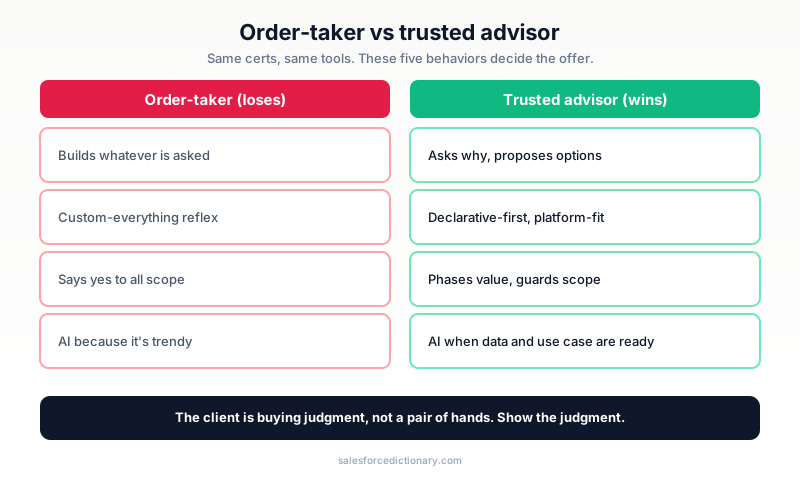
The patterns that lose consultant offers, regardless of certification count:
-
Order-taker, not advisor. Building whatever the client asks without ever asking why. The entire value of a consultant is judgment, and an order-taker brings none to offer, so the client is paying a premium for a pair of hands.
-
Custom-everything reflex. Reaching for code and custom objects before exploring standard and configuration. It signals you'll hand the client an expensive, fragile org that needs a developer for every future change.
-
Can't translate between business and technical. Talking features and config to executives, or talking outcomes to developers. A consultant lives in the translation layer, and failing at it in either direction is disqualifying for the role.
-
No scope discipline. Saying yes to everything, absorbing changes silently, and missing the deadline you never formally renegotiated. Eagerness to please is not a virtue when it costs the project its timeline.
-
AI hype with no readiness grounding. Recommending Agentforce because it's exciting, without checking the data and the use case. Clients can tell the difference between an advisor protecting their interests and a salesperson chasing a trend.
How to prep
-
Day 1: read this list cover to cover and mark your weakest section. For most consultants it's either solution design judgment or AI advisory.
-
Day 2: take a sample requirement from your own experience and write the discovery questions, the user stories with acceptance criteria, and a fit-gap for it, so the process is muscle memory rather than theory.
-
Day 3: practice a build-versus-buy and a Flow-versus-Apex recommendation out loud, in client language, in under three minutes each, because the verbal delivery is what the interview tests.
-
Day 4: rehearse five behavioral answers in STAR format and two stakeholder-conflict scenarios, focusing on showing backbone with a constructive alternative.
-
Day 5: review AI advisory: scope one realistic Agentforce use case end to end, including the data-readiness assessment, so the AI question is your strongest answer rather than your weakest.
What to read next
- Flow vs Apex in 2026 - the recommendation you'll defend in half your design conversations.
- Sales Cloud vs Service Cloud - the cloud-fit question, in depth.
- The Salesforce Career Path 2026 - where the consultant track leads.
- 50 Salesforce Admin Interview Questions - the platform fundamentals consultants are still expected to know.
- 50 Salesforce Developer Interview Questions - so you can tell when a requirement genuinely needs code.
- The full 2026 interview series: Admin, Developer, QA, and Architect.
Take the section you were weakest on, find a real requirement from your own experience, and practice walking it from discovery to recommendation out loud. Consultant interviews reward the person who has sat across from a frustrated VP and changed their mind, not the one who can recite a methodology.
About the Author
Dipojjal Chakrabarti is a B2C Solution Architect with 29 Salesforce certifications and over 13 years in the Salesforce ecosystem. He writes and edits salesforcedictionary.com, published by KineticBit Inc., to help admins, developers, architects, and cert/interview candidates sharpen their fundamentals. More about Dipojjal.
Share this article
Sources
Related dictionary terms
Practise it
Five questions on Agentforce Specialist
Exam-style questions with an explanation after each one. No account needed, and your answers build a weak-topic map once you have one.
Keep reading
Salesforce Sales Cloud vs Service Cloud: Which Do You Need in 2026?
Sales Cloud and Service Cloud share a platform but solve different problems. Here is the 2026 comparison. Features, pricing, decision scenarios, and how Agentforce fits both.

The Salesforce Career Path in 2026: From Admin to CTA (with Salaries & Timelines)
The complete Salesforce career roadmap from Admin to CTA - realistic timelines (5–10 years), 2026 salary bands by region, and the difference between cert collecting and getting promoted.
Salesforce Flow vs Apex in 2026: A Decision Matrix for Admins, Developers & Consultants
Flow vs Apex is not a religious war anymore. Here is the 2026 decision matrix. Capability gaps, governor limits, the 70/30 rule, and 12 worked scenarios with the right answer for each.
Comments
No comments yet. Start the conversation.
Sign in to join the discussion. Your account works across every page.