
Salesforce Technical Architect vs Solution Architect vs Enterprise Architect
Who owns which artifact, the org-chart reality, a decision matrix for which architect to hire, and the cert ladder for each of the three tracks.

The kickoff call has three people whose job titles all contain the word "architect." One keeps redirecting scope questions to "the business outcome." One keeps pulling the conversation toward governor limits and integration throughput. One has not said much but owns the slide that shows Salesforce sitting next to Snowflake and a payments platform. You are the project lead, and you genuinely cannot tell which of them you escalate a data-residency question to.
This post fixes that confusion for good. The difference between a Salesforce Technical Architect, a Solution Architect, and an Enterprise Architect is not seniority and it is not vibes. It is a clean split of which artifacts each one owns and which decisions each one is accountable for. Once you see the split, the kickoff call stops being confusing and the hiring decision stops being a guess.
The one-line version
Before the detail, here is the split that the rest of the post expands.
The Solution Architect (SA) owns what gets built inside Salesforce. The Technical Architect (TA) owns how it gets built and whether it scales. The Enterprise Architect (EA) owns where Salesforce fits in the wider system landscape, including the non-Salesforce systems around it.
Said another way: the SA faces the business, the TA faces the platform, and the EA faces the rest of the company's technology estate. Three different directions, three different artifacts, three different escalation paths. They overlap in practice, but the center of gravity for each is distinct, and that center of gravity is what you hire and escalate against.
The org-chart reality
Titles imply a hierarchy that does not actually exist the way people assume. These three roles are not three rungs of one ladder. They are three specializations that branch from a shared technical foundation and report into different parts of a program.
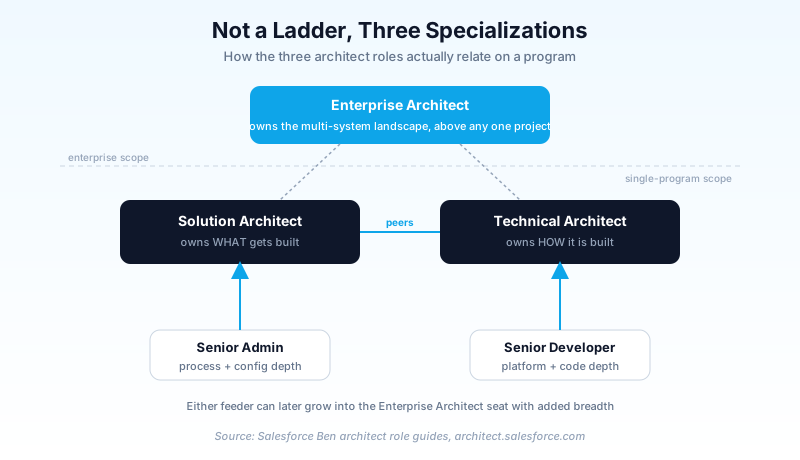
The path into these roles usually starts from a Senior Developer or Senior Admin seat. A Senior Developer who goes deep on platform mechanics tends toward Technical Architect. A Senior Admin or consultant who goes deep on business process and multi-cloud design tends toward Solution Architect. Both can eventually move into Enterprise Architecture, but the EA seat usually requires breadth beyond Salesforce that neither a pure TA nor a pure SA has on day one.
On a single Salesforce program, the SA and TA work as peers, not as boss and report. The SA decides the solution fits the business need; the TA decides the solution is technically sound and will not fall over at scale. When they disagree, they escalate to the program's delivery lead or, on a large multi-system program, to the Enterprise Architect, who holds the wider context.
The Enterprise Architect rarely sits inside a single Salesforce project. The EA sits at the company or business-unit level, owns the technology strategy across many systems, and treats Salesforce as one platform among several. On a small project there is no EA at all; the SA absorbs that thinking. On a large enterprise program, the EA is the person the SA and TA both answer to for landscape-level decisions.
Who owns which artifact
The cleanest way to tell these roles apart is to ask: when this document is wrong, whose name is on it? Every architecture program produces a stack of artifacts, and each role owns a specific subset.
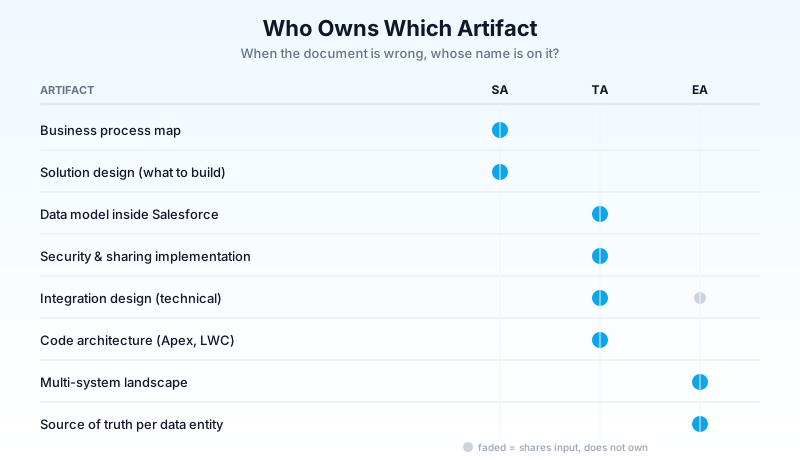
The Solution Architect owns:
- The business process map. What the org actually needs to happen, in business language.
- The solution design. Which Salesforce capabilities (declarative first, Flow, standard objects, clouds) solve that need.
- The build-versus-configure call. Whether something should be clicks, code, or a third-party app.
- The functional acceptance. Does the delivered solution actually solve the business problem.
The Technical Architect owns:
- The code architecture. How Apex, LWC, and triggers are structured, and whether they follow patterns that survive scale.
- The integration design at the technical level. APIs, authentication, payload contracts, error handling.
- The data architecture inside Salesforce. Large data volume strategy, skinny tables, indexing, governor limit headroom.
- The non-functional requirements. Performance, security implementation, environment and release strategy, DevOps.
The Enterprise Architect owns:
- The system landscape. How Salesforce, the ERP, the data warehouse, the payments platform, and the marketing stack fit together.
- The data flow across systems. Which system is the source of truth for each entity.
- The technology standards. Which platforms the company invests in, which it retires, and the integration patterns that connect them.
- The strategic roadmap. What the estate should look like in three years.
The overlap zone is real. A Solution Architect with integration depth will have opinions on the TA's API design. A Technical Architect who has seen enough projects will push back on a SA's solution when it is not buildable. The B2C Solution Architect credential exists precisely because multi-cloud solution design sits in the seam between SA and EA. But the ownership stays clear: when the data model is wrong, that is the TA's problem inside Salesforce and the EA's problem across systems. When the solution does not match the business need, that is the SA's problem.
Where each one spends a typical week
Artifacts tell you accountability. Time allocation tells you what the job feels like day to day.
The Solution Architect spends the week in requirement sessions, solution design reviews, and stakeholder alignment. They are in meetings with the business more than the other two. They sketch solution options, weigh build-versus-buy, and make sure the delivery team is building the right thing. A good SA prevents the most expensive mistake in any Salesforce program: building the wrong solution beautifully.
The Technical Architect spends the week in code review, design review, and firefighting. They review the Apex the developers wrote, design the integration the SA scoped, and answer the "will this scale" questions. When production breaks at 2am, the TA is on the escalation path. A good TA prevents the second most expensive mistake: building the right solution in a way that collapses under real-world load.
The Enterprise Architect spends the week in strategy sessions, vendor conversations, and cross-team alignment. They are rarely in a single project's standup. They decide whether the new requirement belongs in Salesforce at all or in another system, whether to buy MuleSoft or build point-to-point integrations, and how the company's Data Cloud strategy connects to the warehouse. A good EA prevents the most expensive mistake of all: investing three years of build into the wrong platform for the job.
The decision matrix: which architect do you actually need?
Most teams over-hire and under-hire at the same time. They bring in a CTA-track Technical Architect for a project that needed a Solution Architect, or they ask a Solution Architect to own a five-system data-residency design that needed an Enterprise Architect. Here is the matching logic.
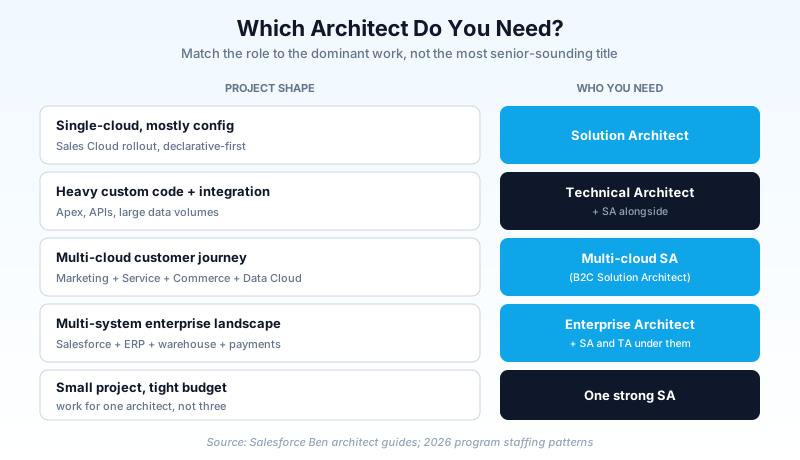
- Mostly-configuration single-cloud build (Sales Cloud rollout, mostly declarative): You need a Solution Architect. The work is solution design and process mapping. A Technical Architect would be underused and the budget wasted.
- Heavy custom code, integrations, large data volumes: You need a Technical Architect, ideally with a Solution Architect alongside for the business side. This is where Apex, LWC, API design, and governor limit strategy decide success.
- Multi-cloud customer journey (Marketing + Service + Commerce + Data Cloud): You need a Solution Architect with multi-cloud depth, the exact profile the B2C Solution Architect credential targets. The hard part is the cross-cloud data and journey design, not any single cloud's code.
- Multi-system enterprise landscape (Salesforce plus ERP plus warehouse plus payments): You need an Enterprise Architect to own the landscape, with a Solution Architect and Technical Architect under them on the Salesforce portion.
- Small project, tight budget: You need one strong Solution Architect who can reach into technical decisions. Do not hire three architects for a project that has work for one.
The single most common hiring mistake in 2026 is asking a Technical Architect to do Solution Architect work because the TA title sounds more senior. They are not ranked. A TA running requirement workshops is a misallocation, and a SA signing off on a 50-million-record data migration strategy is a risk. Match the role to the dominant work, not to the title prestige.
The certification ladder for each track
Salesforce maps these roles to distinct credential paths. The paths share a foundation and then diverge, and they are among the hardest certifications in the entire ecosystem.
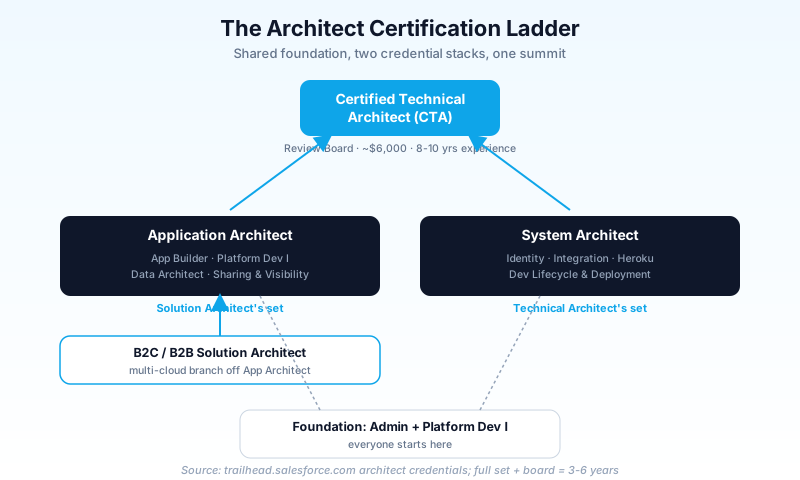
The Application Architect credential is awarded automatically when you hold four certs: Platform App Builder, Platform Developer I, Data Architect, and Sharing and Visibility Architect. It signals you can design well-architected applications on the platform. This is the natural target for a Solution Architect who wants the credential to match the role.
The System Architect credential is awarded when you hold four more: Identity and Access Management Architect, Integration Architect, Development Lifecycle and Deployment Architect, and the Heroku Architect credential. It signals you can handle the technical plumbing: auth, integration, release, off-platform compute, and governance. This is the Technical Architect's natural credential set.
The Certified Technical Architect (CTA) sits at the top and requires both Application Architect and System Architect first. In 2026 the CTA is earned through the Architect Review Board: a roughly $6,000 investment across two assessments, no multiple-choice questions, a complex business scenario you design and defend in front of a panel of CTA judges. Most successful candidates have 8 to 10 years of hands-on Salesforce experience. Completing the full set of eight credentials plus the board typically takes 3 to 6 years alongside real project work. It is the hardest credential Salesforce offers and the closest thing the ecosystem has to a terminal technical degree.
The Solution Architect credentials (B2C and B2B Solution Architect) build on the Application Architect foundation and target multi-cloud design specifically. The B2C Solution Architect credential covers architecting across Marketing Cloud, Service Cloud, Commerce, and Data Cloud to deliver a unified customer experience. These are the credentials that map to the multi-cloud Solution Architect role, and they have grown sharply in relevance as customer-journey programs spanning four clouds became common.
There is no single "Enterprise Architect" Salesforce certification, because the EA role spans beyond Salesforce by definition. EAs often hold the CTA plus non-Salesforce credentials (TOGAF, AWS, Azure) precisely because the job is about the whole estate, not one platform.
What changed for the EA role in 2026
The Enterprise Architect role shifted the most in the last two years, and it is worth calling out because the old definition is now wrong.
Two years ago, a Salesforce Enterprise Architect mostly meant someone who owned the Salesforce multi-org strategy: how many orgs, how they share data, how the CRM landscape fits together. That is still part of it. But in 2026, the EA on a serious Salesforce program increasingly owns a data-plane decision that did not exist at this scale before: how Salesforce, Data Cloud, the cloud data warehouse (Snowflake, BigQuery, Databricks), and the AI layer all share data without duplicating it.
Data Cloud made this central. When the warehouse, the CRM, and the Agentforce agents all need the same customer data, somebody has to decide the source of truth, the sync pattern, and the residency rules. That somebody is the Enterprise Architect. The EA in 2026 is as likely to be in a conversation about zero-copy data federation between Data Cloud and Snowflake as about Salesforce org strategy. The role grew outward from "Salesforce landscape" to "the data plane that Salesforce participates in," and EAs who did not grow with it got narrower than the job now requires.
This is also why the demand numbers diverged. Industry hiring data through 2025 showed Technical Architect demand up sharply and Solution Architect demand up solidly, while traditional developer demand softened. The architect tiers held value because AI raised the stakes on getting the design right; a hallucinating agent on a bad data model is a board-level problem, and the person who prevents it is an architect, not a coder.
How to pick the track you should aim at
If you are a Senior Developer or Senior Admin deciding which architect path to chase, the tell is which kind of problem you reach for.
If you love the platform mechanics, the question of how to make 50 million records query in under a second, the integration that has to be exactly-once, the Apex pattern that survives a subscriber org, aim at Technical Architect. The path runs through System Architect and, if you want the summit, the CTA. It is the deepest technical credential in the ecosystem and it pays accordingly.
If you love the business problem, the multi-cloud customer journey, the question of which cloud and which capability solves the actual need, aim at Solution Architect. The path runs through Application Architect and the B2C or B2B Solution Architect credentials. The admin-to-CTA career path post maps the full arc for people coming from the admin side.
If you find yourself caring less about Salesforce specifically and more about how all the company's systems fit together, whether something even belongs in Salesforce, what the three-year estate looks like, aim at Enterprise Architect. That path usually runs through one of the other two first, plus deliberate breadth into the non-Salesforce stack, plus the seniority to sit in strategy rooms. You rarely start there; you grow into it.
None of these is the "best" one. The TA has the deepest technical ceiling, the SA has the broadest business exposure and the cleanest path from the admin side, and the EA has the most strategic scope and the least hands-on work. The pay converges at the top; a strong CTA-track TA, a senior multi-cloud SA, and a Salesforce-anchored EA all clear the top band (well above the senior admin ceiling mapped in the 2026 admin salary guide). Pick the problems you want to own at 4pm on a Tuesday, because that is what the job actually is.
What to do this week
Three concrete actions depending on where you sit:
-
If you are hiring: Write down the dominant work of your program in one sentence. If it is "make the business process work in Salesforce," hire a Solution Architect. If it is "make the custom build scale and integrate," hire a Technical Architect. If it is "decide how five systems fit together," hire an Enterprise Architect. Match the role to that sentence, not to the most senior-sounding title.
-
If you are a Senior Dev or Admin choosing a path: Pick the artifact you would most want your name on from the ownership matrix above. Then look up the credential path that leads to owning it, and schedule the first cert in that path within 90 days. If you came up through code, the developer primer shows the on-ramp; if you came up through config, the career path post does.
-
If you are on a confusing program right now: Take the artifact ownership matrix to your next architecture sync and ask each architect which rows they own. The gaps and the overlaps will surface in ten minutes, and the program will run smoother for the rest of its life.
The three roles are not a hierarchy to climb in order. They are three doors into senior Salesforce architecture, each owning a different question: what to build, how to build it, and where it fits. Pick the question you want to spend your career answering, and the title sorts itself out.
About the Author
Dipojjal Chakrabarti is a B2C Solution Architect with 29 Salesforce certifications and over 13 years in the Salesforce ecosystem. He writes and edits salesforcedictionary.com, published by KineticBit Inc., to help admins, developers, architects, and cert/interview candidates sharpen their fundamentals. More about Dipojjal.
Share this article
Sources
Related dictionary terms
Practise it
Five questions on Platform Developer I
Exam-style questions with an explanation after each one. No account needed, and your answers build a weak-topic map once you have one.
Keep reading

Salesforce Admin Salary Guide 2026: What US Admins Actually Earn by Tier, Cert, and Metro
You are a year into a Salesforce Admin role, the cert wall above you is full of acronyms, and you do not know what your next raise should look like. Here is the 2026 US pay map.

The Salesforce Career Path in 2026: From Admin to CTA (with Salaries & Timelines)
The complete Salesforce career roadmap from Admin to CTA - realistic timelines (5–10 years), 2026 salary bands by region, and the difference between cert collecting and getting promoted.

What Is a Salesforce Developer (and How to Become One in 2026)
You can build a Flow but you keep hitting the wall where clicks stop and code starts. This is the 2026 Salesforce Developer primer: the specializations, the cert path, and the first 90 days.
Comments
No comments yet. Start the conversation.
Sign in to join the discussion. Your account works across every page.