
Partners See No Agentforce Revenue
Salesforce reported Agentforce annual recurring revenue past $1.5 billion on Wednesday, up more than 240%, on 3.2 billion agentic work units. A TD Cowen survey of implementation partners across the US, Europe and Asia, circulating the same week, found that not one respondent named Agentforce as a driver of recent bookings. Both readings are accurate, and the reason they diverge is where the money is being billed.

Salesforce told investors on Wednesday that Agentforce annual recurring revenue passed $1.5 billion, growing more than 240%. Five days earlier, a TD Cowen survey of its implementation partners across the US, Europe and Asia reported that not one respondent could name Agentforce as a driver of recent bookings.
Zero. Not "a small share". Not "below expectations". Nobody.
Both numbers are real, and the ecosystem has spent the week treating them as a contradiction. They are not. They measure two different transactions, and the gap between them is the most useful thing published about Agentforce this month.
Two Scoreboards, Same Product
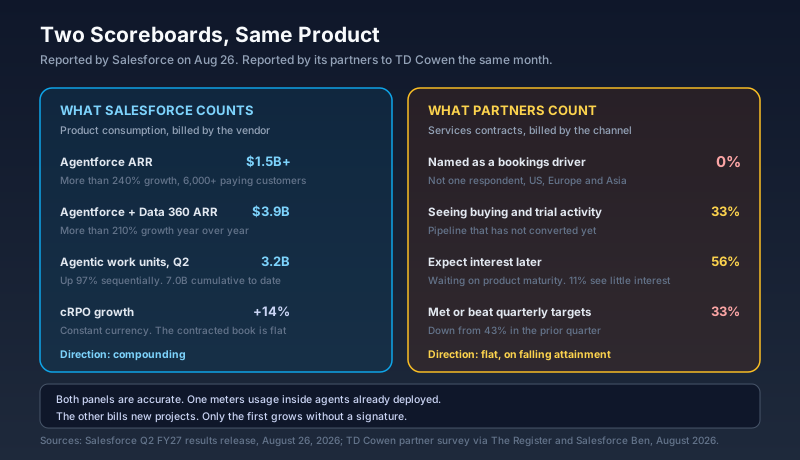
The vendor scoreboard is the one that ran on every wire on Wednesday night. Agentforce ARR past $1.5 billion across more than 6,000 paying customers. Combined Agentforce and Data 360 ARR near $3.9 billion. Consumption of 3.2 billion agentic work units in the quarter, up 97% sequentially, for 7.0 billion cumulative. We covered the full print and the Claudeforce announcement in Wednesday's report.
The channel scoreboard is quieter and, for anyone who works in the ecosystem, more directly relevant. TD Cowen asked partners a straightforward question about what is driving their contract activity, and Agentforce did not appear in a single answer.
The rest of that survey is not uniformly bleak. A third of respondents reported real buying and trial activity. Another 56% expect the demand to arrive once the product matures a little further. Only 11% reported little interest at all. Read together, that describes a market full of evaluation and short of signed statements of work.
One number in the survey deserves more attention than the Agentforce line. Just 33% of surveyed partners met or exceeded their quarterly targets, down from 43% the quarter before. That is a channel with a general revenue problem, not only an Agentforce one.
Ten points of attainment lost in a single quarter is a bigger operational event for most practices than any AI narrative. It shows up as hiring freezes, bench time, and discounting on the traditional work that still pays the bills. Any partner reading the Agentforce line as their main problem this quarter is reading the wrong line.
The Question Is Not Whether, It Is Who Bills
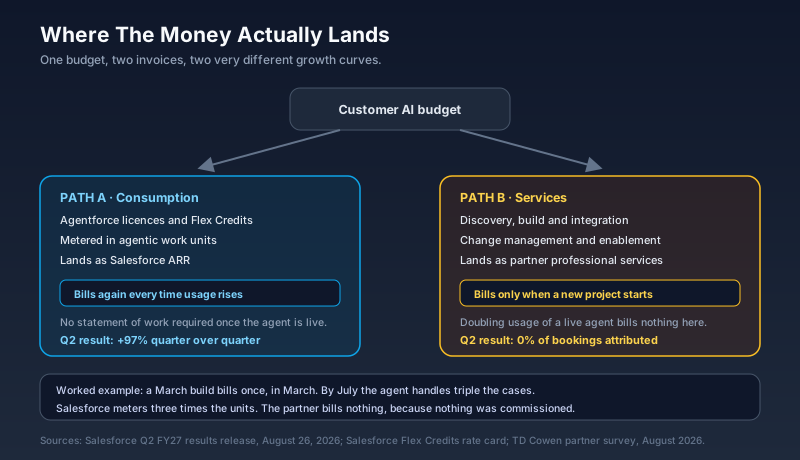
Here is the mechanism that reconciles the two panels.
Agentforce revenue is consumption revenue. It is metered in agentic work units and billed through Flex Credits or committed licence spend. Once an agent is deployed and handling volume, that meter runs on its own. A customer that doubles its agent traffic in July pays Salesforce more in July. It does not pay its implementation partner a cent more, because no new project started.
Partner revenue is project revenue. It bills on discovery, build, integration and change management. It bills when something new begins.
So a quarter can deliver 97% sequential growth in consumption and 0% growth in partner bookings at the same time, without either party misreporting. Deepening usage inside already-deployed agents is exactly the shape that pays the vendor and skips the channel.
Run the arithmetic on a single account and the point lands harder. A mid-market customer signs an agent build in March. The partner bills the build once, in Q1. The agent goes live in April and handles a few thousand cases a month. By July the same agent is handling three times that volume because service moved two more queues onto it. Salesforce records three times the work units. The partner records nothing, because nobody asked them to build anything in July.
Multiply that across 6,000 paying customers and you get Wednesday's press release and last week's survey, from the same underlying activity.
That also explains why the growth rates are so lopsided. Agentforce ARR grew more than 240% while current remaining performance obligation held at 14% in constant currency. A meter compounding on a small base inside a large contracted book produces exactly those two numbers, and neither one tells you how many new agent projects started.
Two Years In, The Build Is Getting Smaller
Agentforce reaches its second anniversary next month. For most of that time the partner pitch has been implementation: scope the use case, wire the actions, tune the prompts, ship it. That surface has been shrinking all year, and it shrank twice in the last nine days.
The shrinking started before this month. Agentforce Vibes moved prompt and action scaffolding into generated code. The legacy Agentforce Builder retirement in July pushed everyone onto a studio that assembles agents from packaged components rather than hand-wired configuration. Each step was defensible product work and each step removed hours somebody used to invoice.
On August 19, Salesforce expanded Headless 360 with more than 100 reusable Agent Skills, a Headless 360 MCP Server and a Data 360 MCP Server. On August 26, Claudeforce launched with 37 prebuilt sales skills that let a seller work live CRM records from inside Claude, with open beta due in September.
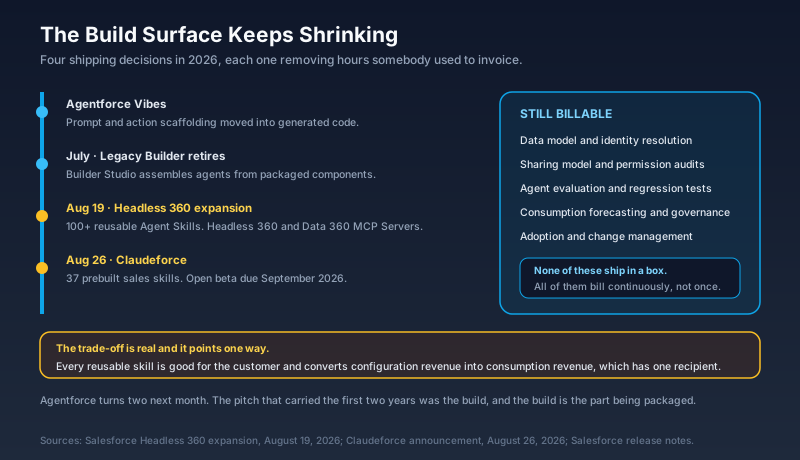
A prebuilt skill is a component the customer no longer pays anyone to build. Ninety percent of a sales agent arriving in the box is excellent for the customer and awkward for a practice that priced its year on building that ninety percent.
This is not a complaint about product quality. It is an observation about where the hours went. Every reusable skill Salesforce ships converts configuration revenue into consumption revenue, and consumption revenue has one recipient.
The Partner Program Already Bet On This
March made the tension structural. Salesforce collapsed the consulting partner tiers from four (Base, Ridge, Crest, Summit) down to two, Summit and Select. It replaced the 14-metric Trailblazer Scorecard with an outcome-weighted model and cut 170 Navigator distinctions to 28 competencies. Summit status now requires demonstrated Agentforce delivery competency.
Read that against the survey. Partners are being asked to prove Agentforce delivery to hold their tier, in a market where Agentforce is producing no measurable bookings for them. The investment is mandatory and the return is, so far, evidence-free.
That is a real cost, and it is one of the more plausible explanations for the 33% target attainment figure. Practices are funding Agentforce enablement out of margin earned on other work.
The tier consolidation sharpens it further. With four tiers there was a survivable middle. With two, a practice either clears the Summit bar or sits in Select alongside firms a fraction of its size, and the bar it has to clear is competency in the exact product producing no bookings. Salesforce framed the redesign around verifiable customer outcomes, which is a reasonable thing to ask for. It also means the proof of an Agentforce outcome has to come from a deployment the partner may not have been paid to run.
What Cuts The Other Way
Three things argue against reading the survey as a verdict on the product.
The first is timing. TD Cowen asked partners about bookings that had already closed. The 33% reporting trial and buying activity are describing pipeline that has not converted yet. Pilots that started in the spring show up as bookings in the autumn, not in an August survey.
The second is data readiness, which KeyBanc flagged in July when Jackson Ader downgraded the stock. Enterprises whose data is fragmented cannot run a useful agent, no matter how good the agent is. That blocks the pilot before it reaches a partner statement of work, and it is a delay rather than a rejection.
The third is that 6,000 paying customers exist. Somebody deployed those agents. A survey of partner bookings will not capture direct Salesforce-led deployments, in-house builds, or expansions inside accounts that a partner touched eighteen months ago. Salesforce has also been running its own delivery motion through forward-deployed engineers since May, which by design puts vendor staff on the early Agentforce work.
A fourth caveat is methodological. TD Cowen did not publish a sample size in the coverage that circulated, and a partner survey with a few dozen respondents is a signal rather than a census. The zero is striking precisely because it is a zero, and a zero is easy to produce in a small sample. Treat it as a directional read that matches KeyBanc's, not as a measurement.
Where The Billable Work Actually Moved
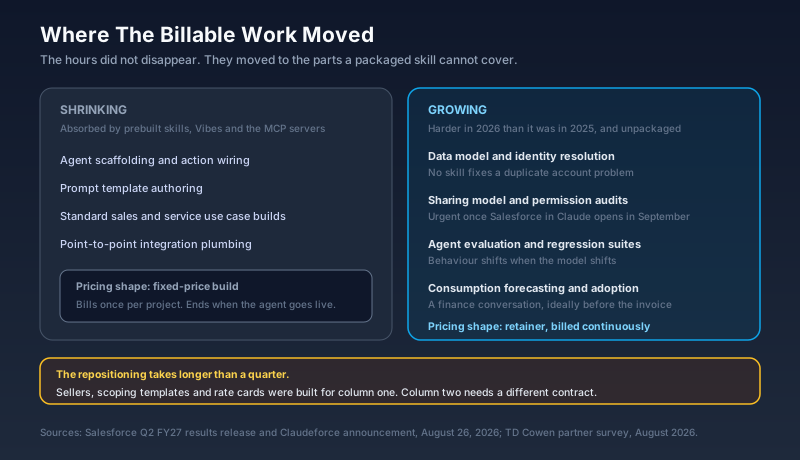
The work has not disappeared. It moved to the parts of an agent deployment that a prebuilt skill cannot cover.
Data model and identity resolution still have to happen before any agent reasons correctly, and no reusable skill fixes a duplicate account problem. Sharing model audits are about to become urgent rather than optional: when Salesforce in Claude reaches open beta in September, every permission mistake in your org becomes reachable from a chat window. Agent evaluation and regression testing is genuinely new work, because agent behaviour shifts when the underlying model changes and nobody has a Winter '27 test class for that. Consumption forecasting against the Flex Credits rate card is now a finance conversation, and finance would rather have it before the invoice.
Each of those bills continuously rather than once. That is a retainer, not a fixed-price build, and repositioning a practice around it takes longer than a quarter.
What To Do Next
If you run or sell for a partner, stop leading with agent builds. Take one existing Agentforce customer, pull their agentic work unit consumption for the last two quarters, and show them the trend line next to their Flex Credits commitment. That conversation is billable this month and does not depend on a new project starting.
If you are a customer, ask your partner directly how many Agentforce deployments they have taken to production, not how many they have scoped. The survey says a third of them are still in trials. You want the answer before Dreamforce, which runs September 15 to 17, and before the September open beta puts your sharing model in front of a chat interface.
Either way, open Setup and run a permission audit against your guest and integration users this week. That is the one item on this list with a date attached.
About the Author
Dipojjal Chakrabarti is a B2C Solution Architect with 29 Salesforce certifications and over 13 years in the Salesforce ecosystem. He writes and edits salesforcedictionary.com, published by KineticBit Inc., to help admins, developers, architects, and cert/interview candidates sharpen their fundamentals. More about Dipojjal.
Share this article
Sources
- Salesforce Partners Are Not Seeing Agentforce ROI (Salesforce Ben, August 24 2026)
- Salesforce partners not seeing meaningful revenue from Agentforce AI platform, report says (The Register, August 21 2026)
- Salesforce Partners Report Zero Revenue Boost from Agentforce Two Years After Launch (Techstrong.ai, August 24 2026)
- Salesforce Delivers Record Second Quarter Fiscal 2027 Results (Salesforce, August 26 2026)
- The Outcome Advantage: Driving Customer Value through the New Salesforce Partner Program (Salesforce, March 10 2026)
- Salesforce Massively Overhauls Partner Program (Salesforce Ben)
- Salesforce and Anthropic Announce Claudeforce (Salesforce, August 26 2026)
- Salesforce's Agentforce product maturity questioned as KeyBanc cites weak customer traction (CIO)
Related dictionary terms
Practise it
Five questions on Agentforce Specialist
Exam-style questions with an explanation after each one. No account needed, and your answers build a weak-topic map once you have one.
More news

KeyBanc Downgrades Salesforce
KeyBanc cut Salesforce to Sector Weight on July 9 and pulled its price target, saying customer checks found no Agentforce acceleration. Shares fell near 5%, eight days after Guggenheim upgraded the same stock.

Inside the Agentic Enterprise Index
Salesforce's second Agentic Enterprise Index, published August 7, reports 5 agents per customer growing to 13, deployment time down to 1.9 days, and 734 million Agentic Work Units. The sample only counts customers who never stopped.

Salesforce Pros Are Going Agnostic
A quarter of respondents to Salesforce Ben's 2025-26 salary survey are looking at non-Salesforce tech roles and 11 percent are weighing an exit from tech. Demand grew 8 percent last year. Supply grew 27 percent. The gap is the whole story.
Data 360 MCP Server Goes Live
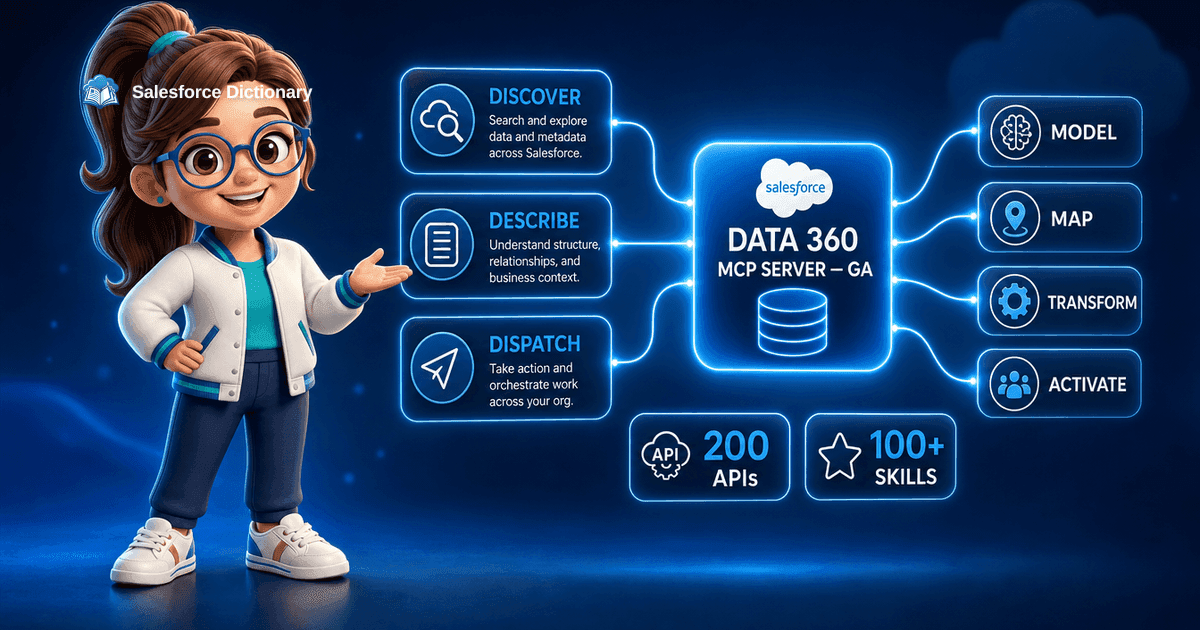
Salesforce shipped the Data 360 MCP Server to GA yesterday along with a 100 plus Skills repository, but left the umbrella Headless 360 MCP Server in open beta. Here is what actually shipped and what to test before Dreamforce.
Comments
No comments yet. Start the conversation.
Sign in to share your take on this article. Your account works across every page.