
KeyBanc Downgrades Salesforce
KeyBanc's Jackson Ader cut Salesforce from Overweight to Sector Weight on July 9 and pulled his price target, saying his own customer checks found none of the Agentforce momentum management keeps describing. The stock dropped near 5% by the opening bell.
KeyBanc pulled its price target on Salesforce on July 9 and cut the stock from Overweight to Sector Weight. No new number to replace it, just gone. Eight days earlier, Guggenheim had upgraded the same stock to Buy at $228, arguing the AI bear case was overdone. KeyBanc's analyst went and did the legwork Guggenheim's thesis depended on, and came back with a different answer.
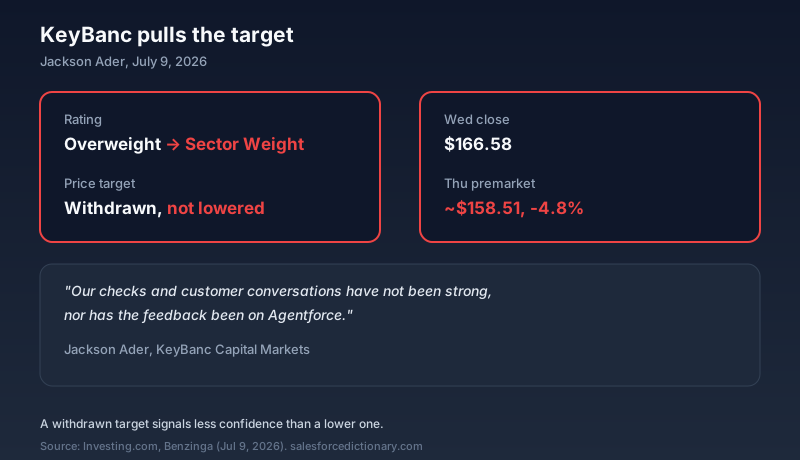
Shares fell close to 5% by the opening bell, from Wednesday's close of $166.58 toward $158.51. Here is what analyst Jackson Ader actually found, what it does and does not prove about Agentforce, and what to do with it whether you sell this platform, build on it, or just hold the stock.
What Ader actually changed
Strip the note to its mechanics first. KeyBanc moved Salesforce from Overweight to Sector Weight, its neutral tier, and withdrew the price target rather than lowering it. Removing a target instead of cutting it is its own signal. A lower number still says "we have a model and a conviction, just a smaller one." No number says "we do not currently have enough confidence in the inputs to defend one."
His reasoning, in his own words: "Our checks and customer conversations have not been strong, nor has the feedback been on Agentforce." He added that the growth acceleration management keeps promising "is further out than we'd expected, if it plays out at all." That is a KeyBanc analyst spending a research budget on primary research, calling customers and partners himself, instead of re-reading Salesforce's own slides back to investors. The downgrade carries more weight for that reason. It is not a spreadsheet reaction to a printed number. It is a channel check that came back thin.
Sector Weight is not a bearish call. It is KeyBanc saying, plainly, that it no longer has a reason to prefer this stock over the rest of enterprise software. That is a smaller claim than a downgrade to Underweight, and it is also a more uncomfortable one for a company that has spent a year telling investors Agentforce changes the growth math. A neutral rating from a former bull reads as: prove it, then we will move.
The two-line customer complaint
Ader's checks kept surfacing the same two problems, and they are worth separating because they are not the same problem.
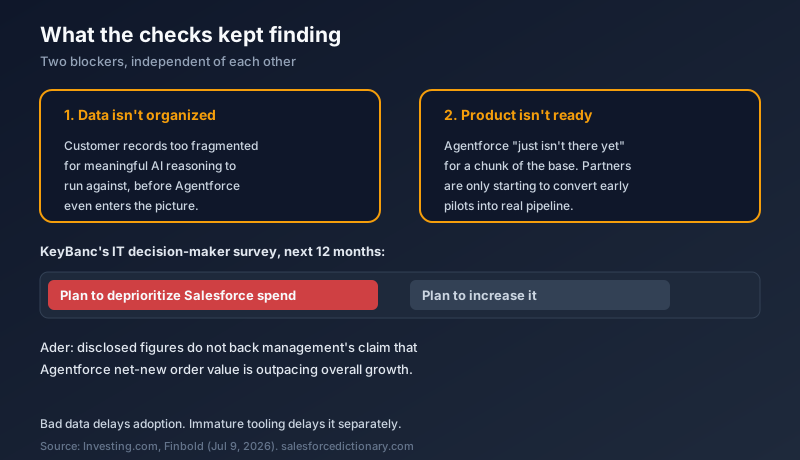
First: customer data is not organized well enough to do meaningful AI work. This is not an Agentforce defect. It is a prerequisite Agentforce cannot solve for a customer, no matter how good the agent reasoning gets. An agent answering questions against duplicate records, orphaned objects, and three different definitions of "active customer" produces confident, wrong answers faster than a human would. Every Salesforce architect who has scoped a Data Cloud project already knows this. What is new is a Wall Street analyst putting it in a rating action.
Second, and more damaging: Agentforce itself, as a product, "just isn't there" for a chunk of the base Ader talked to. Paired with the first point, partners are described as only beginning to convert early proof-of-concept work into real pipeline, months after Agentforce's general availability. Two problems, one dependent on the other. Bad data delays adoption. Immature tooling delays it independently. Fix one and the other still slows you down.
The survey line that should worry Salesforce more than the stock move
Buried under the rating change is the detail with the longest half-life: in KeyBanc's own IT decision-maker survey, more respondents said they plan to deprioritize Salesforce spending over the next twelve months than said they plan to increase it.
A single quarter of soft bookings is noise. A survey where the deprioritize column outweighs the prioritize column is budget behavior, and budget behavior takes quarters to show up in a Salesforce income statement and quarters more to reverse once it does. Ader also flagged that Salesforce showed up in a recent CIO survey as, in his words, "a standout for the wrong reasons." That is a company getting noticed by buyers for being the vendor they are trimming, not the one they are expanding.
Ader went further than sentiment. He argued the numbers Salesforce has actually disclosed do not back management's claim that Agentforce's net-new average order value is outpacing overall growth. If that is right, the company is asking investors to trust a growth narrative the disclosed figures do not independently confirm. That is a specific, checkable claim, and it is the kind of claim that gets resolved one way or the other the next time Salesforce reports.
The valuation twist
Here is the part that cuts against the easy read of this stock. Salesforce trades at a forward P/E near 19 and a PEG ratio near 0.5, numbers that look cheap on their face, especially after a drawdown that has taken the stock down more than a third of its value this year. "Cheap stock, temporary AI panic, buy the dip" has been the bull case since spring.
Ader takes that argument apart directly. He found Salesforce trading near the median of its software peer group, and above peers once you adjust for growth. The headline multiple looks like a discount. The growth-adjusted multiple does not. You cannot simultaneously argue the stock is a bargain because growth will reaccelerate and also treat the current growth rate as evidence of cheapness. Pick one. Ader's note picks neither, and that is precisely why he pulled the target instead of lowering it.
Eight days, opposite conclusions
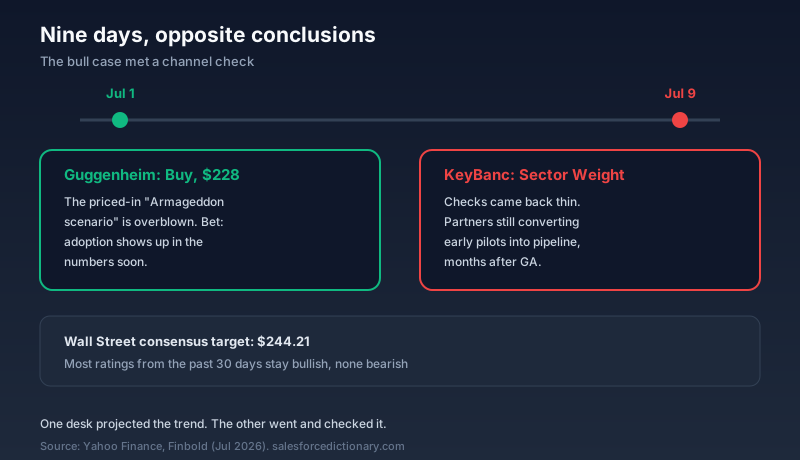
This is the second time in ten days Wall Street has split hard on the exact same stock. On July 1, Guggenheim upgraded Salesforce to Buy at $228, calling the priced-in "Armageddon scenario" around AI disruption overblown. Analyst John DiFucci's case rested on a specific bet: that Agentforce adoption would show up in the numbers before the market gave Salesforce credit for it.
KeyBanc's note is the first real test of that bet, and it did not go Guggenheim's way. Ader was not modeling a hypothetical. He called the customers and partners the bull case needs to be converting right now, and came back with "not strong" and "further out than expected." Two research desks, same facts on the tape, and a nine-day gap in which one of them went and checked the thing the other was projecting.
One wrinkle in the coverage worth flagging
A handful of wire aggregators ran this story under a second headline, attributing an identical downgrade, with the same rating scale and nearly the same quotes, to Bernstein rather than KeyBanc. Bernstein does not use an Overweight or Sector Weight scale, and the named analyst in that version is the same Jackson Ader who covers Salesforce for KeyBanc. Read closely, it looks like a syndication error rather than a second, independent call. Treat this as one downgrade from one desk, not two firms arriving at the same conclusion separately. That distinction matters if you are the one repeating this story to a client or a boss.
It is also a small reminder to check the byline before you forward a headline. A single credible channel check traveling under two mastheads can look, at a glance, like a consensus forming. It is not a consensus. It is one analyst's phone calls, reported twice.
What still cuts the other way
None of this makes Salesforce a broken stock. The Wall Street consensus target sits at $244.21, more than 46% above Wednesday's close, and the bulk of ratings published in the past month remain positive with none outright bearish. Salesforce also still has the largest pool of implementation partners and the deepest CRM data footprint of any vendor selling agentic AI into the enterprise. A KeyBanc downgrade did not delete that.
What it did do is put a specific, falsifiable claim on the record: partners are early in converting Agentforce pilots to pipeline, and the disclosed numbers do not yet back the acceleration story. That claim gets tested again at the next earnings call. If Agentforce annual order value growth shows up clearly in the numbers Salesforce actually reports, rather than in a slide adjective, Ader's thesis breaks. If it does not, the July 9 downgrade will look less like an outlier and more like the first one that read the room correctly.
What to do next
If you are pitching Agentforce internally, do not lead with the growth narrative KeyBanc just challenged. Lead with the two blockers Ader's checks actually found, data readiness and product maturity, and show your own org how you have solved for both before you promise acceleration. That is a harder pitch to make and a much easier one to defend when someone in the room has read this note.
If you track CRM as an investor or a partner, put a date on your calendar for the next earnings call and watch one line specifically: whether management discloses Agentforce net-new average order value in a way that lets you check Ader's claim yourself, rather than restating that it is growing. A vendor confident in that number shows it. A vendor still building toward it talks around it.
About the Author
Dipojjal Chakrabarti is a B2C Solution Architect with 29 Salesforce certifications and over 13 years in the Salesforce ecosystem. He writes and edits salesforcedictionary.com, published by KineticBit Inc., to help admins, developers, architects, and cert/interview candidates sharpen their fundamentals. More about Dipojjal.
Share this article
Sources
- KeyBanc downgrades Salesforce stock rating on AI product concerns (Investing.com)
- This Salesforce Analyst Is No Longer Bullish; Here Are Top 5 Downgrades For Thursday (Benzinga)
- Bernstein downgrades Salesforce, cites lack of evidence for Agentforce momentum (Investing.com)
- Salesforce Can't Catch A Break: Analyst Downgrades CRM Stock And Finds Little Proof Agentforce Is Gaining Speed (Yahoo Finance)
- Wall Street Sets Salesforce Stock Price Target For Next 12 Months (Finbold)
Related dictionary terms
Practise it
Five questions on Agentforce Specialist
Exam-style questions with an explanation after each one. No account needed, and your answers build a weak-topic map once you have one.
More news

Wall Street Splits on Salesforce
Within one trading week, Phillip Securities downgraded Salesforce to Neutral and Guggenheim upgraded it to Buy, using the same facts. Here is what that split tells Salesforce professionals.

Salesforce Stock Hits 52-Week Low
Salesforce stock set a new 52-week low of $163.31 on June 11, 2026, down roughly 37% this year, while Agentforce ARR surged 205% to $1.2 billion. The disconnect explained.

BofA Cuts Salesforce to Underperform
BofA reinstated Salesforce at Underperform on May 18 with a $160 target. With 23,000 of 200,000+ customers on paid Agentforce deals and CRM down 35% YTD, the monetization debate peaks nine days before Q1 FY27 earnings.
Comments
No comments yet. Start the conversation.
Sign in to share your take on this article. Your account works across every page.