
Legacy Agentforce Builder Retires
Starting the week of July 13, the New Agent button in Setup stops opening the old Agentforce builder. New agents are created only in the new Agentforce Builder, which runs on Agent Script, a language Salesforce also open-sourced under Apache 2.0. Here is what breaks, what does not, and what to do before Monday.

You open Setup, type "Agentforce" in the quick find, and click New Agent the way you have since last year. A wizard appears, you name the agent, pick a type, drop in some topics, and ship it. That muscle memory has a shelf life now. Starting the week of July 13, 2026, that button stops going where it used to go, and the builder you learned first is no longer the one Salesforce hands new agents to.
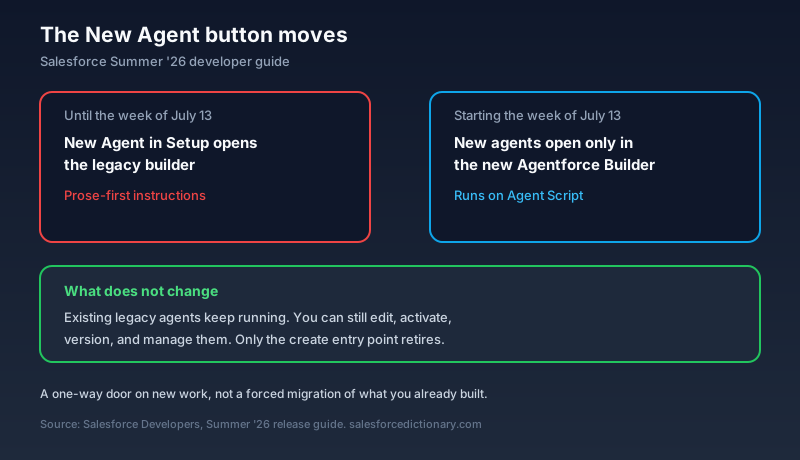
Salesforce's Summer '26 developer guide states it plainly: "Starting the week of July 13, 2026, the New Agent button no longer opens the legacy builder in Setup. New agents are created only in the new Agentforce Builder." No countdown banner, no forced migration of what you already built. Just a quiet redirect that changes where every net-new agent begins its life. If you build on Agentforce, this is the kind of change that does not announce itself until you hit the button and land somewhere unfamiliar.
What actually retires, and what does not
Read the wording carefully, because the scope is narrower than "the old builder is gone." What retires is the entry point. The New Agent button in the legacy builder in Setup goes away, and after that, the only place to create an agent is the new Agentforce Builder inside Agentforce Studio.
Your existing legacy agents are not deleted, disabled, or frozen. Salesforce's guidance is explicit that this change does not touch agents already built in the legacy tool. You can still edit them, activate them, create new versions, and manage them the way you always have. Nothing in production breaks the week of July 13. What changes is that you cannot start a fresh one in the old interface anymore.
That distinction matters for planning. This is not an emergency migration with a hard cutover date and a broken deploy waiting on the other side. It is a one-way door on new work. Every agent you stand up from Monday forward starts in Agent Script, whether you were ready to learn it or not.
What replaces it: Agent Script
The new Agentforce Builder went generally available in the Summer '26 release, and its defining piece is Agent Script, the language you now write agents in. This is the real story under the button change. Salesforce is not just moving the create flow to a different screen. It is moving the whole model of how an agent's behavior gets defined.
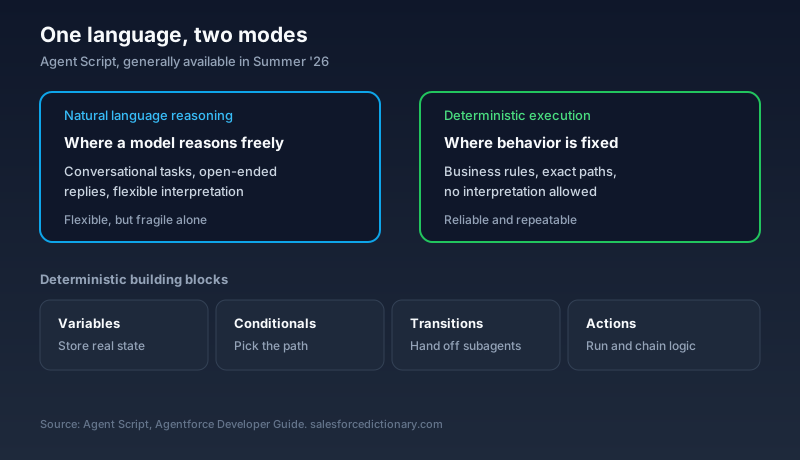
The Agent Script documentation describes the language as one that "combines the flexibility of natural language instructions for handling conversational tasks with the reliability of programmatic expressions for handling business rules." The point is a hybrid. You mark the parts of an agent's job where a model should reason freely, and you mark the parts where the agent must execute deterministically, no interpretation allowed.
The docs spell out the main building blocks. Reasoning instructions define where an LLM gets latitude versus where execution is fixed. Variables "reliably store information about the agent's current state, rather than relying on LLM context memory," which means a value you captured three turns ago is still exactly that value, not a paraphrase the model half-remembers. Conditional expressions decide the execution path or the agent's next utterance. Transitions control when the agent hands off to a subagent. Actions run the business logic and chain together.
If you have spent the last year watching an agent wander off a script because a natural-language instruction was one interpretation away from wrong, this is the response to that pain. The legacy builder leaned almost entirely on prose instructions, which are flexible and also fragile. Agent Script keeps the prose where prose is the right tool and gives you real control everywhere else.
The upgrade path for what you already built
Salesforce is not making you rewrite existing agents by hand, and it is not stranding them on a dead branch either. There is a one-click upgrade, and the Summer '26 guide describes exactly what it does. Upgrading a legacy agent "converts all subagents, actions, system messages, data, and connections to Agent Script," then optionally optimizes the result for reliability.
The optimization step is worth understanding before you run it. Once your agent exists as Agent Script, a built-in tool reviews the natural-language instructions the conversion produced and adds deterministic controls where they will help. In practice it is looking for the spots where prose was doing a job that a variable, condition, or transition does more reliably, and tightening them. You get a converted agent first, then a hardened one if you choose the second pass.
Two cautions apply. First, an upgrade creates a new version of the agent in the new builder. It does not silently overwrite the legacy original, so you have a fallback while you validate the converted behavior. Second, "converts" is not the same as "produces an identical agent." A conversion from loose prose to a structured language will surface ambiguities that were always there and only worked by luck. Test the upgraded version against your real conversation transcripts before you point production traffic at it. The conversion is the easy 80 percent. The last 20 percent is confirming the agent still does what you meant, not just what you wrote.
Salesforce open-sourced the language it runs on
Here is the part that got less attention than the button change and probably deserves more. Agent Script is not a closed, Salesforce-only format. The company published the toolchain on GitHub as the salesforce/agentscript repository under an Apache 2.0 license, described there as "an open agent specification language" that was "developed for agentforce, but is meant to apply towards agents in general."
The repository is not a token gesture. It ships the parser, in both a Tree-sitter and a JavaScript implementation, a core layer with AST types and a linting framework, three schema dialects covering base Agent Script plus Agentforce and Agent Fabric variants, and a compiler that turns parsed Agent Script into a Salesforce runtime specification. On the developer-tooling side it includes the linter, a Language Server Protocol implementation, editor integrations for VS Code and Monaco, and a UI playground. The most recent release listed is @sf-agentscript/lsp@2.3.8, dated June 10, 2026, across 22 total releases under the @sf-agentscript/* npm scope.
For anyone who has watched agent frameworks turn into vendor lock-in, an Apache 2.0 parser and compiler is a genuinely different posture. You can lint Agent Script in CI without a Salesforce org. You can build editor tooling against a published grammar. The runtime still belongs to Salesforce, so this is not portability of the executing agent, but the definition of the agent is now something you can read, validate, and tool outside the platform. That is a meaningful hedge against the format itself becoming a trap.
The honest read on the timing
Not everyone is going to greet a language on Monday morning with enthusiasm. The legacy builder's appeal was that an admin could stand up a working agent in an afternoon with no code and no new syntax. Agent Script raises the floor of what you can control and, with it, the floor of what you need to understand. Salesforce would call that maturity. A team that just wanted to click through a wizard will feel it as friction first.
There is also a fair question about pace. The FIFA World Cup Agentforce rollout, the Commerce agents going generally available, Help Agent's pay-per-resolution pricing, and now a builder swap have all landed inside a single release cycle. Admins are absorbing a lot at once, and "the button moved and the language changed" is not a small ask on top of everything else. The Salesforce Admins blog frames Agent Script as a top Summer '26 feature for exactly the reliability reasons above, which is true, and it is also true that the learning curve is real and lands the same week the old path closes.
The mitigating fact is the one from the top of this piece: nothing you already run breaks. The retirement is on the create button, not on your live agents. That gives you room to learn the new builder on new work while your existing fleet keeps serving, instead of a forced flag day.
What to do before Monday
The change is small in mechanics and large in habit. Get ahead of it with a short checklist.
- Open the new Agentforce Builder before you need it. Go into Agentforce Studio and create one throwaway agent in the new builder this week, while the pressure is off. The first time you meet Agent Script should not be the first time you have a real agent to ship.
- Inventory your legacy agents. List every agent still living in the old builder, note which are in production, and decide which ones you want to upgrade to Agent Script versus leave running as-is. Both are valid. Just make it a decision, not an accident.
- Run one upgrade as a test. Pick a low-risk legacy agent, run the one-click upgrade, then run the optimization pass, and compare the converted behavior against your existing conversation transcripts. You will learn where prose-to-script conversion gets loose, and you want that lesson on a safe agent.
- Wire the open-source tooling into your process if you build seriously. If your team ships agents at any real volume, pull the
salesforce/agentscriptlinter and LSP into your editor and CI now. Catching an Agent Script error before it reaches an org is cheaper than catching it after. - Tell your builders the button is moving. The most likely support ticket the week of July 13 is "the New Agent button is gone." It is not gone. It moved, and new agents start in a new place. A one-line heads-up to your admin team prevents the panic.
The single most useful thing you can do today is the first item: spend twenty minutes creating a disposable agent in the new builder and reading its Agent Script. The button change is trivial once you have already met what waits on the other side of it.
About the Author
Dipojjal Chakrabarti is a B2C Solution Architect with 29 Salesforce certifications and over 13 years in the Salesforce ecosystem. He writes and edits salesforcedictionary.com, published by KineticBit Inc., to help admins, developers, architects, and cert/interview candidates sharpen their fundamentals. More about Dipojjal.
Share this article
Sources
- The Salesforce Developer's Guide to the Summer '26 Release (Salesforce Developers Blog)
- Agent Script (Agentforce Developer Guide, Salesforce Developers)
- salesforce/agentscript: an open, schema-driven language for configuring agent orchestration systems (GitHub)
- Jen's Top Summer '26 Release Features For Admins (Salesforce Admins)
Related dictionary terms
Practise it
Five questions on Agentforce Specialist
Exam-style questions with an explanation after each one. No account needed, and your answers build a weak-topic map once you have one.
Comments
No comments yet. Start the conversation.
Sign in to share your take on this article. Your account works across every page.