
Salesforce FDE Partner Network
Salesforce's Forward Deployed Engineering Partner Network now spans 30+ firms, including Accenture, Deloitte, IBM Consulting, PwC, Slalom, TTEC Digital, and Bridgenext. Here is what the FDE designation actually changes for Agentforce buyers and what to ask any partner pitching you this quarter.

Salesforce's Forward Deployed Engineering (FDE) Partner Network picked up two more members this week. TTEC Digital was announced on May 19, 2026 (GlobeNewswire), and Bridgenext confirmed its FDE designation in the same window (Bridgenext). The count is now past 30 firms. If you are scoping an Agentforce build this quarter, the FDE list is the short list you should be working from. Here is why, and what the designation actually changes.
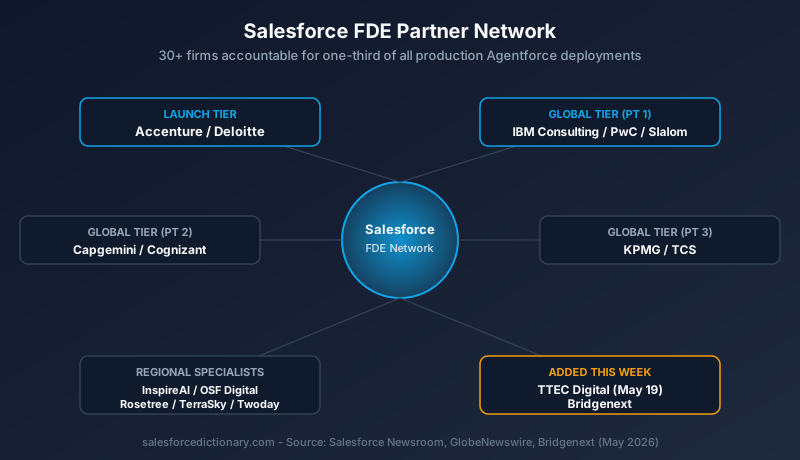
The FDE Partner Network launched in April 2026 with Accenture and Deloitte as the headline launch tier and a global second tier that includes Capgemini, Cognizant, IBM Consulting, KPMG, PwC, Slalom, and Tata Consultancy Services. Regional specialists InspireAI, OSF Digital, Rosetree Solutions, TerraSky, and Twoday Oy round out the original membership. The pitch from Salesforce is direct: FDE partners have already driven roughly one-third of all successful Agentforce production deployments to date (Salesforce Newsroom).
What "Forward Deployed Engineering" means in this context
The term is borrowed from Palantir. The idea is that the vendor does not throw software over the wall to a system integrator. Instead, vendor engineers (or partner engineers trained to vendor standards) embed with the customer, write production code alongside the customer team, and stay accountable for whether the system actually works in production.
Salesforce is packaging that model. FDE partner firms get direct access to Salesforce product teams, production-focused training that goes deeper than standard partner certification, and what Channel Insider describes as "side-by-side engineering collaboration during implementation and post-launch adjustments" (Channel Insider).
The Salesforce pitch from Miguel Milano, President and CRO: "The most successful organizations don't just invest in Agentforce. They align with partners who possess the engineering and industry knowledge depth to turn that technology into the engine that transforms them into Agentic Enterprises" (Channel Insider).
That is marketing language. The operational change underneath it is what matters.
What is actually different from a standard SI engagement
Three things, in order of impact for the buyer.
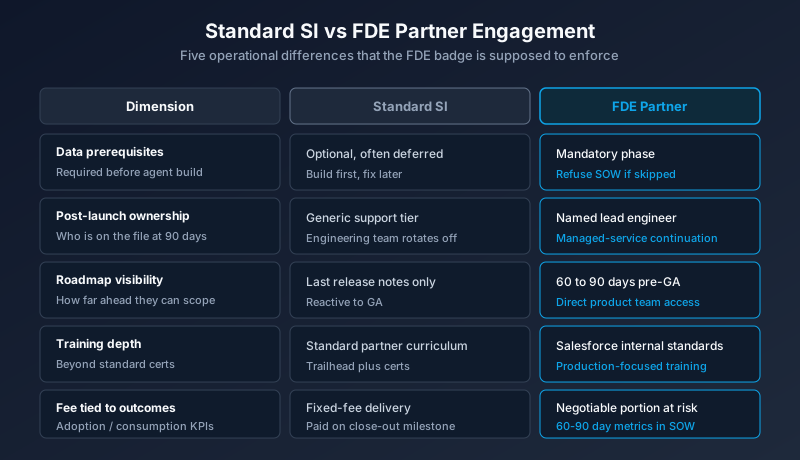
First, the data and integration work happens before the agent work. The Bridgenext framing on this is clean: "Every Agentforce engagement with Bridgenext starts in the same place: getting the data and use cases right before anything gets built, because AI that isn't grounded in clean, connected data and clear growth outcome doesn't transform a business" (Bridgenext). FDE partners are required to do data architecture, permission modeling, and integration scaffolding as a precondition to building agents. The pattern that has burned a lot of early Agentforce pilots, building flashy agent demos on top of inconsistent data, is what FDE designation is supposed to prevent.
Second, post-launch accountability is part of the engagement model. TTEC Digital President Chris Brown described it this way: "Forward Deployed Engineering reflects how we already work with our customers, deeply embedded, accountable, and focused on outcomes" (GlobeNewswire). FDE partners offer managed services after deployment, not just statement-of-work close-out. The engineering team that built the agent stays on the file.
Third, the partners get product-roadmap visibility that non-FDE partners do not. Salesforce describes this as "extending its engineering expertise and product roadmap insights to a select global partner network" (Unix Commerce). In practice that means an FDE partner can scope an Agentforce build against features that are 60 to 90 days from GA, rather than against what shipped last release. For an enterprise buyer planning a 12-month rollout, that lead time is the difference between a build that ages well and a build that needs to be rewritten in the Winter '27 release.
What the analysts are calling out
The HFS Research take is the sharpest. The analyst frames the FDE move as Salesforce becoming "the first enterprise SaaS vendor to institutionalize Forward-Deployed Engineering as a packaged capability through partners." The core problem the analyst points at: 75 percent of enterprises building agentic AI are still stuck in early maturity, and only 7 percent have achieved enterprise-grade deployment tied to KPIs (HFS Research).
The HFS critique is worth quoting directly: "Payment to GSI partners must be tied to sustained production metrics such as consumption thresholds, adoption rates of over 60 to 90 days post launch." And: "Partners resisting this conversation are telling you exactly how committed they intend to be after launch."
That is the buyer-side test. If you are evaluating an FDE partner, the contract terms should include outcome metrics that survive past the launch date. If the partner pushes back on tying any portion of fees to 90-day adoption or consumption thresholds, the FDE badge is decoration and not substance.
The Channel Insider analysis adds the structural point: the FDE network "shifts incentive structures to reward actual agent deployment rather than completion metrics alone, raising accountability standards for production outcomes" (Channel Insider). Whether that incentive shift is real on a given engagement is something the buyer has to verify in the SOW.
What the FDE designation does not change
Three things to be honest about.
It does not change the cost model. FDE partners are still GSIs and specialist firms with full GSI bill rates. Anyone expecting the FDE badge to drop fees should reset that expectation. The argument from Salesforce and the partners is that the total cost of ownership comes down because the build does not have to be redone twelve months in. That argument is plausible. It is not the same as a discount.
It does not eliminate the need for in-house ownership. FDEs embed alongside the customer team. The customer still needs a product owner who can make decisions, a data engineer who knows the source systems, and an admin who owns the org. If the customer side is hollow, no FDE partner can fill that gap. A few of the firms (Bridgenext is explicit about this) will refuse to start a build until the data foundation work is done first. That refusal is a feature, not a bug.
It does not make the Agentforce platform itself any simpler. The roadmap visibility helps, but Data Cloud licensing, the Einstein Trust Layer configuration, agent topic and action design, and the integration with Slack and Tableau Next still take the time they take. FDE partners can ship faster than a generic SI on the same scope. They cannot bend the platform's learning curve.
The buyer checklist
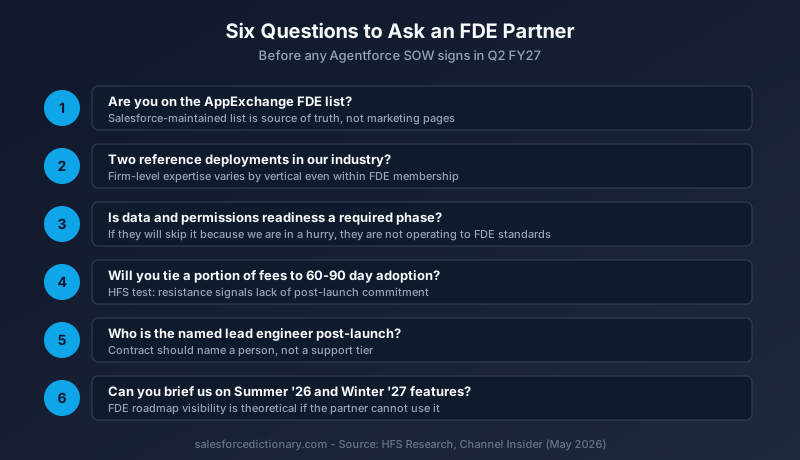
If you are scoping an Agentforce engagement in the next 90 days, work the list:
- Verify the FDE designation on AppExchange (Salesforce FDE Partner Network). Some firms market the badge loosely. The Salesforce-maintained list is the source of truth.
- Ask for two reference deployments in your industry from the same firm. FDE membership is exclusive but firm-level expertise still varies by vertical. A firm that has shipped Agentforce in financial services may not have the field service or healthcare patterns down yet.
- Insist on a data and permissions readiness phase before any agent work. If the partner is willing to skip it because the customer is in a hurry, the partner is not actually operating to FDE standards.
- Tie a meaningful portion of the fee to a 60- to 90-day post-launch adoption metric. The HFS framing is the right one. If the partner will not sign up for that, the badge does not mean what you need it to mean.
- Confirm who owns the engagement post-launch. FDE partners offer managed services. The contract should name the lead engineer who stays on the file, not just a generic support tier.
- Ask about roadmap exposure. An FDE partner should be willing to brief you on what is shipping in Summer '26 and Winter '27 that affects your design choices. If they cannot, the roadmap-visibility benefit is theoretical.
How this fits the broader Salesforce strategy
Three signals from May alone tell the same story. The Agentforce Operations launch in late April pushed agentic automation into back-office processes, with claims of 50 to 70 percent cycle-time reduction and 80 percent reduction in manual data entry (Salesforce Newsroom). The FDE network gives those agents an implementation partner ecosystem with skin in the game. The Air Force MissionForce contract earlier this month (covered in our May 17 piece) showed Salesforce winning on industry-specific implementation depth, not just core platform capability.
All three are consistent. Salesforce is pushing the value proposition for Agentforce away from "buy the platform, hire any SI" and toward "buy the platform, work with a specific accountable partner." That is a defensible strategy in the current environment, where the BofA downgrade (our May 18 coverage) flagged the gap between AI feature shipping and AI revenue realization. Closing that gap is exactly what FDE designation is designed to do. Whether it closes fast enough to move the Q1 FY27 numbers is the question that gets answered on May 27.
What to do this week
If you are running an Agentforce evaluation, pull the AppExchange FDE list and shortlist two or three firms with verifiable industry references in your vertical. If you are already inside an active engagement with a non-FDE firm, the question is honest: does the firm have the engineering depth to deliver production-grade agents, or are you paying for slideware? The FDE-versus-not distinction is a useful diagnostic either way.
The platform is shipping faster than most buyers can absorb. The partner ecosystem just got narrower by design. That narrowing is supposed to be good news. Whether it is depends entirely on what is in the statement of work.
About the Author
Dipojjal Chakrabarti is a B2C Solution Architect with 29 Salesforce certifications and over 13 years in the Salesforce ecosystem. He writes and edits salesforcedictionary.com, published by KineticBit Inc., to help admins, developers, architects, and cert/interview candidates sharpen their fundamentals. More about Dipojjal.
Share this article
Sources
- TTEC Digital Selected for Salesforce Forward Deployed Engineering Partner Network (GlobeNewswire, May 19, 2026)
- Bridgenext Joins Salesforce FDE Partner Network to Scale Agentforce Success (Bridgenext)
- Salesforce Creates FDE Partner Network for Agentforce (Channel Insider)
- Salesforce's FDE Partner Network Puts Agent Accountability on the Clock (HFS Research)
- Salesforce AI Implementation Partners | FDE Partner Network (AppExchange)
Related dictionary terms
Practise it
Five questions on Agentforce Specialist
Exam-style questions with an explanation after each one. No account needed, and your answers build a weak-topic map once you have one.
Comments
No comments yet. Start the conversation.
Sign in to share your take on this article. Your account works across every page.