
Salesforce Pros Are Going Agnostic
Salesforce Ben published its read of the 2025-26 salary survey on Monday. A quarter of respondents are looking at tech roles outside the ecosystem, 11 percent are weighing an exit from technology entirely, and the architects, the one group with rising demand, are the most restless of all.

Twenty-five percent of the people who answered Salesforce Ben's 2025-26 salary survey said they are looking at tech roles outside the Salesforce ecosystem. Another 11 percent said they are considering leaving technology altogether. Salesforce Ben published its read of those numbers on Monday, and it is the most direct answer the ecosystem has to a question people have been asking each other quietly since 2023.
The answer is not a collapse. It is a drift, and the direction it runs in is the part worth your attention.
The Numbers, Read Properly
Start with the caveat, because the headline percentages break if you skip it. The career-intention question allowed multiple selections, so the numbers do not add to 100 and nobody is locked into one column. A respondent can be hunting for a better Salesforce job and keeping a browser tab open on a non-Salesforce role at the same time. Most of them are.
With that established: 76 percent are considering another Salesforce-related role, and 40 percent would take a job at Salesforce itself. That is the loyal core, and it is still the biggest block by a wide margin. Underneath it, 49 percent say they are open to either a Salesforce role or another tech role, 25 percent are actively exploring outside the ecosystem, 11 percent are weighing an exit from tech, 6 percent are heading for retirement or out of full-time work, and 2.5 percent are considering full-time education.
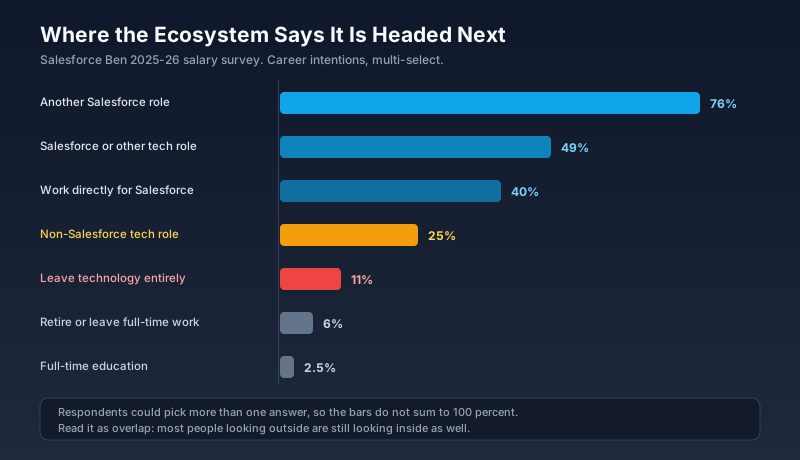
Read that as a funnel rather than a split. Roughly three quarters of the ecosystem still sees its next move inside the ecosystem. About a quarter has stopped assuming that. And a group large enough to matter, one in nine, has stopped assuming the industry itself.
The 11 percent is the number I would put in front of a leadership team. People do not casually consider leaving an industry they spent five years qualifying into. That figure is a measure of how much friction has accumulated, not how many resignations are coming.
Demand Came Back. Supply Came Back Harder.
The intention data makes sense the moment you put the market data beside it.
10K Advisors' ecosystem report tracked global Salesforce talent demand growing 364 percent in 2021. It then fell 46 percent in 2023 and another 37 percent in 2024. In 2025 it turned positive again, at 8 percent. Two years of contraction, then a recovery so small you could miss it in a rounding error.
Supply did not follow the same curve. It grew 28 percent in 2023, 19 percent in 2024, and 27 percent in 2025. Every year that demand fell, the pool of certified people kept expanding, because the certification machine has no brake connected to the hiring market. The result is a saturation ratio of roughly 3.4 to 1: for every unit of demand, there are about three and a half units of qualified supply.
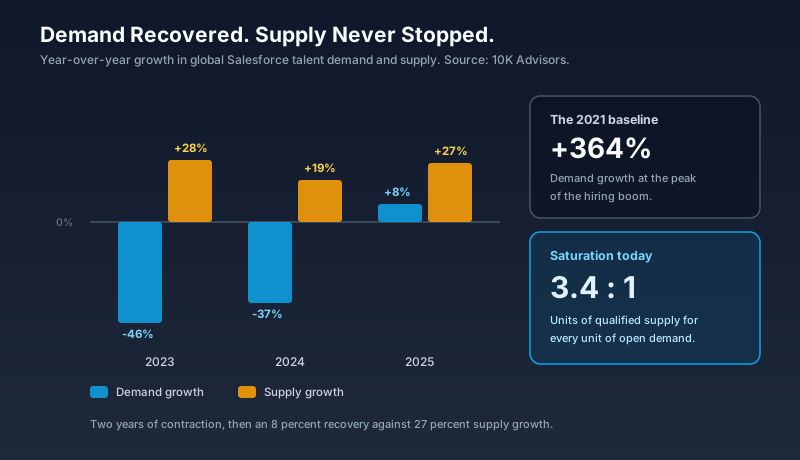
That ratio is the mechanism behind everything else in this story. It sets who gets called back, what a role pays, and how much extra scope a hiring manager can pack into one job description before candidates walk. At 3.4 to 1, the answer to the last one is: quite a lot.
The recovery is real, and it deserves saying plainly. Positive is better than negative, and 2025 was the first year since 2022 that the line pointed up. But an 8 percent demand recovery against 27 percent supply growth does not feel like a recovery to the person sending the applications. It feels like the same market with slightly better news headlines.
The Architects Are the Surprise
Here is the part that should stop you.
Technical architect demand grew 27 percent year over year, and solution architect demand grew 21 percent. Technical architect supply grew 4 percent, and technical architects are about 1 percent of the total talent pool. By every market signal available, this is the best position in the ecosystem to hold.
The architects are the ones looking hardest at the door.
Salesforce Ben's 2026 Architect Survey, drawn from 2,316 responses across 76 countries, found only 31.8 percent want to continue doing what they are doing now. A year earlier that figure was 42.6 percent. Over the same period, the share saying it is important to expand beyond Salesforce for their career went from 17.8 percent to 35.4 percent. It doubled. And they are not talking about it in the abstract: architects report spending 45.1 percent of their working time outside the Salesforce platform already.
Pay satisfaction moved the same way. 65 percent got a raise in the past year and 62 percent were satisfied with career progression, but only 49 percent were satisfied with their actual pay, down 19.3 points from the prior year. Raises went up. Satisfaction with the number went down. That combination usually means the comparison set changed, not the paycheck.
So the scarcest people on the platform, the ones with the strongest negotiating position, are the ones treating Salesforce as one component of a broader technical identity rather than the identity itself. As CRM advisor Gabie Caballero put it in the Salesforce Ben piece, "I don't want to just be Salesforce anymore," and on the market, "you need to be agnostic."
The Admins Are the Warning
The admin data ran earlier in the year and points the same direction with a blunter instrument. 60 percent of admin respondents are considering a move into a non-admin role within two years.
The reasons are unglamorous and specific. 53.1 percent agree too much is expected of them. Asked which responsibilities should move off their plate, they named business analysis at 44.2 percent, project management at 40.4 percent, and user training and documentation at 37.3 percent. Among admins, 50.7 percent reported a pay decrease and only 21.4 percent an increase, against 57.7 percent of all respondents who felt their salary was fair. And 33 percent of admins with 15 or more years of experience said satisfaction fell versus twelve months earlier, which is the group you would expect to be most settled.
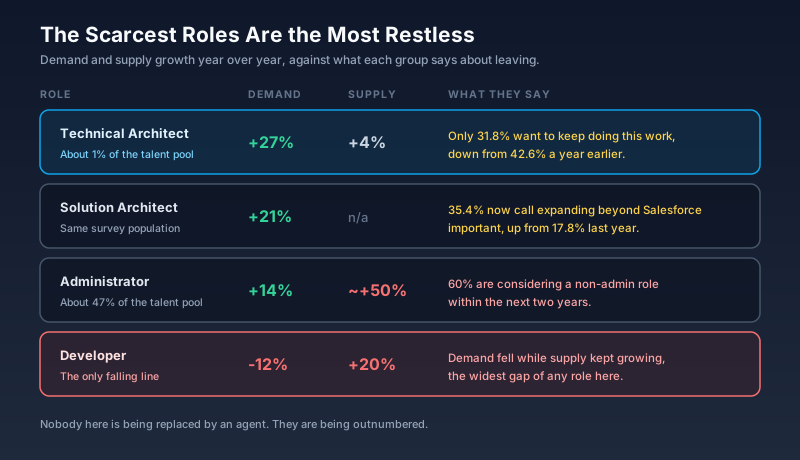
Admin demand did grow 14 percent last year. Admin supply grew close to 50 percent, and admins now account for roughly 47 percent of the entire talent pool while representing 9 percent of job listings. Developers are the one role where demand actually fell, down 12 percent, against 20 percent supply growth.
Nobody in that picture is being replaced by an agent. They are being outnumbered, and then asked to absorb three adjacent job descriptions because the market says they will.
Why It Is Happening Now
Three forces stacked in the same eighteen months, and none of them is AI doing the work.
The first is the arithmetic above. The second is what leaders have been saying out loud. Marc Benioff has described taking customer support headcount from 9,000 to about 5,000 with the line "I need less heads." Whether or not that is a fair account of what agents can do, every practitioner in the ecosystem heard it, and heard it from the vendor whose certifications they hold.
The third is closer to home. Salesforce cut roles across Tableau, Trailhead, community advocacy and events last Thursday, the third restructure of 2026. The programs being trimmed are precisely the ones that convert a stranger into an ecosystem professional. When the company reduces investment in the on-ramp while telling the market that agents reduce headcount, the people already on the road draw a conclusion. Diversifying stops looking like disloyalty and starts looking like ordinary risk management.
None of this is a prediction that the ecosystem shrinks. Demand is positive, architect demand is strongly positive, and 76 percent still want their next role inside it. What is changing is the willingness to be single-platform, and that changes hiring, retention and pay well before it changes headcount.
What This Changes For Your Team
If you employ Salesforce people, the retention risk in your org is not distributed evenly, and the survey tells you exactly where it sits.
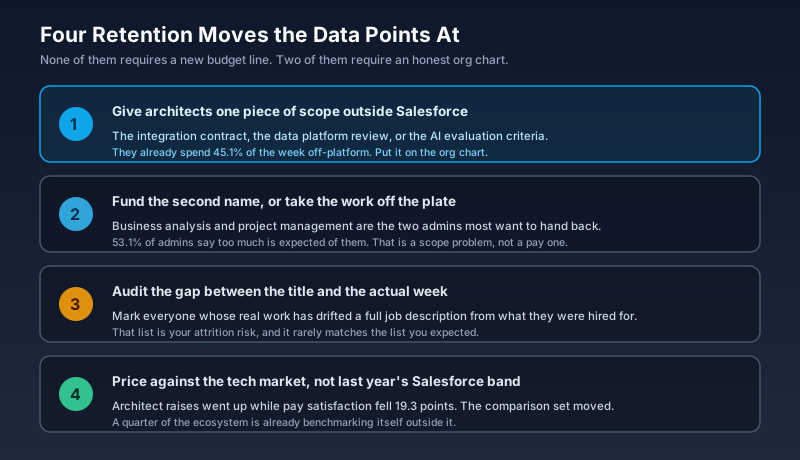
Your most senior architect is statistically the most likely person on your team to want something different next year, and the thing they want is usually breadth rather than money. The cheapest retention move available is to stop treating non-Salesforce work as a distraction. An architect who owns the integration layer, the data platform contract, or the AI evaluation approach is an architect who does not have to leave to get the experience they are already spending 45 percent of their week on.
For admins, the fix is scope, not a title change. Half the dissatisfaction in that data is business analysis and project management arriving without a second name on the org chart. Either fund the second name or take the work off the plate.
If you are the person in the data rather than the person reading it, the practical read is narrower than the headlines suggest. Nothing here says leave. It says the market rewards a second axis, and the architects with the strongest position on the platform are the ones building that axis fastest.
Also This Week
Winter '27 preview orgs went live on Monday, ahead of the August 13 pre-release signup date and the August 19 publication of the full release notes. If you have a preview sandbox from the Winter '27 Flow Builder changes covered on Sunday, the new canvas, the Split elements and the Flow Test Mode beta are all open to poke at now.
The other date on the calendar is August 26. Salesforce reports Q2 FY27 after the close that Wednesday, with the call at 2:00 p.m. Pacific. Given how much of this week's talent story traces back to a headcount narrative, the operating margin line on that call will say more about ecosystem hiring in 2027 than any survey will.
What To Do Next
Open your team roster and mark every person whose actual weekly work has drifted more than one job description away from the title they were hired into. That list is your attrition risk, and it will be shorter than your gut says and different from who you expected. Then take the most senior name on it and give them one piece of scope outside Salesforce before the end of the quarter: the integration contract, the data platform review, the evaluation criteria for whatever AI tooling you are piloting. The survey says they are already doing that work somewhere. The only open question is whether it is on your org chart or somebody else's.
About the Author
Dipojjal Chakrabarti is a B2C Solution Architect with 29 Salesforce certifications and over 13 years in the Salesforce ecosystem. He writes and edits salesforcedictionary.com, published by KineticBit Inc., to help admins, developers, architects, and cert/interview candidates sharpen their fundamentals. More about Dipojjal.
Share this article
Sources
- Are Salesforce Professionals Leaving the Ecosystem? Here's the Data (Salesforce Ben, August 10 2026)
- Is the Salesforce Admin Role Collapsing? 60% Are Planning to Leave (Salesforce Ben)
- The State of the Salesforce Job Market in 2025/26 According to the 10K Report (Salesforce Ben)
- 2025 Salesforce Talent Ecosystem Report (10K Advisors)
- Salesforce Architect Salary Guide 2026 (Salesforce Ben)
- Exclusive: Salesforce Cuts Jobs Across Tableau, Trailhead, Community, and Events (Salesforce Ben)
- Salesforce Winter '27 Treasure Hunt: Preview Orgs Are Live (Salesforce Ben, August 10 2026)
- Salesforce Announces Date of Second Quarter Fiscal 2027 Earnings Release and Webcast (Salesforce Investor Relations)
- Salesforce Administrator Salary Guide 2026 (Salesforce Ben)
Related dictionary terms
Practise it
Five questions on Platform Developer I
Exam-style questions with an explanation after each one. No account needed, and your answers build a weak-topic map once you have one.
More news

Salesforce Cuts Trailhead and Events
Salesforce cut roles across Tableau support, Trailhead, community advocacy and events on August 6. Half the North America Tableau support team was reportedly hit. Tech layoffs passed the full 2025 total with four months left in the year.

Salesforce Architects Are Thriving
Salesforce Ben's 2026 Architect Survey shows only 10.2 percent of architects are dissatisfied and 97 percent now use AI. But ChatGPT and Claude beat Agentforce among Salesforce's own architects, and the talent shortage explains the calm.

Salesforce's AI Jobs Never Arrived
A 2025 study found 72 prompt engineer vacancies across 20,000 LinkedIn listings. Salesforce's operating margin hit 22 percent against a 14.2 percent five-year average. Those two facts are the same story.
Comments
No comments yet. Start the conversation.
Sign in to share your take on this article. Your account works across every page.