
The Salesforce Admin Role in 2026: Satisfaction Is Up, and 60% Are Still Looking for the Exit
A fresh Salesforce Ben survey of 1,100+ admins across 72 countries shows satisfaction rising and technical debt piling up at the same time. What that means for your next two years.

The backlog tab shows 214 open items. Forty of them say "clean up unused fields," filed by you in 2024, never touched since. While you are staring at that number, a recruiter message lands with "Solution Architect" in the subject line. You do not close it right away.
That pause is the story of the Salesforce admin role in 2026.
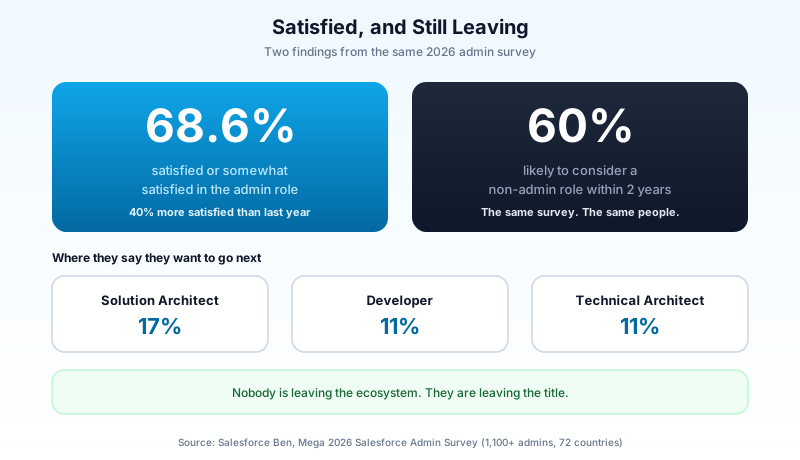
Salesforce Ben ran a large survey this year: more than 1,100 admins across 72 countries. The headline reads like good news. 68.6% say they are satisfied or somewhat satisfied in the role, and roughly 40% say they are more satisfied than they were twelve months ago. Then the same survey says 60% expect to move into a non-admin role within two years.
Both numbers are true at once. People do not usually plan to leave work they enjoy. The reasons they are leaving anyway have very little to do with how they feel about the job and a lot to do with what the job has quietly turned into.
Two numbers that should not sit next to each other
Read the satisfaction number generously, because it deserves it. Admins in 2026 have better tooling than admins in 2020. Declarative automation covers cases that used to require code. Pay has held up: our own 2026 admin salary guide shows the market stabilised after the 2023 correction. The work is respected inside most companies in a way it was not a decade ago.
Now read the exit number literally. 60% say they are likely to consider moving to a non-admin role within two years. The destinations are telling. Solution Architect takes 17%, Developer 11%, Technical Architect 11%. Nobody is fleeing to marketing. They are moving up and sideways inside the same ecosystem.
That distinction matters. This is not disillusionment with Salesforce. It is a verdict on the admin title specifically, and the verdict is that the title has stopped scaling with the responsibility attached to it.
The survey gives you the mechanism in two more numbers. 53.1% feel too much is expected of admins. Nearly 59% agree Salesforce is becoming increasingly difficult to work with. Put those together and you get a role whose surface area keeps expanding while its definition stays frozen in about 2018.
The job description grew and nobody rewrote it
Ten years ago, an admin owned users, page layouts, reports, and a handful of workflow rules. Today the same person is expected to own automation architecture, data quality, release management, security posture, and now AI governance.
None of those were added with a title change. None came with a headcount. 43% of respondents work in admin-only teams with no developer alongside them, and close to 20% are solo admins. In companies with 50 to 199 employees, 70% run admin-only teams. So the expanding job lands on one person who also has to reset a password before the 9 a.m. standup.
I think this is the real finding buried in the survey. The 60% figure is not a burnout statistic. It is a titling problem. When your actual work is solution design and your business card says administrator, the fastest way to get paid and recognised for what you already do is to change the card. The admin to CTA career path that used to take a decade now looks like a two-year plan, because people are already doing the higher-tier work.
Technical debt: the thing nobody schedules
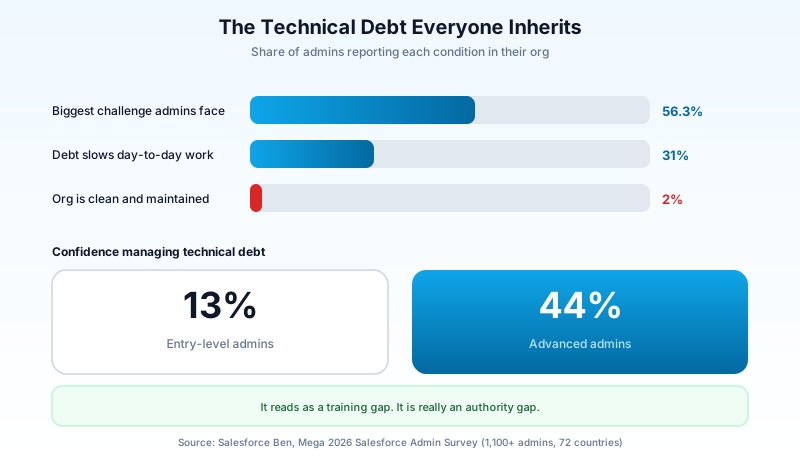
56.3% of admins name technical debt as their single biggest challenge. 31% say it is severe enough to slow day-to-day delivery. And the number that should stop you: only 2% describe their org as clean and well maintained.
Two percent. Out of eleven hundred orgs across seventy-two countries.
Anyone who has inherited a ten-year-old org recognises this. Four automations firing on the same object in an order nobody documented. A validation rule with a hardcoded user ID belonging to someone who left in 2021. Profiles nobody dares touch because the last person who cleaned one up broke an integration. Every one of those is a small unpaid invoice, and interest accrues in the form of longer estimates on every new request.
The part that connects debt to the exit intent is the confidence split. Only 13% of entry-level admins feel confident managing technical debt, against 44% of advanced admins. That gap is not a training gap. It is an authority gap. Paying down debt means telling a stakeholder that this quarter you are going to deliver nothing they can see. Junior admins do not have the standing to say that sentence out loud, so the debt sits, and they eventually conclude the org is broken rather than that the process is.
Debt work also never wins a prioritisation meeting on its own merits. "Retire 40 unused fields" loses to "add a checkbox for the sales VP" every single time, until the day a Flow fails in production and the postmortem points at field 37.
What actually works
Stop pitching cleanup as cleanup. Attach it to delivery. When a request touches an object, budget 20% of that request's estimate to fixing what is already wrong on that object, and put it in the estimate rather than in a separate ticket that will be deferred forever. Nobody approves a debt sprint. Everybody approves a slightly larger estimate.
Second, measure one thing publicly. Count of active automations per object is a good one, because it goes down when you consolidate and it is trivially explainable to a non-technical manager.
The security gap nobody budgeted for
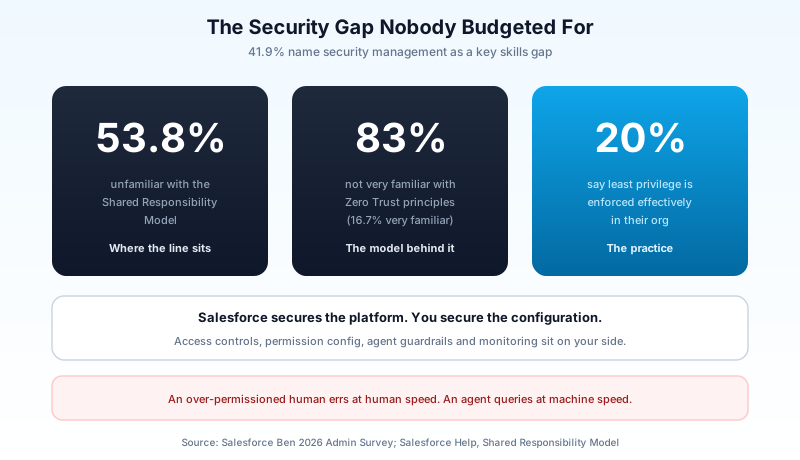
41.9% of admins name security management as a key skills gap. That is not surprising on its own. What follows it is.
53.8% are unfamiliar with Salesforce's Shared Responsibility Model. Roughly 83% are not very familiar with Zero Trust principles, since only 16.7% called themselves very familiar. And only 20% say the Principle of Least Privilege is enforced effectively in their org.
The Shared Responsibility Model is the one to fix first, because misunderstanding it is expensive. Salesforce secures the platform and infrastructure. You secure the configuration on top of it. Salesforce's own documentation is explicit that access controls, permission configuration, agent guardrails, and monitoring sit on the customer side of the line. Half the admin population does not know where that line is drawn, which means half the admin population is assuming somebody else handles things that nobody handles.
Least privilege at 20% is the practical symptom. You already know how it happens. A permission set gets created for one user, gets reused for a team, then gets assigned by default at onboarding because it is the one that makes the errors stop. Three years later it grants Modify All Data to a contractor.
This gap gets more expensive in 2026 specifically, because agents change the blast radius. An over-permissioned human makes mistakes at human speed. An over-permissioned agent queries at machine speed. Salesforce Help frames least privilege as a core control for Agentforce deployments for exactly that reason.
Where to start if security is your gap
Run a permission audit on your top ten most-assigned permission sets and answer one question per set: who needs this and why. Turn on login forensics. If your org handles regulated data and you have budget conversations coming, Salesforce Shield event monitoring is the tool that turns "we think we are fine" into evidence.
Automation confidence is fine. Automation maintenance is not.
56.8% of admins feel confident or very confident in Flow Builder, and only 19.7% report low confidence. That is a healthy number and better than most people would guess.
The confidence splits hard by experience, though: 76% of advanced admins against 20% of entry-level. And the reported challenges are revealing. Debugging comes first at 34%, understanding complex logic at 32%, maintenance at 30%.
Notice what is missing from that list: building. Admins can build flows. What they struggle with is everything that happens after the flow ships, which is precisely the technical debt problem wearing a different hat.
The tooling story reinforces it. 41% still deploy with Change Sets. Only 4.5% use DevOps Center. Change Sets have no version history, no diff, and no rollback. When a flow breaks in production and you cannot see what changed, debugging becomes archaeology. The 34% debugging complaint and the 41% Change Sets number are the same problem measured twice.
AI adoption is running ahead of AI trust
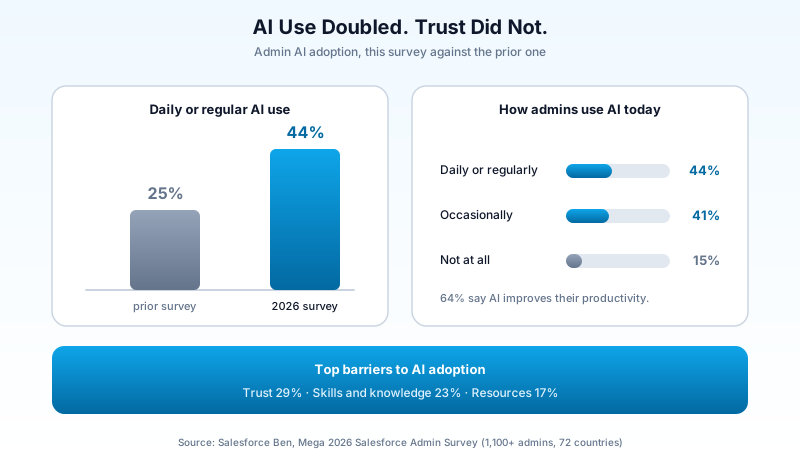
44% of admins now use AI daily or regularly, up from just under 25% in the prior survey. Another 41% use it occasionally. 15% do not use it at all. 64% say it improves their productivity.
That is close to a doubling in a year, which is genuine change rather than survey noise.
The barriers are where it gets interesting. Trust leads at 29%, ahead of skills and knowledge at 23% and resources at 17%. The blocker is not that admins cannot use these tools. It is that they are not sure they should.
That instinct is correct, and it is worth defending. Salesforce's own admin evangelists spent their 2026 roadmap episode arguing that admins should set governance standards proactively rather than after something goes wrong. An admin who hesitates before pointing an agent at customer data is doing the job properly.
Certification uptake tracks the shift. Roughly a third of respondents have completed the Agentforce Specialist certification, and over half see AI credentials as necessary to stay relevant in the market.
Certifications are losing ground to evidence
42.5% of admins hold one to three certifications. 20.3% hold none, and that share is rising year over year.
Meanwhile respondents rated hands-on experience at 9.1 out of 10 for professional value, against 6 out of 10 for certifications. Hiring trends for 2026 point the same direction: entry-level roles are saturated with certified candidates, and the differentiator has moved to demonstrated delivery.
Certifications still open doors. They are a filter for recruiters and a structured way to learn a product you have never touched. Trailhead is still the cheapest way to get from zero to competent on something new. What has changed is that a badge no longer substitutes for a story about a system you built and kept running.
If you are early in the role and wondering what to prioritise, our guide on what a Salesforce administrator actually does is a reasonable map of the fundamentals worth having before you chase credentials.
What to actually do with the next two years
If you are in the 60%, the useful question is not whether to move. It is what to have in hand when you do. Four things, in priority order.
Pick one debt metric and own it publicly. Active automations per object, unused fields retired, or profiles consolidated into permission sets. Report it monthly, unprompted. This is the single most portable thing on this list, because "I reduced automation count on Case from 11 to 3 with no regressions" is an architecture story, and architecture stories are what Solution Architect interviews are made of.
Close the security gap before it closes on you. Read the Shared Responsibility Model this week. Audit your ten most-assigned permission sets this month. Security is named as a gap by 41.9% of the field, which means competence here is a differentiator rather than a baseline.
Get off Change Sets. Move one repeatable deployment to DevOps Center or a Git-based pipeline. You do not need to migrate the whole org. You need one deployment with a diff and a rollback, so you can say you have done it.
Use AI daily, and write down where you stopped trusting it. The 29% trust barrier is a real gap in the market, and the people who can articulate exactly where an agent should not be pointed are the ones who will end up owning AI governance.
Start with the debt metric. Pick your worst object, count the automations on it today, and put that number in a document with this week's date. Everything else on this list gets easier once you have one number you are accountable for.
About the Author
Dipojjal Chakrabarti is a B2C Solution Architect with 29 Salesforce certifications and over 13 years in the Salesforce ecosystem. He writes and edits salesforcedictionary.com, published by KineticBit Inc., to help admins, developers, architects, and cert/interview candidates sharpen their fundamentals. More about Dipojjal.
Share this article
Sources
- The State of the Salesforce Admin Role in 2026 (Salesforce Ben)
- Top 10 Insights from SF Ben's Mega 2026 Salesforce Admin Survey (Salesforce Ben)
- Must Know Salesforce Job Trends for 2026 (Salesforce Ben)
- 2026 Roadmap for Salesforce Admins: AI, Agentforce, and Emerging Trends (Salesforce Admins)
- Agentforce Security and the Shared Responsibility Model (Salesforce Help)
Related dictionary terms
Practise it
Five questions on Administrator
Exam-style questions with an explanation after each one. No account needed, and your answers build a weak-topic map once you have one.
Keep reading

Salesforce Admin Salary Guide 2026: What US Admins Actually Earn by Tier, Cert, and Metro
You are a year into a Salesforce Admin role, the cert wall above you is full of acronyms, and you do not know what your next raise should look like. Here is the 2026 US pay map.

The Salesforce Career Path in 2026: From Admin to CTA (with Salaries & Timelines)
The complete Salesforce career roadmap from Admin to CTA - realistic timelines (5–10 years), 2026 salary bands by region, and the difference between cert collecting and getting promoted.

What Is a Salesforce Administrator (and How to Become One in 2026)
You hear "Salesforce Admin" thrown around in three different rooms and you are not sure what the role actually owns. This is the 2026 primer: day-to-day work, the cert path, and how to break in.
Comments
No comments yet. Start the conversation.
Sign in to join the discussion. Your account works across every page.