
Salesforce Admin Salary Guide 2026: What US Admins Actually Earn by Tier, Cert, and Metro
US salary bands by experience, the certs that move pay the most, metro multipliers, and the Agentforce premium that just landed on the org chart.

Your 18-month review lands on the calendar next Thursday, and you still do not know what number to ask for. Your manager said something vague about "market" last quarter. The job board says $98K. The recruiter who slid into your DMs last month tossed out $115K. The friend who started the same year as you, in the same metro, just got bumped to $120K with one extra cert and a single Agentforce project on their resume.
This is the post that answers the question you were going to spend another six hours on Reddit trying to decode. Real US 2026 numbers, by experience tier, by certification stack, by metro, by industry. And the one detail every other salary post buries: what the Agentforce premium is actually doing to the org chart this year.
The 2026 US baseline
The national median for a Salesforce Admin in the US sits around $92,000 in 2026, per the Salesforce Ben survey of 2,316 respondents across 76 countries. ZipRecruiter pegs the average a notch higher at $98,862. Glassdoor lands at $99,732. PayScale comes in lower at $81,537 because PayScale weights self-reported entry-level data more heavily than the others.
Three averages, three different numbers. The point is not to pick one. The point is to read the percentile spread, because that is where your actual conversation lives.
The 25th percentile is roughly $75,500. The 75th percentile is roughly $119,000. The 90th percentile breaks $140,000. That is the band you are negotiating inside, and where you fall depends on five factors: years of hands-on Salesforce, certification depth, metro, industry, and whether you have shipped anything in the new high-pay areas like Agentforce or Data Cloud.
The averages hide the spread. Use the spread.
What admins actually earn by experience tier
Here is the band breakdown that survives cross-referencing across Salesforce Ben, Mason Frank, and aggregate job-board data for the US market in 2026.
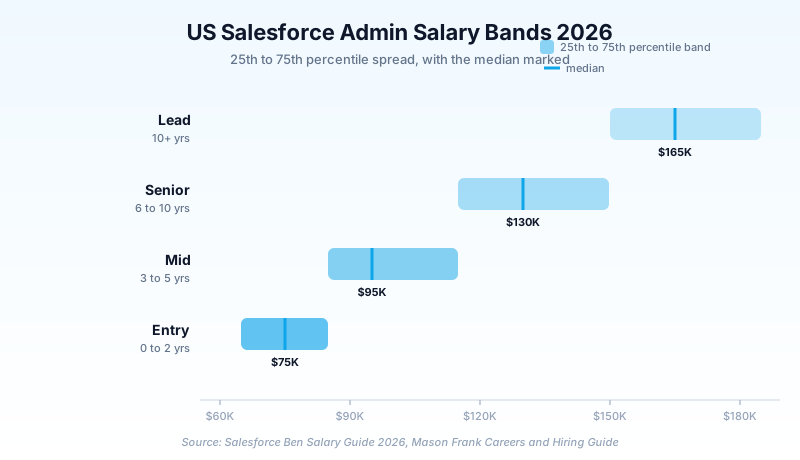
Entry-level admin (0 to 2 years of hands-on Salesforce): $65,000 to $85,000, median around $75,000. You have the Admin cert. You can build a Flow, edit a Profile, troubleshoot a Validation Rule, and run sandbox refreshes. You have not yet led a project from intake to release notes. Half the orgs in this bracket are bootcamp grads getting their first paid Salesforce job. The other half are existing power users who pivoted internally from a Sales Ops or Operations seat.
Mid-level admin (3 to 5 years): $85,000 to $115,000, median around $95,000. You own at least one production org outright. You can read the change history on a Permission Set Group and explain why someone got the wrong access. You have probably finished the Advanced Administrator track or are six months out from it. This is the band most "Senior Salesforce Admin" job titles actually pay, despite the title inflation.
Senior admin (6 to 10 years): $115,000 to $150,000, median around $130,000. You can architect the data model for a new line of business without consulting anyone. You have led a release that touched three sandboxes and one production org. You probably hold three or four certs, including Platform App Builder. You spend at least 30% of your time on things the title "Admin" undersells: integration patterns, AI rollout governance, and Data Cloud ingestion strategy.
Lead admin / admin manager (10+ years): $150,000 to $185,000, median around $165,000. You manage a team of admins, run the steering committee, own the Salesforce roadmap for a business unit, and your job title probably reads "Senior Salesforce Manager" or "Salesforce Platform Lead" rather than "Admin." This is the ceiling for the admin track without crossing into Architect titles, which is where the next $40K of headroom sits.
The Salesforce Ben survey shows the gap between the senior tier ($110,100 median) and the junior tier ($78,000 median) is roughly 41%. That is the prize for going from one cert to four, and from one year of hands-on to six. Every promotion conversation in the middle is about closing that gap in steps.
The certification multiplier (and which certs actually pay)
65% of Salesforce Ben survey respondents believe certifications enhance their salary potential. The 35% who say otherwise are mostly senior people who already cleared the band where certs move the needle. For everyone else, certs are still the cheapest signal you can buy.
Moving up one certification tier correlates with a 6% to 18% salary increase across Salesforce professionals, per the same survey. The two certs that consistently produce the largest pay bumps for admins are Advanced Administrator (ADM 301) and Platform App Builder, each landing roughly a 10% to 15% jump when added to the base Admin cert.
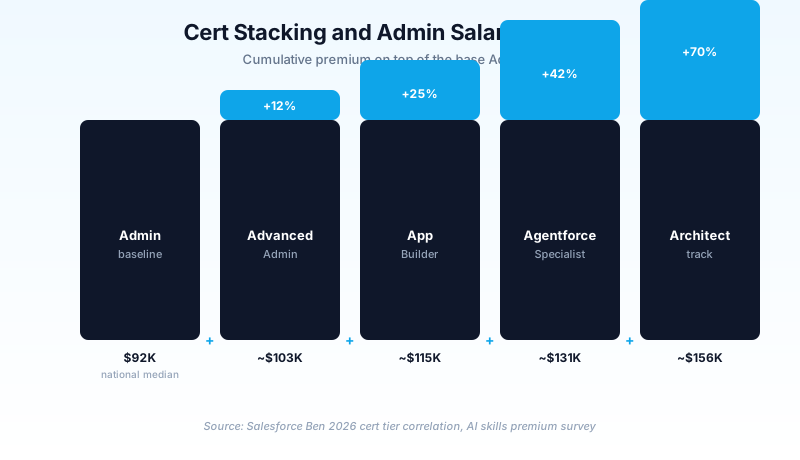
Here is the ladder, with the cert and what it tends to add to your base on top of the prior tier:
- Salesforce Certified Administrator (the foundation cert): required for the floor. No premium on its own beyond getting you past the resume filter.
- Advanced Administrator (ADM 301): +10% to 15% over the floor. This is the most reliable cert pay bump on the admin track.
- Platform App Builder: +10% to 15% on top of Advanced Admin. Signals you can design declarative apps end to end.
- Agentforce Specialist: +15% to 20% in 2026, and rising. This is the new entrant and the one most underpriced today.
- Platform Developer I: +12% to 18% if you are an admin who can also read Apex and write triggers. Increasingly required for the senior tier.
- Architect-track certs (Application Architect, System Architect, B2C Solution Architect): +20% to 30% per major architect cert. This is where the band breaks $150K cleanly.
The math compounds. An admin with the base cert plus Advanced Admin plus App Builder plus Agentforce Specialist is sitting on roughly a 40% to 55% premium over an admin with just the base cert at the same experience level. That is the difference between $75K and $115K at the entry-to-mid transition.
A note on what does not pay much: badge counts. Trailhead Ranger status, Double Star Ranger, the squirrel mascot. None of those move pay. Recruiters look at credentials, not badges. The Trailhead module count is for your own learning velocity, not your raise. If you want the full cert path mapped to your career stage, the 2026 Salesforce certifications roadmap lays out every exam in order.
Where you work changes the number by 25%
The same admin job pays very different numbers in San Francisco versus Atlanta. The cost-of-living adjustment is real, but so is the "tech hub premium" that has nothing to do with rent.
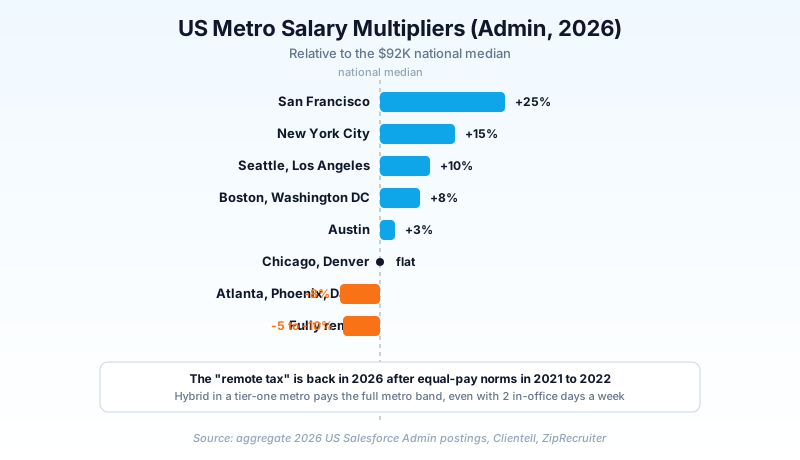
The 2026 metro adjustments vs the national $92K baseline:
- San Francisco Bay Area: $105K to $135K+. Roughly +25%. SaaS-heavy demand, the highest concentration of Salesforce HQ-adjacent jobs.
- New York City: $95K to $125K. Roughly +15%. Financial services and consulting drive the premium.
- Los Angeles and Seattle: $90K to $120K. Roughly +10%.
- Boston and Washington DC: $90K to $118K. Roughly +8%.
- Austin: $85K to $112K. Roughly +3%. The "Texas tech" premium is smaller than people think.
- Chicago, Denver, Minneapolis: $82K to $110K. Roughly flat with the national baseline.
- Atlanta, Phoenix, Dallas: $75K to $102K. Roughly -8%. Lower cost of living, smaller adjusted pay.
- Fully remote (US-only): $80K to $115K, with a 5% to 10% discount vs the metro you actually live in. The "remote tax" is back in 2026 after years of remote-equal pay during 2021 and 2022.
Two things to watch. First, a "remote" job posted by a SF-based company will often pay the local San Francisco band even if you live in Atlanta, but only if you negotiate before signing. After signing, the comp band is set. Second, a "hybrid" role in a tier-one metro pays the full metro band even if you only go in twice a week. The pay attaches to the company location, not your butt-in-seat days.
The Agentforce premium is the 2026 story
Every salary guide before this year ranked AI skills as "trending up." This year is different. AI-related Salesforce roles are commanding a 20% to 40% premium over traditional Salesforce roles, per the Salesforce Ben 2026 skills survey. The premium concentrates in three areas: Agentforce, Data Cloud, and prompt engineering for Einstein features.
For admins specifically, Agentforce skills add roughly $15,000 to $20,000 to baseline admin pay at the mid tier. The premium is smaller at the entry tier because few entry admins have shipped a real agent yet, and larger at the senior tier because Agentforce governance and action design is becoming a core senior-admin responsibility, not an optional skill.
The skills the survey shows admins prioritizing in 2026:
- Generative AI fundamentals: 48.3% of admins flagging it as a focus
- Agentforce builder skills: 27.3%
- Data Cloud / Data 360: 12.4%
The order matters. Admins who only learned how to enable Agentforce in Setup are not getting the premium. The premium goes to admins who can scope an agent, define its actions, write the action metadata, govern who gets access, monitor for hallucinations, and roll back a bad action without breaking the surrounding Flow automations. The skill is the design and governance, not the toggle.
If you are at the entry tier, the cheapest Agentforce upskill is the Agentforce Specialist cert plus shipping one production agent in your org, even a small one. If your company has not started, propose it. If your manager says no, build it in a Sandbox and put the demo on Loom. Then ship it next quarter. Hiring managers who interview you will dig into that build, so polish the story before they ask. The 50 admin interview questions for 2026 covers the Agentforce-specific ones that come up most.
Industry moves your pay band by another 15%
The same admin in the same metro at the same tier earns different numbers depending on the industry. Here is the 2026 spread for mid-tier admins:
- SaaS and tech: $95,000 to $125,000. Highest paying. Cleanest career velocity. Most likely to invest in your Agentforce upskilling.
- Financial services and insurance: $90,000 to $118,000. Heavy compliance overhead, but strong base pay and the best long-term bonus structure.
- Consulting (Big 4 and Salesforce SI partners): $88,000 to $115,000. Lower base than internal roles, but bonus and bench-billable utilization can add 15% to 25% in a good year.
- Healthcare and pharma: $85,000 to $110,000. Slower pace, higher job security, and a long runway in Health Cloud if you specialize.
- Retail and consumer brands: $78,000 to $100,000. Lowest paying industry for admins despite the Commerce Cloud volume, because retail tech budgets get cut first in a downturn.
The industry choice is a four-year decision, not a four-month one. Switching industries every 18 months caps your pay because nobody pays for transferable Salesforce skills the way they pay for vertical-specific Salesforce skills. Pick a vertical by year three, go deep, and let the compounding work.
The 18-month negotiation, scripted
Salesforce Ben's 2026 survey shows 47.2% of admins are satisfied with how raises are handled at their company. 52.8% are not. The dissatisfaction concentrates in two places: people who never asked, and people who asked without data. The script below fixes the second one.
Three weeks before the review:
- Pull your last 12 months of release notes from Git or the change log. Count releases shipped, features delivered, tickets closed, users supported.
- Map your work to one of three buckets: revenue (closed deals you enabled), cost (FTE time you saved), or risk (compliance gaps you closed). Pick two stories per bucket.
- Pull your market band. Use Salesforce Ben, Mason Frank, and the salesforcedictionary.com career path post for the band that matches your current title and metro. Have the URL ready.
The day of the review:
- Lead with the three stories. Two minutes total. Specific numbers, not adjectives.
- State the band you found. Not the average, the 75th percentile of your current tier in your metro.
- Ask the open question: "Given the work above and the band, what range are you targeting for my next comp adjustment?"
- Do not propose a number first. Make them propose. The first-number-loses dynamic applies inside a review too.
If the answer is below the 50th percentile of your band:
- Do not accept on the spot. Say "thanks, I want to think through that against the market."
- Within five business days, send a written follow-up with the specific number you want and the two strongest stories.
- The company knows that roughly 40% of Salesforce comp moves in 2026 come from external offers, not internal raises. If you are within six months of having a marketable resume, you have a strong hand. Play it.
If the answer matches or beats the band:
- Say yes. Get it in writing. Move on.
- Schedule the next conversation for 12 months out with one specific growth milestone (a cert, a project lead, a vertical) you will hit by then.
This is not a clever script. It is the boring script that works because most people skip the prep. Bring data. Ask the open question. Do not panic.
The 5-year compensation curve: job-changes vs internal promos
The fastest path from $75K to $130K is not staying in one role. It is also not changing companies every 12 months. The data shows the optimal cadence is 2 to 3 years per role, with one external move and one internal promo every 4-year cycle.
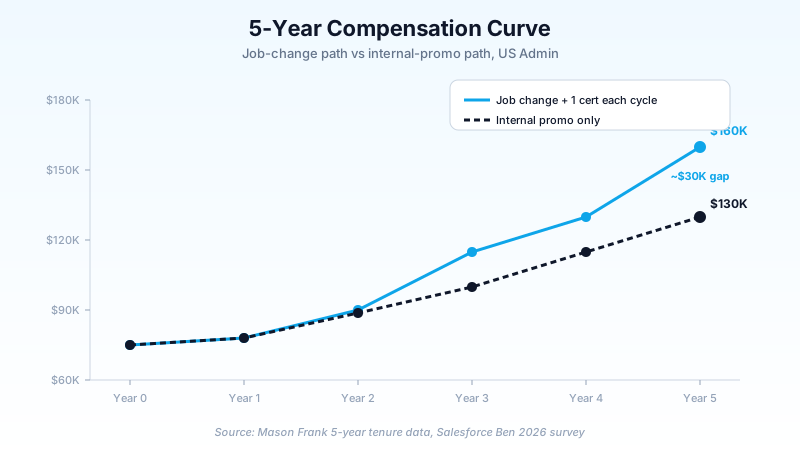
The pattern that produces the best 5-year outcomes:
- Year 0: Land first admin role. $75K baseline.
- Year 2: Internal promotion to mid-admin or "Senior Admin" title. Comp moves from $75K to $90K. About 20% bump.
- Year 3: External move with one new cert (Advanced Admin or App Builder). Comp moves from $90K to $115K. About 28% bump.
- Year 4: Internal promotion again, or add Agentforce Specialist + ship an agent. Comp moves from $115K to $130K. About 13% bump.
- Year 5: Either consultant move or architect-track jump. Comp targets $145K to $160K depending on path.
The "loyalty discount" is real. Mason Frank data shows admins who stay in the same role for 5+ years without a title change earn 22% less than peers who follow the cadence above. The "job hopper penalty" is also real. Three companies in three years caps your salary at around $95K because no employer wants to invest in your training. The sweet spot is the middle.
The 2026 wrinkle: 41.6% of Salesforce professionals who changed jobs in the last 12 months took a pay cut to do it, vs 22.6% who got an increase. The market shifted. If you are mid-cycle and your current pay is at or above the band, do not chase a job change on principle. Wait for the right move. The cadence is a default, not a law.
The 2026 reality check
89.5% of Salesforce professionals say the job market in 2026 feels harder than previous years. 53.4% say there are fewer opportunities than last year. Time-to-hire for admin roles has stretched from 3 months in 2022 to 6 months in 2026.
That is the headline. The detail is more interesting.
Demand has shifted, not collapsed. Per the 10K Advisory 2025 jobs report, demand for technical architects is up 27% globally, demand for solution architects is up 21%, and demand for traditional Salesforce developers is down 12%. The admin role itself is steady on demand, but the bar is higher. Entry-level admin postings now routinely list "Flow design experience" and "exposure to Agentforce" as requirements that did not exist 18 months ago.
The good news for admins who are already employed: the loyalty discount is smaller in a soft market because fewer of your peers are leaving. The internal-promo path is the safer one in 2026. The external-move path still works, but the comp bump on a move has shrunk from a typical 20% to a typical 12% to 15%.
The bad news for admins job-hunting: you need a story. "I am a Salesforce Admin" is no longer enough. The story is "I am a Salesforce Admin who has shipped X agents in Y vertical, governed Z permission sets across W users, and reduced N hours of manual work via Flow automation." Specifics get you past the first screen. Generics get filtered.
What to do this month
Five actions, in order:
- Open Trailhead and check your current cert status. If you are admin-only, schedule Advanced Administrator within 90 days. If you have Advanced Admin, schedule Platform App Builder. If you have both, schedule Agentforce Specialist.
- Pull your last 12 months of work into the three-bucket format (revenue, cost, risk). Pick two stories per bucket. Save them in a document you can refer to from any device.
- Pull your band. Bookmark the Salesforce Ben salary guide, the Mason Frank Careers and Hiring Guide, and your metro's posted admin jobs on LinkedIn. Write down the 25th, 50th, and 75th percentile numbers for your tier.
- Look at your last six months of work. Did you touch Agentforce, Data Cloud, or Einstein prompt features? If no, propose one small Agentforce pilot to your manager. If they say no, build it in a sandbox and demo it next quarter.
- Calendar your next review 12 months out, even if your company does not run formal annual reviews. The 18-month re-baselining is a habit, not a calendar feature.
The 2026 market rewards specific work, specific stories, and specific numbers. The admins who get the raises and the offers in this market are not the smartest admins, they are the ones who can show their work with numbers in 90 seconds. Spend the next four weeks getting your numbers in order. The review takes care of itself.
About the Author
Dipojjal Chakrabarti is a B2C Solution Architect with 29 Salesforce certifications and over 13 years in the Salesforce ecosystem. He writes and edits salesforcedictionary.com, published by KineticBit Inc., to help admins, developers, architects, and cert/interview candidates sharpen their fundamentals. More about Dipojjal.
Share this article
Sources
Related dictionary terms
Practise it
Five questions on Administrator
Exam-style questions with an explanation after each one. No account needed, and your answers build a weak-topic map once you have one.
Keep reading

50 Salesforce Admin Interview Questions & Answers (2026 Edition)
50 real Salesforce admin interview questions across security, automation, data model, reports, and Agentforce - with short answers, longer 'what to actually say' framing, and behavioral patterns.

The Salesforce Career Path in 2026: From Admin to CTA (with Salaries & Timelines)
The complete Salesforce career roadmap from Admin to CTA - realistic timelines (5–10 years), 2026 salary bands by region, and the difference between cert collecting and getting promoted.

Salesforce Certifications Roadmap 2026: All 40+ Exams Mapped (Admin · Developer · Architect · Marketer · Cloud)
The complete 2026 Salesforce certification roadmap - all 40+ exams mapped by role, with study time, prerequisites, exam format, and recommended sequencing for Admin, Developer, Architect, Marketer, and Cloud Specialist tracks.
Comments
No comments yet. Start the conversation.
Sign in to join the discussion. Your account works across every page.