
The Salesforce Career Path in 2026: From Admin to CTA (with Salaries & Timelines)
The full progression - Admin to App Builder to Consultant/Developer to Solution Architect to Domain Architect to CTA - with realistic timelines, 2026 salary bands, and the certs that actually matter.

The Salesforce ecosystem is one of the most career-rewarding in tech. It's also one of the most cert-fixated, which makes it hard to tell genuine progression from credential collecting. This guide is the honest roadmap I wish I had at year one - written first-person from a CTA's perspective, with the moves that actually move careers and the dead-ends that look like progress but aren't.
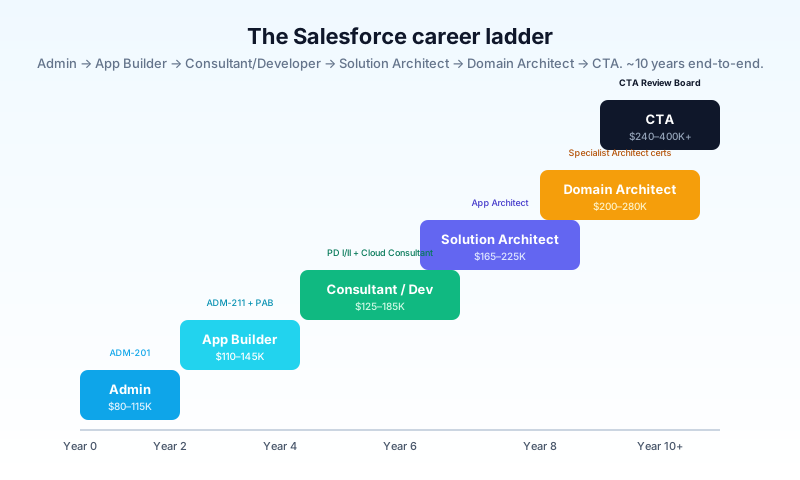
The seven stages
Six rungs plus the alternate path through development. Most people don't go all the way to CTA - and that's fine.
1. Salesforce Administrator (years 0–2)
The entry rung. You configure objects, fields, page layouts, basic Flow, reports, dashboards, profile/[permission set](/terms/permission-set) basics. Day-to-day: ticket queue, user provisioning, small builds.
Key cert: Salesforce Administrator (ADM-201). Salary band (US): $80–115K. Higher in CA/NY/Boston, lower in Tier-2 cities. Move out by: End of year 2. Staying past 30 months risks "career admin" framing.
2. Advanced Admin / App Builder (years 2–4)
You're now leading multi-step automation projects, designing data models, mentoring juniors, and starting to weigh in on architectural decisions. The App Builder cert is the bridge to a builder mindset.
Key certs: Advanced Administrator (ADM-211), Platform App Builder. Salary band (US): $110–145K. The fork in the road: at year 3-ish, decide whether to go consultant (broader, business-facing) or developer (deeper, code-facing). Both lead to architect; neither is "better."
3a. Consultant track (years 3–6)
Customer-facing. You scope projects, lead requirements workshops, build cross-cloud solutions, and start owning client outcomes. Consultants often work at SIs (Slalom, Deloitte, Accenture), boutiques, or freelance.
Key certs: Sales Cloud Consultant, Service Cloud Consultant, Experience Cloud Consultant. Pick by industry alignment. Salary band (US): $125–175K. Skill emphasis: business analysis, stakeholder management, change management, multi-cloud trade-offs.
3b. Developer track (years 3–6)
Code-facing. You build Apex, Lightning Web Components, integrations, complex automation. Developers more often work in-house at customer companies, ISVs, or specialized dev shops.
Key certs: Platform Developer I, Platform Developer II, JavaScript Developer I. Salary band (US): $130–185K. Skill emphasis: TypeScript / JS, OOP, system integration, performance optimization, governor limits.
4. Solution Architect (years 6–9)
You own end-to-end solutions across multiple clouds. You decide build-vs-buy, design integrations, scope packages, and validate the work of consultants/developers under you. Many careers cap here - and pay well.
Key cert: Application Architect (cumulative). Plus the cert most relevant to your domain - B2B Solution Architect, B2C Commerce Architect, Industries Architect. Salary band (US): $165–225K. Skill emphasis: trade-off articulation, ROI framing, multi-cloud reference architectures, Data Cloud + Agentforce competency.
5. Domain Architect / Specialist Architect (years 8–12)
You're a deep expert in one or two domains: integration, data, security, identity, Einstein Trust Layer, Industries Cloud. You're called in for the hardest problems - usually as an internal SME or a senior consultant at a top-tier SI.
Key certs: B2B Solution Architect, Identity & Access Management Architect, Sharing & Visibility Architect, Integration Architect, Data Architect, Development Lifecycle & Deployment Architect. Salary band (US): $200–280K. Skill emphasis: depth over breadth. Authority comes from being the person on a topic.
6. Certified Technical Architect (CTA) (years 10+)
The summit. CTAs are platform-wide architects who can design any Salesforce solution, defend it, and integrate it. The CTA review board is brutal - a 4-hour panel where you whiteboard a complex scenario, defend trade-offs, and survive senior-architect cross-examination.
Key cert: Certified Technical Architect (CTA). Has prerequisites: Application Architect + System Architect + a passed CTA review. Salary band (US): $240–400K+. CTAs at top SIs and Fortune 500s often clear $500K total comp. Skill emphasis: every domain at depth, real-world judgment, communication under pressure.
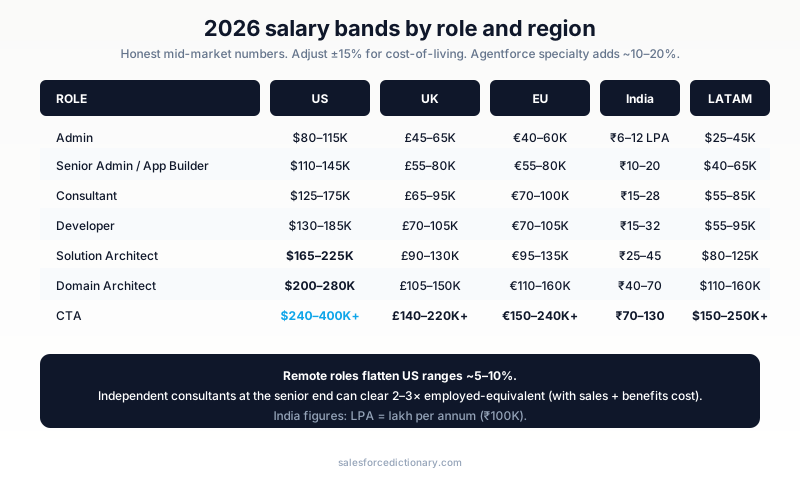
2026 salary ranges by role and region
Numbers below are honest mid-market - not the top-quartile vendor numbers, not the lowball numbers. Adjust ±15% for cost-of-living within each region.
| Role | US | UK | EU | India | LATAM |
|---|---|---|---|---|---|
| Admin | $80–115K | £45–65K | €40–60K | ₹6–12 LPA | $25–45K |
| Senior Admin / App Builder | $110–145K | £55–80K | €55–80K | ₹10–20 LPA | $40–65K |
| Consultant | $125–175K | £65–95K | €70–100K | ₹15–28 LPA | $55–85K |
| Developer | $130–185K | £70–105K | €70–105K | ₹15–32 LPA | $55–95K |
| Solution Architect | $165–225K | £90–130K | €95–135K | ₹25–45 LPA | $80–125K |
| Domain Architect | $200–280K | £105–150K | €110–160K | ₹40–70 LPA | $110–160K |
| CTA | $240–400K+ | £140–220K+ | €150–240K+ | ₹70–130 LPA | $150–250K+ |
Notes:
- Remote jobs have flattened US ranges by about 5–10% over the last two years. Staff still concentrate in major metros.
- Independent consultants can clear 2–3× their employed-equivalent at the senior end, but bear sales + benefits cost.
- Agentforce specialty adds ~10–20% premium in 2026 due to short supply.
Certs that matter vs cert collecting
The hard truth: cert count past ~5 has negative signal. Hiring managers see 30+ certs and read "spent more time studying than building."
Certs that matter for your next role:
- Year 0–2: Admin (mandatory). Platform App Builder once you're confident.
- Year 2–4: Advanced Admin if you're staying admin-track; Platform Developer I if you're moving to dev.
- Year 3–6: One Consultant or Developer cert aligned to your real work.
- Year 4+: Agentforce Specialist - see our study guide. High demand in 2026.
- Year 6–9: Application Architect (a meta-cert - sum of the lower architect-track certs).
- Year 9+: Domain-specific architect certs you're actually using.
Certs that don't matter (yet):
- Anything you'll never use day-to-day. The cert won't keep your skills sharp.
- "Cool sounding" certs in domains you don't work in (Marketing Cloud certs while you're in Sales Cloud).
- More than one cert per release maintenance window. Maintenance load gets brutal.
How to demystify the CTA review board
The CTA review is the single most-feared gate in the ecosystem. It's also the most predictable.
You get a hypothetical scenario - a complex Fortune 500 customer with 8–12 specific requirements. You have 3 hours of prep, then 4 hours of presenting + Q&A with senior architects.
What they're testing:
- Can you elicit the requirements correctly (and challenge ambiguous ones)?
- Can you architect a Salesforce solution that meets them?
- Can you defend your trade-offs under pointed questioning?
- Can you communicate clearly to non-Salesforce stakeholders?
What they're not testing:
- Memorization of release notes
- Trivia about specific limits
- One "correct" answer (there often isn't one)
Prep that works:
- Build 3-5 mock scenarios with a study group. Whiteboard live. Get scored.
- Practice articulating why - not just what. "I'd use Service Cloud + Knowledge because the deflection rate justifies the licensing premium" beats "I'd use Service Cloud."
- Rehearse the timeline. Build a 5-slide deck template you can fill in 30 minutes.
- Review previous-year scenarios published by the community.
Pass rate: ~30–40% on first attempt. Don't be discouraged by a fail; many CTAs needed a second pass.
Common career-path mistakes
- Staying admin too long. If you've been a senior admin for 3+ years and haven't moved to App Builder, Consultant, or Developer, momentum is fading. Force the transition.
- Cert-collecting instead of building. A portfolio of working production builds beats a bookshelf of certs. Always.
- Not learning code. Even consultants benefit from reading Apex. It changes how you scope work.
- Avoiding Agentforce and Data Cloud work. These are the highest-leverage skills in 2026. The senior people you'll be competing with in 2028 are deepening these now.
- Treating salary like the only metric. A $30K bump for a worse manager and bored team is a long-term lose. Optimize for learning velocity in your first 7 years.
- Picking your industry too early. Healthcare, FSI, retail, manufacturing - each has its own quirks. Lock in once you have 5+ years of platform; before that, optionality matters more.
Frequently asked questions
Can I skip certs entirely? For your first job, the Admin cert helps a lot. Past that, certs are signal, not substance. Real builds + a strong portfolio outpace cert count.
Is CTA worth the multi-year grind? For some, yes. The compensation justifies it; the title opens doors. For others, plateauing at Solution Architect with deep domain expertise is equivalent or better.
How does AI / Agentforce change the path? The path is the same. The high-leverage skills shift toward agent design, prompt engineering, Atlas configuration, and Trust Layer understanding. Take the Agentforce Specialist early.
What's the best route from a non-Salesforce background? Trailhead → Admin cert → 6–12 months of paid Salesforce work → second cert → onward. The Trailblazer Community is unusually welcoming to career changers.
Should I freelance or stay employed? Stay employed for years 0–7. The structure, mentorship, and breadth matter more than the ~30% pay bump freelancing can offer earlier. Past year 7, your call.
What to read next
- Trailhead, Superbadge, Agentforce - the dictionary entries.
- Agentforce Specialist Certification Study Guide - the cert with the highest near-term ROI.
- What Is Agentforce 360? - the platform shift that's reshaping which skills get rewarded.
The path is long but well-trodden. Build real things, take 2–3 well-chosen certs per stage, learn from the people one step ahead of you, and the ladder reveals itself.
About the Author
Dipojjal Chakrabarti is a B2C Solution Architect with 29 Salesforce certifications and over 13 years in the Salesforce ecosystem. He writes and edits salesforcedictionary.com, published by KineticBit Inc., to help admins, developers, architects, and cert/interview candidates sharpen their fundamentals. More about Dipojjal.
Share this article
Sources
Related dictionary terms
 Our appAdWake up sharp. Not just awake.The alarm that rings through Silent and DND — free on iOS & Android.Get WakeSharp →
Keep reading

Agentforce Specialist Certification: Complete 2026 Study Guide & Exam Strategy
The Agentforce Specialist exam tests how you build, ground, and operate agents on the Salesforce Platform. Here's the 2026 study plan, the gotchas, and the strategy that gets you to 70%+ on practice tests.

What Is Agentforce 360? The Complete 2026 Guide for Salesforce Admins, Developers & Architects
Agentforce 360 is Salesforce's 2025 rebrand of its agentic-AI platform - built on the Atlas Reasoning Engine, Einstein Trust Layer, and Data 360. Here's the complete admin + dev + architect guide.


Comments
No comments yet. Start the conversation.
Sign in to join the discussion. Your account works across every page.