
Salesforce Paid $3.6B for Fin. Here's What Every Service Cloud Customer Needs to Know.
Fin resolves 76% of support tickets end-to-end without a human. Salesforce bought it to fill the biggest gap in Agentforce. Here's what the deal means for your Service Cloud org, your existing setup, and what comes next.
You are three weeks into rolling out Agentforce for your support team. The sales agents work. The marketing agents work. But the service agent keeps handing tickets back to humans the moment a customer asks anything that requires actually reading two knowledge articles and connecting them. Then your VP forwards you a press release: Salesforce just paid $3.6 billion for a company called Fin, and the headline says it resolves 76% of support tickets with no human involved. Your first reaction is probably the right one. Wait, why didn't Salesforce already have this?
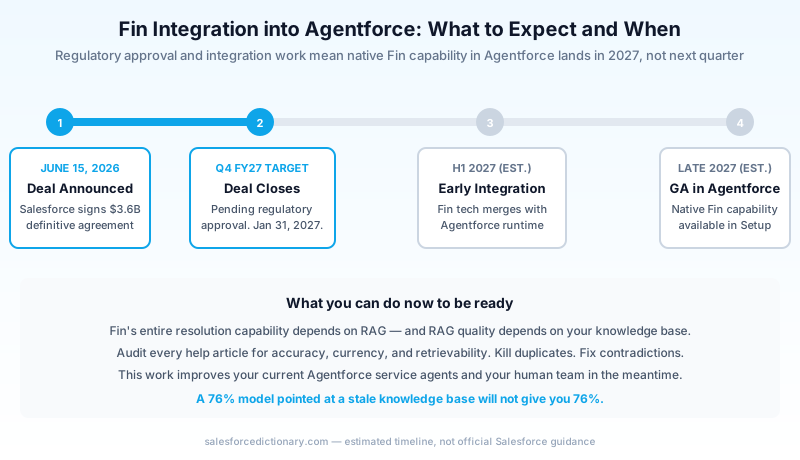
That question is the whole story. On June 15, 2026, Salesforce signed a definitive agreement to acquire Fin for $3.6 billion (Salesforce). The deal is expected to close in Q4 FY27, ending January 31, 2027, pending regulatory approval. Fin's team and technology fold into Agentforce. If you run a Service Cloud org, this acquisition affects you more directly than almost anything else Salesforce announced this year. Let me walk through what Fin actually is, whether that 76% number holds up, and what you should do about it before the deal even closes.
What Fin Actually Is
If the name Fin doesn't ring a bell, the company behind it will. Fin is Intercom. The same Intercom that thousands of SaaS companies used for that little chat bubble in the bottom-right corner of their app since 2011.
Intercom spent its first decade as a customer messaging platform. Live chat, in-app messaging, a help desk, a shared inbox. Useful, popular, and fundamentally a tool for humans talking to humans with some automation bolted on. Then generative AI arrived, and Intercom did something most incumbents are too scared to do. It bet the company.
The pivot was complete. Intercom rebuilt itself around an AI agent named Fin, then rebranded the entire company to match the product. Fin became the flagship and the messaging platform became the delivery layer for it. Today Fin is an AI agent that resolves customer queries end-to-end across chat, email, WhatsApp, SMS, phone, and Slack. Not a chatbot that answers FAQs and escalates everything else. An agent that closes the ticket.
The numbers explain why Salesforce wrote the check. Fin serves more than 30,000 organizational customers worldwide and crossed $400 million in annual recurring revenue (SalesforceBen). That is a real business with a real product that real companies pay for, not an acqui-hire dressed up as a strategy.
The strategic logic also reflects how the company chose to compete. Intercom could have stayed a comfortable messaging vendor and slowly added AI features at the edges, the safe path that most incumbents take and most incumbents regret. Instead it rebuilt the core product around the agent and accepted the risk that its existing customers might not follow. They did follow. That willingness to cannibalize its own model is exactly the kind of thing Salesforce cannot manufacture internally on a quarterly earnings cadence, which is part of why buying it made more sense than building it.
The 76% Number, and Whether to Believe It
Here is the figure doing all the work in every headline: Fin resolves 76% of support volume end-to-end, with no human touch. Some deployments report 85% or higher.
Before you put that on a slide for your leadership team, slow down. That is a vendor-stated average. It is not independently audited. Vendor resolution numbers are notorious for generous definitions of the word "resolved." A conversation where the customer gave up and closed the chat can look identical to a genuine resolution in the wrong dashboard.
That said, the number is worth taking seriously, and here is the context that makes it land. Most traditional chatbot deployments manage 20% to 40% deflection. Deflection and resolution are not the same thing. Deflection means the customer didn't reach a human. Resolution means their problem got solved. A 40% deflection rate often hides a pile of frustrated customers who simply rage-quit the bot.
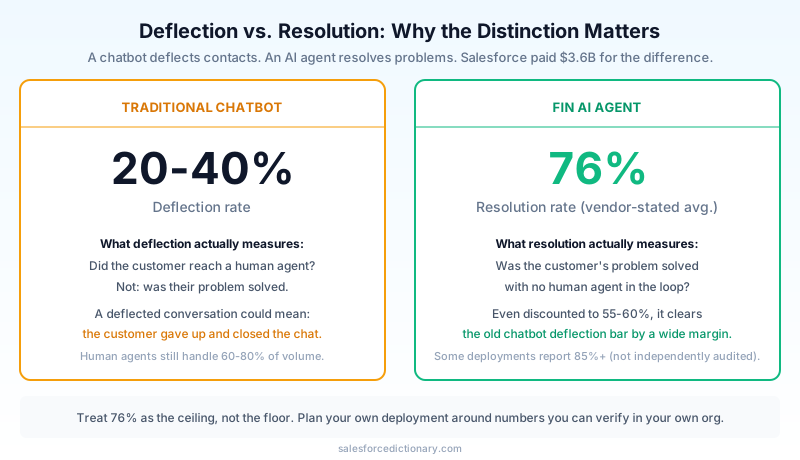
So even if you discount Fin's 76% with a heavy dose of skepticism, even if the real, independently measured number is closer to 55% or 60%, it still clears the old chatbot bar by a wide margin. That gap is what Salesforce paid for. The honest read: treat 76% as the ceiling, not the floor, and plan your own deployment around what you can verify in your own org.
How Fin's Apex AI Model Actually Works
Fin runs on a proprietary model it calls Apex. One naming note up front, because it will confuse every Salesforce developer reading this. Fin's Apex has nothing to do with the Apex programming language you write in Salesforce. Same word, completely different thing. Blame the marketing departments.
Fin's Apex is purpose-built for customer support. It is not a general-purpose large language model that someone pointed at a help center. That distinction matters more than it sounds.
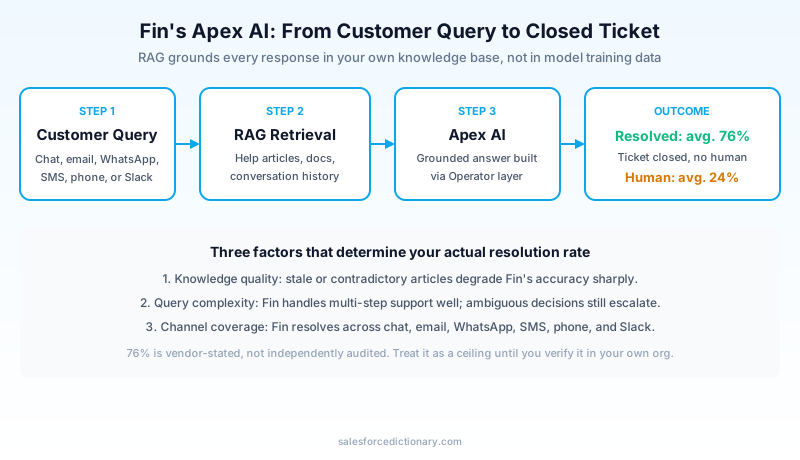
The mechanism is retrieval-augmented generation, or RAG. Instead of answering from whatever the model absorbed during training, Fin grounds every single response in the customer's own material. Help center articles. Uploaded documents. Past conversation history. Connected third-party systems. When a customer asks a question, Fin retrieves the relevant source content first, then generates an answer constrained to that content. If the answer isn't in your knowledge base, Fin is far less likely to make one up.
This is the part that separates a support agent from a clever autocomplete. Fin claims 65% fewer hallucinations than Claude Sonnet 4.6 on support-specific tasks, and a 2.8% higher resolution rate than frontier models from OpenAI and Anthropic on the same kind of work (TechCrunch). Those are narrow, support-shaped benchmarks, not general intelligence tests, and that is exactly the point. A model tuned for one job beats a generalist at that job.
Internally, the orchestration layer that drives full automation is called Operator. It is what lets a company hand over the whole interaction, from the customer's first message to the resolved-and-closed ticket, without a human in the loop. Operator decides when to retrieve, when to act on a connected system, and when, occasionally, to hand off to a person.
The reason this matters to Salesforce is structural. Agentforce for Service has been strong on sales and marketing agents and noticeably weaker on deep customer service resolution. Salesforce's agentic AI delivered 3.8 billion Agentic Work Units in Q1 FY27, and Agentforce ARR hit $1.2 billion, up 205% year over year (CNBC). Impressive growth. But growth concentrated in the areas where Salesforce already had a head start. Service resolution at the Fin level was the gap, and gaps that big rarely get closed by building. They get closed by buying.
What This Means for Your Service Cloud Org
Let me be direct about timeline, because that is what determines what you should do.
The deal closes Q4 FY27 at the earliest, January 31, 2027. Integration into Agentforce happens after that. You will not be flipping on a "Fin" toggle in Setup next quarter. Anyone who tells you otherwise is selling something. Realistically, you are looking at deep, native Fin capabilities inside Agentforce somewhere in calendar 2027, with the messier work of full feature parity stretching beyond that.
So what changes for you in the near term, and what stays the same?
What stays the same: your existing Service Cloud configuration, your case routing, your knowledge base, your Omni-Channel setup. None of that breaks. Salesforce is adding an engine, not ripping out your foundation. If anything, the work you do now on knowledge quality pays off later, because Fin's entire resolution capability depends on the quality of the knowledge it retrieves from.
What changes: the ceiling on what an autonomous service agent can do is about to move up sharply. The service agents you build in Agentforce today will, over the next year, gain meaningfully stronger resolution behavior as Fin's technology lands. Your job between now and then is to get your house in order so you can actually use it.
There is also a pricing signal you should not miss. On June 25, 2026, Salesforce announced that its Help Agent would be available on a pay-per-resolution model: $2 per resolved conversation with no human escalation (CMSWire). Look at how cleanly that pairs with Fin's 76% capability. Salesforce is moving toward charging you for outcomes, not seats, and Fin is the engine that makes outcome-based pricing viable. If you want to understand the economics, read up on how Agentforce pricing and Digital Labor units work, because $2 per resolution is going to reshape how you model support costs.
What This Means for Existing Fin and Intercom Customers
If you are one of the 30,000 organizations already running Fin, your situation is different and your questions are reasonable.
The short version: nothing breaks overnight, and Salesforce has strong incentive to keep your product running. $400 million in ARR is not something you acquire and then immediately disrupt. The Fin product continues. Your contracts continue. The team and technology integrate into Agentforce, which over time means tighter connection to the Salesforce platform, not a forced migration off the tool you already use.
The realistic path: expect Fin to gain Salesforce-native integration points first, then gradually become the customer service layer of Agentforce. If you are a Fin customer who also runs Salesforce, you are in the best position of anyone, because the two halves of your stack are about to become one. If you are a Fin customer with no Salesforce footprint, watch for the inevitable nudge toward the broader platform. There is no urgency to act today, but there is reason to pay attention to renewal terms over the next year.
The Bigger Picture: Salesforce Is Assembling a Stack
Step back from Service Cloud for a second, because Fin is one piece of a deliberate pattern.
Salesforce has spent the last few years buying or building the components of a complete agentic AI enterprise stack. Informatica for trusted, governed data. Contentful for structured content that agents can read and assemble. MuleSoft for workflow and integration orchestration. Slack for the human collaboration surface. And now Fin for autonomous customer interaction.
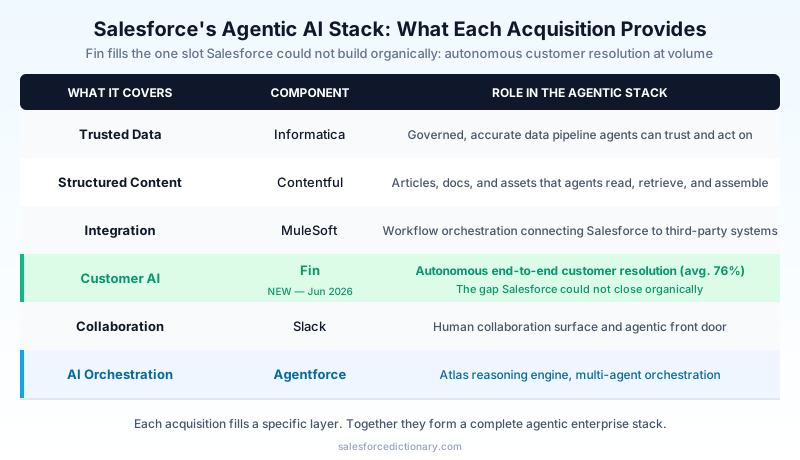
Read those names as a sentence and the strategy is obvious. Trusted data feeds structured content, orchestration connects the systems, agents act, and humans collaborate where they need to. Fin fills the one slot Salesforce couldn't fill organically: an autonomous engine that actually resolves customer problems at volume. The 30,000-customer base is a bonus on top, because it widens Agentforce's addressable market overnight.
This also explains the timing alongside the Summer '26 release, which brought multi-agent orchestration to general availability on June 15, 2026, the very same day as the Fin announcement. Multi-agent orchestration lets specialized agents hand work to each other. Fin gives Salesforce a best-in-class service specialist to plug into that orchestration. A sales agent qualifies a lead, a service agent resolves the post-purchase issue, and they coordinate. That is the architecture Salesforce is building toward, and Fin was the missing specialist.
I'll offer one genuine take here. This acquisition is the clearest admission yet that Salesforce sees autonomous resolution, not assisted resolution, as the actual product. For years the polite framing was that AI would "augment" your agents. Paying $3.6 billion for a company whose entire pitch is closing tickets without a human is a different message. The augmentation era is ending. Plan accordingly.
A Few Things Worth Knowing About the Transition
A handful of practical realities will shape how this plays out, and they are easy to overlook in the noise.
First, regulatory approval is a real gate, not a formality. A $3.6 billion acquisition by a company Salesforce's size draws scrutiny. The Q4 FY27 close date assumes a clean review. Build a little slack into your own planning.
Second, integration is hard, and Salesforce has a mixed record. Slack went relatively smoothly. Other acquisitions took years to feel native. Fin's Apex model and Operator orchestration are sophisticated, opinionated systems. Welding them onto the Atlas reasoning engine and the existing Agentforce runtime is nontrivial engineering. Expect the first integrated release to be capable but incomplete.
Third, your knowledge base is the variable you control. Every claim about Fin's resolution rate depends on retrieval quality, and retrieval quality depends on whether your help articles are accurate, current, and well-structured. A 76% resolution model pointed at a stale, contradictory knowledge base will not give you 76%. It will give you fast, confident wrong answers.
What to Do Now
You have roughly a year before this lands natively. Use it. Here is the concrete next step.
Audit your knowledge base this quarter. Pull every help article your support team relies on and check three things: is it accurate, is it current, and is it written so a retrieval system can find it. Kill the duplicates. Fix the contradictions. Tag and structure the content so an agent can match a customer question to the right source. This single piece of work determines whether the Fin capability lands as a step change or a disappointment when it arrives, and it improves your existing Agentforce service agents and your human team in the meantime. Do that first, before you touch a single new feature. Everything else Salesforce ships will only be as good as the knowledge you feed it.
About the Author
Dipojjal Chakrabarti is a B2C Solution Architect with 29 Salesforce certifications and over 13 years in the Salesforce ecosystem. He writes and edits salesforcedictionary.com, published by KineticBit Inc., to help admins, developers, architects, and cert/interview candidates sharpen their fundamentals. More about Dipojjal.
Share this article
Sources
- Salesforce Signs Definitive Agreement to Acquire Fin
- Salesforce acquires AI customer service platform Fin for $3.6B
- Salesforce to buy AI customer service platform Fin for $3.6 billion
- Salesforce to Acquire Fin for $3.6 Billion, Adding AI Customer Service Agent to Agentforce Portfolio
- Salesforce Acquires Fin, Adding 30K AI Customers
Related dictionary terms
Practise it
Five questions on Agentforce Specialist
Exam-style questions with an explanation after each one. No account needed, and your answers build a weak-topic map once you have one.
Keep reading
What Is Agentforce 360? The Complete 2026 Guide for Salesforce Admins, Developers & Architects
Agentforce 360 is Salesforce's 2025 rebrand of its agentic-AI platform - built on the Atlas Reasoning Engine, Einstein Trust Layer, and Data 360. Here's the complete admin + dev + architect guide.
Salesforce Slack AI: The Complete 2026 Guide
You return from a week off, your Slack has 4,300 unread messages across 27 channels, and a customer call in 30 minutes. This is what Slack AI was built for: how it works, how Agentforce plugs in, and where it still gets things wrong.
Salesforce Multi-Agent Orchestration: The Complete 2026 Guide
In 2026, orgs run an average of 12 AI agents - half in isolated silos. Learn the primary-and-specialist architecture, Agent Fabric, and the A2A protocol that turn agent sprawl into coordinated enterprise AI.
Salesforce + Contentful: What Architects Need to Know in 2026
Salesforce is buying Contentful to add a governed, headless content layer to Headless 360 and Agentforce. Here is what architects should design for before the deal closes in Q3.
Agentforce Digital Labor Units Explained: What You're Actually Buying in 2026
Agentforce switched from per-conversation pricing to Digital Labor Units. Here is how DLU consumption works, what counts as a billable interaction, and how to estimate costs before you commit.
Agentforce Service: The Complete 2026 Guide (Formerly Service Cloud)
Service Cloud is now Agentforce Service. This 2026 guide cuts through the rebrand: the Service Agent, IT Service, Agentic Milestones, knowledge grounding, and the real deflection numbers.
Comments
No comments yet. Start the conversation.
Sign in to join the discussion. Your account works across every page.