
Agentforce Digital Labor Units Explained: What You're Actually Buying in 2026
DLU consumption model, pricing tiers, cost estimation, and how to avoid a bill that surprises your CFO.

Your customer success manager is three slides into the Agentforce demo when the executive sponsor leans in. "How much will this cost per month for our service team?" The room goes quiet. Nobody has the number.
That silence is the whole problem with Agentforce pricing in 2026. The demo sells itself. The bill is where people get caught off guard, because the unit you are buying is not the one most teams assume.
What Agentforce Actually Sells Now
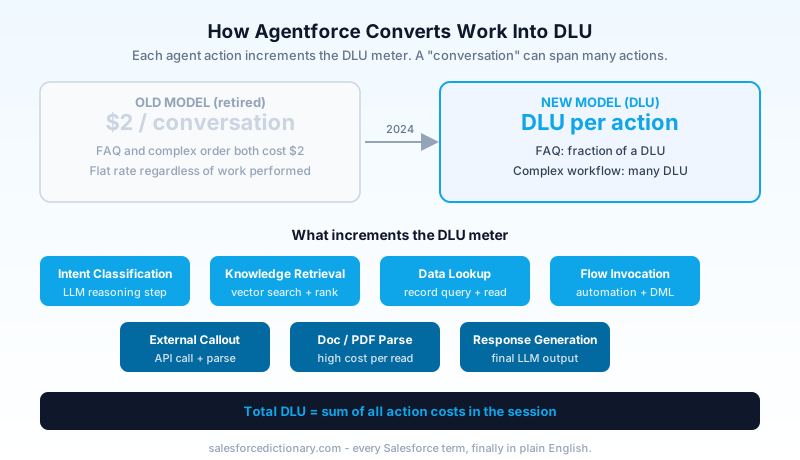
For a while, the pitch was simple. Two dollars per conversation. Easy to model, easy to forecast, easy to put in a slide. Then Salesforce moved to a consumption model built on Digital Labor Units, or DLUs.
A DLU is a unit of AI work. Think of it as a meter on the agent's labor rather than a flat fee on the door it walks through. One customer interaction might burn a fraction of a DLU. Another might burn ten. The meter does not care how many "conversations" happened. It cares how much the agent actually did.
Why abandon the clean $2 model? Because it priced a one-line FAQ answer and a fifteen-step order-modification workflow exactly the same. That math only works if every interaction has roughly equal cost. Agentforce interactions do not. A password reset and a multi-system refund are not the same amount of work, and Salesforce was eating the difference. The DLU model pushes that variance back into the price, which is fairer in theory and far less predictable in practice.
The Salesforce Agentforce pricing page frames DLUs as flexible. That is accurate. Flexible also means you have to do real estimation work instead of multiplying conversations by two.
What Counts as a DLU
Here is the part that trips up nearly every first-time buyer. A "conversation" is not atomic. It is a container, and the container can hold a lot.
When a user asks an agent a question, the agent does not just generate one reply. It reasons about intent. It may call a retrieval step to pull knowledge articles. It may invoke a Flow. It may run a data lookup against your records, call an external API, then reason again over what came back. Each of those steps is work, and work consumes DLU.
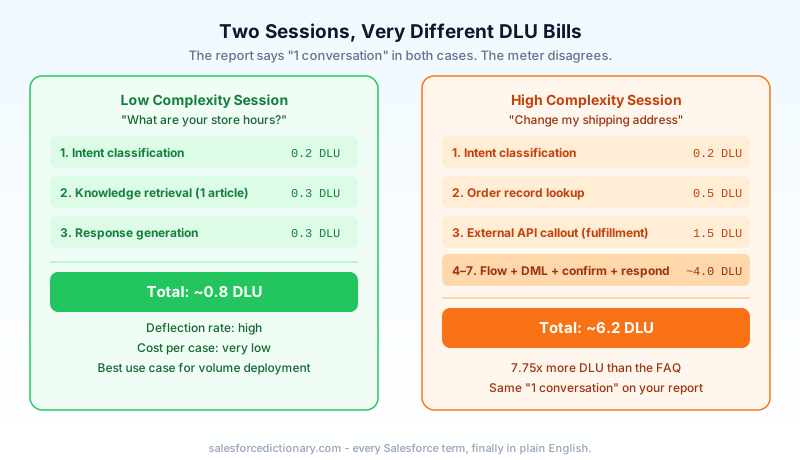
So a single conversation can quietly rack up consumption across many tool calls. Picture two interactions that both look like "one conversation" on a report.
The first: a customer asks for store hours. The agent classifies the intent, pulls one short answer, replies. Low complexity, minimal DLU.
The second: a customer wants to change a shipping address on an in-flight order. The agent retrieves the order, checks fulfillment status through an API callout, runs a Flow to update the record, confirms inventory routing, then summarizes. Same "one conversation" label. Many times the DLU cost.
The Salesforce Help documentation on Agentforce and Digital Labor breaks down how actions map to consumption. The takeaway is blunt. Retrieval consumes DLU. Data lookups consume DLU. Flow invocations consume DLU. The more capable you make your agent, the more each session can cost. Capability and consumption move together.
The Three Licensing Tiers
Agentforce licensing falls into three broad shapes. The exact numbers come from your account executive, but the structure is public enough to plan around.
Starter
A baseline allocation ships inside your existing Salesforce licenses. This is enough to run a pilot, demo internally, and prove the concept on a narrow use case. It is not enough to run a production service queue at volume. Treat the included allocation as a sandbox budget, not an operating budget.
Standard DLU Pack
You buy DLUs in committed packs. This is where most production deployments live. You commit to a monthly or annual DLU volume, and you pay overage rates when you exceed it. The committed rate is cheaper per DLU than overage, which means under-forecasting hurts you twice. You miss the volume discount and you pay the penalty rate on top.
Custom and Enterprise
High-volume orgs negotiate custom DLU pricing, often bundled with Data Cloud consumption and platform commitments. If you are running agents across service, sales, and commerce at scale, this is the tier where the per-unit rate actually becomes negotiable.
One contract detail worth chasing before you sign. Einstein features such as Copilot inside Sales Cloud may draw from the same DLU pool as your Agentforce agents, or they may carry a separate allocation. It depends entirely on how your contract is written. If they share a pool, a chatty sales team can drain the budget your service agents were counting on. Ask your AE to put the pool structure in writing.
How to Estimate Your DLU Consumption
Let us run real numbers. Take a service org with 10,000 cases per month. Say your Agentforce agent deflects 60 percent of them, so 6,000 cases are handled fully or partly by the agent.
Now you need an average DLU cost per deflected case. This is the variable everyone wants to skip and nobody should. It depends on three things.
Tool calls per session. A simple deflection might involve two or three agent actions. A complex one involves eight or more. Estimate a blended average across your case mix.
Retrieval steps. Every trip to a knowledge base or Data Cloud retrieval adds cost. Count how many your typical resolution needs.
Escalation rate. When an agent escalates to a human, you often pay for the agent's work up to that point and gain nothing in deflection. High escalation is the worst of both worlds.
A rough working model. If your blended average is, say, 3 DLU per deflected case, then 6,000 cases consume around 18,000 DLU per month. If your case mix skews complex and the blended average is 6 DLU, the same deflection volume costs 36,000 DLU. The deflection rate did not change. The bill doubled. That sensitivity is the entire reason executives get surprised.
Do this estimate before you commit to a pack size, not after the first invoice lands.
What Burns Through DLU Faster Than You Expect
Some patterns inflate consumption quietly. They rarely show up in the demo because demos use clean, small data sets. Production does not.
Retrievals from large knowledge bases. A retrieval over 50 curated articles is cheap. A retrieval over 50,000 uncurated ones means more reasoning, more candidate handling, and more cost per call. Big knowledge bases are not free to search.
Multi-hop reasoning. When an agent has to chain several reasoning steps to reach an answer, each hop is its own slice of work. Vague Topics that force the agent to figure out what to do are expensive by design.
Flows with multiple DML operations. A Flow that updates one record is light. A Flow that loops through records, performs several updates, and triggers downstream automation pulls more weight, and the orchestration around it adds DLU.
Document parsing. PDF and document parsing is heavy. If your agent reads attachments, contracts, or scanned forms, expect each of those interactions to cost noticeably more than a text lookup.
External API callouts. Every callout to an outside system means the agent reasons before the call, waits, then reasons over the response. Two reasoning passes per callout, sometimes more. Agents that orchestrate across many systems consume accordingly.
None of these are bugs. They are the cost of capability. The mistake is not knowing which of your use cases trigger them.
How to Monitor and Optimize
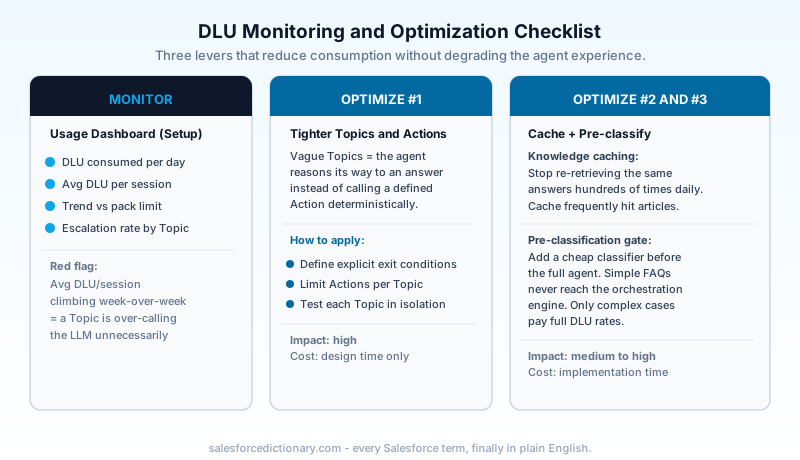
Agentforce Setup includes a Usage Dashboard. Make it the first thing your admin opens every Monday. Watch DLU consumed per day, average DLU per session, and the consumption trend against your committed pack. A creeping average DLU per session usually means a Topic is over-escalating to the model when it should be resolving cheaply.
Three concrete moves cut consumption without hurting the experience.
Write tighter Topics and Actions. Vague instructions push the agent to lean on the LLM for decisions a well-scoped Action could make deterministically. Specific Topics with clear boundaries keep the agent from improvising expensive reasoning loops. This is the highest-return optimization, and it costs only design time. The Agentforce Basics module on Trailhead is the right place to ground your team on Topic and Action design.
Cache retrieved knowledge. If the agent fetches the same answer hundreds of times a day, repeated retrieval is wasted spend. Caching common results means the agent stops paying to re-discover what it already knows.
Add a cheap classification step before the full agent. Not every inbound message needs the orchestration engine. A lightweight classification step can resolve simple FAQs directly and route only the genuinely complex cases into the full agent. You stop paying premium DLU for "what are your hours."
The ROI Math
Strip away the complexity and the business case is one comparison. DLU cost per deflected case versus human agent cost per case.
A human-handled service case carries a loaded cost. Salary, benefits, tooling, management overhead, often somewhere between several dollars and well over ten depending on your region and complexity. If your DLU cost per deflected case lands well under that human cost, every deflection is margin you keep.
The IDC research on AI agent ROI points to meaningful returns when agents are aimed at high-volume, repeatable work rather than edge cases. That qualifier matters. The ROI lives in the boring, repetitive queue, not the gnarly exceptions a human would handle better anyway.
The number to compute is your break-even deflection rate. Take your committed DLU spend, divide by the human cost per case you avoid, and you get the number of cases you must successfully deflect to break even. If that break-even sits comfortably below your realistic deflection rate, the program pays for itself. If it sits above, you are buying convenience, not savings, and you should know that going in.
Run this calculation with your actual loaded cost per case, not a vendor benchmark. Your finance team will trust your own numbers and poke holes in everyone else's.
What to Do This Week
Three steps, in order.
First, audit your current Salesforce contract for any included DLU allocation. You may already be paying for capacity you have not switched on. Find out what you own before you buy more.
Second, open Agentforce Setup and run the consumption estimator against one real queue. Use actual case volumes, not round numbers. The estimate is only as honest as the inputs.
Third, scope a low-risk pilot on your highest-volume, lowest-complexity case queue. That is where DLU cost per case is lowest and deflection rate is highest, which means the cleanest possible ROI signal. Prove it there, measure the real consumption, then expand into the harder queues with numbers you can defend.
Get those three done and the next time an executive asks what it costs per month, you will have an answer instead of a silence.
About the Author
Dipojjal Chakrabarti is a B2C Solution Architect with 29 Salesforce certifications and over 13 years in the Salesforce ecosystem. He writes and edits salesforcedictionary.com, published by KineticBit Inc., to help admins, developers, architects, and cert/interview candidates sharpen their fundamentals. More about Dipojjal.
Share this article
Sources
Related dictionary terms
Practise it
Five questions on Agentforce Specialist
Exam-style questions with an explanation after each one. No account needed, and your answers build a weak-topic map once you have one.
Keep reading

Agentforce Service: The Complete 2026 Guide (Formerly Service Cloud)
Service Cloud is now Agentforce Service. This 2026 guide cuts through the rebrand: the Service Agent, IT Service, Agentic Milestones, knowledge grounding, and the real deflection numbers.

Salesforce Einstein Trust Layer: The Complete 2026 Guide to Secure AI
Your security team asks where the customer data goes when Agentforce processes it. Here is the full answer: how the Einstein Trust Layer's prompt journey, data masking, zero-data retention, and toxicity detection actually work.

What Is Agentforce 360? The Complete 2026 Guide for Salesforce Admins, Developers & Architects
Agentforce 360 is Salesforce's 2025 rebrand of its agentic-AI platform - built on the Atlas Reasoning Engine, Einstein Trust Layer, and Data 360. Here's the complete admin + dev + architect guide.
Comments
No comments yet. Start the conversation.
Sign in to join the discussion. Your account works across every page.