
Salesforce Multi-Agent Orchestration: The Complete 2026 Guide
How Agentforce's primary-and-specialist pattern, Agent Fabric, and the A2A protocol let teams of AI agents collaborate at enterprise scale - without the complexity landing on the user.
The era of the lone AI assistant is ending. In 2026, Salesforce customers aren''t asking "how do I build an agent?" - they''re asking "how do I get my twelve agents to work together?" According to the Salesforce Connectivity Report 2026, organizations now deploy an average of 12 AI agents, and that number is projected to grow 67% within two years. The catch: half of those agents currently operate in isolated silos, and 86% of IT leaders fear that without proper orchestration, agents will create more complexity than they solve.
That tension - between the explosive growth of agent deployments and the very real risk of an "agent sprawl" crisis - is exactly what Agentforce Multi-Agent Orchestration is built to solve. Multi-agent orchestration is the architectural pattern, the runtime infrastructure, and the open protocol layer that allows specialized AI agents to collaborate as a coordinated team, both inside the Salesforce platform and across third-party ecosystems like Microsoft, Google, AWS, ServiceNow, and SAP.
This guide is for the Salesforce admins, architects, and developers who are moving past their first proof-of-concept agent and need to understand how to design systems where many agents work together reliably, securely, and at scale. We''ll walk through the architecture, the new Agent Fabric control plane, the Agent2Agent (A2A) protocol, and a practical build path you can apply to your own org.
Why Single-Agent Architectures Hit a Wall
The first wave of Agentforce deployments looked a lot like chatbots with better memory. One agent, one topic library, one set of actions, one persona. That model works beautifully for a focused use case - a service deflection agent, a sales SDR agent, an internal HR helper. But the moment you try to extend a single agent across business domains, three problems appear quickly.
First, instruction overload. A monolithic agent that handles sales pipeline questions, billing disputes, contract renewals, and product configuration ends up with hundreds of topics and thousands of instructions. The underlying LLM has to weigh all of them on every turn, which degrades routing accuracy and inflates latency. Anyone who has watched an agent confidently pick the wrong topic on a simple question has felt this firsthand.
Second, ownership and governance ambiguity. When one agent owns everything, no single team really owns it. Sales ops wants to ship a new pricing topic on Monday, customer service wants to lock the agent down for compliance review on Tuesday, and finance wants its own data exposed but only to certain personas. A single agent becomes a political bottleneck.
Third, data grounding limits. Specialist domains need specialist grounding. A finance agent should be grounded on revenue recognition policy and Data Cloud financial objects. A field service agent should be grounded on work orders, parts, and asset history. Cramming all of that into one knowledge layer dilutes retrieval quality.
Multi-agent orchestration solves these problems by treating agents the way modern software treats microservices: small, focused, independently owned, and composed at runtime by an intelligent router.
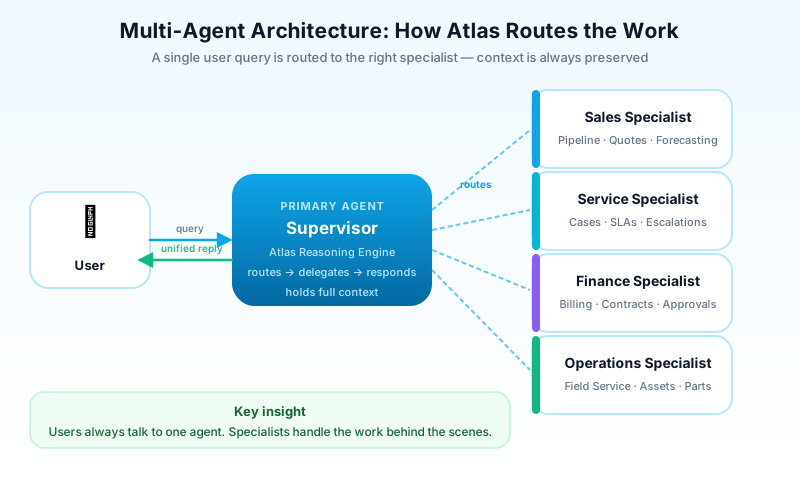
The Core Architecture: Primary, Specialists, and Atlas
The Agentforce Architecture Guide describes a deceptively simple pattern that powers nearly every production multi-agent deployment on the platform. It has three components.
The Primary (Supervisor) Agent
The primary agent is the single contact point for the end user or end system. Whether the entry point is a Slack thread, a Service Cloud chat window, a voice channel, or an API call from a custom app, the primary agent is what answers. It does not necessarily do the work itself. Its job is to understand the user''s intent, hold the conversation context, and decide which specialist is best equipped to handle each turn.
Crucially, the primary agent maintains state across the entire conversation. When a user asks a sales question, then pivots to a billing question, then asks "can you summarize what we just discussed?" - the primary agent has the full thread. Users never have to repeat themselves, even as the work is being handed off behind the scenes.
Specialist (Secondary) Agents
Specialist agents are domain-focused workers. Each one has a tight set of capabilities, a clear description of when it should be invoked, and grounding tailored to its purpose. A specialist agent might own:
- A specific business process (quote-to-cash, lead qualification, case triage)
- A specific data domain (financial accounts, customer service cases, manufacturing assets)
- A specific tool integration (Slack, Workday, an external pricing engine)
Specialist agents return their work - answers, generated content, action confirmations - back to the primary agent, which weaves the responses into a coherent reply to the user.
The Atlas Reasoning Engine
Sitting underneath the primary agent is the Atlas Reasoning Engine, Salesforce''s purpose-built reasoning layer. Atlas does not just pick a specialist by keyword match. For every turn, it reviews each available agent''s description, its instructions, its registered actions, and the current conversational context to determine the optimal route. It can chain calls, run specialists in parallel, and reconcile their outputs.
This is why writing high-quality agent descriptions and topic instructions is the single highest-leverage activity in a multi-agent build. Atlas is reading those descriptions on every routing decision.
Here is how the responsibilities split between primary and specialist agents:
| Concern | Primary Agent | Specialist Agent |
|---|---|---|
| User-facing voice and persona | Yes | Rare - usually internal |
| Conversation memory and context | Owns the full thread | Receives a scoped sub-task |
| Routing and delegation | Yes, via Atlas | No - does focused work |
| Domain-specific grounding | Light, conversational | Deep, domain-bound |
| Action execution | Sometimes | Primarily where actions live |
| Ownership team | Platform / CoE | Business domain team |
| Topic count | Small (router topics) | Focused per domain |
If you''ve read our Agentforce Operations guide, you already know how blueprints and operational tooling fit into this picture - multi-agent design is what those operations now need to govern.
Agent Fabric: The Enterprise Control Plane
Designing a clean primary/specialist hierarchy inside one Salesforce org is one thing. Running dozens of agents - some built in Agentforce, some in Amazon Bedrock, some in Microsoft Foundry, some on partner MCP servers - across multiple business units is another entirely. That is the problem Salesforce Agent Fabric was built to solve.
Originally announced in September 2025 and substantially expanded in April 2026, Agent Fabric is the enterprise control plane for agents. Think of it as the "single pane of glass" where you register, manage, govern, and observe every agent and every MCP endpoint in your enterprise - regardless of which platform built them.
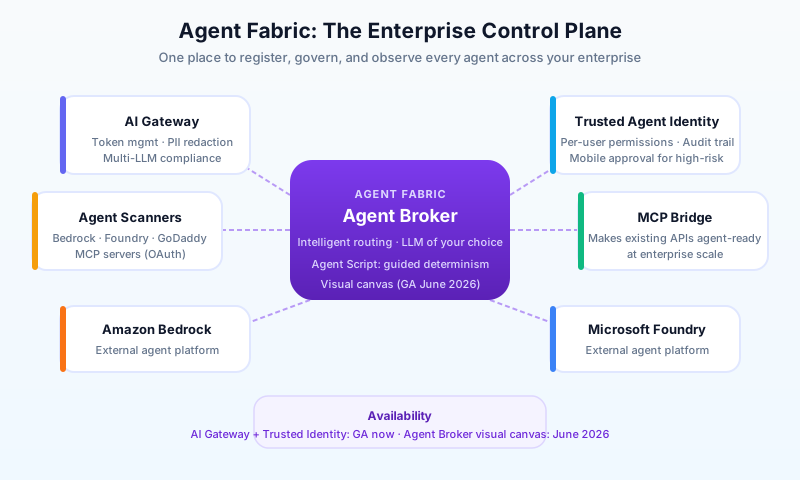
Agent Fabric is not a single product; it''s a suite of capabilities that together solve the agent sprawl problem the Connectivity Report identified.
MuleSoft Agent Broker
The MuleSoft Agent Broker is the intelligent routing engine at the heart of Agent Fabric. Where the Atlas Reasoning Engine routes within an Agentforce deployment, the Agent Broker routes between agents that may live on completely different platforms. Given an incoming task, the Broker dynamically matches it to the best-fit agent or tool based on capability metadata, performance, cost, and policy.
For Salesforce shops that have leaned on MuleSoft for API-led connectivity for years, the mental model is familiar: the Broker is to agents what the API gateway was to services. It abstracts callers from the underlying implementation, lets you swap agents without rewiring consumers, and gives you a single place to enforce policy.
Agent Script for Agent Broker
LLM-based routing is powerful but probabilistic. Enterprises often need certain handoffs to be deterministic - "if the customer is enterprise tier and the case is severity 1, always route to the on-call human agent, period." Agent Script is the new declarative layer that sits on top of Agent Broker to provide what Salesforce calls "guided determinism": you write deterministic rules where you need them and let the LLM handle the open-ended cases. It is the same philosophy that made Flow a complement to Apex - declarative where possible, code where required.
LLM Governance on AI Gateway
Most enterprises now run a multi-LLM stack: Claude for reasoning, Gemini for long context, Llama for cost-sensitive workloads, in-house models for proprietary domains. The AI Gateway standardizes token management, rate limiting, prompt logging, PII redaction, and compliance controls across all of them. Your CISO gets one place to audit. Your finance team gets one place to see token spend. Your developers get one consistent SDK.
Trusted Agent Identity
This is the piece most overlooked in agent architecture conversations, and arguably the most important for production. Trusted Agent Identity ensures that when an agent takes an action - updates a record, sends an email, transfers funds - it does so with the specific user''s permissions, not a service account''s. Permissions, sharing rules, field-level security, and audit trails all flow through correctly.
For high-risk actions, Trusted Agent Identity supports mobile approval workflows: the agent prepares the action, the user gets a push notification on their phone to approve or reject, and only then does the action execute. This is how you safely let an agent move money or change contracts.
Agent Scanners
Agent Fabric ships with Agent Scanners that automatically discover and register agents running on Amazon Bedrock, Microsoft Foundry, GoDaddy, and any MCP server reachable via OAuth. The 27% of APIs that the Connectivity Report found to be ungoverned has a direct analog in agents - and the scanners are how you find the shadow agents already running in your enterprise.
Availability Timeline
As of April 2026, AI Gateway, MCP Bridge, and Trusted Agent Identity are generally available. The MCP server scanner ships in May 2026, and the full Agent Broker GA with the new visual canvas arrives in June 2026 alongside the Salesforce Summer 2026 Release.
The Agent2Agent (A2A) Protocol
Inside your enterprise, Agent Fabric handles routing. But what happens when your Agentforce agent needs to hand off a sub-task to a Google Vertex AI agent running at a partner, which itself needs to query a ServiceNow agent at a supplier? You need an open protocol - and that is exactly what Agent2Agent (A2A) provides.
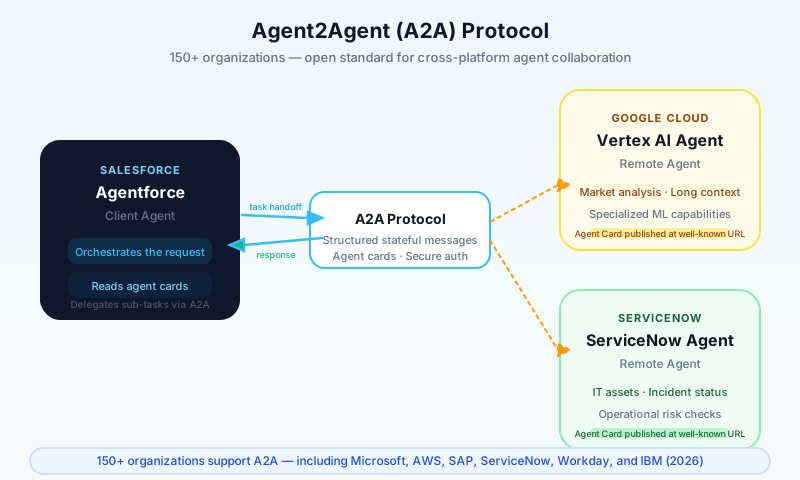
A2A is the open standard for AI agent interoperability that Salesforce co-created with Google. As of 2026, more than 150 organizations support it, including Microsoft, AWS, SAP, ServiceNow, Workday, and IBM. It is doing for agents what REST did for services and what OAuth did for identity: providing a vendor-neutral contract so that any compliant agent can call any other compliant agent.
Agent Cards
The foundation of A2A is the agent card - a machine-readable metadata file that describes what an agent can do, what inputs it accepts, what outputs it produces, what authentication it requires, and how to invoke it. Think of an agent card as a digital résumé. When a client agent is deciding whether to hand off work, it reads the agent card the same way a hiring manager reads a CV.
Agent cards include capability declarations, skill descriptions, supported modalities (text, structured data, streaming), and the endpoints to actually invoke the agent. They are typically served at a well-known URL on the agent''s host so that discovery is straightforward.
Client and Remote Agents
A2A defines a client-server model. A client agent is the one orchestrating the work - typically the primary agent in your Agentforce setup. A remote agent is the one processing a specific task on behalf of the client. The two communicate via structured, stateful messaging that can support long-running tasks, streaming responses, and human-in-the-loop checkpoints.
A real example from the Salesforce documentation: an Agentforce agent in a financial services org receives a request to "prepare a comprehensive risk assessment for client X." It hands off to a Google Vertex AI agent that specializes in market analysis. That Vertex agent, in turn, hands off to a ServiceNow agent to check whether any open IT incidents at the client could affect operational risk. The Agentforce agent never needed to know the internal architecture of either the Vertex or ServiceNow agents - A2A let them collaborate as peers.
Why A2A Matters for Architects
For Salesforce architects, A2A is what keeps your multi-agent strategy from becoming a single-vendor lock-in. You can build best-of-breed: Agentforce for CRM-grounded work, a specialist medical-AI agent for clinical reasoning, an internal homegrown agent for proprietary logic. As long as each speaks A2A, they can be composed.
Building Your First Multi-Agent System: A Practical Path
Here is the build path most successful Salesforce teams follow when moving from one agent to many.
Step 1: Inventory the Work, Not the Tools
Before you design any agent, list the conversations and tasks your users actually have. Write them as user stories: "As a sales rep, I want to prep for a customer meeting in under five minutes." For each story, note the data domains involved, the systems of record, and the actions that need to happen. You will start to see clusters - these clusters are your specialist agent candidates.
Step 2: Define Specialist Boundaries
Aim for specialists with one job each. A "Pricing Specialist" agent that knows the rate cards, discount approval rules, and quote generation actions is better than a "Sales Operations" agent that also handles forecast queries and territory questions. Tight boundaries make Atlas''s routing job easier and let domain teams own their agents independently.
Document each specialist with:
- A one-sentence description of when to invoke it
- A list of capabilities (topics) it owns
- The data it is grounded on (Data Cloud objects, knowledge sources)
- The actions it can execute, and which require approval
- The user permissions it inherits via Trusted Agent Identity
Step 3: Design the Primary Agent
The primary agent should have very few topics of its own. Its job is delegation. Its instructions should describe each specialist clearly enough that Atlas can route accurately, and they should describe the persona the user experiences (tone, brand voice, escalation triggers).
A common mistake is loading the primary agent with fallback topics "in case the specialists don''t cover something." Resist this. If a specialist is missing, the right answer is usually to build it, not to paper over the gap in the primary.
Step 4: Wire In External Agents via A2A or MCP
If parts of your workflow require capabilities that live outside Salesforce, register those agents through Agent Fabric. For agents from A2A-compliant platforms, point Agent Broker at their agent cards. For tool-style integrations, use MCP endpoints. Agent Fabric will treat them as first-class participants in routing. The Salesforce Headless 360 guide covers MCP tooling in depth if you need the API-first angle.
Step 5: Add Guardrails with Agent Script and Approvals
Walk through your most consequential actions - anything that touches money, contracts, customer records at scale, or compliance-sensitive data. For each, decide whether the action should be fully automated, require mobile approval via Trusted Agent Identity, or require a hard deterministic rule in Agent Script. This is where you turn an exciting demo into a production-grade system.
Step 6: Observe, Measure, Iterate
Agent Fabric''s observability features show you which agents are being routed to, how often Atlas picks the right specialist on the first try, where users abandon conversations, and where latency spikes. Use these to refine specialist descriptions, prune unused topics, and identify candidates for new specialists.
Real-World Use Cases by Industry
Multi-agent orchestration is delivering measurable results across every major industry vertical. A few representative examples make the pattern concrete.
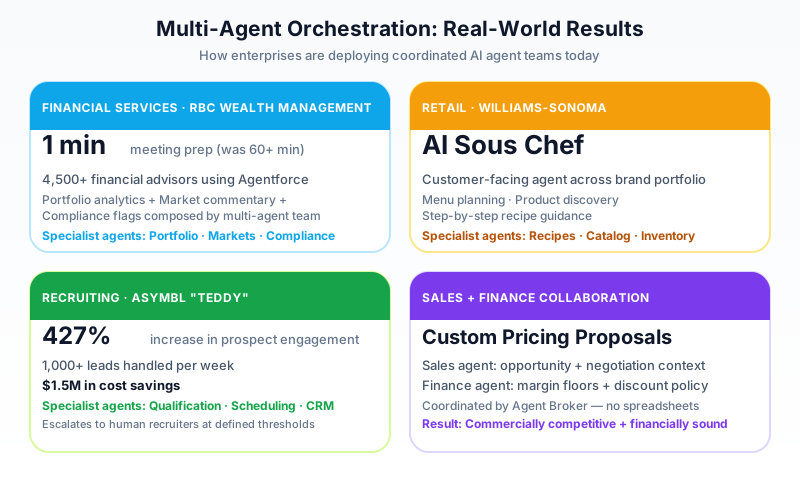
Financial Services: RBC Wealth Management
RBC Wealth Management deployed Agentforce to more than 4,500 financial advisors. The headline result: meeting preparation that used to take over an hour now takes under a minute. Behind that number is a multi-agent system. A primary advisor agent orchestrates specialists that pull portfolio analytics, market commentary, recent client interactions, and compliance flags, then composes a meeting brief. No single agent could have produced the brief alone - and no advisor would have stitched it together by hand under time pressure.
Retail: Williams-Sonoma
Williams-Sonoma''s AI sous chef is a customer-facing primary agent that helps shoppers plan a menu. It delegates to a recipe specialist for cooking guidance, a product catalog specialist that spans the company''s full brand portfolio (Williams-Sonoma, Pottery Barn, West Elm), and an inventory specialist for availability. The customer experiences one helpful assistant; the business gets cross-brand merchandising opportunities surfaced organically.
Recruiting and Lead Engagement: Asymbl
Asymbl''s "Teddy" agent handles more than 1,000 leads per week. Asymbl reports a 427% increase in prospect engagement and $1.5M in cost savings. Teddy is a primary agent that delegates qualification, scheduling, and CRM updates to specialists, escalating to human recruiters only when the conversation crosses a defined threshold.
Sales and Finance Collaboration
A particularly elegant pattern that many B2B Salesforce customers are now deploying: a sales agent and a finance agent collaborate to produce custom pricing proposals. The sales agent understands the opportunity, the customer history, and the negotiation context. The finance agent understands margin floors, discount policy, and approval routing. Together - coordinated by Agent Broker - they generate proposals that are both commercially competitive and financially sound, without a human spreadsheet exchange.
Governance, Limits, and Best Practices
The same Connectivity Report that surfaced the average-of-12-agents statistic also found that 96% of IT leaders consider seamless data integration essential for agent success, and 94% agree that AI success requires more API-driven infrastructure. These numbers map directly to practical governance work.
Treat agents like applications, not features. Each specialist should have an owner, a roadmap, a change log, a test plan, and a deprecation path. The "shadow agent" problem is real - the Agent Scanners exist precisely because organizations were finding agents in production that no one knew about.
Ground specialists narrowly. A specialist grounded on three highly relevant Data Cloud objects will outperform one grounded on thirty marginally relevant ones. Retrieval quality is multiplicative with routing accuracy.
Write descriptions for Atlas, not for humans. The agent and topic descriptions you write are read by the reasoning engine on every routing decision. They should be precise about when to invoke the agent and when not to. Examples and counter-examples in the description help significantly.
Set explicit handoff contracts. When a primary delegates to a specialist, the specialist should know exactly what it received and what it must return. Vague handoffs produce vague answers.
Default to least privilege. Trusted Agent Identity makes it easy to scope agents to specific user permissions - use this, do not run agents as super-users for convenience.
Govern the LLMs centrally. Use AI Gateway to enforce token budgets, log prompts, redact PII, and produce the audit trail your security team will eventually ask for. Doing this on day one is enormously cheaper than retrofitting it after an incident.
Plan for ungoverned APIs. With 27% of enterprise APIs ungoverned on average, your agents will eventually try to call something that nobody is monitoring. Use Agent Fabric and MuleSoft together so that every agent-driven API call inherits the same policy controls as every human-driven one.
What''s Coming Next
The 2026 roadmap for multi-agent orchestration on Salesforce is unusually concrete. The Summer 2026 release brings the full Agent Broker GA along with a visual canvas for designing multi-agent flows declaratively - finally giving admins a drag-and-drop experience for what has been a code-and-config exercise. The MCP server scanner reaching GA in May 2026 will let security teams discover and register the long tail of partner and homegrown agents that have proliferated in many enterprises.
Looking further out, expect three trends to dominate. First, A2A coverage will broaden: as more vendors ship compliant agents, the value of being on the protocol compounds, and we''ll likely see industry-specific extensions for healthcare, financial services, and public sector. Second, deterministic orchestration patterns will mature: Agent Script is a first step, but expect richer policy languages, simulation tooling, and pre-production testing harnesses. Third, agent-to-agent commerce will start to appear in production - agents transacting on behalf of their owners, with cryptographic identity and policy enforcement provided by the fabric layer.
For Salesforce architects, the practical implication is that today''s multi-agent design choices will compound. Investing now in clean specialist boundaries, well-written descriptions, and Agent Fabric registration pays off as the protocol and platform mature.
Conclusion
Multi-agent orchestration is the defining Salesforce architectural pattern of 2026. The shift from single-agent deployments to coordinated teams of specialists is being driven by hard business reality: organizations are running an average of 12 agents already, projected to grow 67% in two years, and the half that operate in silos are leaving most of the value on the table.
The good news is that Salesforce has built - and is rapidly shipping - the full stack needed to do this well. The primary-and-specialist architecture, with the Atlas Reasoning Engine at its core, gives you a clean design pattern. Agent Fabric, with Agent Broker, AI Gateway, Trusted Agent Identity, and Agent Scanners, gives you the enterprise control plane. The Agent2Agent protocol, co-created with Google and adopted by 150-plus organizations, gives you the open standard that prevents lock-in and enables cross-platform collaboration.
For Salesforce admins and architects, the path forward is clear: start cataloging your work into specialist-shaped chunks, design primary agents that delegate rather than do, register everything through Agent Fabric, govern with Trusted Agent Identity and AI Gateway, and stay close to the A2A and MCP ecosystems as they mature. The teams that get this right in 2026 will be the ones whose AI investments compound - and the teams that don''t will be the ones running 25 disconnected agents in 2027, wondering why their AI roadmap stalled.
Sources
- Agentforce Multi-Agent Orchestration
- Salesforce Agent Fabric Announcement
- Agent2Agent Protocol
- Salesforce Connectivity Report 2026
- MuleSoft Agent Fabric
- Salesforce Summer 2026 Release
- Agentforce Architecture Guide - Salesforce Developers
About the Author
Dipojjal Chakrabarti is a B2C Solution Architect with 29 Salesforce certifications and over 13 years in the Salesforce ecosystem. He writes and edits salesforcedictionary.com, published by KineticBit Inc., to help admins, developers, architects, and cert/interview candidates sharpen their fundamentals. More about Dipojjal.
Share this article
Sources
Related dictionary terms
Practise it
Five questions on Platform Developer I
Exam-style questions with an explanation after each one. No account needed, and your answers build a weak-topic map once you have one.
Keep reading
Agentforce Operations: The Complete 2026 Guide for Salesforce Admins, Developers & Architects
Agentforce Operations (GA April 2026) brings AI agents to back-office work - invoice auditing, supplier onboarding, compliance checks, and more. Built on Regrello and the Einstein Trust Layer.
Salesforce Flow vs Apex in 2026: A Decision Matrix for Admins, Developers & Consultants
Flow vs Apex is not a religious war anymore. Here is the 2026 decision matrix. Capability gaps, governor limits, the 70/30 rule, and 12 worked scenarios with the right answer for each.

What Is Salesforce Headless 360? The Complete 2026 Guide for Developers, Admins & Architects
Salesforce Headless 360 exposes Salesforce capabilities as APIs, MCP tools, and CLI commands so work can happen in agents, Slack, voice, and custom apps without relying on the browser UI.

What Is Agentforce 360? The Complete 2026 Guide for Salesforce Admins, Developers & Architects
Agentforce 360 is Salesforce's 2025 rebrand of its agentic-AI platform - built on the Atlas Reasoning Engine, Einstein Trust Layer, and Data 360. Here's the complete admin + dev + architect guide.
Comments
No comments yet. Start the conversation.
Sign in to join the discussion. Your account works across every page.