
Salesforce + Contentful: What Architects Need to Know in 2026
The acquisition fills the content gap in Headless 360 and Agentforce. Here is how to think about it before the deal closes in Q3.
Your marketing team asks an Agentforce service agent to send a customer the latest return policy, in German, formatted for WhatsApp. The agent does it instantly. The problem: the policy it wrote is three months out of date, the legal disclaimer is gone, and the tone is off-brand. Nobody approved a word of it. The agent improvised, because nothing in your stack told it where the approved content actually lives.
That gap is exactly what Salesforce is trying to close. On June 1, 2026, Salesforce signed a definitive agreement to acquire Contentful, the Berlin-founded headless CMS, for a reported $1B to $1.5B. The deal is expected to close in Q3 of FY2027. There is plenty of news coverage of the announcement itself. This post is about the part the news skipped: what it means for how you architect content, agents, and channels going forward.
What Contentful is (and why Salesforce paid for it)
Contentful is a composable, headless content management system founded in Berlin in 2013. "Headless" means the content is decoupled from any single presentation layer. You author content once, structured as reusable models with typed fields, and deliver it through APIs to any surface: a website, a mobile app, a kiosk, a chatbot, a smart watch. The CMS does not care where the content renders. It just serves clean, structured data.
That model has found a serious audience. Contentful is used by roughly 4,800 brands, including IKEA, Vodafone, Electronic Arts, and DoorDash, and reaches close to 30% of the Fortune 500. It is not a niche tool. It is one of the default choices when a large enterprise wants content infrastructure that scales across dozens of channels.
The price tells its own story. Contentful raised around $350M and was valued at more than $3B in 2021. Salesforce buying it at $1B to $1.5B is a clear discount from that peak. The CMS market cooled, growth-stage valuations reset, and Salesforce moved at a moment when a category leader was available for less than it once commanded.
So why buy a CMS at all? Salesforce already has content tools. The honest answer is that none of them were built for what Salesforce now wants to do with content: feed it to agents and project it onto channels Salesforce does not own.
The gap it fills: Headless 360 and agentic content
To see why this deal makes sense, you have to look at where Salesforce has been heading.
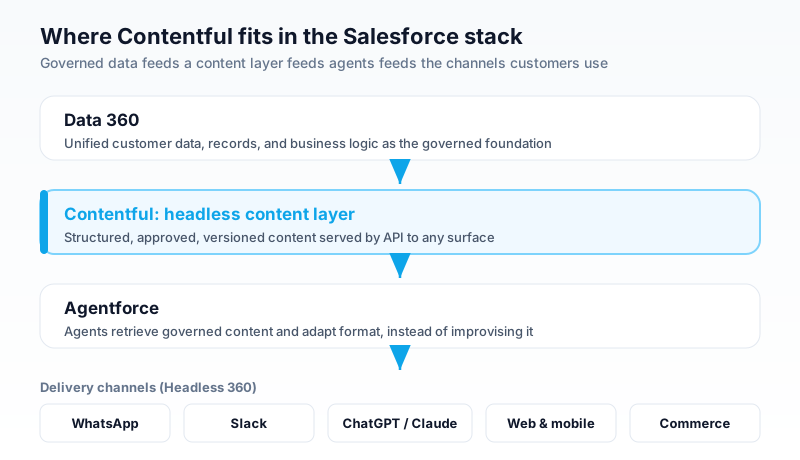
Headless 360 is Salesforce's strategy to project CRM data and logic into surfaces Salesforce does not control. WhatsApp. Slack. ChatGPT. Claude. The idea is that work no longer has to happen inside a Salesforce browser tab. Data and logic flow out to wherever the customer or employee already is.
Data and logic, though, are only two of the three things you need to run a customer interaction. The third is content. The actual words, images, disclaimers, product descriptions, and policies that a customer reads. Salesforce could push a customer record and a business rule to WhatsApp. It could not push approved, structured, channel-ready content with the same rigor.
Jujhar Singh, President of C360 Applications, framed it plainly: "With Contentful, we complete that picture by adding a native, headless, composable content layer." Forrester analyst Chuck Gahun, quoted by The Register, read the deal the same way: Contentful tops off a headless bet Salesforce has been making for over a year.
Now layer Agentforce on top. Agents are generative by default. Ask one for the return policy and it will write you a return policy, whether or not it knows the real one. That is the failure mode in the opening scenario. The fix is not a smarter prompt. The fix is architecture: wire Contentful into Data 360 so agents retrieve approved, governed content instead of inventing it.
That is the strategic core of the deal. Salesforce is not buying a website builder. It is buying a governed source of truth for content that agents can be forced to use.
The agentic content orchestration pattern
This is the part architects should actually design around, so let me be specific.
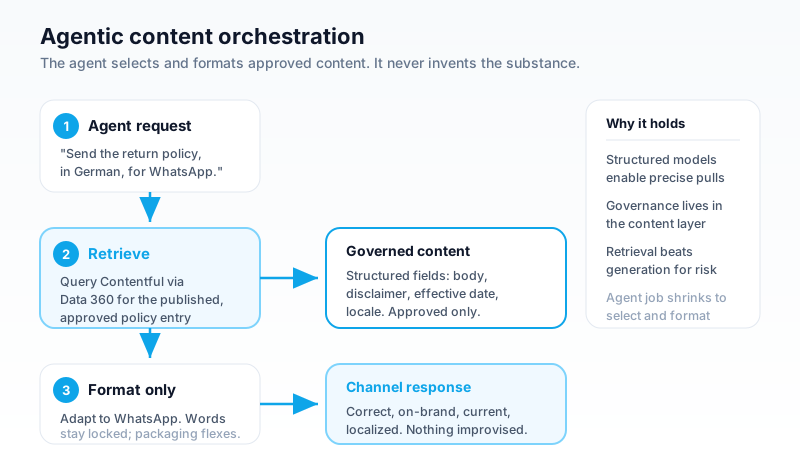
The pattern works like this. An agent receives a request that needs content. Instead of generating that content from its own weights, the agent calls out to a governed content source, retrieves the approved asset, and adapts only the format to the channel. The words stay locked. The packaging flexes.
Walk through the return-policy example again, done right.
The agent gets the request. It recognizes that "return policy" maps to a content type in Contentful, not to free-form generation. It queries Contentful through Data 360 for the current, published, legally approved policy entry, filtered by region and language. Contentful returns structured content: the policy body, the required legal disclaimer, the effective date, the localized German variant. The agent then formats that approved content for WhatsApp, respecting message length and link structure, and sends it. The customer gets correct, on-brand, current content. The agent did zero improvising on the substance.
A few things make this work, and they are all architectural decisions you control.
Content modeling matters more than ever. If your content lives as a blob of HTML in a rich text field, an agent cannot reliably pull the disclaimer separate from the body. Structured content models, with typed fields for body, disclaimer, effective date, and locale, are what let an agent retrieve precisely. Contentful's whole design assumes structured models. Lean into that.
Governance lives in the content layer, not the prompt. Publishing workflows, approval states, and versioning in Contentful become the control plane. An agent should only ever see published, approved entries. If legal has not signed off, the agent cannot find it. This is far stronger than trying to constrain a model with instructions.
Retrieval beats generation for anything that carries risk. Prices, policies, compliance language, contractual terms. None of these should be generated. All of them should be retrieved from a governed source. The agent's job shrinks to selection and formatting, which is exactly where you want it for high-stakes content.
If you have built retrieval-augmented generation before, this will feel familiar. The difference is that the retrieval source is now a first-class, governed CMS with editorial workflow, not a vector database someone stuffed with PDFs.
The overlap problem: Salesforce CMS, Experience Cloud, and Contentful
Here is the question every architect will ask, and Salesforce has not fully answered it yet: does this not overlap with what Salesforce already owns?
It does. Salesforce already ships Salesforce CMS and Experience Cloud. Both touch content. Pretending otherwise would insult your intelligence. So let me give you the honest version.
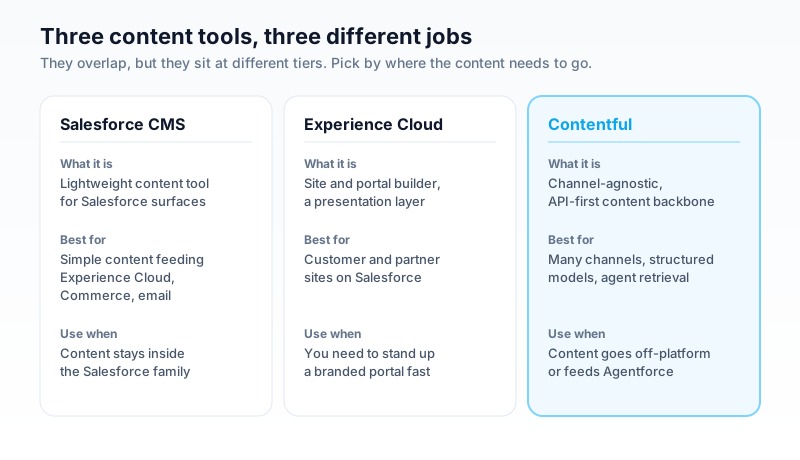
Salesforce CMS is a lightweight content tool built primarily to feed Salesforce-owned surfaces: Experience Cloud sites, Commerce storefronts, marketing emails. It is convenient when your content stays inside the Salesforce family. It was never designed to be an enterprise-grade content backbone for hundreds of channels.
Experience Cloud is a site and portal builder. It is a presentation layer, a way to stand up customer and partner sites on Salesforce. Content is one ingredient it consumes, not the product itself.
Contentful is a content backbone. Channel-agnostic, API-first, built for content teams who serve many surfaces and treat content modeling as a discipline. It is the layer the other two were never trying to be.
My read: these are not redundant so much as positioned at different tiers. Salesforce CMS handles simple content for Salesforce-native surfaces. Contentful becomes the serious content layer for everything else, especially anything agentic or off-platform. Experience Cloud keeps being a presentation layer that can now draw from a much stronger content source.
That said, the overlap is real enough that you should expect messaging confusion, redundant capabilities, and a multi-year integration story before the lines are clean. Do not assume same-day, native interoperability. Acquisitions take quarters to become products.
There is also a competitive wrinkle worth naming. Contentful's 4,800 brands include plenty of companies that do not run Salesforce CRM. The moment this closes, competitors will pitch those brands hard on neutrality, arguing that a Salesforce-owned CMS is no longer a neutral choice. Some of those brands will stay. Some will start evaluating alternatives. If you are one of those non-Salesforce shops, factor that dynamic into your roadmap.
And because Contentful is German-founded, EU data sovereignty deserves a line in your risk register. Ownership changing hands can change where data is processed and under whose legal regime. If you operate under strict EU data residency requirements, put a question about data location and processing on your due-diligence list now, not after the deal closes.
This acquisition also fits a clear pattern. Salesforce has been buying capability to fill Agentforce and Data 360 gaps at a steady clip: Informatica, Convergence AI, Qualified, Cimulate, Momentum, Regrello, and now Contentful. Each fills a specific hole. Contentful fills the content one. Read the deal in that context and it stops looking like a surprise.
Who needs to act now vs wait
Not everyone needs to do something this quarter. Be honest about which group you are in.
Act now if you are already building with Agentforce and your agents touch customer-facing content, you run Contentful today, or you are mid-flight on a Headless 360 strategy that pushes content to non-Salesforce channels. For you, this deal changes your target architecture, and waiting means rework later.
Pay attention but wait if you run a mostly Salesforce-native content footprint through Salesforce CMS and Experience Cloud, with no agentic content use cases yet. Nothing breaks for you on close. You have time to watch how the integration takes shape before committing.
Treat it as a risk item if you are a Contentful customer who does not use Salesforce CRM. Your priority is not adoption. It is understanding what changes under new ownership and whether neutrality still matters to you.
What to do this quarter
Concrete steps, in order.
-
Inventory where agents currently get content. Find every Agentforce use case that produces customer-facing text. For each one, write down whether the content is retrieved from a governed source or generated on the fly. The generated ones are your risk list.
-
Audit your content models. Look at how your content is structured today. If critical content lives as unstructured blobs, start planning for structured models with typed fields. This work pays off no matter which CMS wins internally.
-
Map your channels. List every surface where content lands, especially the non-Salesforce ones: WhatsApp, Slack, third-party chat, ChatGPT, Claude. This is your Headless 360 surface map, and it tells you how much you need a channel-agnostic content layer.
-
Open the data sovereignty question. If you operate in the EU, ask your Salesforce account team where Contentful data is processed and what changes on close. Get it in writing.
-
Hold off on big platform bets for one quarter. Do not rip out Salesforce CMS or commit to a full Contentful migration based on a signed agreement alone. The deal closes in Q3. Architect toward governed, retrievable, structured content now, because that direction is right regardless. Decide on specific tooling once the integration story is real.
The throughline is simple. Whatever the org chart looks like after close, the winning pattern is the same: agents should retrieve governed content, never improvise it. Build toward that this quarter and the acquisition becomes an accelerant rather than a surprise.
About the Author
Dipojjal Chakrabarti is a B2C Solution Architect with 29 Salesforce certifications and over 13 years in the Salesforce ecosystem. He writes and edits salesforcedictionary.com, published by KineticBit Inc., to help admins, developers, architects, and cert/interview candidates sharpen their fundamentals. More about Dipojjal.
Share this article
Sources
Related dictionary terms
Practise it
Five questions on Agentforce Specialist
Exam-style questions with an explanation after each one. No account needed, and your answers build a weak-topic map once you have one.
Keep reading
Salesforce Data 360: The Complete 2026 Implementation Guide
Data 360 is Salesforce's unified data platform for the agent era. This 2026 implementation guide walks data streams, identity resolution, segmentation, activations, and zero-copy federation.
Salesforce Experience Cloud: The Complete 2026 Guide (Sites, Portals & Agentic Customer Experiences)
Experience Cloud is no longer Communities. In 2026, it's an LWR-powered site runtime, a Digital Experience identity layer, and an Agentforce-first portal surface. Here's the complete admin, developer, and architect guide.

What Is Salesforce Headless 360? The Complete 2026 Guide for Developers, Admins & Architects
Salesforce Headless 360 exposes Salesforce capabilities as APIs, MCP tools, and CLI commands so work can happen in agents, Slack, voice, and custom apps without relying on the browser UI.
What Is Agentforce 360? The Complete 2026 Guide for Salesforce Admins, Developers & Architects
Agentforce 360 is Salesforce's 2025 rebrand of its agentic-AI platform - built on the Atlas Reasoning Engine, Einstein Trust Layer, and Data 360. Here's the complete admin + dev + architect guide.
Comments
No comments yet. Start the conversation.
Sign in to join the discussion. Your account works across every page.