
Dreamforce 2026: Dates, Pricing, Session Tracks, and a Prep Checklist That Actually Helps
Dreamforce 2026 runs September 15–17 at Moscone. Here are the real dates, how the pricing tiers work right now, what changed about this year's format, and a role-based prep plan.

You have the Dreamforce registration page open in one tab and your manager's "let me know what you need" email in another. The individual pass reads $1,499. A banner says that price ends in a few days. After that it is $2,299. And you still have not decided whether flying to San Francisco in September is a smart use of a training budget or a very expensive way to stand in line for coffee.
That decision is easier once you know how the money, the calendar, and the agenda actually work. So here is the practical version: the dates that matter, how the pricing tiers really behave right now, what changed about this year's format, and a prep plan you can run based on whether you are an admin, an architect, or a developer. No hype about the future of work. Just what to do before September.
The dates, and the one deadline that bites first
Dreamforce 2026 runs September 15 to 17 at the Moscone Center in San Francisco. That is confirmed on the official Dreamforce FAQ, which also lists a virtual option: an exclusive broadcast experience streamed on Salesforce+, free, with keynotes and selected sessions, some available on demand afterward.
Three days, one city, and roughly nine weeks of lead time from today. That sounds like plenty. It is not, because two of the deadlines that shape your trip land well before September.
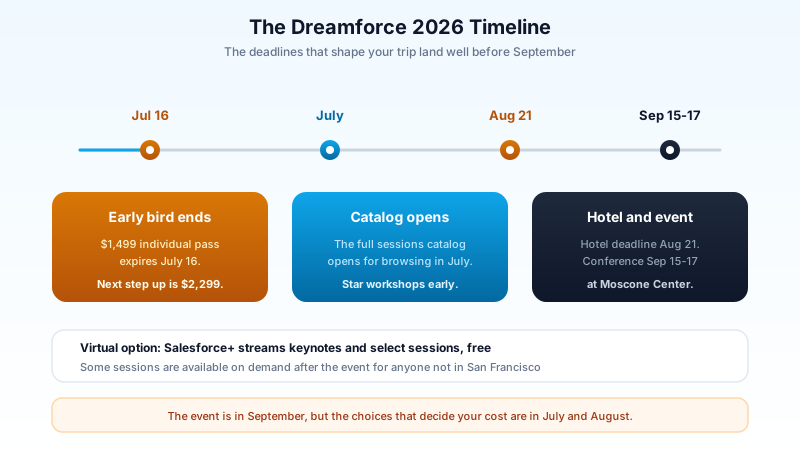
The first is registration pricing. The second is hotels. The registration page lists a hotel booking deadline of Friday, August 21, and there is a reason that date exists: the conference hotel block empties fast, and San Francisco room rates during Dreamforce week are not gentle. More on both of those below. For now, the point is that the event is in September, but the choices that decide your cost are in July and August.
How the pricing actually works right now
Here is the honest state of the pricing, read straight off the official pages today.
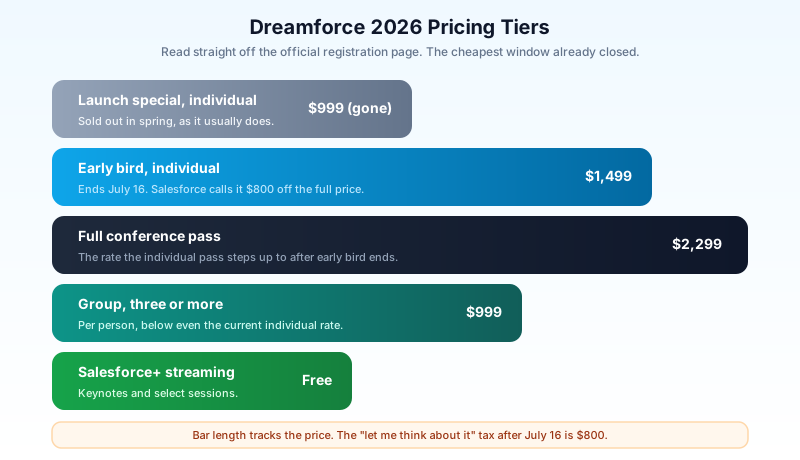
The cheapest tier is already gone. The registration page still shows a $999 "launch special" individual pass, marked expired. That was the early-early window, and Apex Hours' Dreamforce 2026 planning guide noted back in April that this tier historically sells out well before summer. It did. If you were waiting for a sign to buy, that sign left in the spring.
What you can buy now is the $1,499 early bird individual pass, which Salesforce describes as a savings of $800 off the full conference pass price of $2,299. The register page attaches a date to that early bird rate: it ends July 16. After that, the individual price steps up toward $2,299. So the current decision is not "$1,499 or wait for a better deal." There is no better deal coming. It is "$1,499 this week, or $2,299 later."
If you are sending more than one person, group registration changes the math entirely. Groups of three or more get passes starting at $999 each, per the FAQ. That is below even the current individual early bird rate, so if two colleagues are on the fence, pulling in a third makes the whole group cheaper per head than going alone.
The full conference pass, whatever you pay for it, covers a lot: all keynotes, breakouts, theater sessions, hands-on workshops, roundtable discussions, community networking, the Welcome Reception, and Dreamfest, plus daily breakfast, lunch, and refreshments across the three days. The food and the concert are bundled. The flights and the hotel are not, which brings us to the part of the budget people underestimate.
Apex Hours' guide recommends booking a hotel the day registration opens, because the official room block at properties like the Marriott Marquis, Hilton Union Square, and the W San Francisco fills quickly. Their estimate for Dreamforce-week rates is roughly $200 to $350 a night, two to three times what the same rooms cost in a normal week. Treat those numbers as a third-party estimate, not a quote. The takeaway holds either way: a $1,499 pass can quietly become a $3,500 trip once four nights in San Francisco and a flight are added. Budget the whole thing, not just the badge.
What changed about this year's format
Every Dreamforce has a theme, and this year's is "Building an Agentic Enterprise," the idea of organizations running AI agents alongside people across sales, service, marketing, and operations. You will hear the phrase "agentic enterprise" enough times over three days to develop a mild allergy to it. That is the marketing layer. Underneath it, two structural changes to the event are genuinely useful to know about.
First, there is a dedicated Community Keynote debuting alongside the main keynote. In past years the community got shout-outs inside other sessions. This year it gets its own stage moment. If you came up through Trailblazer groups, user groups, or the certification grind, this is the keynote aimed squarely at you rather than at a CIO evaluating a platform purchase.
Second, there is a full community zone on the third floor set aside for Trailblazer community groups, first-timers, and peer-led sessions. If this is your first Dreamforce, that floor is where the event stops feeling like a trade show and starts feeling like the people you have only ever known as avatars in a Slack channel. First-timers consistently report that the hallway conversations outlasted the keynote takeaways, and a dedicated space for those conversations is a real improvement.
One more piece of context that matters if you are weighing a multi-year travel plan: Marc Benioff has said Salesforce locked in an agreement to keep Dreamforce in San Francisco for at least the next two years. So if you skip 2026, the event is not moving somewhere more convenient in 2027. Same city, plan accordingly.
The session tracks, decoded
Salesforce organizes the agenda into role, industry, and product tracks, and the full sessions catalog opens for browsing in July per the FAQ. Past Dreamforces have run well over 1,600 sessions, so the catalog is less a schedule and more a small library. You will not "see everything." Anyone who tells you they did is counting the sessions they walked past.
The content clusters into a handful of themes worth knowing before you build a schedule.
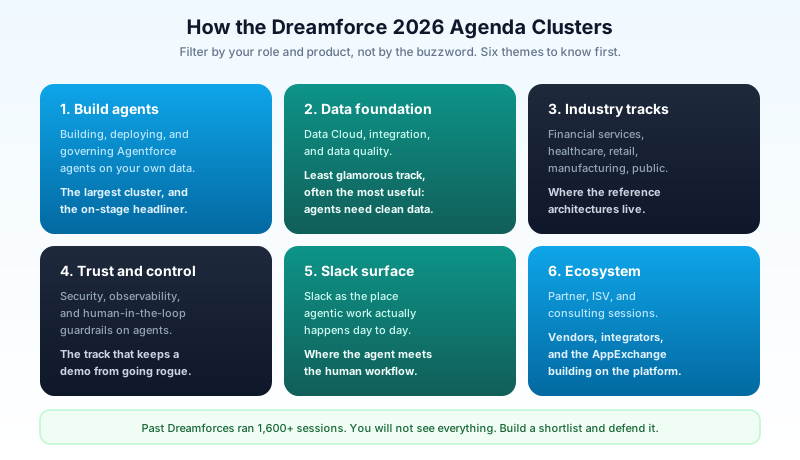
The largest cluster is building, deploying, and governing Agentforce agents against your own company data. Expect deep dives on the products that went generally available this summer, so the on-stage demos will not be vaporware. Agentforce Commerce went GA on July 6 with its Shopper, Buyer, and Merchant agents, and the Agentforce Help Agent shipped in July as well. If you want the implementation detail, read those before you go and treat the sessions as a chance to ask the product teams the questions the docs did not answer.
The second cluster is the data foundation. Data Cloud, integration, and data quality get their own heavy track, and for good reason: an agent is only as reliable as the data it reads. This is the least glamorous track and often the most useful, because it addresses why your proof of concept worked in a demo org and fell over on real data.
The rest sorts into industry tracks (financial services, healthcare, retail, manufacturing, public sector), a trust and safety cluster covering security, observability, and human-in-the-loop controls, Slack as a surface for agentic work, and the partner, ISV, and consulting ecosystem. If you run Sales Cloud or Service Cloud day to day, note that a lot of the agent content now lives inside those clouds rather than in a separate "AI" track, so filter by your product, not just by the buzzword.
A prep checklist, by role
Generic conference advice ("wear comfortable shoes") is true and useless. Here is what actually changes based on the job you do.
If you are an admin. One thing to get out of the way first: if you wanted to speak, that window closed. The Dreamforce 2026 Admin Track Call for Participation opened April 29 and closed May 27, with speaker notifications sent June 22. So this year you are attending the Admin Track, not presenting in it, and that is fine. Your prep is about triage. When the catalog opens in July, filter to the Admin Track and the Agentforce sessions tied to the clouds you actually run, then star the hands-on workshops early, because those cap attendance and fill first. Build a shortlist of two or three specific problems from your own org and go find the session or the expert who addresses each one. A conference without a question list is just expensive people-watching.
If you are an architect. Your value at Dreamforce is the roadmap conversations you cannot get from release notes. Prioritize the deeper technical sessions on Data Cloud, integration patterns, and agent governance, and book time in the expert areas and the True to the Core style Q&A formats where you can push product managers on the parts of the platform your designs depend on. The industry tracks matter more for you than for anyone else, because that is where the reference architectures live. If you are mapping a longer-term platform strategy, the Agentforce 360 architecture guide is worth reading first so the sessions land as depth rather than introduction.
If you are a developer. Skip the keynote-adjacent overview sessions and go straight to the hands-on workshops, the code-level Agentforce and Apex content, and the developer expert lounges. This is the one time each year the people who build the platform are in the same building as you, so bring the bug you could not reproduce and the design question the docs never answered. If certifications are on your radar, the on-site Trailhead and certification areas let you knock out an exam between sessions, and the 2026 certification roadmap helps you decide which one is worth the seat.
Whatever your role, three logistics items apply to everyone. Book the hotel before the August 21 deadline and inside the room block if you can get it. Download the event app the moment it launches and build your schedule there, because the "I'll figure it out when I arrive" plan collides with 1,600 sessions and loses. And pick two evening community events over the big-name party, because the Trailblazer community connections you make in a smaller room are the part of Dreamforce that pays off in November when you are stuck on something and need a real person who has solved it.
What is worth prioritizing, and what to skip
I will be blunt about where the value is, because the schedule is designed to pull you toward the flashiest rooms and those are rarely the useful ones.
Skip most of the main-stage keynote experience if you have a badge and a tight schedule. The keynote is streamed free on Salesforce+, in higher quality than the seat you will fight for, and you can watch it later at 1.5x speed while the announcements are still fresh. Trading two hours of prime in-person time to sit in a keynote you could stream is a bad exchange. Watch the recap, read the announcement, spend the live hours on things that require your physical presence.
What requires your presence: hands-on workshops, expert one-on-ones, the small roundtables, and the hallway conversations on that third-floor community zone. Those do not stream. Nobody uploads the fifteen-minute conversation with a product manager who told you the feature you have been waiting for slipped to Spring '27. Optimize your three days for the interactions that only happen in person, and let the broadcastable content stay broadcast.
And keep a healthy skepticism about the "agentic enterprise" framing without dismissing the substance under it. The branding is doing a lot of work. But the underlying products, Agentforce, Data Cloud, the agent governance tooling, are real, shipping, and going to land in your org whether or not you like the slogan. Go to understand what is actually generally available versus what is a roadmap slide, because telling those two apart is the single most valuable thing you can bring home. A demo is not a delivery date.
What to do this week
Two actions, both before July 16. First, decide on the pass. If you are going alone, the $1,499 early bird ends July 16 and the next number is $2,299, so the "let me think about it" tax is $800. If you can find two colleagues, price the group rate at $999 a head instead. Second, put the August 21 hotel deadline in your calendar now with a reminder, because that is the deadline that turns a manageable trip into an expensive one when it slips.
Then, when the sessions catalog opens later in July, spend twenty minutes filtering to your role and your actual products and starring the hands-on workshops before they fill. Everything else about Dreamforce can be figured out on the ground. Those three things cannot.
About the Author
Dipojjal Chakrabarti is a B2C Solution Architect with 29 Salesforce certifications and over 13 years in the Salesforce ecosystem. He writes and edits salesforcedictionary.com, published by KineticBit Inc., to help admins, developers, architects, and cert/interview candidates sharpen their fundamentals. More about Dipojjal.
Share this article
Sources
Related dictionary terms
Practise it
Five questions on Agentforce Specialist
Exam-style questions with an explanation after each one. No account needed, and your answers build a weak-topic map once you have one.
Keep reading
The Salesforce Career Path in 2026: From Admin to CTA (with Salaries & Timelines)
The complete Salesforce career roadmap from Admin to CTA - realistic timelines (5–10 years), 2026 salary bands by region, and the difference between cert collecting and getting promoted.

What Is Agentforce 360? The Complete 2026 Guide for Salesforce Admins, Developers & Architects
Agentforce 360 is Salesforce's 2025 rebrand of its agentic-AI platform - built on the Atlas Reasoning Engine, Einstein Trust Layer, and Data 360. Here's the complete admin + dev + architect guide.

Salesforce Certifications Roadmap 2026: All 40+ Exams Mapped (Admin · Developer · Architect · Marketer · Cloud)
The complete 2026 Salesforce certification roadmap - all 40+ exams mapped by role, with study time, prerequisites, exam format, and recommended sequencing for Admin, Developer, Architect, Marketer, and Cloud Specialist tracks.

Agentforce Help Agent: The Implementation Guide Before You Flip It Live
Agentforce Help Agent went GA in July 2026 with a setup wizard fast enough to finish before your coffee cools. Here is the architecture work that decides whether it resolves cases or embarrasses you in front of customers.

Agentforce Commerce: The Complete 2026 Guide (Formerly Commerce Cloud)
Commerce Cloud is now Agentforce Commerce. This 2026 guide covers the unified B2C/D2C/B2B platform, Intent-Aware Search, ChatGPT catalog syndication, and the agentic-shopping rollout.
Comments
No comments yet. Start the conversation.
Sign in to join the discussion. Your account works across every page.