
Agentforce Commerce: The Complete 2026 Guide (Formerly Commerce Cloud)
The Commerce Cloud rebrand, the unified B2C/D2C/B2B platform, Intent-Aware Search, ChatGPT catalog syndication, and the agentic-shopping numbers that actually shifted in 2026.

You launch a holiday-season promo on Friday and watch the analytics dashboard on Saturday. Conversion is flat on the homepage hero. Conversion is up 18 percent on a buried product page nobody on the merchandising team has touched in months. You dig in. The traffic to that buried page came from ChatGPT. Customers asked ChatGPT for a product recommendation, ChatGPT pulled from your syndicated catalog, customers landed on a page you forgot you had, and they bought. That is not how 2024 commerce worked.
That is the Agentforce Commerce story in 2026. Commerce Cloud, as a SKU, is now Agentforce Commerce. The catalog syndication to consumer AI channels is real. The agentic shopping experiences on owned properties are real. Salesforce announced AI assistants drove a 119 percent increase in retail traffic volumes in the launch window. The numbers that follow that headline matter more than the headline itself.
This post walks through what the rebrand actually changed, the unified B2C/D2C/B2B platform, Intent-Aware Search, two-way agentic messaging, merchandiser automation, the headless options, and the rollout pattern that ships in real storefronts.
What the Commerce Cloud to Agentforce Commerce rebrand actually changed
The headline product on salesforce.com/commerce is now "Agentforce Commerce (formerly Commerce Cloud)". B2C Commerce, D2C Commerce, and B2B Commerce all picked up the Agentforce branding. The license you bought as B2C Commerce stays a B2C Commerce license. The Storefront Reference Architecture, the Page Designer, the SLAS auth flow, the OCAPI and SCAPI endpoints, none of those went away.
What did not change:
- B2C Commerce site genesis, Storefront Reference Architecture (SFRA), and the Salesforce Commerce API stack.
- D2C Commerce on the Salesforce Core platform with the Lightning Web Runtime storefront.
- B2B Commerce on the Salesforce Core platform with B2B-specific objects (Account hierarchies, contracted pricing, quotes).
- Order Management, Payments, and Returns engines.
- The headless options. Both SCAPI for B2C and the B2B/D2C Commerce APIs are unchanged. LWR storefronts still work.
What did change:
- Unified Commerce platform. Salesforce announced the next generation of Commerce Cloud unifies B2C, D2C, B2B, Order Management, and Payments on one platform powered by Data Cloud and the agent layer. The unification is real for new customers. Existing customers stay on the platform they bought and get features added.
- ChatGPT catalog syndication. Brands can syndicate their product catalogs to consumer AI channels like ChatGPT, where customers ask for product recommendations and the AI surfaces your catalog. The 119 percent traffic-volume increase Salesforce cited at launch is the number to watch on its own metric over time, not as a one-time spike.
- Intent-Aware Search. Replaces the static keyword search with a real-time, natural-conversation search that handles intent (and the dreaded zero-results page). Shipped March 2026.
- Two-way agentic messaging. Agents close sales over email, SMS, and WhatsApp by managing conversations, generating personalized offers, upselling, and taking payment.
- Merchandiser automation. Merchandisers can promote high-margin or trending items and bury slow-moving or out-of-stock products via agent automation rather than manual list curation.
- Agentforce Localization. B2B Guided Shopping now interacts with buyers in their preferred language and locale.
The rebrand is more pragmatic than the Marketing Cloud rebrand. Commerce Cloud was already a unified product brand, even if internally it had separate stacks (B2C from Demandware acquisition, B2B/D2C on Core). The Agentforce rebrand layers agents on top without forcing migrations of existing storefronts. That is the right call for a product where storefronts are mission-critical and changes carry revenue risk.
The unified B2C/D2C/B2B platform
This is the architectural change that matters most for enterprises running multi-model commerce.
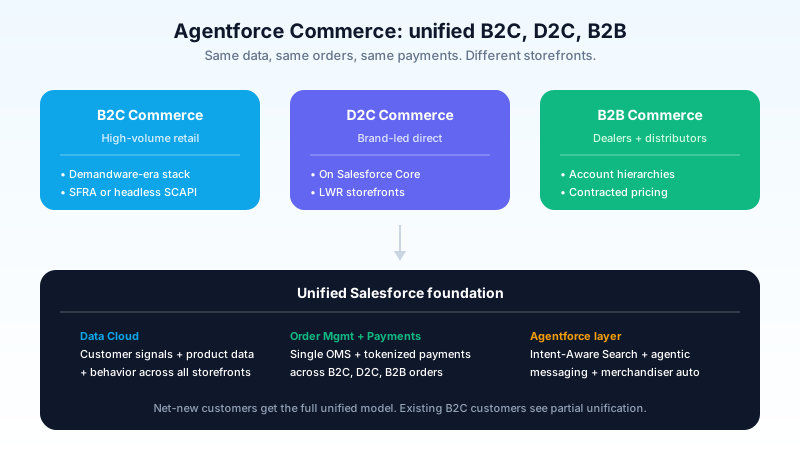
Old model: B2C Commerce ran on the Demandware-derived stack (separate codebase, separate tenancy, separate admin). B2B and D2C Commerce ran on the Salesforce Core platform (LWR storefronts, Salesforce objects, Lightning admin). The two worlds barely touched. Enterprise customers running both ended up with two systems of record, two reporting surfaces, and integration projects to bridge them.
New model: Salesforce announced the next-generation Commerce platform unifies B2C, D2C, B2B, Order Management, and Payments on a single foundation. For new customers, that means one tenancy, one admin model, one reporting view across business models. For existing B2C Commerce customers, the unification is partial and will take time to fully materialize. The Demandware-era infrastructure does not migrate overnight.
The practical implication for architects: when designing a new commerce stack in 2026, the default assumption should be unified. Pick the platform variant that matches your primary business model (B2B Commerce for manufacturers selling to dealers, D2C for brands selling direct, B2C for high-volume retail), and rely on the unified data and order layer to bridge into the other models as your business grows.
The platform variants:
B2C Commerce. High-volume retail, mass-market consumer storefronts, complex merchandising. SFRA or headless via SCAPI. Hundreds of major brands run on it.
D2C Commerce. Direct-to-consumer for manufacturers, wholesalers, brand-led retail. Built on Salesforce Core. Lighter weight to stand up. LWR storefronts.
B2B Commerce. B2B-specific data model (Account hierarchies, contracted pricing, multi-level catalogs). Built on Salesforce Core. Used by manufacturers selling to dealers, distributors, partners.
The same set of Agentforce features (Intent-Aware Search, two-way messaging, merchandiser automation) is being rolled across all three variants. The timing of feature parity varies by platform, with B2C typically first and B2B following.
Intent-Aware Search and the death of the zero-results page
The single most-cited customer pain in pre-2026 commerce was the zero-results search page. Customers type "running shoes for flat feet" and get nothing because the catalog tags say "neutral arch support". The intent did not match the keyword. The conversion is lost.
Agentforce Intent-Aware Search, shipped March 2026 and powered by Salesforce's acquisition of Cimulate, replaces static keyword search with a conversational, intent-aware retrieval. Same example: customer types "running shoes for flat feet", the search interprets the intent (foot anatomy + use case), retrieves shoes with neutral or motion-control support, returns them with explanatory copy ("these are designed for runners with low arches"). The customer either buys or refines.
The mechanism is a commerce-optimized small language model context engine. Salesforce trained it on real shopping journey data and simulated journey data. The output: relevance that is grounded in shopping intent, not keyword overlap.
The numbers worth watching in your own org after enabling Intent-Aware Search:
- Zero-results rate. Should drop from whatever your current baseline is (often 5 to 15 percent of searches in retail) toward 1 percent or below.
- Search-to-add-to-cart rate. Should rise meaningfully on long-tail or specific queries.
- Search-to-purchase conversion. Should rise on the same queries, with the bigger gains on queries with three or more words (the long tail).
The search experience requires Data Cloud to feed it customer behavior signals for the relevance ranking to improve over time. Enable it on a sample of traffic first, measure against the zero-results baseline, then roll to 100 percent.
Two-way agentic messaging: closing sales in chat
The two-way conversational pattern that Agentforce Marketing introduced for email extends to commerce-specific use cases in Agentforce Commerce. Agents can hold a conversation with a customer over email, SMS, or WhatsApp, generate personalized offers, upsell at the right moment, take payment, and confirm the order without a human touching the conversation.
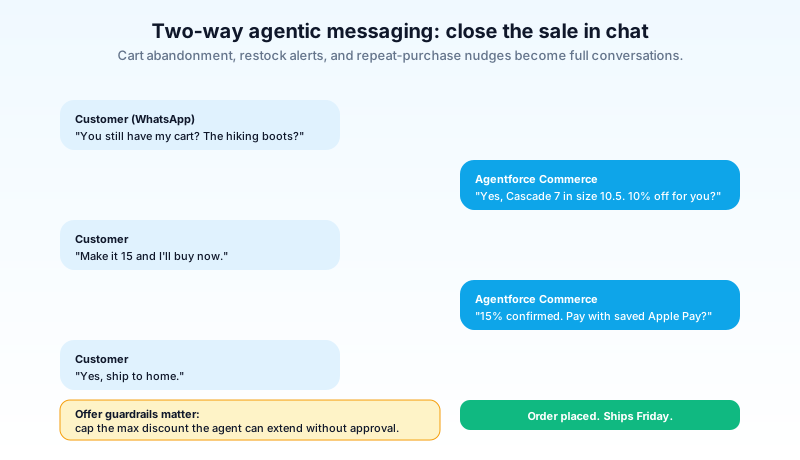
The use cases that work today:
- Cart-abandonment recovery. Customer leaves with three items in cart, the agent sends a WhatsApp message thirty minutes later with a 10 percent first-time-buyer offer, customer replies "make it 15", agent generates a one-time code, customer completes purchase in-thread.
- Re-stock notifications. Customer signed up for back-in-stock alert, item is back, the agent sends an SMS, customer replies "two please in size medium", agent confirms inventory, takes payment, ships.
- Repeat-purchase nudges. Customer last bought 30 days ago in a category with a 35-day repurchase median. Agent sends an email at day 30, customer replies with the order, agent processes.
- Question-answering during the funnel. Customer asks "does this work with X", agent retrieves the compatibility data from Product Information Management, responds with a yes/no plus a citation.
The use cases that still need a human:
- High-value B2B negotiations.
- Cancellations, refunds, and disputes.
- Anything where the customer is upset.
Route those to the service or sales agent path.
The Trust Layer architecture is the same as Service Agent and Marketing Agent: intent classify, retrieve product and customer data, draft response, scan for PII echo and toxicity, send. The commerce-specific guardrail is the offer-generation logic. The agent should not generate a discount the merchandiser did not pre-approve. Configure offer guardrails before enabling agent-driven offer generation.
Merchandiser automation
The merchandising team's day shifts the most under Agentforce Commerce.
Old work: log in every morning, review the inventory dashboard, manually update the "Featured" list, manually remove out-of-stock items from the homepage hero, manually re-rank the category page based on the previous day's performance.
New work: configure rules ("promote items with margin above 30 percent and inventory above 500 units", "bury items with inventory below 20 units", "feature trending items based on click velocity"), let the agent run the daily updates, review the agent's recommendations weekly, override when needed.
The agent is not making category-strategy decisions. It is automating the operational tier of merchandising work that used to consume the team's morning. The category-strategy work moves to the weekly review, where the team studies the agent's data on what worked and what did not, and adjusts the rules.
For categories where merchandising judgment is critical (luxury, beauty, fashion editorial), the agent runs in suggest-only mode. The merchandiser approves each change. For commodity categories (electronics accessories, household basics), the agent runs in execute mode. The merchandiser audits the changes weekly.
ChatGPT and the catalog syndication question
This is the new traffic source that did not exist in 2024.
Brands using Agentforce Commerce can syndicate their product catalogs to ChatGPT and similar consumer AI channels. Customer asks ChatGPT "I need a new vacuum cleaner under $300 with good pet-hair pickup", ChatGPT searches its connected catalogs, surfaces your products with descriptions and links, customer clicks through and buys.
The 119 percent traffic-volume increase number Salesforce cited at the launch is real for early adopters and worth watching as a steady-state metric, not a peak. The composition of that traffic is different from organic search or paid social. Customers arriving via AI assistants have higher intent (they already described what they wanted to the AI), shorter consideration windows (they expect to buy now), and less brand affinity (they are buying the product the AI recommended, not the brand they preferred).
The practical implication for merchandising: the product detail pages have to stand alone. A customer arriving via ChatGPT has not seen your homepage, your brand story, your trust signals. The PDP has to do the conversion lift it never had to do when the customer arrived via a branded campaign.
The longer-term implication for the commerce stack: optimizing for the AI-assistant referral source becomes a discipline like SEO was a decade ago. Schema markup, structured product attributes, clean comparison data, and explicit use-case tagging all matter more than they did when search engines were the only intermediary.
Agentforce Localization for B2B Guided Shopping
For B2B Commerce customers selling across markets, Agentforce Localization is the smaller-but-meaningful 2026 feature.
The B2B Guided Shopping experience now interacts with buyers in their preferred language and locale. The agent reads buyer profile data, identifies the locale, and switches conversational language without requiring a separate translated storefront. A buyer in Munich gets German prompts, German offer copy, and Euro pricing without the merchant maintaining a separate German storefront with separate inventory.
The localization layer handles three jobs the merchant used to do manually: language translation of agent responses, locale-specific tax and shipping rule application, and culturally-adjusted offer wording (the same discount is framed differently in a Tokyo conversation than a Berlin conversation).
The catch: localization works against the source product data the merchant maintains. Product names, descriptions, and category labels still need translation by either the merchant's team or a translation provider. The agent localizes the conversation, not the catalog. Merchants planning a multi-market rollout should still budget for catalog localization work, and treat Agentforce Localization as the agent-conversation overlay on top of that work.
The rollout pattern that works in production
The orgs that succeed at adding Agentforce features to an existing Commerce Cloud storefront follow a discipline that matches the Sales and Service rollout patterns: narrow scope, instrument tightly, expand by surface.
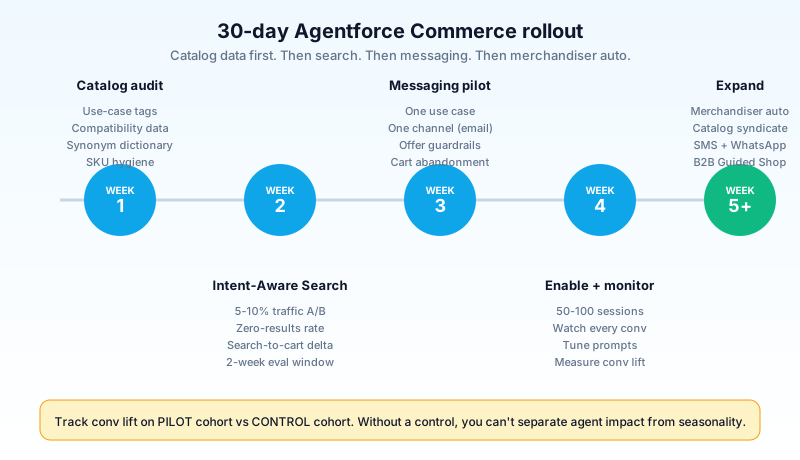
Week 1: catalog and search data audit. Pull the current product catalog. Check the structured-data quality: are all products tagged with use-cases, compatibility, and material attributes? Are SKUs without inventory still active in search? Is the synonym dictionary current? This audit determines how well Intent-Aware Search will perform when you turn it on.
Week 2: Intent-Aware Search pilot. Enable it on 5 to 10 percent of search traffic via the experiment framework. Compare zero-results rate, search-to-cart rate, and search-to-purchase against the baseline cohort. Two-week evaluation window minimum.
Week 3: two-way messaging pilot scope. Pick one use case (cart abandonment is the safest starting point). Pick one channel (email or SMS, not WhatsApp yet). Configure the offer guardrails. Set the maximum discount the agent can extend without human approval.
Week 4: enable agentic messaging on one channel. Send through fifty to a hundred abandoned carts. Monitor every conversation. Tune the prompts and offers. Watch the conversion delta against your control cohort that received no agent outreach.
Week 5+: expand. Add merchandiser automation on commodity categories first. Add the catalog syndication once your PDP audit is complete. Add B2B Guided Shopping if you run a B2B variant.
The orgs that fail enable all features at once, get inconsistent quality signals across channels, and pull back without learning what worked.
The pieces of Agentforce Commerce that are bad
Calling out what is worse, with specifics:
The B2C / D2C / B2B unification is more story than reality for existing customers. Salesforce announced the unified platform. If you are a net-new customer designing in 2026, you get the unified version. If you are running B2C Commerce on the Demandware-era stack, you are still on that stack with Agentforce features layered on. The full migration to the unified platform is a multi-quarter project for most enterprise customers.
ChatGPT catalog syndication is early. The traffic numbers are encouraging. The conversion economics, the attribution back to AI-assistant referrals, the cannibalization analysis vs other channels, all of that is still developing. Treat the AI-assistant channel as an investment and instrument it carefully before betting big budget on it.
Headless complexity is unchanged. Headless on B2C via SCAPI or on D2C via LWR is still a real engineering project. The new Agentforce features (Intent-Aware Search, agentic messaging) ship on the managed storefronts first, with headless integration following. Headless customers should expect a lag.
Pricing is consumption-based at the agent layer. Two-way messaging burns credits per turn. Intent-Aware Search burns credits per query. Agentforce 1 at the predictable tier is the answer for large commerce orgs. The mid-market complaint is the same as in the other Agentforce SKUs: budgeting is hard before deployment.
Real issues, not dealbreakers. The platform is a genuine step forward for B2C and D2C commerce in 2026. The rough edges are what to plan around.
What to do next
Open the merchandising dashboard in your B2C or D2C storefront. Pull the zero-results-rate metric from the last 30 days. That number is the single best argument for piloting Intent-Aware Search. If your zero-results rate is above 5 percent of searches, the math on Intent-Aware Search ROI is straightforward.
If you sell B2C, the next concrete move is the catalog syndication evaluation. Pick one product category. Syndicate it to the consumer AI channels Agentforce Commerce supports. Watch the referral traffic for sixty days. If the traffic and conversion economics work, expand. If they do not, the catalog is still on file and you have lost nothing.
Open one product detail page in your storefront. Read it as a customer who arrived via ChatGPT, not via your homepage. Does it stand alone? Does it answer the use-case question without requiring brand context? If no, that is tomorrow's first improvement.
About the Author
Dipojjal Chakrabarti is a B2C Solution Architect with 29 Salesforce certifications and over 13 years in the Salesforce ecosystem. He writes and edits salesforcedictionary.com, published by KineticBit Inc., to help admins, developers, architects, and cert/interview candidates sharpen their fundamentals. More about Dipojjal.
Share this article
Sources
Related dictionary terms
Practise it
Five questions on Agentforce Specialist
Exam-style questions with an explanation after each one. No account needed, and your answers build a weak-topic map once you have one.
Keep reading
Agentforce Marketing: The Complete 2026 Guide (Formerly Marketing Cloud)
Marketing Cloud is now Agentforce Marketing. This 2026 guide covers conversational email, real-time segments, brand settings, business units, and the rollout that does not stall in pilot.

Agentforce Sales: The Complete 2026 Guide (Formerly Sales Cloud)
Sales Cloud got a new name and five new agents. This 2026 guide cuts through the marketing: what changed, the SDR and Sales Coach agents, the pricing tiers, and the 30-day rollout that actually works.

What Is Salesforce Headless 360? The Complete 2026 Guide for Developers, Admins & Architects
Salesforce Headless 360 exposes Salesforce capabilities as APIs, MCP tools, and CLI commands so work can happen in agents, Slack, voice, and custom apps without relying on the browser UI.
Comments
No comments yet. Start the conversation.
Sign in to join the discussion. Your account works across every page.