
Salesforce Sales Cloud vs Service Cloud: Which Do You Need in 2026?
Shared platform, sales-only features, service-only features, pricing under the unified UPC, and 6 decision scenarios that end the argument.

A founder asks you, three weeks before the contract renewal, whether the company should "switch to [Service Cloud](/terms/service-cloud)" because the support team is drowning. You open the org and see twenty sales reps using Opportunities, eight support reps using Cases in the same Sales Cloud license, and an SLA program nobody has set up. The switch they want is real, but the framing is wrong. They do not need to switch; they need to add. This guide is the one I wish I had on the call that day.
The "Sales Cloud or Service Cloud" question only feels like a binary choice if you have never deployed both. In practice, every customer-facing org has both. Sometimes from day one, more often by year two. The real questions are: which do you start with, what is actually cloud-specific (versus platform), and how does pricing work in the unified license model?
This guide answers all three.
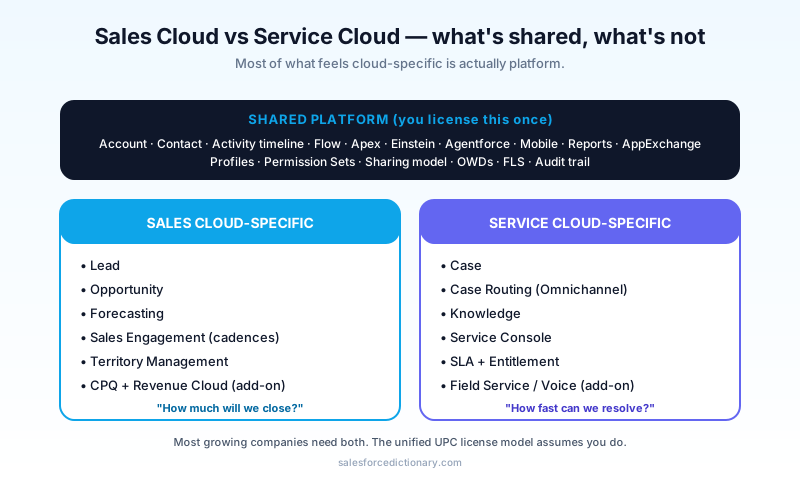
What both clouds share
Most of what feels "Sales Cloudy" or "Service Cloudy" is actually platform. Built once, licensed once.
- Account, Contact. Both clouds manage relationships against the same shared records.
- Activity timeline. Tasks, Events, Emails, Logged Calls. One unified history per record.
- Flow, Apex, Einstein. Automation, code, and AI work the same way.
- Agentforce. Same platform, same Atlas, same Trust Layer. You build agents once and surface them in either cloud.
- Mobile app, dashboards, reports, AppExchange. All platform-native.
- Security model. Profiles, Permission Sets, sharing rules, FLS, OWDs all work identically.
If your team uses any of the above, you are already on Salesforce Platform. Sales Cloud and Service Cloud are expansions of that foundation, not separate stacks. That single framing prevents most of the noise in the original question, because the conversation shifts from "should we replace what we have?" to "which capabilities should we turn on?"
Sales Cloud: what is actually Sales-only
Buy Sales Cloud when sales reps are the primary users. The Sales-specific objects and features:
| Feature | What it does | Why it matters |
|---|---|---|
| Lead | Pre-qualified prospects | Convert to Account + Contact + Opportunity in one step |
| Opportunity | Active deals with stage + amount | Pipeline currency; basis for forecasting |
| Forecasting | Roll-up of weighted Opportunities by territory | What your CFO actually trusts |
| Sales Engagement | Cadences, calls, emails | Inside-sales / outbound activity tracking |
| Territory Management | Geographic/account assignment rules | Complex sales orgs |
| Quote + CPQ (separate SKU) | Configure-Price-Quote | Complex pricing, approvals |
| Revenue Cloud (separate SKU) | Subscription revenue + billing | Subscription/SaaS models |
Sales Cloud is right when: your team's primary metric is pipeline and deal velocity. If "How much will we close this quarter?" is the most-asked question in your weekly meeting, you need Sales Cloud. A useful follow-up test: does your CFO routinely ask for a forecast roll-up by territory or business unit? If yes, you not only need Sales Cloud, you probably need Sales Cloud at a tier that includes Collaborative Forecasts.
Service Cloud: what is actually Service-only
Buy Service Cloud when customer-support agents are primary users.
| Feature | What it does | Why it matters |
|---|---|---|
| Case | Customer support ticket | Replaces email-based support |
| Case Routing | Skill-based, queue-based, manual | Without it, support does not scale |
| Knowledge | Internal + public articles | Powers self-service deflection + agent answers |
| Omnichannel | Unified routing across web, chat, voice, social | Required when channel volume splinters |
| Service Console | Multi-record agent UI | The default workspace for support reps |
| SLA + Entitlement | Time-based response/resolution targets | Required for paid support tiers |
| Field Service (separate SKU) | Mobile dispatch + work orders | Anyone with field technicians |
| Service Cloud Voice | Embedded telephony | Replaces standalone call-center stacks |
Service Cloud is right when: your team's primary metric is resolution time and customer satisfaction. If "How fast can we get back to customers?" drives weekly meetings, you need Service Cloud. The other tell is channel diversity. Once you have customers reaching you through email, chat, web form, voice, and at least one social channel, the per-agent productivity gain from Omnichannel routing pays for the upgrade in roughly one quarter.
The "Service Cloud User" license
A licensing trap. A Sales Cloud user cannot work on Cases by default, even though the Case object is technically there. To work on Cases, the user must be marked as a Service Cloud User (a checkbox on their User record), which requires a Service Cloud license to be available in the org.
Two practical implications:
- If you bought 50 Sales Cloud licenses and want one rep to work on escalations, you need at least one Service Cloud license assigned to that rep.
- The unified UPC (User Pricing Catalog) since 2024 simplifies this. Most companies now buy a unified Salesforce license that covers both clouds plus a base of platform features. Look at your contract, not at SKU lore. If you cannot tell from your contract whether a given user has Service Cloud rights, your AE can pull that report in five minutes; ask before assuming.
Pricing under the unified UPC
Salesforce's UPC consolidated dozens of legacy SKUs into a tiered set of "User" licenses (Foundations, Pro, Enterprise, Unlimited, Unlimited+). Higher tiers include both Sales and Service Cloud capabilities. Add-ons are licensed separately:
- Service Cloud Voice. Per-minute or per-user.
- CPQ + Billing / Revenue Cloud. Per-user.
- Field Service. Per-user (technicians) plus per-dispatcher.
- Agentforce capacity. Per-conversation.
- Data Cloud. Credit-based.
In 2026, the question "do I need Sales Cloud or Service Cloud?" has been mostly subsumed by the question "what tier of unified license do we need?" Talk to your AE about the capabilities you will use, not the legacy product names. The tiers are designed so most companies do not have to choose; the choice is between Enterprise and Unlimited, with the add-ons sized to your actual workload.
A practical budgeting tactic: model your license cost as base license plus add-ons separately. The base scales linearly with headcount and is easy to forecast. Add-ons scale with usage and are the line items finance most often misses. Build a quarterly review of add-on consumption into your operating cadence and renewal conversations get noticeably easier.
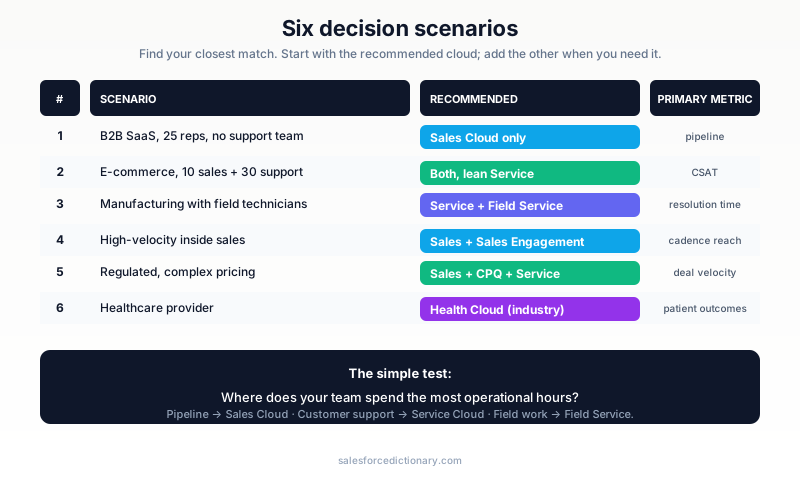
Six decision scenarios
For each, the recommended answer.
| # | Scenario | Recommended | Why |
|---|---|---|---|
| 1 | B2B SaaS, 25 reps, no support team | Sales Cloud only | Service work is light enough to handle in email |
| 2 | E-commerce, 10 sales + 30 support | Both, lean Service | Support volume dominates |
| 3 | Manufacturing with field technicians | Service Cloud + Field Service | Sales Cloud comes later if needed |
| 4 | High-velocity inside sales, no service | Sales Cloud + Sales Engagement | Cadences are the differentiator |
| 5 | Regulated industry, complex pricing | Sales + CPQ + Service | Quote complexity + audit trail demand both |
| 6 | Healthcare provider | Health Cloud (built on both) | Use the industry SKU |
If your business model is not on this list, the test is simple: where does your team spend the most operational hours? That is the cloud you start with. Watch the operational-hours signal over time, because it shifts. A B2B SaaS that hits product-market fit suddenly grows support volume, and the operational-hours center moves from sales to service inside two quarters.
How Agentforce changes the picture
Agentforce agents work in both clouds. Same Topics, same Actions, same Atlas Reasoning Engine. But the use cases differ.
- Sales-side agents. Lead enrichment, meeting summarization, opportunity coaching, RFP drafting, follow-up email drafting, forecasting commentary.
- Service-side agents. Case deflection, knowledge-article suggestion, ticket routing, sentiment monitoring, agent-assist during a live conversation, post-resolution survey follow-up.
A common 2026 pattern: a single "Customer 360 agent" that spans both, grounded in Data Cloud, able to pull from Opportunities and Cases when answering. The agent does not care which cloud you are licensed for, but its Actions must respect FLS and sharing. That last constraint is what trips up the first generation of cross-cloud agents in most orgs; the fix is upstream in the permission model, not in the agent definition.
A second pattern emerging in 2026: agent-driven warm handoff. The sales-side agent on a lead conversion call detects a service question, files a Case, and routes a draft response back through the service-side agent for the rep to confirm. The customer sees one continuous experience; the back-end is two agents sharing a Customer 360 record. Build for this from the first agent; do not let the sales and service agents grow in isolation.
Common mistakes
- Buying Sales Cloud when you need Service Cloud. Cases in Sales Cloud are second-class. If support is core to your business, start with Service.
- Building Service workflows in Sales Cloud Cases. It works for roughly six months. Then routing, SLA, and Omnichannel demands force a re-platform.
- Treating Knowledge as documentation. Knowledge is part of the resolution workflow. It deflects cases, surfaces during agent assist, grounds Agentforce. Treat it as product.
- Ignoring the Service Cloud User flag. Tickets pile up in mystery queues until someone notices the rep cannot see them.
- Forgetting that Sales Cloud and Service Cloud share Profiles and Permission Sets. A user can be both. It is not an either/or per person.
- Skipping a unified data model exercise. When you stand up Service alongside Sales, the temptation is to bolt Cases onto the existing data model. Spend a week deciding which fields are shared, which are cloud-specific, and which belong on Account versus Contact. The data-model decisions made in that week shape the next three years of reporting.
Frequently asked questions
Can I migrate from Service Cloud to Sales Cloud (or vice versa)? You do not migrate. You add. The two coexist on the same org with no data migration. You buy additional licenses and turn on the features you need.
Is Service Cloud more expensive than Sales Cloud? Historically, yes. Slightly. Under unified UPC pricing, the difference shows up in tier choice and add-ons (Voice, Field Service, Live Agent) more than in base license cost.
Does Agentforce require one or the other? Agentforce works on the platform. You do not need either Sales or Service Cloud specifically, but most agent use cases involve objects from one or both, so you will have one of them in practice.
What if my org uses both heavily, is there a "Salesforce 360" SKU? Effectively, yes. The Unlimited and Unlimited+ tiers include broad capability across Sales, Service, and platform. Plus add-ons.
How does this compare to HubSpot or Microsoft Dynamics 365? Salesforce's clouds are deeper but pricier per seat. HubSpot wins on usability for SMB; Dynamics wins for Microsoft-stack integration. Salesforce wins on enterprise-scale, AppExchange depth, customization, and now Agentforce.
How do reports work across both clouds? Reports run against shared objects (Accounts, Contacts, Activities) without any extra work and pull from cloud-specific objects (Opportunities, Cases) the same way. The complication is when you want a single report that joins both, for example "Accounts with open Opportunities and open Cases." That requires a custom report type or a Data Cloud-backed view; build the report type once and reuse it.
What to read next
- Lead, Opportunity, Case, Knowledge Article: the dictionary entries.
- What Is Agentforce 360?: how agents work across both clouds.
- Profile vs Permission Set vs PSG: managing access across both clouds.
If your business sells and supports customers, you will end up with both. The only question is which you stand up first, and the answer is the one your team spends more hours doing.
About the Author
Dipojjal Chakrabarti is a B2C Solution Architect with 29 Salesforce certifications and over 13 years in the Salesforce ecosystem. He writes and edits salesforcedictionary.com, published by KineticBit Inc., to help admins, developers, architects, and cert/interview candidates sharpen their fundamentals. More about Dipojjal.
Share this article
Sources
Related dictionary terms
 Our appAdWake up sharp. Not just awake.The alarm that rings through Silent and DND — free on iOS & Android.Get WakeSharp →
Keep reading

Profile vs Permission Set vs Permission Set Group: The Complete Salesforce Access Guide
Profiles, Permission Sets, and Permission Set Groups all grant 'access' but in different layers. Here is the canonical 2026 guide with a mnemonic that finally makes it stick.

What Is Agentforce 360? The Complete 2026 Guide for Salesforce Admins, Developers & Architects
Agentforce 360 is Salesforce's 2025 rebrand of its agentic-AI platform - built on the Atlas Reasoning Engine, Einstein Trust Layer, and Data 360. Here's the complete admin + dev + architect guide.


Comments
No comments yet. Start the conversation.
Sign in to join the discussion. Your account works across every page.