
Salesforce Exits the Russell Top 50
Salesforce dropped out of the Russell Top 50 in the June 2026 reconstitution, effective today. The stock is down 45% from its high while Agentforce grows 205%. Here is the disconnect.

Salesforce is no longer one of the fifty largest companies in the United States. As of the June 2026 FTSE Russell reconstitution, effective after the close on Friday, June 26, the stock was dropped from the Russell Top 50 Index. Today, Monday, June 29, is the first trading day with the reconstituted indexes in place.
The exit is mechanical, not a verdict. The Russell Top 50 tracks the fifty biggest US stocks by market cap. Salesforce fell out because its market cap fell. That is the whole story on the surface. Underneath it sits a stranger one: the company is shrinking on the tape while its AI business grows faster than almost anything else in enterprise software.
What the Russell Top 50 exit actually means
The Russell Top 50 is a megacap index. It holds the fifty largest US companies by market value and gets rebuilt twice a year. Rank day for this reconstitution was April 30, 2026. On that date, the index providers ranked every eligible US stock and drew the line at number fifty.
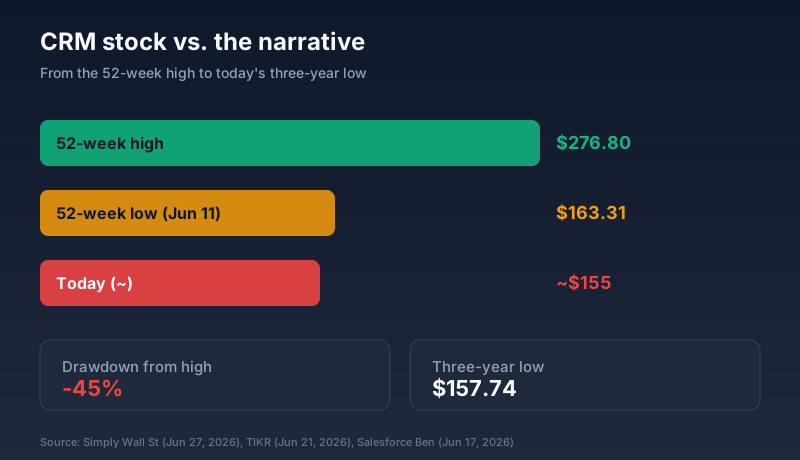
Salesforce landed below the line. At its 52-week high of $276.80, the company was worth roughly $271 billion. By late June, with CRM trading near $151 to $158, market cap had fallen to somewhere around $147 to $155 billion. That is a brutal slide in absolute dollars, but the bigger problem is the company it keeps. Apple, NVIDIA, and Microsoft each sit near or above $3 trillion. When the top of the market is measured in trillions, a $150 billion company has no business in a top-fifty club. The math pushed Salesforce out.
Here is the part that matters for anyone holding the stock. Index funds that track the Russell Top 50 are required to mirror the index. When CRM leaves, those funds have to sell it. Not because a portfolio manager soured on Agentforce. Because the rulebook says so. This is passive, technical selling, and it clusters around the effective date. Reconstitution Fridays are some of the highest-volume trading days of the year for exactly this reason.
So part of the recent pressure on CRM is structural. Forced sellers do not care about gross margin. They care about tracking error.
The SpaceX angle on the same reconstitution
The June 2026 reconstitution had a marquee addition that tells you how the index machinery is changing. SpaceX joined the Russell indexes, and it did so under a new FTSE Russell fast-track rule that lets a newly listed company enter just five trading days after its listing, rather than waiting for the next scheduled reconstitution.
SpaceX went into the broad Russell 1000, not the Top 50, so it is not a like-for-like swap with Salesforce. But it is the same event, and it frames the day. One of the most watched private companies in the world walked into the index on a rule that did not exist a year ago, while one of the defining SaaS names of the last decade walked out. The same week, Alphabet joined the Dow Jones Industrial Average. The composition of the megacap club is shifting toward AI infrastructure and away from application software, and the June rebalance put that shift on paper.
The paradox at the center of the story
Now the disconnect. Salesforce is being de-rated by the market while its AI numbers accelerate.
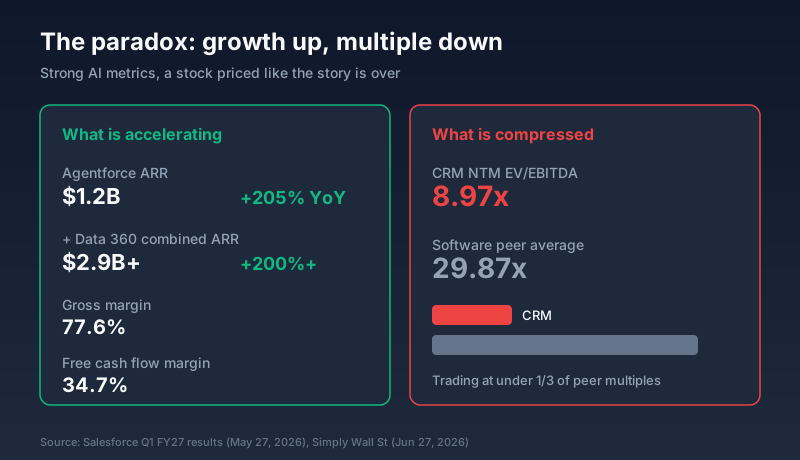
Start with the operating results. In Q1 FY27, reported May 27, 2026, Agentforce reached $1.2 billion in annual recurring revenue, growing 205% year over year. Combine Agentforce with Data 360 and the figure passes $2.9 billion in ARR, still growing north of 200%. Total quarterly revenue came in at $11.13 billion. Adjusted EPS hit $3.88, a beat. Operating margins set records. Fiscal 2026 revenue was $41.5 billion, up roughly 10%.
Now the valuation. CRM trades at about 8.97x next-twelve-months EV/EBITDA. The software peer average is 29.87x. Salesforce changes hands at less than a third of what comparable companies command. Its gross margin is 77.6%. Its free cash flow margin is 34.7%. These are not the numbers of a broken business. They are the numbers of a profitable, cash-generating platform trading like the growth story is over.
The market is pricing in a specific fear: that Agentforce, however fast it grows in isolation, is not yet large enough to move the total revenue line at the pace investors want. A $1.2 billion ARR product inside a $41.5 billion revenue company is real, but it has to keep compounding for years before it dominates the top line. That gap between product momentum and consolidated growth is what the multiple is punishing.
Agentforce is shipping in the real world
The skeptic's question is whether Agentforce is a demo or a deployment. Recent customer news leans toward deployment.
On June 22, 2026, Salesforce and Visa Cash App Racing Bulls, the Formula 1 team known as VCARB, announced a partnership built on Agentforce 360 and Slack. The centerpiece is TORO, an AI agent built on Agentforce 360 that generates real-time data visualizations on garage screens through Tableau dashboards. The team also stood up a dedicated Slack community for fans and handed VIP Paddock Club logistics to Agentforce 360.
A race weekend is an unforgiving environment for software. Data moves fast, the schedule does not bend, and the screens have to be right the moment a car comes in. Putting an Agentforce agent in that loop is a credibility signal. It is one data point, not a trend, but it is the kind of named, operational deployment that the $1.2 billion ARR figure is supposed to be made of.
The investment case math
This is where analysts and the stock disagree, sharply.
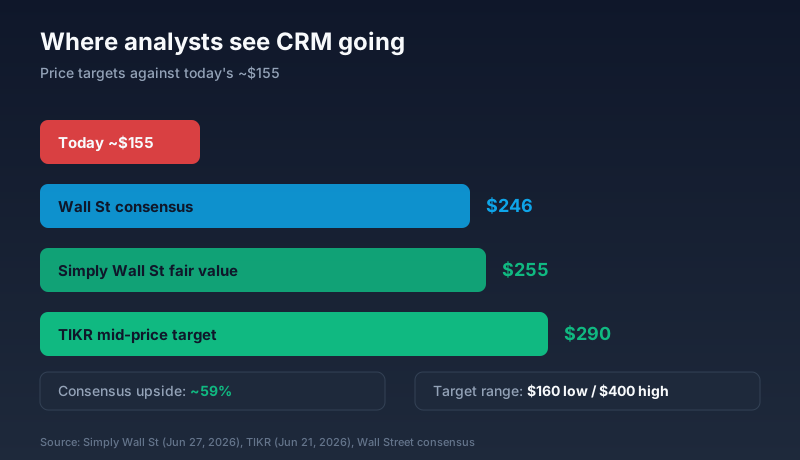
Simply Wall St, in its June 27 piece about the Russell exit, put fair value at $255.28. Against a price near $158, that is roughly 61% upside. TIKR's June 21 analysis carried a mid-price target near $290, about 94% upside. Wall Street's consensus average target sits around $246. The spread on the street is wide: the highest target is $400, the lowest is $160. The ratings skew bullish, with about 30% of analysts at Strong Buy, 42% at Buy, 21% at Hold, and 6% at Sell.
Every one of those bullish targets rests on the same assumption. AI monetization has to pick up through the back half of fiscal 2027 and translate Agentforce growth into faster consolidated revenue. Simply Wall St's model projects revenue reaching $56.7 billion by 2029 to justify its number.
The near-term wrinkle is guidance. Q2 FY27 guidance came in at $11.27 billion to $11.35 billion, just under the $11.36 billion consensus. A small miss on the outlook, but enough to feed the worry that revenue acceleration is still a quarter or two away. That light guide, plus the index-driven selling, is a fair part of why the stock sits where it does.
So you have a three-year low of $157.74, a 45% drawdown from the high, forced index selling, and a slightly soft guide on one side. On the other, you have 205% Agentforce growth, record margins, a 34.7% free cash flow margin, and a multiple at a third of peers. Both sides are real. The resolution comes down to whether the AI revenue shows up on the consolidated line, and when.
What to watch next
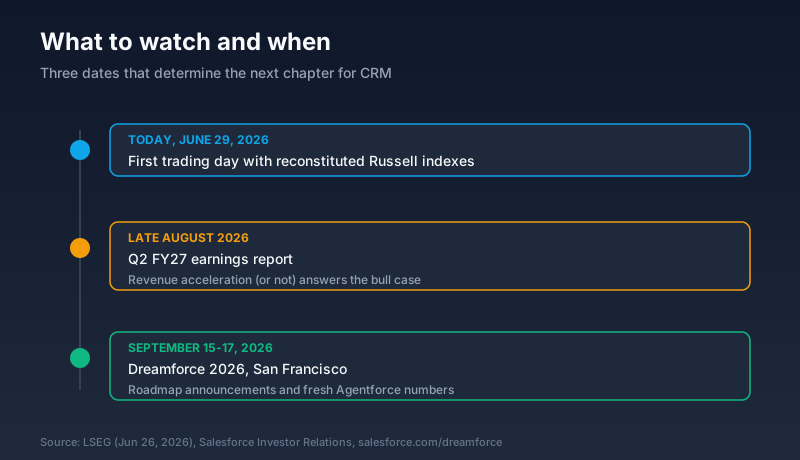
Two dates carry the next chapter.
Q2 FY27 earnings are expected in late August 2026. That report is the proof point. The bull case needs to see organic revenue accelerate and the soft Q2 guide cleared, not just Agentforce ARR climbing in isolation. If consolidated growth ticks up and management raises the full-year outlook, the valuation gap has a reason to close. If revenue stays in the high single digits while Agentforce keeps sprinting, the de-rating likely holds.
Dreamforce 2026 follows on September 15 to 17 in San Francisco. Expect roadmap announcements and fresh Agentforce customer numbers. Dreamforce moves narrative more than fundamentals, but in a year where the narrative is the whole fight, it matters.
What to do with this
If you hold CRM, separate the signal from the noise. The Russell Top 50 exit is a market-cap event with a mechanical selling tail, not a downgrade of the business. Near-term volatility around the reconstitution is normal and should fade. The real catalyst is the August earnings print, so anchor your thesis to revenue acceleration, not to a Friday rebalance.
If you build on Salesforce for a living, the stock price changes nothing about your work. The product roadmap, Agentforce 360, Data 360, and the Slack-centered agentic stack ship on their own schedule regardless of where CRM trades. A company throwing off a 34.7% free cash flow margin is not about to starve its platform. Keep building, and treat the August earnings call as the read on how aggressively Salesforce will price and push agents over the next year.
About the Author
Dipojjal Chakrabarti is a B2C Solution Architect with 29 Salesforce certifications and over 13 years in the Salesforce ecosystem. He writes and edits salesforcedictionary.com, published by KineticBit Inc., to help admins, developers, architects, and cert/interview candidates sharpen their fundamentals. More about Dipojjal.
Share this article
Sources
- How Salesforce's Russell Top 50 Exit Amid Agentforce Momentum Has Changed Its Investment Story (Simply Wall St)
- FTSE Russell Begins June 2026 Semi-Annual Russell US Indexes Reconstitution (LSEG)
- Salesforce Has Fallen 45%. Could 2026 Be the Turning Point? (TIKR)
- SpaceX Joins the Russell 1000: What This Friday's Historic Index Rebalancing Means for Your ETF (ETF.com)
- Salesforce Delivers Record First Quarter Fiscal 2027 Results (Investor Relations)
- VCARB Partners with Salesforce to Supercharge Fan Engagement with AI, Deploying Agentforce 360 (Salesforce Newsroom)
Related dictionary terms
Practise it
Five questions on Agentforce Specialist
Exam-style questions with an explanation after each one. No account needed, and your answers build a weak-topic map once you have one.
More news

Salesforce Stock Hits 52-Week Low
Salesforce stock set a new 52-week low of $163.31 on June 11, 2026, down roughly 37% this year, while Agentforce ARR surged 205% to $1.2 billion. The disconnect explained.

Agentforce vs. ServiceNow: Who Wins?
Agentforce hit $1.2B ARR growing 205% while ServiceNow grows steadily at 21%. Two platforms, two different jobs. Here is where each wins and why most enterprises will run both.

Help Agent Pay-Per-Resolution
Salesforce launched Agentforce Help Agent on June 25, 2026, with pay-per-resolution pricing at $2 per resolved issue. Here is how it works and where it breaks.
Comments
No comments yet. Start the conversation.
Sign in to share your take on this article. Your account works across every page.