
Agentforce vs. ServiceNow: Who Wins?
The Motley Fool and analyst firms published the same question this week: which platform wins enterprise AI? A grounded answer, by the numbers.

Salesforce posted Agentforce ARR of $1.2 billion in Q1 FY27, up 205% year over year. The Motley Fool ran a piece on June 23, 2026 asking a question that has been building for months: Salesforce or ServiceNow, who will lead AI in business? The framing matters because both companies have now planted the same flag. Each says it will be the platform on which enterprise AI agents actually run.
Why this question matters now
For most of 2024 and 2025, enterprise AI lived in pilots. Teams stood up chatbots, ran proof-of-concept summarizers, and waited to see what stuck. That waiting period is over. AI has moved out of infrastructure and into real productivity work, and the question buyers ask has shifted from "does this work" to "whose platform do we standardize on."
June 2026 is the crystallization point because the analyst coverage converged. The Motley Fool's June 23 piece put Salesforce and ServiceNow head to head as the defining enterprise AI rivalry of the year. The CallSphere blog framed it bluntly as the enterprise AI agent platform war. The Futurum Group raised the harder question underneath all of it: whether these platforms redefine agent trust or simply deepen vendor lock-in.
Both vendors shipped real product in the same window. Salesforce took Multi-Agent Orchestration to general availability with the Summer '26 release on June 15. ServiceNow launched its AI Specialists at Knowledge 2026 in May. So this is not analysts speculating about roadmaps. It is two shipping platforms competing for the same enterprise budget line.
Where they come from
The architectural origins explain almost everything about how these two platforms behave.
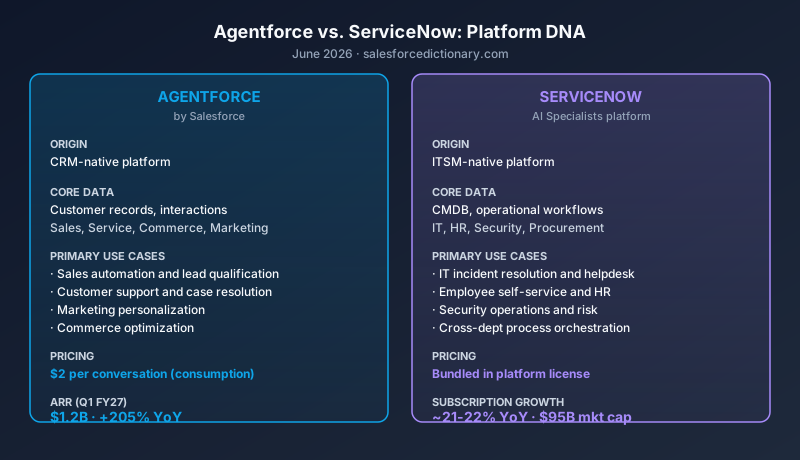
Agentforce grew out of CRM. Its data foundation is the customer record: Sales Cloud, Service Cloud, Commerce Cloud, Marketing Cloud. Agentforce agents live natively in the Salesforce data model, so an agent reasoning about a case or an opportunity is reading the same objects your sales and service teams already use. The Atlas Reasoning Engine drives how those agents plan and act. The center of gravity is the customer.
ServiceNow grew out of IT service management. Its operational context is the CMDB and the workflows that move tickets, incidents, and requests through an organization. The platform was built to orchestrate processes across departments, and that lineage shows. ServiceNow reasons about how work gets done inside a company, not about who the customer is.
That difference is not cosmetic. A platform that started with the customer record sees the world through relationships and interactions. A platform that started with ITSM sees the world through processes and operational state. Both can attach AI agents. They just point those agents at different problems.
Where Agentforce wins
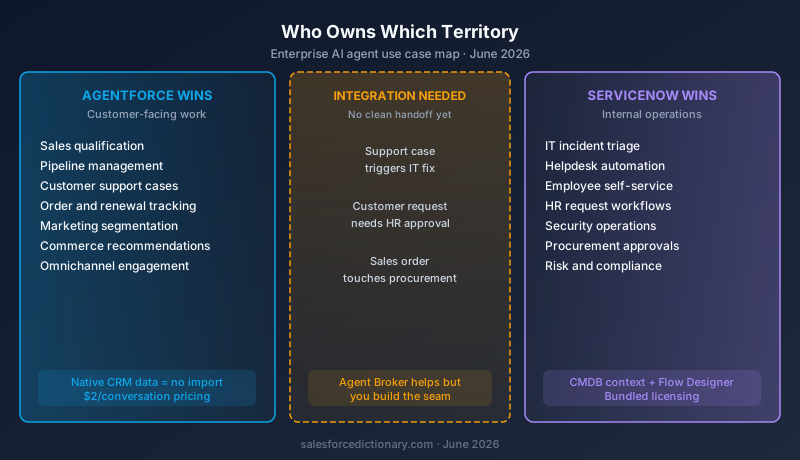
Agentforce is strongest where the work is customer-facing and the answer depends on rich relationship data.
Sales automation is the clearest case. An agent that already sits inside the opportunity, account, and contact records can qualify leads, draft follow-ups, and update pipeline without a separate integration layer. Customer support is the same story. A service agent reading live case history, entitlements, and prior interactions resolves issues with context that an external bot would have to fetch and stitch together. Marketing personalization and commerce round out the set, because both depend on the customer data Salesforce already holds.
The pricing model is consumption based: roughly $2 per conversation. That is worth thinking through carefully. Consumption pricing aligns cost with use, which finance teams like in a pilot. It also means a successful, high-volume deployment generates a bill that scales with success. For a customer support workload running millions of interactions, $2 per conversation is a number you model out before you commit, not after.
The native data advantage is the real moat here. Agentforce does not need to import the customer record because it is the customer record. That removes an entire class of integration and sync problems that any competing customer-facing agent has to solve first.
Where ServiceNow wins
ServiceNow is strongest where the work is internal and the value comes from orchestrating a process across teams.
IT incident resolution is its home turf. An agent grounded in the CMDB knows the relationships between systems, so it can triage and remediate with operational context that a CRM simply does not carry. Employee self-service, HR requests, procurement, security operations, and risk all sit in the same wheelhouse. These are back-office workflows that cross departments, and ServiceNow's Flow Designer handles that orchestration with more depth than Salesforce's current workflow tooling offers for complex back-office cases.
The licensing model is bundled rather than per-conversation. For a high-volume internal helpdesk, bundled pricing can be far more predictable than consumption billing. You are not metering every employee question. That predictability is part of why ServiceNow keeps growing subscription revenue in the low twenties percent range while sitting on a market cap around $95 billion.
If your hardest problem is moving a request through five departments with the right approvals and the right operational data at each step, ServiceNow's process depth is a genuine advantage. That is what it was built to do.
The numbers in June 2026
The financials tell two different stories depending on which line you read.
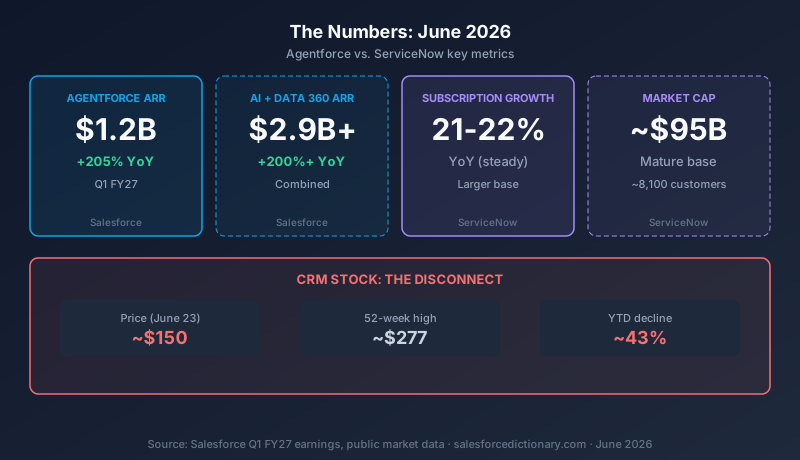
Agentforce ARR hit $1.2 billion in Q1 FY27, up 205% year over year. Combined with Data 360, the figure is north of $2.9 billion, growing more than 200%. Those are large numbers growing fast, and they are real revenue, not bookings. ServiceNow, by contrast, is a more mature line: subscription revenue growing roughly 21 to 22% year over year on a much larger base, with a market cap near $95 billion.
Then there is the stock. As of June 23, 2026, CRM traded around $150, close to its 52-week low near $146 and well off its 52-week high near $277. An earlier Motley Fool piece caught the tension exactly: the AI business is growing more than 200%, but the stock sits near a 52-week low. The market is not pricing Agentforce growth as a clean win. It is weighing that growth against deceleration in the core, the cost of building the agent platform, and the consumption-pricing question above.
Fast growth on a small base versus steady growth on a large one. That is the honest read.
The honest answer: most enterprises will run both
The framing as a winner-take-all fight makes for a good headline. It is also wrong for how enterprises actually buy.
The analyst consensus that emerged around June 23 is that this is not either/or. Most large enterprises will run Agentforce for customer interactions through their CRM and ServiceNow for internal IT and HR operations through ITSM. These are different jobs grounded in different data. A company does not pick one agent platform any more than it picks one database.
The catch is the seam between them. Neither platform makes cross-platform agent orchestration easy yet, and both vendors acknowledge it. Salesforce shipped Agent Broker for multi-vendor orchestration with Summer '26, which is a step toward letting agents from different systems coordinate. But the reality on the ground in mid-2026 is that an Agentforce agent and a ServiceNow agent do not hand work to each other cleanly. When a customer support case needs an IT system fix, that handoff is still a thing you build and maintain.
This is where the Futurum question bites. Picking both platforms means accepting lock-in on both sides, and the integration burden lands on you.
What this means for Salesforce practitioners
If you work in the Salesforce ecosystem, the takeaway is not which stock to buy. It is where your work moves.
The competitive pressure from ServiceNow pushes Salesforce to keep investing in agent orchestration and back-office workflow depth, which are historically ServiceNow's strengths. Expect Agentforce to keep reaching beyond pure customer-facing use cases. That means the skills that matter are shifting: data model design for agent grounding, consumption-cost modeling, and integration architecture across platforms you do not own.
The $2-per-conversation model is going to show up in your scoping conversations. Architects who can forecast agent volume and tie it to a defensible cost estimate will be the ones trusted to greenlight deployments. The integration seam between Agentforce and ServiceNow is also a career opening. Someone has to own that handoff, and right now very few people can design it well.
What to do now
Map your use cases to the right side first. Sort your AI agent candidates into customer-facing (Agentforce territory) and internal operations (ServiceNow territory). Do this before you talk pricing with either vendor.
Model the consumption cost. For any Agentforce customer-support use case, estimate annual conversation volume and multiply by $2. Compare that number against ServiceNow's bundled pricing for any overlapping internal workload. Bring real volume, not guesses.
Identify your handoff points. List the workflows where a customer interaction triggers an internal IT or HR process. Those are your integration risks today, because neither platform automates that handoff for you.
Test Multi-Agent Orchestration. It went GA on June 15 with Summer '26. Stand up a sandbox and validate whether Agent Broker covers your multi-vendor needs before you assume it does.
Read the primary sources. Start with the Motley Fool June 23 piece and the Futurum Group analysis on agent trust and lock-in, so your strategy rests on the actual debate and not the headline version of it.
The defining enterprise AI rivalry of 2026 is real. For most organizations the answer is both platforms, and the hard part is the seam between them. Plan for that now.
About the Author
Dipojjal Chakrabarti is a B2C Solution Architect with 29 Salesforce certifications and over 13 years in the Salesforce ecosystem. He writes and edits salesforcedictionary.com, published by KineticBit Inc., to help admins, developers, architects, and cert/interview candidates sharpen their fundamentals. More about Dipojjal.
Share this article
Sources
- Salesforce or ServiceNow: Who Will Lead AI in Business? (The Motley Fool)
- Salesforce vs ServiceNow: The Enterprise AI Agent Platform War (CallSphere)
- Will Salesforce and Databricks Redefine AI Agent Trust or Deepen Platform Lock-In? (Futurum Group)
- Salesforce's AI Business Is Growing More Than 200% but the Stock Is Near a 52-Week Low (The Motley Fool)
- Agentforce vs ServiceNow: The Complete 2026 Comparison (CustomerTimes)
Related dictionary terms
Practise it
Five questions on Agentforce Specialist
Exam-style questions with an explanation after each one. No account needed, and your answers build a weak-topic map once you have one.
More news

Salesforce x Databricks Partnership
Salesforce and Databricks expanded their Zero Copy partnership at Data + AI Summit 2026. New governance controls, federated search, and MuleSoft Agent Scanner for Databricks. Some of it GA now. Most lands in H2 2026.

Salesforce Q1 FY27: Agentforce $1.2B
Salesforce beat Q1 FY27 estimates on every major metric: $11.13B revenue, $3.88 non-GAAP EPS, $33.6B cRPO at 14% growth. Agentforce ARR crossed $1.2B at 205% growth. Then Benioff revealed engineers haven't been hired in two years.
Comments
No comments yet. Start the conversation.
Sign in to share your take on this article. Your account works across every page.