
Help Agent Pay-Per-Resolution
Salesforce launched Agentforce Help Agent on June 25 with a pricing model that only bills when the agent fully resolves a customer issue. Here is what changed and what it costs you to find out.

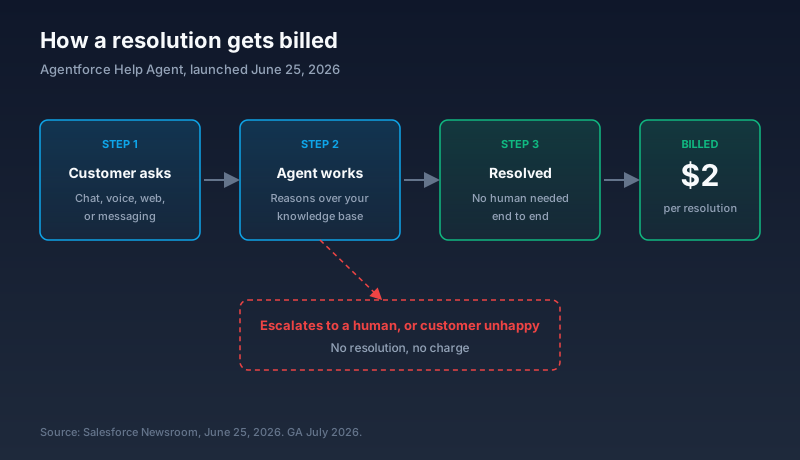
Salesforce launched Agentforce Help Agent on June 25, 2026. The product itself is a pre-packaged service agent you can stand up in minutes. The headline is the price tag: you pay only when the agent resolves a customer issue end to end, at $2 per resolution. No resolution, no charge. That is a real break from how Salesforce has billed Agentforce until now.
Here is what shipped, how the pricing actually works, and the spots where the model gets uncomfortable.
What Agentforce Help Agent is
Help Agent is an autonomous service agent built on the Agentforce 360 platform. The selling point is speed to value. Guided setup walks you through connecting your knowledge base and enabling channels from a single screen. Salesforce says you can deploy in minutes rather than weeks.
It runs across the channels customers actually use. Chat, web, messaging, and voice. For voice, the agent provisions phone numbers so it can take calls directly. It comes with built-in skills for appointment scheduling, order management, and account management, plus a search experience that behaves like a search bar and then drops into a conversation.
The proof point Salesforce keeps pointing to is its own help portal. Help.salesforce.com handled 4.3 million inquiries and resolved 70 percent of them autonomously. That is the number the whole pitch rests on, and it is a number from Salesforce running Salesforce, so weigh it accordingly.
Help Agent and the companion Agentforce Customer Service Portal both reach general availability in July 2026. The pay-per-resolution pricing lands at the same time.
How pay-per-resolution actually works
This is the part worth slowing down on, because the definition of "resolution" is where the money is.
You buy resolutions in packets. The minimum purchase is 1,000 resolution packets. Each successful resolution costs $2. A resolution counts when the agent answers the customer's question without needing a human to step in.
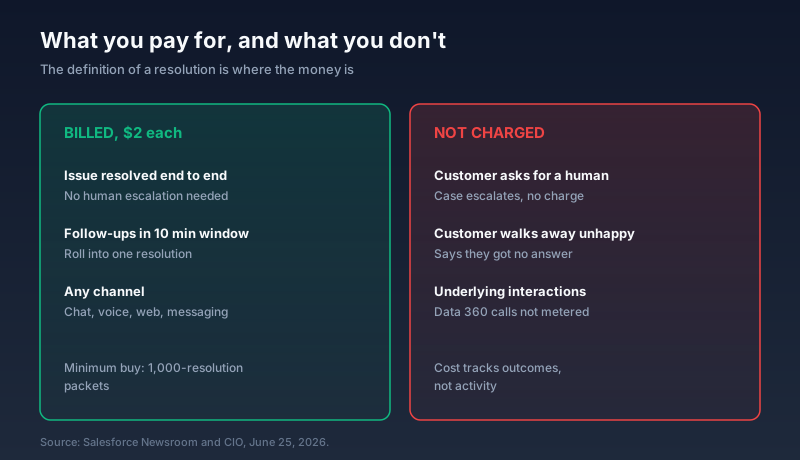
Three things do not trigger a charge:
- The customer asks for a human and the case escalates.
- The customer explicitly says they did not get an answer.
- Follow-up questions inside a 10-minute window roll into the same resolution rather than billing as new ones.
Krishnan Chetan, EVP and GM for the platform, framed it plainly: a resolution means "the user's question doesn't need a human escalation." Salesforce's own summary is blunter: "If the customer asks for a human or walks away unhappy, there is no charge."
There is one more detail that matters for budgeting. During a Help Agent engagement, the underlying Data 360 and Agentforce interactions are not metered separately. You are not paying for tokens, retrieval calls, or reasoning steps on top of the resolution fee. The $2 is the line item.
Why this is a real shift
Salesforce has changed its Agentforce billing three times now, and the direction tells a story.
The first model was per-conversation. Every conversation cost about $2 whether the agent helped or not. Then came Flex Credits, a consumption model where actions drew down a credit balance. Now the meter only moves on a resolved outcome.
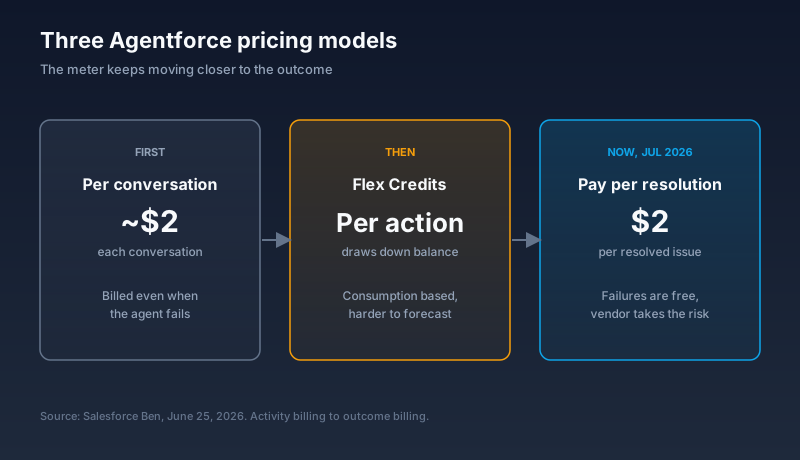
The change is more than cosmetic. Under per-conversation pricing, a customer who opened a chat, got nowhere, and rage-quit to a human still cost you money. You paid for the activity. Under pay-per-resolution, that same failed interaction is free. Your spend tracks the work that actually landed.
Keith Kirkpatrick at Futurum Group called it what it is: Salesforce is "transferring performance risk from buyer to vendor." For two years the loudest objection to enterprise AI has been ROI. Buyers could not tie spend to results. This pricing answers that objection directly by refusing to bill for failure.
It also legitimizes a model that smaller players have pushed for a while. Outcome-based pricing already shows up at Decagon, Intercom, and Zendesk, with hybrid versions at ServiceNow, UiPath, and others. Kirkpatrick's point is about scale: when an incumbent the size of Salesforce commits to pay-per-resolution, it stops being a startup gimmick. Futurum's survey data backs the timing. Roughly 18.7 percent of enterprises now use outcome-based pricing, near parity with the 17.1 percent on per-user models for the first time.
Where the model gets uncomfortable
A pricing model that sounds this friendly to buyers has to make its money somewhere, and the seams are visible.
Start with the obvious gaming risk. The agent does not charge if the customer "walks away unhappy" or says they did not get an answer. A customer who learns that pattern can get free support by claiming dissatisfaction at the end of every interaction. At consumer scale, even a small fraction doing this shifts the economics. Salesforce has not published how it distinguishes genuine non-resolution from a customer dodging the implied courtesy of a satisfied close.
Then there is the cost side for Salesforce itself. The vendor now eats the compute for every failed interaction. Reasoning models are not cheap, and a customer who burns through a long, multi-turn conversation that ends in escalation costs Salesforce real money and bills the buyer nothing. The model assumes the 70 percent autonomous resolution rate holds across messier orgs than help.salesforce.com. If your knowledge base is thin or your cases are genuinely hard, the agent resolves less, you pay less, and Salesforce absorbs more. That is fine for you and a problem for them.
Kirkpatrick flagged the deeper enterprise blocker, and it is not price. It is governance. His read is that "governance, not technology, has become the gating factor for scale." Regulated industries need auditability, clean escalation paths, and compliance controls before they let an autonomous agent close cases unsupervised. Pay-per-resolution does nothing to answer that, and a finance or healthcare buyer will not care that a misfire was free if the misfire created a compliance incident.
The open question Futurum poses is whether large enterprises actually stay on this model or whether risk aversion pulls them back to predictable per-seat pricing within 12 months. Outcome-based billing is great until your CFO cannot forecast next quarter's support cost because it floats with resolution volume.
What this means next to the rest of Agentforce
Help Agent does not arrive in a vacuum. It is the third major Agentforce launch in a week. Agentforce Commerce went GA on June 24 with its three selling agents. The MCE MCP Server hit GA on June 22. Salesforce is shipping fast and pricing aggressively, and the through-line is outcomes over activity.
The strategic logic is consistent. Salesforce wants Agentforce to be judged on results because results are where it thinks it wins against ServiceNow and the pure-play AI service vendors. Tying the bill to resolved outcomes is a confidence play. It only pays off if the agent is good enough, often enough, across enough orgs, that resolved volume covers Salesforce's compute on the failures.
For a service org, the math is now straightforward to model. Multiply your expected autonomous resolution rate by your case volume, times $2, against your current per-seat or per-conversation spend. If your knowledge is solid and your cases are routine, the new model likely wins on cost. If your support is complex and human-heavy, you will resolve fewer cases autonomously, pay less, and quietly hand Salesforce the harder economics.
What to do with this
If you run Service Cloud, do not wait for July to react. Pull your last quarter of case data now and estimate what fraction Help Agent could plausibly close end to end. Be honest about your knowledge base, because the 70 percent figure came from Salesforce's own well-tended portal, not yours. Model the $2-per-resolution cost against your current spend, then build in a slush factor for customers who learn to dodge the charge.
Before you green-light a pilot, write down your escalation and audit requirements first. The pricing is friendly. The governance is on you. Get your compliance and escalation paths defined before an autonomous agent starts closing cases in your name.
About the Author
Dipojjal Chakrabarti is a B2C Solution Architect with 29 Salesforce certifications and over 13 years in the Salesforce ecosystem. He writes and edits salesforcedictionary.com, published by KineticBit Inc., to help admins, developers, architects, and cert/interview candidates sharpen their fundamentals. More about Dipojjal.
Share this article
Sources
- Salesforce Launches Agentforce Help Agent That Deploys in Minutes and Only Charges for Resolutions (Salesforce Newsroom)
- Salesforce unveils AI Help Agent with pay-per-resolution pricing (CIO)
- Huge Agentforce Pricing Shift: Salesforce Introduces Pay-Per-Resolution (Salesforce Ben)
- Salesforce's Agentforce Help Agent Bets on Pay-Per-Resolution, Will Enterprises Trust the Model? (Futurum Group)
- Salesforce Debuts Help Agent With Pay-Per-Resolution AI (CMSWire)
Related dictionary terms
Practise it
Five questions on Agentforce Specialist
Exam-style questions with an explanation after each one. No account needed, and your answers build a weak-topic map once you have one.
More news

Marketing Cloud MCP Server Goes GA
Salesforce's first-party MCP server for Marketing Cloud Engagement is now GA. AI agents like Claude, ChatGPT, Cursor, and Gemini can build data extensions, journeys, and automations in plain English. What it does and how to lock it down.

Agentforce vs. ServiceNow: Who Wins?
Agentforce hit $1.2B ARR growing 205% while ServiceNow grows steadily at 21%. Two platforms, two different jobs. Here is where each wins and why most enterprises will run both.
Agentforce Commerce Goes GA
Agentforce Commerce hit GA on June 24, 2026, with three agents, native ChatGPT sync, and Google buying. Here is the breakdown and the real risk underneath.
Comments
No comments yet. Start the conversation.
Sign in to share your take on this article. Your account works across every page.