
Salesforce Stock Hits 52-Week Low
CRM touched $163.31 on June 11, a new 52-week low, even as Agentforce ARR grows 205% to $1.2 billion. Here is what the market is pricing in and what it means for the ecosystem.

Salesforce Stock Hits a New 52-Week Low While Agentforce Grows 205%
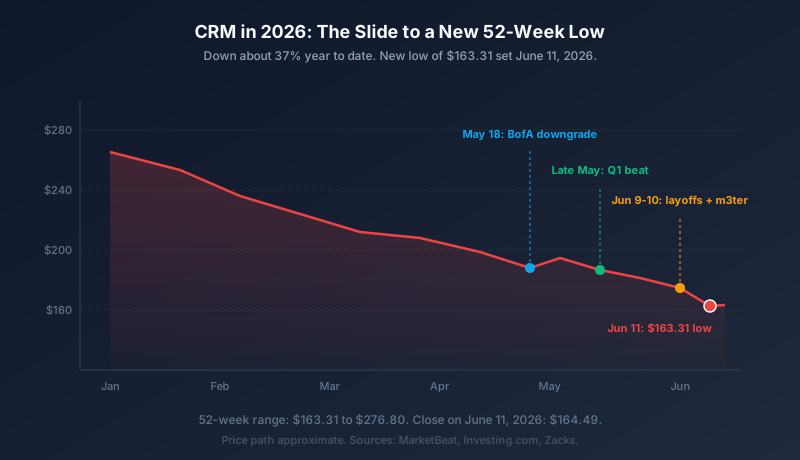
Salesforce stock touched $163.31 on Thursday, June 11. That is a new 52-week low, undercutting the $163.52 floor set earlier this month. Shares closed at $164.49, down from Wednesday's $170.92, on volume of roughly 4.5 million shares. The 52-week high of $276.80 now sits 41 percent overhead, and the stock is down about 37 percent in 2026.
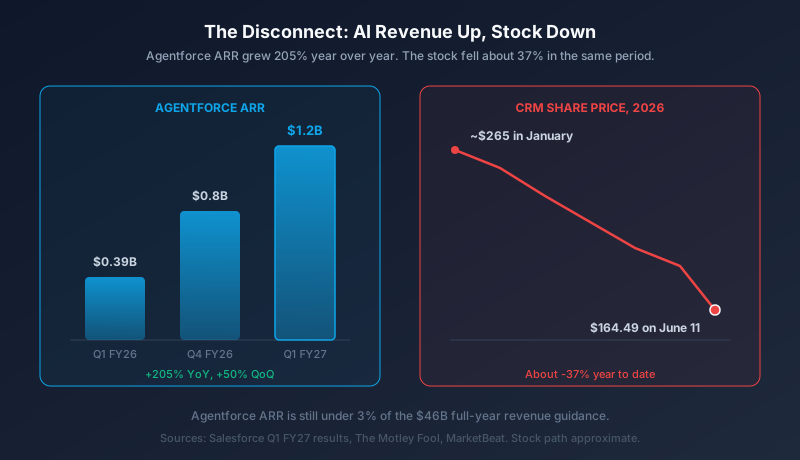
Here is the part that makes this newsworthy rather than just painful. The selloff is happening while Agentforce annual recurring revenue grows 205 percent year over year. The company beat on revenue and earnings in late May. Operating margin hit a record. And the stock keeps falling anyway. Something in that picture has to give, and this week the market voted on which side it thinks will break.
What Happened This Week
The slide accelerated in early June. Shares fell 3.9 percent on June 9 alone, extending a 13 percent decline across five trading sessions, per TIKR. The proximate triggers were the two stories we covered yesterday: a fresh round of layoffs touching Agentforce, MuleSoft, and Marketing Cloud teams, and the m3ter acquisition that signals a pivot toward consumption-based pricing.
Neither story is bad on its own. Layoffs of fewer than 1,000 roles at a company with over 70,000 employees are routine portfolio management. Buying a usage-billing platform is a logical move if you plan to charge for agent actions instead of seats. But investors read the pair as confirmation of the thesis that has hung over the stock all year: the seat-based SaaS model that built Salesforce is eroding, and the replacement model is not yet proven at scale.
Then Thursday happened. No single headline drove the June 11 drop. MarketBeat's alert offered no specific catalyst, which is its own kind of signal. When a stock makes new lows on no news, the selling is about positioning and conviction, not events.
The Numbers the Market Is Ignoring
Salesforce reported its fiscal Q1 2027 results in late May, and they were good. Not good-with-an-asterisk. Good.
- Revenue of $11.13 billion, up 13.3 percent year over year, beating the $11.05 billion consensus
- EPS of $3.88 against a $3.13 estimate
- Record operating margin of 34.8 percent
- Net margin of 18.73 percent and return on equity of 18.72 percent
We broke those results down when they landed. The caveat then, and the caveat now, is that organic growth excluding acquisitions ran closer to 9 percent. That number matters to anyone deciding whether 13 percent headline growth reflects the core business or the M&A pipeline.
Still, the AI numbers are hard to argue with. Agentforce ARR reached $1.2 billion in the quarter ended April 30, up 205 percent year over year and up 50 percent from $800 million just one quarter earlier. Combined AI and Data ARR, which includes Data Cloud, hit $3.4 billion, roughly 200 percent above the prior year. Management has guided to revenue acceleration in the back half of fiscal 2027.
So Why Is the Stock at $164?
Three reasons, in descending order of weight.
The denominator problem. Agentforce at $1.2 billion ARR is growing fast, but it is less than 3 percent of the $46 billion in revenue Salesforce has guided for the full fiscal year. The market is not pricing what Agentforce is. It is pricing what the other 97 percent of the business does while agents mature. If core Sales Cloud and Service Cloud seats stagnate or shrink faster than consumption revenue ramps, triple-digit AI growth becomes a rounding error on a declining base. That is the bear case in one sentence, and it has been winning since January.
The disruption discount. Software as a category is out of favor on the theory that agentic AI lets companies build, or simply prompt, what they used to buy. The Internet-Software industry is down 11.4 percent this year. But Salesforce is down roughly three times that, worse than Microsoft at negative 16.6 percent, SAP at negative 26.3 percent, and even ServiceNow at negative 30.2 percent, per Zacks data through June 9. The market has decided Salesforce is the most exposed large-cap name in the cohort. Ironic, given that Salesforce is also the loudest large-cap evangelist for the technology supposedly disrupting it.
The model transition. The m3ter deal made explicit what the pricing experiments of the past year implied. Salesforce intends to charge customers based on how much its agents do, not how many humans hold licenses. Transitions like this compress revenue visibility. Wall Street pays a premium for predictable subscription revenue and applies a discount to consumption revenue it cannot model yet. Salesforce is voluntarily trading the former for the latter, and the multiple is adjusting in real time.
The Valuation Picture
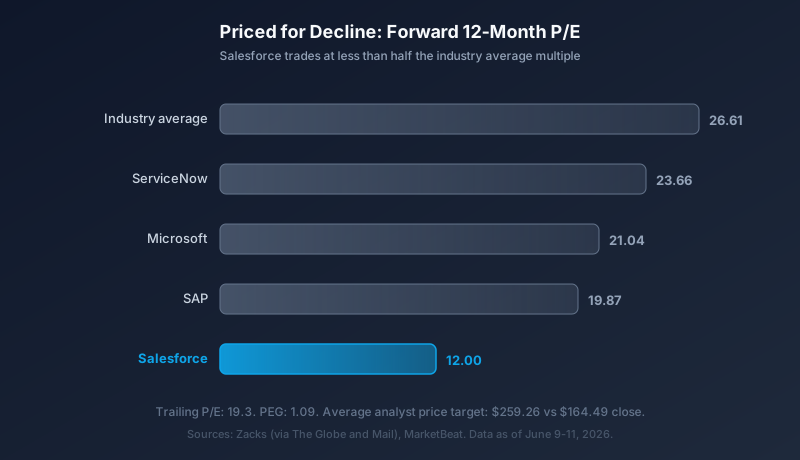
Whatever you think of the strategy, the stock is now priced like a company in decline. Salesforce trades at a forward 12-month P/E of 12. The industry average is 26.61. ServiceNow trades at 23.66, Microsoft at 21.04, SAP at 19.87. On trailing earnings the P/E is 19.3 with a PEG ratio of 1.09. Market cap stands at $136.48 billion.
The technicals confirm the trend is firmly down. The 50-day moving average sits at $180.90 and the 200-day at $207.60. The stock is below both, and the 50-day is below the 200-day. Anyone waiting for a chart-based reason to buy does not have one yet.
Analysts have not capitulated. The consensus rating is Moderate Buy, with one Strong Buy, 27 Buys, nine Holds, and two Sells. The average price target is $259.26, about 58 percent above Thursday's close. That gap between sell-side targets and the tape is one of the widest among megacap software names, which tells you either the analysts are slow or the market is wrong. Zacks splits the difference with a Hold rating, arguing the weakness "looks more like a reason to stay invested than a signal to exit" for long-term holders. The Motley Fool's framing is blunter: the stock is priced as if its best days are behind it, while its fastest-growing product line says otherwise.
We have seen this argument before. Bank of America downgraded the stock in May on AI monetization doubts, and the shares rallied days later on Anthropic spending disclosures. The stock has been a battleground all year. New 52-week lows mean the bears currently hold the field.
What This Means If You Work in the Ecosystem
A falling stock price does not change your org's API limits. But sustained pressure on the share price shapes company behavior in ways that reach admins, developers, and architects.
Expect the consumption push to intensify. The whole point of the m3ter acquisition and the Flex Credit model is to build revenue that scales with usage. Account executives are now incentivized to move customers toward agent consumption contracts. If you own a renewal in the next two quarters, model your Agentforce usage before the negotiation, not during it. Per-action pricing rewards customers who know their own volumes.
Expect more cost discipline. Record operating margins during a stock slide are not a coincidence. Management is defending profitability while growth reaccelerates, which means continued pressure on headcount, slower backfills, and more internal Agentforce dogfooding. The June layoffs fit this pattern. So will the next round, if there is one.
Expect M&A to continue while the currency is cheap, with a twist. A depressed stock makes equity-funded deals expensive, which pushes Salesforce toward smaller cash acquisitions like Contentful and m3ter rather than another Slack-sized swing. Tooling gaps in agent observability and evaluation are still open. Watch that space.
Do not confuse the stock with the platform. Salesforce generated $11.13 billion in a quarter at a 34.8 percent operating margin. The platform is not going anywhere. Career decisions, certification investments, and architecture bets should track product adoption data, not the daily tape. On that score, $1.2 billion of Agentforce ARR growing 50 percent quarter over quarter is the number that matters.
What to Watch Next
Three checkpoints will decide whether June 11 was the bottom or a waypoint.
- Q2 FY2027 earnings in late August. Management promised second-half revenue acceleration. The first data point arrives in about ten weeks. Watch organic growth and the Agentforce ARR sequential number, not the headline beat.
- Consumption revenue disclosure. If Salesforce starts breaking out usage-based revenue with the m3ter integration, the market gets the modeling visibility it currently lacks. That alone could compress the gap between the $259 average target and the $164 price.
- Seat count commentary. Any disclosure on net seat expansion or contraction in core clouds will get more scrutiny than any AI metric. The bear case lives or dies on the 97 percent.
For ecosystem professionals, the practical homework is simpler. Audit your org's agent usage so you can negotiate consumption contracts from data. Keep certifications current on the products Salesforce is funding, which right now means Agentforce, Data Cloud, and Revenue Cloud. And read the next earnings call transcript yourself rather than the headlines about it. The gap between the two is where the useful information lives.
About the Author
Dipojjal Chakrabarti is a B2C Solution Architect with 29 Salesforce certifications and over 13 years in the Salesforce ecosystem. He writes and edits salesforcedictionary.com, published by KineticBit Inc., to help admins, developers, architects, and cert/interview candidates sharpen their fundamentals. More about Dipojjal.
Share this article
Sources
- Salesforce (NYSE:CRM) Sets New 52-Week Low - Here's Why (MarketBeat)
- Salesforce's AI Business Is Growing More Than 200%, but the Stock Is Near a 52-Week Low (The Globe and Mail / The Motley Fool)
- Salesforce Trades Near 52-Week Low: Time to Hold the Stock or Exit? (The Globe and Mail / Zacks)
- Salesforce Stock Falls as Software Giant Rolls Out Fresh Layoffs and Acquires Pricing Platform (TIKR)
- Salesforce Stock Hits 52-Week Low at $163.52 (Investing.com)
Related dictionary terms
Practise it
Five questions on Agentforce Specialist
Exam-style questions with an explanation after each one. No account needed, and your answers build a weak-topic map once you have one.
More news

Salesforce Buys m3ter, Cuts 86 Jobs
Salesforce acquires usage-billing platform m3ter for Agentforce Revenue Management while cutting 86 jobs across Agentforce, MuleSoft, and Marketing Cloud.

BofA Cuts Salesforce to Underperform
BofA reinstated Salesforce at Underperform on May 18 with a $160 target. With 23,000 of 200,000+ customers on paid Agentforce deals and CRM down 35% YTD, the monetization debate peaks nine days before Q1 FY27 earnings.

CRM Rallies on $300M Anthropic Bet
Salesforce shares opened up 3.66% on May 19, 2026, one trading day after BofA's $160 Underperform reset. The catalyst was a $300 million Anthropic token commitment from Marc Benioff and Agentforce ARR crossing $800 million.

Salesforce Q1 FY27: Agentforce $1.2B
Salesforce beat Q1 FY27 estimates on every major metric: $11.13B revenue, $3.88 non-GAAP EPS, $33.6B cRPO at 14% growth. Agentforce ARR crossed $1.2B at 205% growth. Then Benioff revealed engineers haven't been hired in two years.
Comments
No comments yet. Start the conversation.
Sign in to share your take on this article. Your account works across every page.