
Salesforce's AI Jobs Never Arrived
Three stories landed in 48 hours and they are all the same story. The new AI job titles promised in 2024 never got created, Salesforce's operating margin quietly climbed to 22 percent, and the company now tracks how its own employees use AI.
Search LinkedIn for prompt engineer roles in the Salesforce ecosystem. You will find close to nothing. Two years after the ecosystem was promised a wave of new AI job titles, Salesforce Ben ran the numbers on July 31 and confirmed the wave never landed.
That piece did not publish alone. Over the previous 48 hours two other stories went up that read like separate topics and are actually one. On July 29, Salesforce Ben reported that Salesforce now tracks how its own employees use AI. On July 30, a Trefis analysis pointed out that Salesforce's operating margin has quietly climbed to 22 percent, well clear of its 14.2 percent five-year average, while the stock sits down 31.4 percent on the year.
Line the three up and the picture is straightforward. The efficiency gain is real. The margin is real. The jobs that were supposed to absorb the people displaced by that efficiency did not get created.
The Roles That Were Supposed to Appear
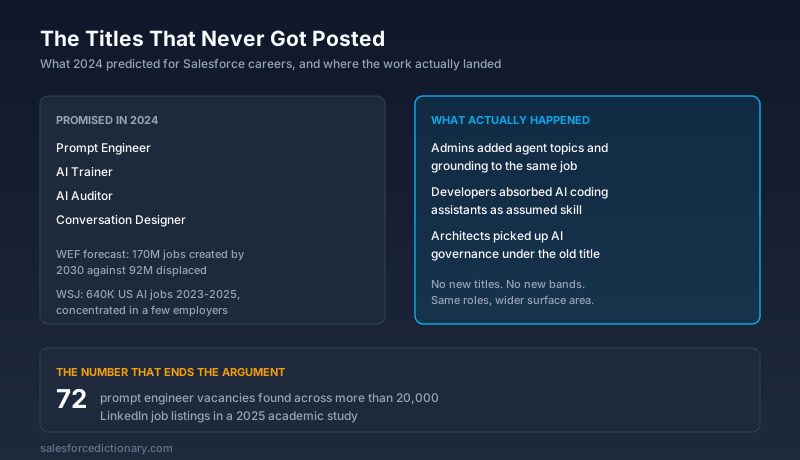
Rewind to 2024. The forecast handed to every Salesforce professional went roughly like this: AI will remove some work, and it will also create entirely new categories of work to move into. Prompt engineer. AI trainer. AI auditor. Conversation designer. Learn the new thing, take the new seat, come out ahead.
The World Economic Forum supplied the headline framing that everyone quoted: 170 million new jobs created globally by 2030 against 92 million displaced, a net gain of 78 million. The Wall Street Journal counted roughly 640,000 new AI jobs created in the United States between 2023 and 2025, which reads like confirmation right up until you get to the qualifier. Those roles concentrated among a small group of employers. Frontier labs, hyperscalers, a handful of AI-native startups. Not the tens of thousands of companies running Salesforce orgs, and not the consultancies staffing them.
The prompt engineer figure is the one that ends the argument. A 2025 academic study went through more than 20,000 LinkedIn job listings and found 72 vacancies carrying the title. Seventy-two out of twenty thousand. That is not an emerging profession. That is a rounding error with a conference track named after it.
What Actually Happened to the Job Description
AI did not create Salesforce jobs. It got added to the ones that already existed.
Look at what an admin does now. Setup with Agentforce sits in the same console as the flows and the permission sets. The admin who used to build a screen flow now also configures agent topics, writes the instructions, checks the grounding, and explains to a stakeholder why the agent answered the way it did. No new title. No new requisition. No salary band adjustment. Same job, wider surface area.
Developers got the same treatment on a faster clock. AI coding assistants went from novelty to assumed competence inside about eighteen months. Nobody opened a req for an AI-assisted developer. Teams simply started expecting the developers they already had to ship more per sprint with the tooling in front of them. Architects picked up AI governance on top of the rest: which models are permitted, what data is allowed to reach them, who signs off on an agent touching a production record. That work is genuinely difficult, and it arrived as a new bullet under an old title.
The Salesforce Ben analysis frames this as the prediction being incomplete rather than wrong, which is a fair reading. The forecasts said AI would transform work, and it has. They also implied that transformation would surface as new job postings, and that half did not happen through 2026.
The consequence lands on compensation. When AI competence becomes assumed rather than specialised, there is no premium left to claim for it. You do not get paid extra for prompting well, in the same way you do not get paid extra for knowing your way around a keyboard. The skill got folded into the baseline before anyone had time to build a career on top of it. The 2026 architect survey showed the same shape from the other end: 97 percent of architects use AI regularly, and their satisfaction is driven by the drudgery it removes, not by a new role it opened.
The Margin Line Nobody Connected
This is where the July 30 analysis stops being a stock story.
Trefis argued that Salesforce has quietly become a far more profitable company than the market has priced. The numbers support it. Operating margin over the last twelve months sits at 22 percent against a five-year average of 14.2 percent. The three-year average is 20 percent, so this is a trend rather than a good quarter. Revenue still grew 11 percent over the trailing twelve months. Operating cash flow ran at 190 percent of net income, the kind of conversion that normally earns a premium multiple.
It earned the opposite. CRM is down 31.4 percent year to date against an S&P 500 up 9.1 percent, trades 29 percent below its high, and has seen its price-to-sales multiple compress 33 percent over the past year.
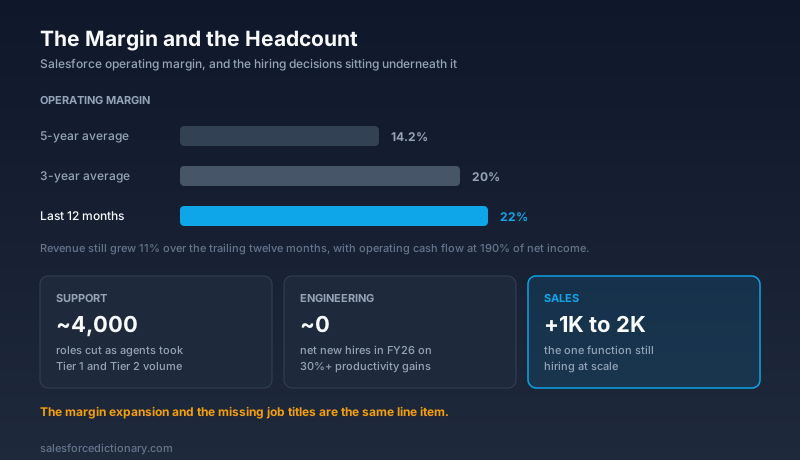
Now hold the two stories in the same frame and ask where nearly eight points of operating margin came from. Not from price increases alone. Salesforce cut roughly 4,000 roles from its customer support organisation as Agentforce and Einstein absorbed Tier 1 and Tier 2 volume. It made effectively zero net new engineering hires in fiscal 2026 after reporting productivity gains above 30 percent from its own AI tooling, while spending close to $300 million on Anthropic model tokens over the same stretch. Marc Benioff has said openly that hiring is near frozen everywhere except sales, where the company has been adding one to two thousand people to sell the AI products.
The margin expansion and the missing job titles are the same line item read from two directions. Salesforce is the proof case for its own product, and the proof looks like a headcount chart that stopped climbing.
Your AI Usage Is Now a Metric
The July 29 story supplies the uncomfortable third piece.
Salesforce, Amazon, and Meta all now track how employees use AI tools. Salesforce described its approach carefully: "We use dashboards to understand AI tool adoption and identify roadblocks." That is a defensible framing. Adoption dashboards are ordinary enterprise software management, and the company reports that 91 percent of its employees feel confident using AI in daily work, which is a number you only get by measuring something.
The question is what a dashboard turns into when the next restructuring arrives. Meta is currently defending a suit brought by 26 former employees alleging AI tools were used to target layoffs, with particular effect on people on medical or maternity leave and people with disabilities. Meta rejects the claim outright: "These claims lack merit and are not based on facts. Workforce management decisions were made by people, not AI."
Whether that case succeeds is almost beside the point. It has already established the question every employee at a measured company will now ask themselves. If my AI usage sits on a dashboard, and that dashboard exists during a cost-cutting cycle, is low usage a training gap or a performance flag? Very few employers have answered that in writing, and the silence is doing the damage.
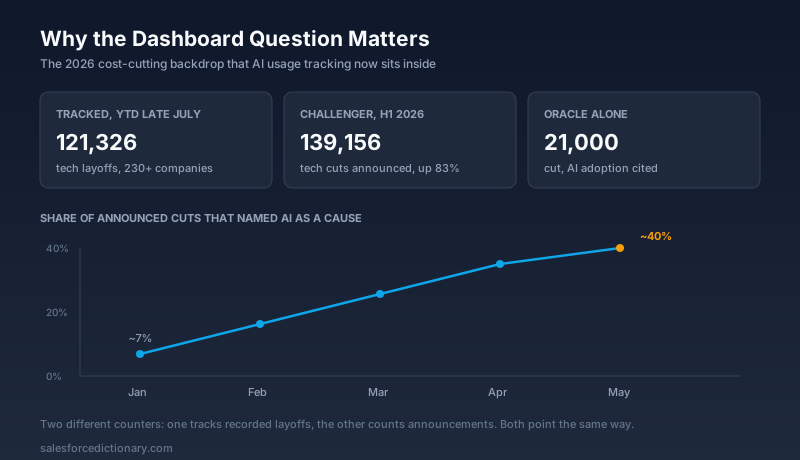
The backdrop makes the question sharper. Tech layoffs in 2026 have passed 121,326 across more than 230 companies by late July, on pace to match or exceed 2025's total of 122,606. Challenger, Gray & Christmas, counting announcements rather than tracked events, logged 139,156 technology job cuts in the first half alone, up 83 percent year over year. AI was named in 101,743 of the cuts Challenger recorded across all sectors in that period, and the citation rate climbed from about 7 percent of cuts in January to roughly 40 percent by May. Oracle cut 21,000 and named AI adoption as a driver.
What the Market Thinks of the Trade
The equity side has its own read, and it is not flattering.
Agentforce annual recurring revenue reached $1.2 billion, growing 205 percent year over year. Strong on its own terms. Then set it against a fiscal 2027 revenue midpoint of roughly $46 billion and it works out to about 2.6 percent of the business. Salesforce also executed a $25 billion accelerated share repurchase in the first quarter of fiscal 2027, funded with debt, cutting diluted share count 10.2 percent from 970 million shares to 871 million. GAAP diluted earnings per share rose 52 percent, and a large share of that came from the buyback and investment gains rather than from operations.
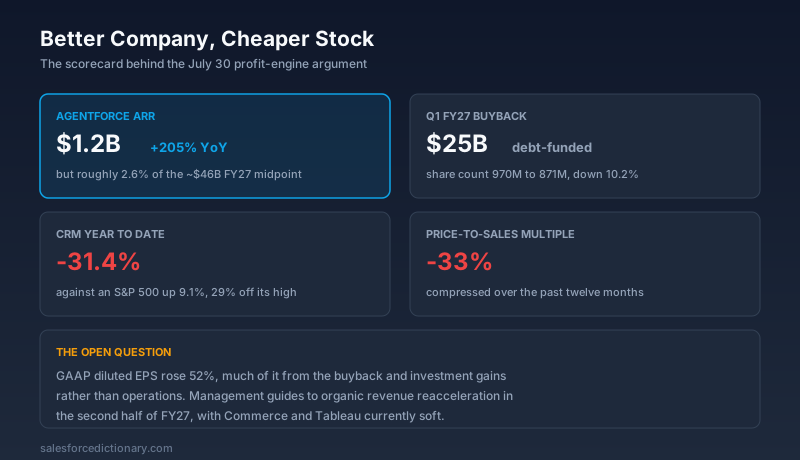
So the market is looking at a company whose margins improved through cost discipline, whose per-share numbers improved through buybacks, and whose flagship AI product grows fast off a base still too small to move the top line. Management has guided to organic revenue reacceleration in the second half of fiscal 2027, with Commerce and Tableau currently soft. Until that reacceleration shows up, the buyback and the hiring freeze are carrying the results, and investors have priced that as a holding pattern rather than a turnaround. The average price on that repurchase was $198.34, above where the stock trades today, so the trade is underwater for now.
What To Do With This
Stop waiting for the new job title. It is not coming, and planning around it costs you a year you do not have.
If you are an admin or a developer, make the AI work you are already doing legible. Agent topic design, grounding strategy, evaluation and regression testing of agent output, and AI governance are real specialisations that currently sit buried inside generic job descriptions. Write down what you built, what it replaced, how many cases or hours it absorbed, and what broke on the way. That record is what converts quietly absorbed responsibility into a promotion case or a higher offer, because nobody is going to hand you the title unprompted.
If you manage a team, publish your AI usage policy before you need it. State plainly what the adoption dashboard measures, who can see it, and whether it feeds performance review. Salesforce's framing of dashboards as roadblock detection is the right one to borrow. Put it in writing so your people are not guessing during the next reorg.
And if you are planning partner capacity or reading this as an investor, take the 22 percent margin seriously as a statement of intent. It is the clearest available signal of how Salesforce expects work to get done from here, and none of it was achieved by hiring.
About the Author
Dipojjal Chakrabarti is a B2C Solution Architect with 29 Salesforce certifications and over 13 years in the Salesforce ecosystem. He writes and edits salesforcedictionary.com, published by KineticBit Inc., to help admins, developers, architects, and cert/interview candidates sharpen their fundamentals. More about Dipojjal.
Share this article
Sources
- AI Was Supposed to Create New Salesforce Jobs, So Where Are They? (Salesforce Ben)
- Salesforce Is Tracking How Employees Use AI, Will This Become the Norm? (Salesforce Ben)
- CRM Upgraded Its Profit Engine. Quietly (Trefis)
- Salesforce Shares Climb, Tightening Agentforce Discount as Buybacks Drive Per-Share Increase (TS2)
- Tech Accounts for Nearly a Third of US Layoffs in H1 2026 (HR Dive, on Challenger data)
- AI Agents Drive 4,000 Job Cuts in Salesforce Support Division (Salesforce Ben)
Related dictionary terms
 Our appAdWake up sharp. Not just awake.The alarm that rings through Silent and DND — free on iOS & Android.Get WakeSharp →
More news

Vibe Coding Reaches the Enterprise
Starbucks is building in-house AI tools against a $400M software bill, and Salesforce Ben calls vibe coding a survival test for Salesforce. Plus: the community delivers its verdict on the permissions U-turn.

Salesforce Architects Are Thriving
Salesforce Ben's 2026 Architect Survey shows only 10.2 percent of architects are dissatisfied and 97 percent now use AI. But ChatGPT and Claude beat Agentforce among Salesforce's own architects, and the talent shortage explains the calm.
KeyBanc Downgrades Salesforce
KeyBanc cut Salesforce to Sector Weight on July 9 and pulled its price target, saying customer checks found no Agentforce acceleration. Shares fell near 5%, eight days after Guggenheim upgraded the same stock.


Comments
No comments yet. Start the conversation.
Sign in to share your take on this article. Your account works across every page.