
Salesforce Cuts Trailhead and Events
Salesforce Ben reported on Thursday that Salesforce has cut roles across Tableau, Trailhead, community advocacy, events, Marketing Cloud and Industries Cloud. It is the third round of 2026, and it landed on the same day software stocks sold off over AI costs.

The first sign was LinkedIn, not a press release. On Thursday morning a run of posts went up from people who write Trailhead content, run community programmes, staff the events team and answer Tableau support tickets, all saying the same thing on the same day. Salesforce Ben confirmed it a few hours later: another round of cuts, spread across Tableau, Trailhead, community, events, Marketing Cloud and Industries Cloud.
Salesforce had not put out a statement when the story published. There is no filing to read, no number to quote, no internal memo circulating. What exists is a pattern of individual announcements dense enough that a publication was willing to run it, which is how most of these rounds have surfaced this year.
What Got Cut
The reported list is worth reading slowly, because the shape of it says more than the size.
Tableau technical support took the visible hit. Roughly half the North America team was reportedly affected, according to a source who spoke to Salesforce Ben. That is a support function attached to an acquired product, and it is the part of the list with the most direct customer impact. If you have a Tableau case open, the queue behind it just got shorter on the wrong side.
The rest of the list is the ecosystem-facing layer. Community advocacy. Content. Events. Trailhead. These are the people who ran user group programmes, produced the learning material most of this ecosystem trained on, and staffed the conferences where the community actually meets. Marketing Cloud and Industries Cloud roles were also named.
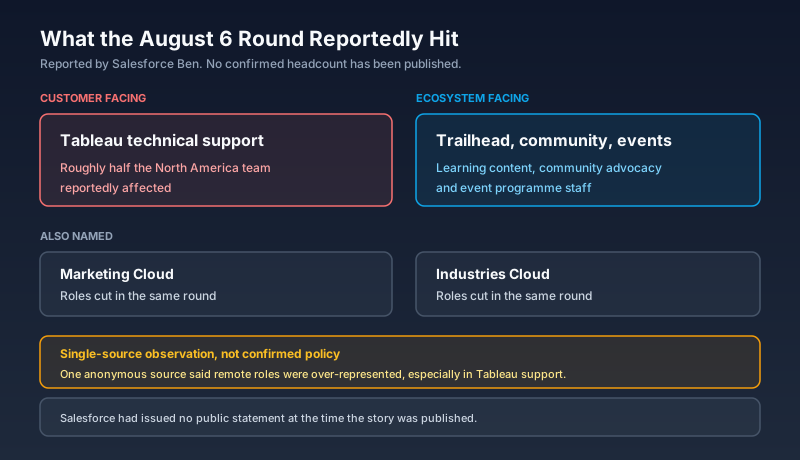
One detail from the reporting deserves a flag rather than a conclusion. An anonymous source said remote positions were disproportionately represented, particularly inside Tableau technical support. Salesforce Ben was careful to say it is unclear whether that was systematic. It is worth holding that as an observation from one source and not a policy, because the difference matters and nobody outside the company can currently tell them apart.
No confirmed headcount has been published. Treat any number you see circulating today as an estimate.
There is a reason the number stays fuzzy. Salesforce is a large employer with a global footprint, and a round spread thinly across six or seven organisations rarely trips the disclosure thresholds that force a public filing. State WARN notices in California and elsewhere are the usual paper trail, and they lag the actual notification by days or weeks. If a hard figure exists for this round, that is where it will show up first, not in a press release.
Third Round, and It Is Only August
This is the third round of cuts Salesforce has run in 2026. The company cut close to 1,000 employees earlier in the year, and separately reduced its customer support organisation by roughly 4,000 roles as Agentforce and Einstein absorbed frontline case volume.
The backdrop published one day earlier, and it is worse than the individual rounds suggest. Salesforce Ben's August 5 analysis of Layoffs.fyi data found that 2026 tech layoffs have already passed the full-year 2025 total, with four months still to run. More than 250 companies have cut staff this year. The 100,000 mark was crossed in June 2026; in 2025 that did not happen until late October.
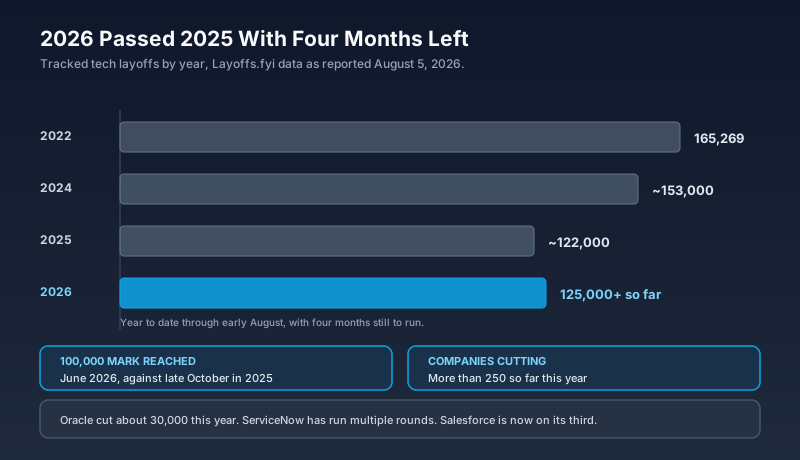
At the current pace 2026 passes 2024's roughly 153,000 and threatens 2022's 165,269, which is the worst year on record for the sector. Oracle alone cut about 30,000 this year. ServiceNow has run multiple rounds. Vernon Keenan, quoted in the same piece, put it plainly: "We're definitely witnessing a shift in jobs due to AI."
That framing needs one qualifier. AI is the most-cited reason, but citation is not causation, and it is a convenient reason to cite. Budget pressure, over-hiring in 2021 and 2022, and investor pressure on operating margin all sit underneath the same cuts. We walked through how the margin and the missing headcount are the same line item last week. Thursday added another data point to that column.
The Market Repriced AI Costs the Same Day
The timing was accidental and the connection is not.
While the layoff posts were going up, software stocks were selling off hard. Datadog, Figma and HubSpot each fell more than 15 percent. The iShares Expanded Tech-Software ETF dropped over 2 percent. Salesforce fell roughly 4 percent, ServiceNow and Workday and Cloudflare went with it.
The trigger was earnings commentary, not a guidance cut. Figma beat on revenue, at $370.1 million against expectations near $351.6 million, and raised full-year guidance to $1.463 to $1.467 billion. It still lost 16 percent, because operating expenses came in near $426.9 million, roughly double the prior-year quarter, with research and development more than doubling. Figma's CFO Praveer Melwani explained the mechanism in one sentence that every software CFO is about to be asked about: "we bear the cost of inference without offsetting consumption revenue."
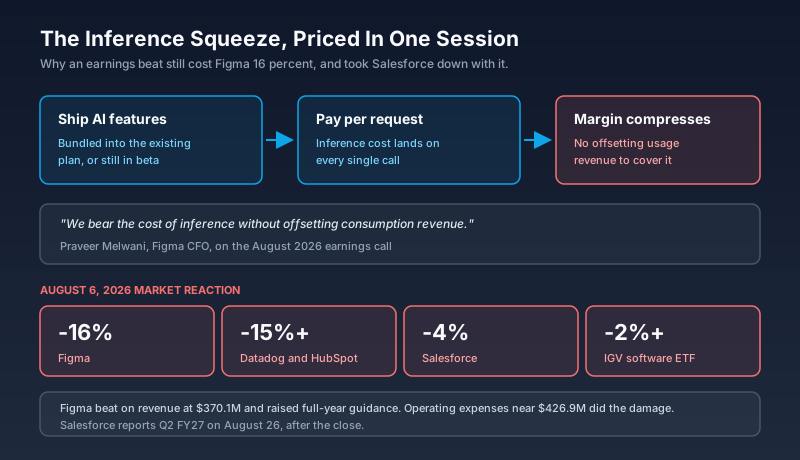
Read that alongside a support organisation shrinking by 4,000 and an ecosystem team shrinking on Thursday, and the two stories stop being unrelated. Inference costs money on every request. If the AI feature is bundled rather than metered, the cost lands in gross margin and the offset has to come from somewhere else in the operating line. Salesforce has been managing that offset in public for a year, first by re-architecting Agentforce inference costs downward in July, and now by taking cost out of the parts of the business that do not appear in a bookings number.
Salesforce also confirmed on August 5 that second quarter fiscal 2027 results land on Wednesday, August 26, after the close. That is the next hard number in this story. Everything between now and then is inference.
An Agent Where the Guidance Used To Be
The fourth item from these two days is the one that will age strangely.
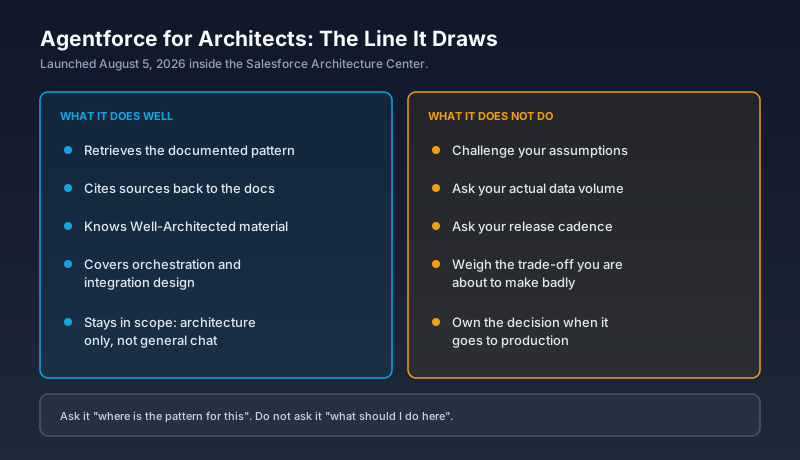
On August 5, Salesforce introduced Agentforce for Architects, a conversational assistant living inside the Architecture Center. You ask it things like "show me agentic patterns" or "when should I use Apex instead of Flow", and it answers from Salesforce's own architecture material, with citations linking back to the supporting documentation. The scope is deliberately narrow. It is an architecture assistant, not a general Salesforce chatbot.
On the retrieval task it is genuinely good. It knows the Well-Architected material, it handles orchestration and integration and automation design questions, and the citations make it auditable in a way that a generic model answer is not. For finding the pattern document you half-remember, it beats searching for it.
Where it falls short is the part that makes an architect an architect. It does not push back on your assumptions. It does not ask what your data volume actually is before recommending an approach, or what your release cadence looks like, or who owns the integration on the other side. It does not walk you through the trade-off you are about to make badly. Those clarifying questions are the job, and a retrieval system does not have them.
Put the launch date next to the cut list and the juxtaposition is uncomfortable without being sinister. Salesforce shipped an AI guidance layer for architects on Wednesday and cut part of its human enablement and community layer on Thursday. Those are almost certainly separate decisions made by separate organisations on separate timelines. They still describe the same direction of travel, and the ecosystem is entitled to notice.
There is a fair criticism sitting underneath this, and it predates Thursday. Community members have been saying for months that Salesforce events have narrowed onto Agentforce messaging at the expense of actual community engagement. Cutting the events and advocacy staff does not fix that complaint. It removes the people who were best positioned to fix it.
It is worth being precise about what the community layer actually produced, because it is easy to file under marketing. Trailhead is the reason this ecosystem has a training path that costs nothing to start. Community advocacy is what kept thousands of unpaid user group leaders supplied with content, swag and a point of contact inside the company. Events are where the trust that sells the next licence gets built, slowly, by people who are not on a quota. None of that shows up cleanly in a bookings number, which is exactly why it is vulnerable when the bookings number is the thing under scrutiny.
What This Changes For You
If you were affected, file for your regional support first and update your LinkedIn headline second. The Salesforce ecosystem hires from LinkedIn faster than from job boards, and the ecosystem is unusually good at closing ranks around this. Salesforce Ben is taking tips at tips@salesforceben.com if you want the round documented accurately.
If you run a Tableau deployment, assume support response times get worse before they get better, and act on that now. Open the cases you have been putting off this week rather than next month. Write down the internal workaround for your top three recurring Tableau issues so your own team can resolve them without a ticket. If you are inside a renewal window, ask your account executive directly what the North America support coverage looks like now and get the answer in writing.
If you manage careers in this ecosystem, stop treating community and content work as a safe adjacent path into Salesforce. For most of the last decade it was one of the most reliable routes in. Thursday says it is now among the first line items cut when margin gets scrutinised. Build toward the roles that sit on the revenue side of the ledger, and treat community contribution as the thing that opens those doors rather than as the job itself.
And if you are an architect, use Agentforce for Architects for what it is. It is a fast, cited index of Salesforce's own guidance. Point it at "where is the documented pattern for this" and it will save you real time. Do not point it at "what should I do here" and expect the question you actually needed to be asked. That part is still yours.
About the Author
Dipojjal Chakrabarti is a B2C Solution Architect with 29 Salesforce certifications and over 13 years in the Salesforce ecosystem. He writes and edits salesforcedictionary.com, published by KineticBit Inc., to help admins, developers, architects, and cert/interview candidates sharpen their fundamentals. More about Dipojjal.
Share this article
Sources
- Exclusive: Salesforce Cuts Jobs Across Tableau, Trailhead, Community, and Events (Salesforce Ben, August 6 2026)
- 2026 Tech Layoffs Already Exceed the 2025 Total (Salesforce Ben, August 5 2026)
- Software stocks sink, led by declines from Figma, Datadog (Yahoo Finance, August 6 2026)
- CRM, NOW, INTU, ADBE: Software Stocks Slide After Figma Flags Surging AI Costs (Stocktwits)
- Introducing Agentforce for Architects: Guidance On Demand (Salesforce Ben, August 5 2026)
- Salesforce Announces Date of Second Quarter Fiscal 2027 Earnings Release and Webcast (Salesforce Investor Relations, August 5 2026)
- Salesforce Architecture Center (Salesforce)
- Layoffs.fyi tracker
Related dictionary terms
Practise it
Five questions on Agentforce Specialist
Exam-style questions with an explanation after each one. No account needed, and your answers build a weak-topic map once you have one.
More news
Salesforce Cuts Agentforce AI Costs
Salesforce revealed on July 8 that Agentforce now runs on five specialized models instead of one rented frontier model, cutting classification time and giving it room to swap vendors.

Salesforce Architects Are Thriving
Salesforce Ben's 2026 Architect Survey shows only 10.2 percent of architects are dissatisfied and 97 percent now use AI. But ChatGPT and Claude beat Agentforce among Salesforce's own architects, and the talent shortage explains the calm.
Salesforce's AI Jobs Never Arrived
A 2025 study found 72 prompt engineer vacancies across 20,000 LinkedIn listings. Salesforce's operating margin hit 22 percent against a 14.2 percent five-year average. Those two facts are the same story.
Comments
No comments yet. Start the conversation.
Sign in to share your take on this article. Your account works across every page.