
Tableau CRM Is Now CRM Analytics: The Rename History and 2026 Guide
Tableau CRM became CRM Analytics in April 2022. The four-rename history (Wave to Einstein Analytics to Tableau CRM to CRM Analytics), what survived, what changed, and where to look for current docs.
You type "Tableau CRM dashboards" into a Salesforce admin's search bar in 2026 and the top results are a mix of help articles from three different product eras. Some say "Tableau CRM", some say "[Einstein Analytics](/terms/einstein-analytics)", some say "CRM Analytics", and one says "Wave". Same product. Four names. You start the day trying to build a dashboard and end the morning trying to figure out which generation of documentation actually applies to the product in your org.
The short answer: Tableau CRM was renamed to CRM Analytics in April 2022. The current name, the current documentation, and the current Trailhead modules all reference CRM Analytics. The Tableau CRM name only persists in older blog posts, Stack Exchange answers, recorded conference sessions, and Trailhead modules that were never updated. The product itself is the same evolving platform that has been around since 2014.
This post is the reference for anyone searching for Tableau CRM in 2026: the four-rename history, what survived each rename, what genuinely changed in each transition, where to look for current docs, and how to map old material to its current equivalent.
The current state in one paragraph
If you are evaluating, learning, or administering the product today: search for CRM Analytics, not Tableau CRM. The documentation at help.salesforce.com under the Analytics section is current. The Trailhead modules under "CRM Analytics" are current. The job postings still occasionally say "Tableau CRM" because the rename is recent enough that recruiters have not caught up, but the skill set is identical. The full current-state walkthrough lives in the Salesforce CRM Analytics complete 2026 guide.
The rest of this post is the history that explains how the product picked up four names in a decade, and the practical mapping from old names to current concepts.
The full rename timeline
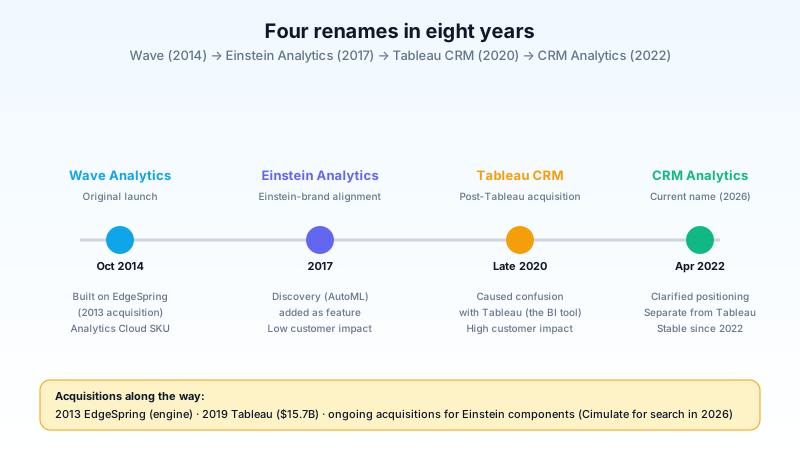
2013: EdgeSpring acquisition. Salesforce acquired EdgeSpring, a small analytics startup. EdgeSpring's columnar query engine became the foundation of what would launch a year later.
October 2014: Wave Analytics launches. Salesforce announced Wave Analytics at Dreamforce 2014. The original branding emphasized the data exploration metaphor: ride the wave of your data. Wave was sold as the analytics cloud alongside Sales Cloud, Service Cloud, and Marketing Cloud. The product included datasets, dashboards, the Wave Designer (the predecessor to Analytics Studio), and the SAQL query language.
2017: rename to Einstein Analytics. Salesforce rolled the product under the Einstein brand alongside Einstein Predictions, Einstein Bots, and the broader Einstein AI portfolio. The product itself did not radically change. The rename was a marketing alignment: every AI-adjacent product became an Einstein product. Einstein Discovery (the predictive AutoML layer) was introduced around the same time and became a feature of the renamed Einstein Analytics platform.
August 2019: Salesforce acquires Tableau. $15.7 billion deal. Tableau remained a separate product with its own brand, customer base, and roadmap. The acquisition raised an obvious question: with Tableau in the portfolio, what is Einstein Analytics?
Late 2020: rename to Tableau CRM. Salesforce's answer: Einstein Analytics becomes Tableau CRM, positioned as the in-Salesforce analytics product, while Tableau (the acquired brand) remains the enterprise BI product for cross-system analytics. The rename was meant to clarify the portfolio. In practice it confused customers because the two products had genuinely different architectures, query engines, and target use cases. Calling them both Tableau implied a shared codebase that did not exist.
April 2022: rename to CRM Analytics. The Tableau CRM brand was retired. The product became CRM Analytics. The reasoning Salesforce gave was clarity: the product is the analytics layer for CRM, full stop, separate from Tableau the enterprise BI product. CRM Analytics inherits the Einstein Discovery predictive layer, the Analytics Studio admin surface, and the dataset/recipe/dashboard data model.
2026 current state. CRM Analytics is the current name. Tableau remains a separate product. Einstein is now spread across multiple specialized predictive products (Lead Scoring, Opportunity Scoring, Bots, Conversation Insights) plus the Einstein Discovery layer inside CRM Analytics. The four-name history is artifact, not product confusion.
What survived each rename
The underlying product evolved through these renames. The core capabilities survived consistently:
The columnar query engine. EdgeSpring's original engine still powers CRM Analytics in 2026. The architecture is the same: denormalized datasets, fast aggregation, indexed dimensions, optimized for analytics workloads rather than transactional reads. Performance has improved (2026 incremental upserts cut recipe run times 5 to 10x), but the underlying data model has been stable across all four renames.
The dataset / recipe / dashboard pattern. The three-object data model that defined Wave in 2014 still defines CRM Analytics in 2026. Datasets hold data, recipes transform data into datasets, dashboards visualize datasets. This pattern survived every rename.
SAQL (Salesforce Analytics Query Language). The query language Wave introduced is still callable in CRM Analytics. Most admins never write SAQL directly because the dashboard builder generates it. Power users who want fine-grained control over queries still write SAQL.
Embedded analytics on Lightning record pages. The ability to embed dashboards on Account, Opportunity, Case, and other record pages was in the product from early on and remained through every rename. Embedded analytics is the differentiator versus standalone BI tools and has been the consistent product positioning.
Einstein Discovery. Added in the Einstein Analytics era around 2017, survived the Tableau CRM rename and the CRM Analytics rename. Still the AutoML predictive layer in 2026, now callable from Agentforce actions.
What genuinely changed in each transition
The renames were marketing exercises. The product also evolved underneath them. The substantive changes:
Wave to Einstein Analytics (2017). Einstein Discovery added as the AutoML predictive layer. AutoML model training on datasets, explainable predictions, embedded prediction widgets on dashboards. This was the biggest product addition in the platform's history.
Einstein Analytics to Tableau CRM (2020). Templated apps expanded significantly. Sales Analytics, Service Analytics, Revenue Analytics, B2B Marketing Analytics, all available as prebuilt template installs. The data integration story improved with more third-party connectors. Analytics Studio (the admin surface) got a refresh.
Tableau CRM to CRM Analytics (2022). The rename itself was the headline. The substantive change: deeper integration with Data Cloud, which was launching around the same time. CRM Analytics started accepting Data Cloud objects as recipe inputs and emitting recipe outputs back into Data Cloud.
CRM Analytics in 2026. The current era added incremental upserts (recipes run on changed rows only), semi-join and anti-join in recipes, recipe output to Data 360 lake objects, recipe output to S3 and remote destinations, custom repeater headers, and Discovery models callable from Agentforce. These are the changes that justify the product's continued investment in 2026 versus shifting customers entirely to Tableau.
Mapping old documentation to new
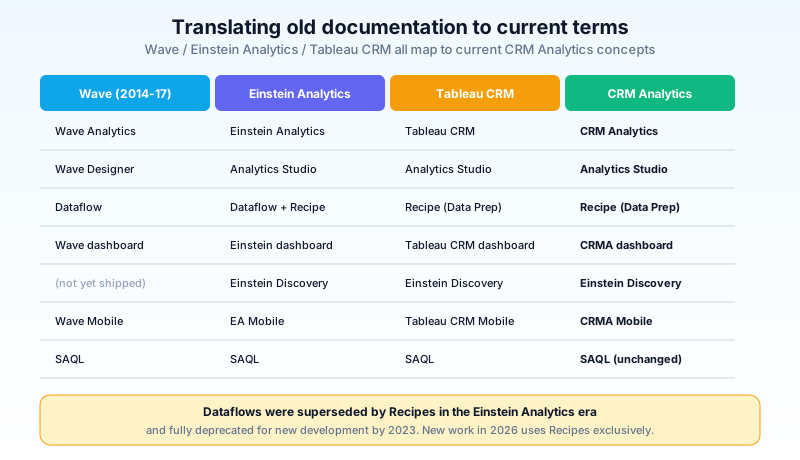
If you have a Wave-era or Einstein Analytics-era reference open, here is the renaming map:
| Wave era (2014-2017) | Einstein Analytics (2017-2020) | Tableau CRM (2020-2022) | CRM Analytics (2022-) |
|---|---|---|---|
| Wave Analytics | Einstein Analytics | Tableau CRM | CRM Analytics |
| Wave Designer | Analytics Studio | Analytics Studio | Analytics Studio |
| Dataflow | Dataflow + Recipe (deprecated dataflow eventually) | Recipe (Data Prep) | Recipe (Data Prep) |
| Wave dashboard | Einstein dashboard | Tableau CRM dashboard | CRM Analytics dashboard |
| Wave mobile | Einstein Analytics Mobile | Tableau CRM Mobile | CRM Analytics Mobile |
| -- | Einstein Predictions / Discovery | Einstein Discovery in Tableau CRM | Einstein Discovery in CRM Analytics |
| -- | Templated apps | Templated apps | Templated apps |
| SAQL | SAQL | SAQL | SAQL |
When a 2018 blog post says "Einstein Analytics dashboard", read it as "CRM Analytics dashboard" and you will be ninety-five percent correct. When a 2021 article says "Tableau CRM dataset", read it as "CRM Analytics dataset". The terminology shifted but the concepts mapped one-to-one across the renames.
The exception: Dataflows were the original transformation mechanism in Wave and Einstein Analytics. They were superseded by Recipes (Data Prep) starting around the Einstein Analytics era and fully deprecated for new development by 2023. If your reference talks about Dataflows, that is the recipe predecessor. New work in 2026 uses recipes exclusively.
How CRM Analytics differs from Tableau
The single most-asked question, because Salesforce owns both products. Briefly:
CRM Analytics. In-Salesforce embedded analytics. Lives inside the CRM org. Inherits Salesforce security context. Built for Salesforce users who need analytics at the record level. Sold as a Salesforce add-on license.
Tableau. Enterprise BI. Lives outside Salesforce (cloud or on-prem deployment). Connects to many systems including Salesforce. Built for BI analysts who need cross-system analytics and the broadest visualization library. Sold separately under Tableau pricing.
Both are owned by Salesforce. Both can coexist in the same enterprise. Neither replaces the other. Common pattern: BI team owns Tableau for executive and cross-system dashboards. Sales Ops team owns CRM Analytics for embedded record-level analytics. Standard Reports & Dashboards stay for ad-hoc operational queries.
For the full decision framework, see the Salesforce CRM Analytics complete 2026 guide, which has the side-by-side comparison.
How each rename affected customers
The four renames were not equivalent in impact. Some cleanly updated branding without disturbing customer workflows. Others created real operational pain. Worth grading each one.
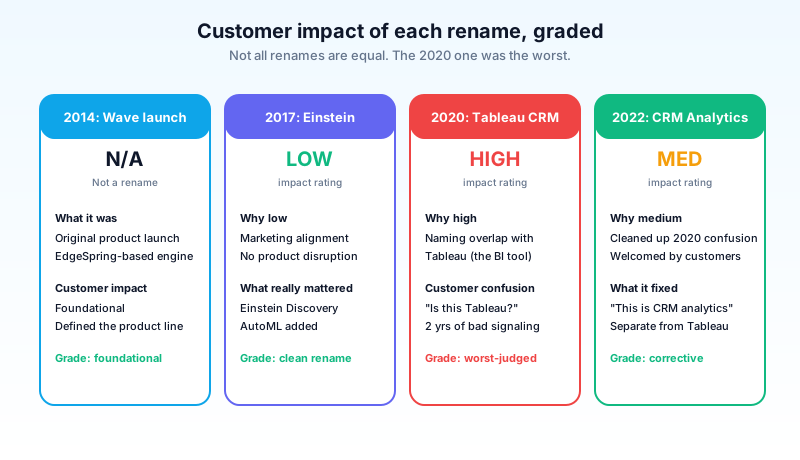
2014 Wave launch. Not a rename, the original product launch. Impact rating: foundational. Salesforce had no analytics product before this; the launch defined what came next. EdgeSpring's columnar engine was the technical foundation. The product positioning (analytics for CRM) has not changed since.
2017 Einstein Analytics rename. Low impact on customers. The rebrand under the Einstein umbrella made marketing sense; existing customers kept their dashboards, their datasets, their reports. The substantive product change (Einstein Discovery added as the AutoML layer) was the real story, and the rename was secondary cover for it. Customer documentation needed updates, but the workflows did not change.
2020 Tableau CRM rename. Highest impact on customer confusion. Customers asked "did you replace Einstein Analytics with Tableau" and the answer required a long explanation: no, the in-CRM product was renamed to Tableau CRM, but Tableau (the acquired enterprise BI product) remained separate. The naming overlap was a genuine problem. Sales teams, support teams, and customers all had to internalize the distinction. The transition burned roughly two years of branding clarity.
2022 CRM Analytics rename. Medium impact. The Tableau CRM brand was retired and the product was renamed to CRM Analytics, which was the cleaner positioning. Customers welcomed the clarification. Documentation needed updates again, but the product itself was stable. The April 2022 rename effectively closed the chapter on the Tableau brand confusion that started in 2020.
The composite lesson for product teams: rebranding for marketing alignment is low-impact if the underlying product positioning stays consistent. Rebranding that creates ambiguity with another product in the portfolio is high-impact and slow to recover from. The 2020 to 2022 cycle is a textbook example of the latter, and the 2022 rename to CRM Analytics is the corrective step.
Where to find current documentation
The product moved through four renames, and the documentation moved with each one. In 2026:
Official help. help.salesforce.com under the Analytics section. Search for "CRM Analytics". Articles labeled with the older names (Tableau CRM, Einstein Analytics, Wave) are either redirects to current content or archived. The current canonical home is help.salesforce.com/s/articleView with the CRM Analytics topic.
Trailhead. trailhead.salesforce.com search for "CRM Analytics". The maintained learning paths are under the current name. Older modules tagged Tableau CRM are still searchable but the search-result ordering surfaces the current modules first. Be aware that some older modules use "Tableau CRM" terminology in the module body even when the title was updated.
Release notes. Spring '26, Summer '26, Winter '26 release notes are organized by product area. The Analytics section covers CRM Analytics features. Older release notes (Spring '22 and earlier) referenced the product by the name in effect at the time. Search the release notes archive by feature name (e.g., "Einstein Discovery model") rather than product name to bridge across the renames.
Stack Exchange and Trailblazer Community. Older answers reference older names. Look at the question date. A 2018 answer about "Einstein Analytics dashboards" is still mostly accurate; an answer about "Einstein Analytics Dataflows" needs to be translated to current Recipe concepts.
Conference recordings. Dreamforce sessions from 2017 to 2022 reference the name in effect at the time. The substantive content (architecture, query patterns, embedded analytics, Einstein Discovery) translates forward. The named features may be renamed.
The pieces of this story that are bad
Calling out what is genuinely worse, with specifics:
Four product renames in eight years is too many. Each rename invalidates a generation of documentation, training material, conference content, and customer mental models. The product team had real reasons for each rename (Einstein alignment in 2017, Tableau acquisition rationalization in 2020, simplification in 2022), but the cumulative effect is customer confusion that has not fully cleared even in 2026.
The Tableau CRM rename was the worst-judged of the four. Calling the in-Salesforce analytics product "Tableau CRM" while Tableau the enterprise BI product also existed implied a shared codebase that did not exist. Customers asked "is this Tableau" and the honest answer was "no, it is a different product that shares a brand". The 2022 rename to CRM Analytics fixed the confusion the 2020 rename created.
Documentation lag is still real in 2026. Half the Stack Exchange answers about analytics still use Tableau CRM terminology. Half the Trailhead module bodies still reference older names even when the module titles have been updated. The cleanup work after a rename is enormous and was never fully completed for any of the four transitions.
Job postings have not caught up. Recruiters in 2026 still post "Tableau CRM consultant" roles when they mean CRM Analytics. The skill set is identical. The hiring manager often does not know the rename happened. If you are job-hunting, list both names on your resume.
These are real frustrations. The product underneath has been a credible embedded-analytics platform for the better part of a decade. The marketing churn around its name has done it no favors.
The trade-off Salesforce is still living with
The four renames are now history. The trade-off they reflect is still active: Salesforce owns both CRM Analytics and Tableau, two analytics products with overlapping addressable use cases. The 2022 rename clarified that they are separate products. The product roadmaps have stayed separate. The customer conversation, in 2026, still asks "should we use Tableau or CRM Analytics, given Salesforce owns both".
The answer that has emerged: use both, for the use cases they fit. Tableau is the enterprise BI platform. CRM Analytics is the embedded-in-CRM analytics layer. The decision is not a competition between two products; it is two products solving two different jobs. The early-2020s confusion about whether Tableau CRM was Tableau-the-acquired-product or Einstein-Analytics-renamed pushed customers to ask the wrong question. The 2022 rename to CRM Analytics let customers ask the right question (which job does each product do best).
The lingering customer conversation in 2026 is sometimes still framed as "Tableau vs Tableau CRM", which is an outdated framing. The current framing is "Tableau vs CRM Analytics", and the answer is "both, for different jobs". Documentation, sales conversations, and customer support all still occasionally use the outdated framing. Plan for the framing-update lag the same way you plan for the documentation-update lag.
What to do next
If you came here because you searched for Tableau CRM, the next move is the Salesforce CRM Analytics complete 2026 guide. It is the same product, walked through with current terminology and 2026 features.
If you are a Salesforce admin with legacy Tableau CRM (or Einstein Analytics, or Wave) reference material, do not throw it away. The concepts map one-to-one to the current product. Translate the names as you go. SAQL still works. Datasets, dashboards, and recipes are still the model.
If you are a job-hunter, put both "Tableau CRM" and "CRM Analytics" on your resume. The skill set is identical. The recruiters have not caught up. Listing both names increases your match rate without misrepresenting your background.
Open one of your existing dashboards in Analytics Studio. Notice how the underlying objects (datasets, recipes, widgets) are the same as they were under any of the previous four names. The continuity is real. The name shift is the only thing that ever moved.
About the Author
Dipojjal Chakrabarti is a B2C Solution Architect with 29 Salesforce certifications and over 13 years in the Salesforce ecosystem. He writes and edits salesforcedictionary.com, published by KineticBit Inc., to help admins, developers, architects, and cert/interview candidates sharpen their fundamentals. More about Dipojjal.
Share this article
Sources
Related dictionary terms
Practise it
Five questions on Agentforce Specialist
Exam-style questions with an explanation after each one. No account needed, and your answers build a weak-topic map once you have one.
Keep reading
Data Cloud Is Now Data 360: What Actually Changed (and Why It Matters)
Data Cloud became Data 360 in October 2025. Beyond the rename: Zero-Copy Federation, Tableau Semantics, the Lakehouse, and a new credit model. Here's the full picture.
Salesforce CRM Analytics: The Complete 2026 Guide
CRM Analytics is Salesforce's native embedded analytics. This 2026 guide covers datasets, recipes, dashboards, Einstein Discovery models, and how to pick it over Tableau or standard Reports.
Salesforce Reports & Dashboards: The Complete 2026 Guide
The complete 2026 guide to Salesforce reports and dashboards - report types, filters, summaries, bucketing, joined reports, dashboards, subscriptions, snapshots, and Tableau / CRM Analytics integration.
Comments
No comments yet. Start the conversation.
Sign in to join the discussion. Your account works across every page.