
Claudeforce Has a Licensing Problem
Salesforce's own president told investors that only 5% of the knowledge workers on Sales Cloud and Service Cloud have moved to the higher-end editions. Claudeforce requires one of those editions. Six days before it is expected to reach general availability at Dreamforce, the product with the loudest launch of the year is gated to a small slice of the customer base, and it still cannot be bought on a single contract.

Read the Claudeforce announcement, decide your sales team wants it, then open your own contract. If the org sits on Enterprise Edition, which most orgs do, the answer coming back this week is that you cannot buy it yet.
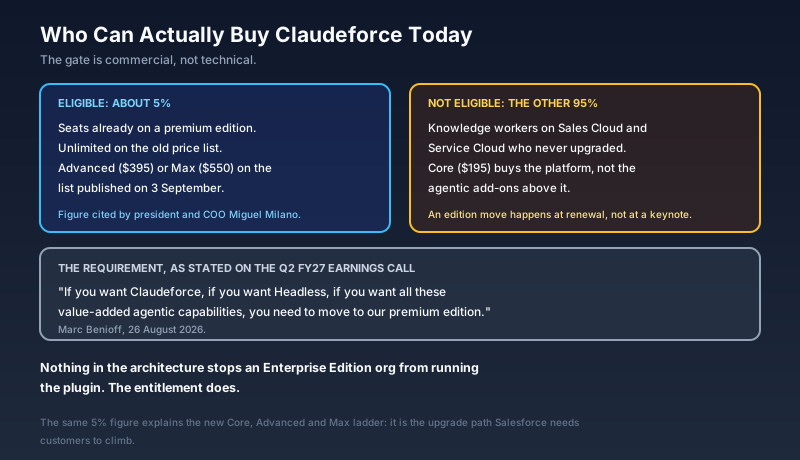
That gap moved from footnote to headline on Tuesday, when the numbers behind it got quoted back at Salesforce. Claudeforce requires a premium edition. Salesforce president and chief operating officer Miguel Milano has told investors that only about 5% of the knowledge workers using Sales Cloud and [Service Cloud](/terms/service-cloud) have upgraded to the higher-end editions. Put those two facts next to each other and the biggest product story of the year is currently addressed to roughly one in twenty seats.
The Number That Frames Everything
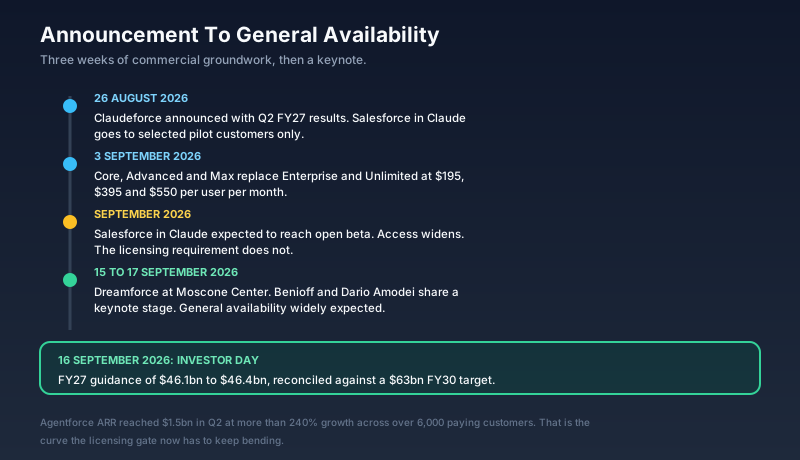
Claudeforce was announced on 26 August alongside Q2 FY27 results. Three workstreams sit under the name: Claude as the model behind Agentforce reasoning, Claude powering Slackbot and Slack Code inside Slack, and Salesforce in Claude, a plugin carrying 37 prebuilt sales skills that lets sellers prep meetings, review deal health and update records without opening Salesforce at all.
The third piece is the one customers asked about, and it is the one behind the gate. The skills were co-engineered with Anthropic rather than wrapped around a public API, so each one carries task-specific guidance about which fields matter and in what order. An administrator connects the plugin once, centrally, and every call it makes against the Salesforce MCP server inherits the requesting user's own permissions, which means a record a rep cannot see stays a record Claude will not return. It is a well-designed access model, and it is not the thing standing between customers and the product.
Marc Benioff said the quiet part on the earnings call: if you want Claudeforce, if you want Headless, if you want the value-added agentic capabilities, you move to the premium edition.
On the old price list, premium meant Unlimited. On the price list Salesforce published on 3 September, it means Advanced at $395 or Max at $550 per user per month. Either way the requirement is the same shape, and the 5% figure is what makes it interesting. Nothing in the architecture stops an Enterprise Edition org from running the plugin. The entitlement does.
You Cannot Buy It On One Piece Of Paper
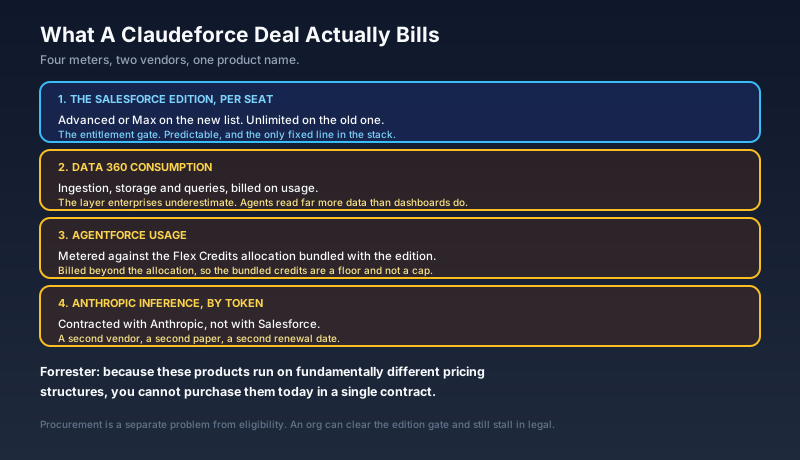
Eligibility is only the first obstacle. The second is procurement, and it is the one Forrester put a spotlight on: because the products run on fundamentally different pricing structures, customers cannot purchase them today in a single contract. A Salesforce spokesperson conceded the same point in plainer language, saying you cannot buy this on one piece of paper at the moment.
Count the meters. The Salesforce edition is per seat and predictable. Data 360 is consumption based, and it is the layer analysts keep flagging as the one enterprises underestimate, because agents read far more data than dashboards ever did. Agentforce usage draws down the Flex Credits allocation bundled into the new editions and bills beyond it. Claude inference is token based and contracted with Anthropic, not with Salesforce.
Four meters, two vendors, one product name. For a finance team that has spent two years trying to get software spend into a forecastable shape, that is a hard paper to sign, and it explains why the pilot has stayed narrow while the marketing has stayed loud.
Why The New Editions Exist
The 5% figure also explains last week's repricing better than the press release did.
Salesforce did not replace Enterprise and Unlimited with Core, Advanced and Max as a tidying exercise. It built a ladder with the agentic features on the top two rungs, bundled Slack, Tableau Next, Premier Success and a fixed Flex Credits allocation into each tier so the upgrade reads as value rather than a price rise, and then attached the most desirable product of the year to the tiers it wants customers to climb to.
That is a coherent strategy. It is also a slow one. Edition upgrades happen at renewal, renewals are annual, and a customer who renewed in July is not revisiting the contract because a keynote was good. If Claudeforce reaches general availability at Dreamforce next week, the addressable base on day one is whoever is already on a premium tier plus whoever has a renewal date in the next two quarters and the budget headroom to move up.
There is a pattern here that anyone who followed Agentforce through 2025 will recognise. Salesforce spent a year answering questions about adoption numbers that looked small next to the marketing, and the answer each time was that the ramp was real and the base was building. It largely was. But the reason the questions kept coming is that the reported figure and the addressable market never quite lined up, and gating the follow-up product behind an edition upgrade sets that same conversation up again, this time with the constraint written into the price list rather than hidden in a sales motion.
The Numbers Salesforce Prefers
The counterargument from Salesforce is usage, and it is a real one.
Internally, the company says 83% of its own workforce actively uses the Claude-powered Slackbot, with about 8.1 million annualised hours of productivity gain and Slackbot users up more than 150% quarter over quarter. Agentforce annual recurring revenue reached $1.5 billion in Q2 at more than 240% growth across over 6,000 paying customers, and combined Agentforce and Data 360 ARR sat near $3.9 billion.
Those are strong numbers for a product line two years old. They also come with an asterisk that the licensing story sharpens. Salesforce runs on the top edition of everything it sells, so its internal adoption rate says nothing about the friction a customer on Enterprise Edition hits. The 8.1 million hours are evidence the product works. They are not evidence anyone outside the premium tier can get to it.
Elsewhere This Week
Salesforce published its CFO Priorities Report on Wednesday, and it lands on the same theme from the buyer's side. The research is a double-blind survey of 865 finance leaders across France, Germany, Japan, the UK and the US, fielded from 4 to 15 May. Nearly three quarters say their remit has expanded, with managing AI the top reason. Of those already using AI, 90% report positive return. Underneath the optimism sit the blockers, and they are the ones a Claudeforce deal has to clear: security at 46%, governance at 42%, integration at 42%. The report also finds 65% of finance teams now manage multiple revenue models and 87% plan to add consumption-based products of their own, which is a quiet irony given how hard consumption pricing is proving to buy.
Marketing Cloud Next got a practical governance piece this week too, laying out seven decisions to settle before letting agents touch a customer. The first one is the one teams skip: give agent oversight a named owner on day one, because marketing AI crosses marketing, admin, data, architecture, security and compliance, and problems that fall between those teams do not get found by anyone.
On the market side, CRM traded around $249 on Wednesday against a consensus target near $272, at roughly 27 times trailing earnings with a free cash flow yield near 7%. The stock is up sharply over the past month on the Q2 print and still down year to date. The next scheduled catalyst is Investor Day on 16 September, where the arithmetic between FY27 guidance of $46.1 billion to $46.4 billion and the $63 billion FY30 target gets walked through in public.
And Dreamforce is six days out, 15 to 17 September at Moscone Center, with free virtual sessions on Salesforce+ running through the 18th. The catalogue has grown past 1,600 breakout sessions with more than 50 keynotes, 150 hands-on trainings and 240 community roundtables, which is a lot of room for announcements that have nothing to do with pricing. Benioff and Anthropic chief executive Dario Amodei are scheduled to share a keynote stage to talk about the partnership. Expect general availability, expect a number, and expect the licensing question to be asked from the floor.
What To Do Before The Keynote
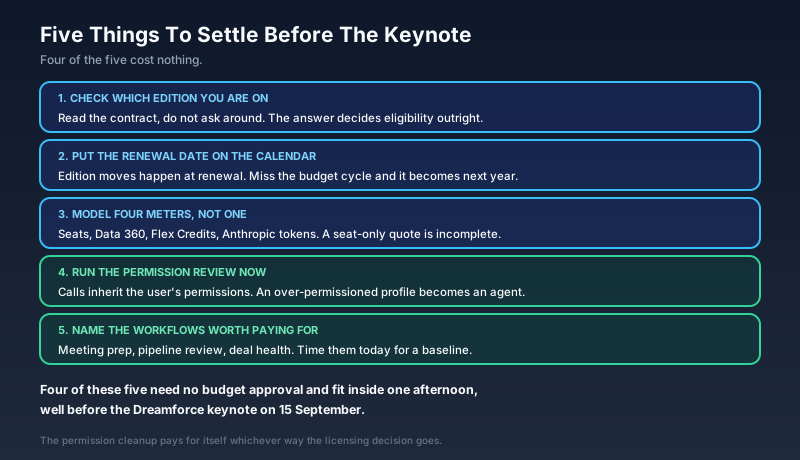
Check which edition you are actually on. Read the contract, do not ask around. On the new price list this single fact decides whether Claudeforce is a budget conversation or a non-starter.
Put your renewal date on the calendar. Edition moves happen at renewal. If yours falls after the budget cycle closes, a next-quarter decision has quietly become a next-year decision.
Model four meters, not one. Seats, Data 360 consumption, Flex Credits drawdown, Anthropic tokens. Any quote showing only the seat price is incomplete, and the gap will show up in a finance review you would rather not be in.
Run the permission review now. Every call the plugin makes inherits the requesting user's permissions, so an over-permissioned profile becomes an over-permissioned agent the moment the entitlement lands. This work costs nothing and does not wait on a licence.
Name two or three workflows worth paying for. Meeting prep, pipeline review, deal health. Time how long they take today. Without that baseline, a pilot produces enthusiasm and no evidence.
Start with the edition check, because it decides the shape of every other conversation. Teams already on a premium tier have a pilot to design and six days to design it in. Teams on Enterprise have a renewal to plan and a stronger negotiating position than they think, because a vendor with a flagship product addressed to 5% of its own installed base needs that number to move more than any single customer needs the product.
About the Author
Dipojjal Chakrabarti is a B2C Solution Architect with 29 Salesforce certifications and over 13 years in the Salesforce ecosystem. He writes and edits salesforcedictionary.com, published by KineticBit Inc., to help admins, developers, architects, and cert/interview candidates sharpen their fundamentals. More about Dipojjal.
Share this article
Sources
- Why Salesforce's Licensing Problem May Damage Claudeforce's Adoption Numbers (Salesforce Ben)
- Claudeforce: The AI Interface Salesforce Never Built (Forrester)
- Salesforce and Anthropic Announce Claudeforce (Salesforce Newsroom)
- New Salesforce Editions Bundle Everything Businesses Need for Agentic Transformation (Salesforce News)
- New Research: CFOs Use AI and Agents to Tame Revenue Complexity (Salesforce News)
- 7 Decisions to Make Before Activating AI Agents in Marketing Cloud Next (Salesforce Ben)
- Claudeforce Explained: What Salesforce and Anthropic Actually Ship (Apex Hours)
- Dreamforce 2026 (Salesforce)
- Salesforce Investor Relations (Q2 FY27 results and Investor Day)
Related dictionary terms
Practise it
Five questions on Agentforce Specialist
Exam-style questions with an explanation after each one. No account needed, and your answers build a weak-topic map once you have one.
More news
Salesforce Rebuilds Its Price List
Salesforce replaced Enterprise and Unlimited with Core, Advanced and Max editions on 3 September. Here is the real arithmetic, what the bundled Flex Credits actually buy, and what to check before your renewal.

The Developer Console Went Missing
Winter '27 makes Web Console the default in-org IDE and switches Developer Console off by default. Here is the Setup toggle that brings it back, the four things the new tool still cannot do, and when your org gets this.
Comments
No comments yet. Start the conversation.
Sign in to share your take on this article. Your account works across every page.