
Salesforce Rebuilds Its Price List
Enterprise Edition and Unlimited Edition are gone from the Salesforce price list. In their place are Core at $195, Advanced at $395 and Max at $550 per user per month, each bundling Slack, Tableau Next, Premier Success and a fixed annual Flex Credits allocation. Salesforce calls it simplification and up to 70% more value. For the two tiers most orgs actually sit on, it is also a list price rise of 11% and 13%.
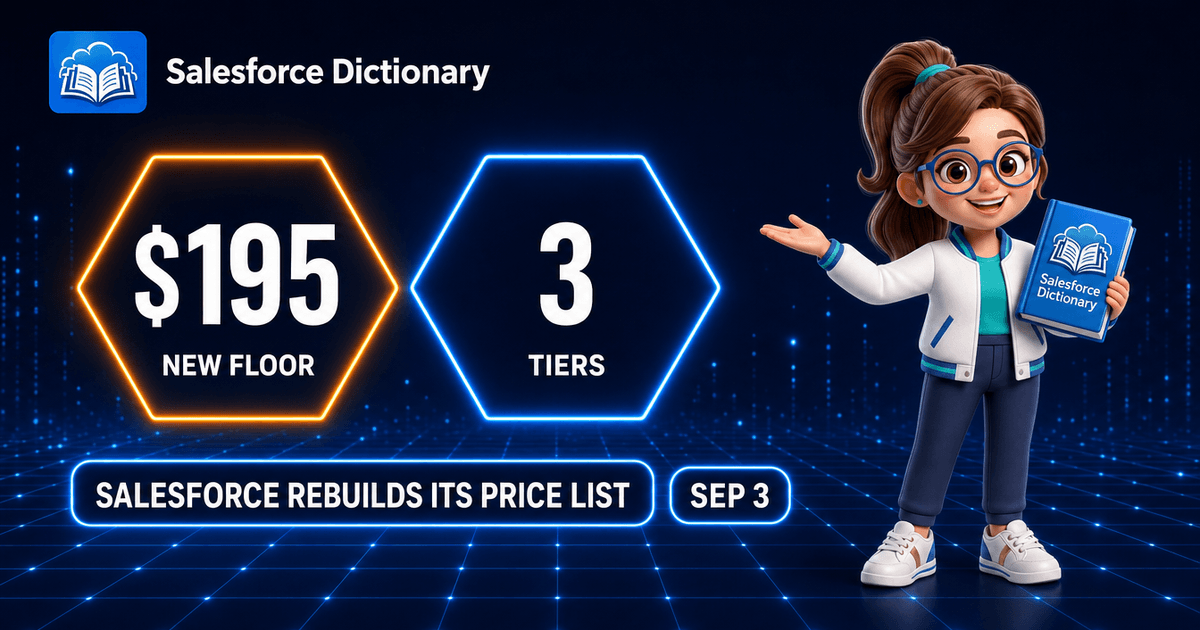
Sales Cloud Enterprise Edition listed at $175 per user per month on Wednesday. On Thursday the tier a new buyer lands on is called Core, and it lists at $195.
Salesforce published a new edition structure on 3 September. Core, Advanced and Max now run across Agentforce Sales, Agentforce Service and Agentforce Industries, replacing the Enterprise, Unlimited and Agentforce 1 ladder that customers have been buying against for years. The framing is simplification: fewer SKUs, one purchase, everything a company needs for what Salesforce calls agentic transformation.
The framing is fair. The arithmetic is worth doing yourself.
The New Ladder, With The Old One Underneath It
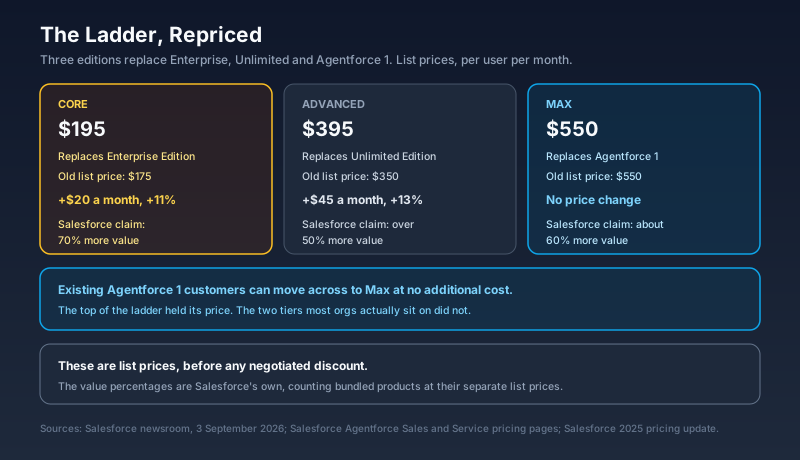
Three tiers, three prices, and three different stories depending on where you sit today.
Core lists at $195. It replaces Enterprise Edition, which has listed at $175 since the August 2025 increase. That is $20 more per user per month, or 11%. Salesforce's claim against it is 70% more value.
Advanced lists at $395. It replaces Unlimited Edition at $350. That is $45 more per user per month, or 13%, against a claim of more than 50% more value.
Max lists at $550. Agentforce 1 Edition also listed at $550, so the top of the ladder did not move. Salesforce puts the added value at roughly 60%, and says existing Agentforce 1 customers can move to Max at no additional cost.
So the shape of this is clear before you read a single feature comparison. The tier where most Salesforce customers actually live got more expensive. The tier almost nobody had bought yet got a lot more generous. That is not a scandal. It is a company using packaging to pull the middle of its base upward, which is what packaging is for. It is just worth naming, because "simplification" is doing a fair amount of work in the press release.
Where The Extra Value Actually Comes From
The value claims are not invented. They are the list prices of things that used to be separate lines on your order form, now inside the edition.
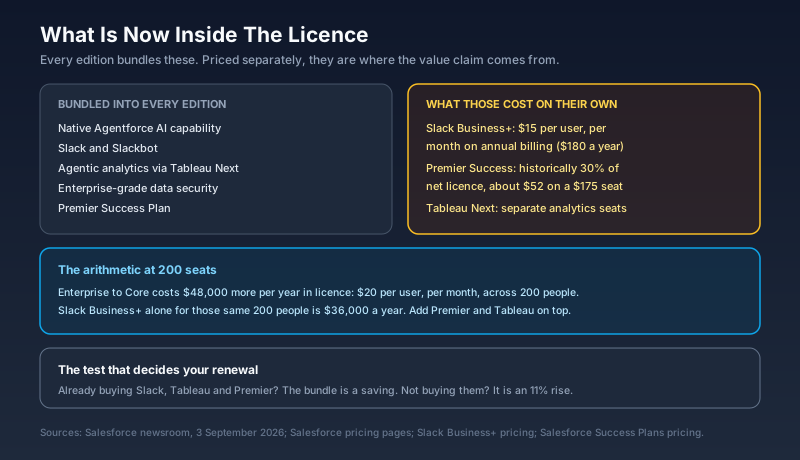
Every edition now ships with Agentforce capability built in, Slack and Slackbot, embedded agentic analytics through Tableau Next, enterprise-grade data security and the Premier Success Plan. Core and Advanced carry Slack Business+. Max carries Slack Enterprise+.
Price those separately and the claim holds up. Slack Business+ lists at $15 per user per month on annual billing, which is $180 per user per year. Premier Success has historically been priced at 30% of net licence fees, which on a $175 licence is roughly $52 per user per month. Tableau seats were their own purchase entirely.
Run it at 200 seats. Moving from Enterprise to Core costs an extra $48,000 a year in licence. Slack Business+ for those same 200 people, bought on its own, is $36,000 a year. Add Premier and Tableau and the bundle is comfortably cheaper than the parts.
Which produces a clean test, and it is the only one that matters for your renewal. If your org was already paying for Slack, Tableau and Premier Success, this repackaging is a saving and you should take it. If your org runs on Teams, has never opened Tableau, and has Standard Success because Premier never cleared the finance conversation, then you are being asked to pay 11% more for three products you decided against.
Liz Herbert at Forrester made this point in 2023, when Salesforce launched Unlimited Edition Plus at $500 a seat. Customers get swayed by simplified packaging and big discounts, she wrote, and regret it later when the shelfware shows up in an audit. The advice was to calculate real usage rather than aspirational usage. Three years and one agent platform later, the advice has not aged.
The Flex Credits Line Is Per Org, Not Per User
This is the number that will surprise people, and it is the number the announcement is quietest about.
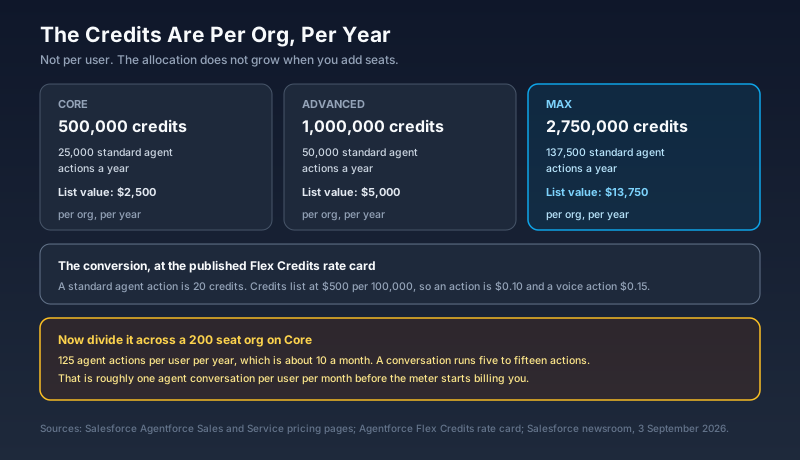
Core includes 500,000 Flex Credits. Advanced includes 1 million. Max includes 2.75 million. Salesforce's own pricing pages state the Max allocation as 2.75 million credits per org per year, which tells you the unit for all three: per organisation, per year. Not per user. It does not grow when you add seats.
Convert it. The published Flex Credits rate card prices a standard agent action at 20 credits, and credits list at $500 per 100,000, so a standard action is $0.10 and a voice action is $0.15. That makes the Core allocation 25,000 standard agent actions a year, Advanced 50,000, and Max 137,500. At list, the credits are worth $2,500, $5,000 and $13,750.
Now divide. A 200 seat org on Core has 125 agent actions per user per year, about ten a month. A typical agent conversation runs five to fifteen actions. So the bundled allocation covers roughly one agent conversation per user per month before the meter starts billing.
That is not a scandal either, and it is not hidden. It is the same Agentic Work Unit arithmetic that Salesforce has been showing investors all year, pointed the other way. What it means practically is that the credits in your edition are a pilot budget, not an operating budget. Anyone who reads "500,000 Flex Credits included" and concludes that agent consumption is now a solved line item is going to be wrong by an order of magnitude in a year with real usage.
What Moves Between The Tiers
The feature split is where the pricing pressure actually lives, because the things most orgs want are sitting one or two rungs up.
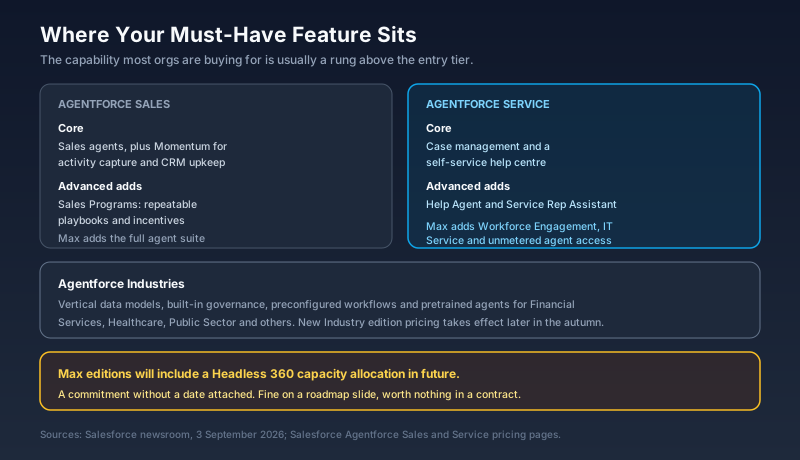
On Agentforce Sales, Core gets you sales agents and Momentum, the capability that captures activity data and keeps CRM records current without a rep typing it. Sales Programs, the structured playbook and incentive layer, starts at Advanced. The Prospecting Agent, which researches a target market continuously and pushes ranked candidates into CRM and Slack, is the headline agent on this side of the house.
On Agentforce Service, Core is case management and a self-service help centre. The prepackaged Help Agent and the Service Rep Assistant start at Advanced. Workforce Engagement, Quality Management, IT Service and unmetered agent access are Max only. That last phrase deserves attention: unmetered access at the top tier is the clearest signal yet that Salesforce expects consumption pricing to be the thing large customers most want to buy their way out of.
Agentforce Industries brings vertical data models, built-in governance, preconfigured workflows and pretrained agents for Financial Services, Healthcare, Public Sector and others. New pricing for the Industry editions takes effect later in the autumn rather than today, so if you are on an industry cloud, your number is not on the price list yet.
Salesforce has also said Max editions will include an allocation of Headless 360 capacity in future. That is a commitment without a date, which is fine as a roadmap statement and worth nothing in a contract.
Read This Next To Yesterday
Three days, three announcements, one direction.
On Monday, Salesforce booked its investor webinar around the Agentic Work Unit, the metric that counts discrete agent tasks and reported 3.2 billion of them last quarter. On Tuesday, the platform started switching itself on in orgs that had never enabled it, with the Setup toggle scheduled for removal in Winter '27. On the same call where that was happening, executives told analysts that pricing and packaging were evolving. Today the packaging arrived, and every tier of it carries an agent capacity allocation.
There is no evidence these were coordinated as a single campaign, and it would be lazy to claim they were. They do not need to be. The platform is on everywhere, the credits are in the SKU, and the meter runs past the allocation. Each step is defensible on its own. The sequence is what changes your budget.
The timing matters for a separate reason. Dreamforce runs 15 to 17 September at Moscone Center, twelve days from now, with an Investor and Analyst Session on the 16th. Pricing news released before the keynote rather than during it is pricing news the company wants absorbed and argued about early, so the stage can be about product. Take the twelve days.
What To Do Before Your Renewal
Work out which side of the bundle test you are on. List what you pay today for Slack, Tableau and your Success Plan, per user per year. If that total beats $240 a year on Core or $540 on Advanced, the new edition is cheaper than your current stack and the conversation is about migrating, not negotiating. If it does not, you are looking at an 11% to 13% list increase and you should say so out loud in the renewal.
Pull your actual Flex Credits consumption and compare it to the allocation. Setup, your Agentforce usage dashboard, last two quarters by month, annualised. If you are already past 25,000 standard actions a year, the Core allocation is a rounding error against your bill and the credit line should not carry any weight in your evaluation of the tier.
Check where your must-have capability sits. If the Help Agent or the Service Rep Assistant is the reason you are buying at all, your floor is Advanced at $395, not Core at $195. Pricing a project against the entry tier and discovering the feature is one rung up is how software budgets get rewritten in November.
If you are on Agentforce 1, ask for the Max move in writing. No additional cost is the stated position, and stated positions belong in an amendment rather than in a slide deck.
If you are on an industry cloud, hold. Industry edition pricing lands later in the autumn. Signing a multi-year commitment against a price list that is explicitly incomplete is a bad trade even when the vendor is acting in good faith.
The honest read is that this is a good package badly framed. Bundling Slack, analytics and premium support into the licence is genuinely simpler than the SKU sprawl it replaces, and holding the top tier at $550 while adding 60% more to it is a real concession to the customers spending the most. The part that deserves scrutiny is the word value doing the work that the word price used to do. Salesforce is quoting the list cost of everything it added and not quoting the 11% it took at the entry tier. Do that subtraction yourself before the renewal call, and you will be the best prepared person in the room.
About the Author
Dipojjal Chakrabarti is a B2C Solution Architect with 29 Salesforce certifications and over 13 years in the Salesforce ecosystem. He writes and edits salesforcedictionary.com, published by KineticBit Inc., to help admins, developers, architects, and cert/interview candidates sharpen their fundamentals. More about Dipojjal.
Share this article
Sources
- New Salesforce Editions Bundle Everything Businesses Need for Agentic Transformation (Salesforce News)
- Agentforce Sales pricing (Salesforce)
- Agentforce Service pricing (Salesforce)
- Salesforce editions and pricing overview (Salesforce)
- Salesforce Announces Pricing Update, the August 2025 list-price increase (Salesforce News)
- Salesforce Success Plans and Professional Services Pricing (Salesforce)
- Slack Business+ plan pricing (Slack)
- Salesforce Debuts New High-End Editions For Sales And Service (Forrester, Liz Herbert)
- Dreamforce 2026 registration and dates (Salesforce)
Related dictionary terms
Practise it
Five questions on Agentforce Specialist
Exam-style questions with an explanation after each one. No account needed, and your answers build a weak-topic map once you have one.
More news
Salesforce's September Adoption Test
Salesforce scheduled two September investor events and put the Agentic Work Unit at the centre of both. Here is what that metric measures, what it costs you per action, and which September dates land on your org.
The Winter '27 Enforcement Shuffle
Winter '27 started landing in production this weekend with a shorter enforcement list than the one published on August 19. Three release updates moved out, two still bite, and the checklists disagree. Here is the current state.
Agentforce Turns Itself On
Salesforce began auto-enabling the Agentforce platform in existing orgs this week and is removing the setting from Setup in Winter '27. Here is who is affected, which controls survive, and what to check today.
Salesforce's Beat Was Anthropic
Salesforce's $5.90 earnings headline included $2.53 from a mark on its Anthropic stake. Here is what the quarter looks like once that line is set aside, and which number actually describes your renewal.
Comments
No comments yet. Start the conversation.
Sign in to share your take on this article. Your account works across every page.