
Agentforce Commerce Goes GA
Salesforce just made its three commerce agents generally available and tied them directly into ChatGPT and Google. Here is what shipped and what it means for the 2026 shopping season.
Salesforce shipped Agentforce Commerce to general availability on June 24, 2026, and called it the biggest Agentforce Commerce release it has done. The pitch is simple: three AI agents that sell on your storefront, sell through ChatGPT and Google, and run your back office, all wired into Commerce Cloud.
The announcement landed at the Boston stop of the Agentforce World Tour, Hynes Convention Center. Here is what actually went GA, where the real value sits, and where the bodies are buried.
Three agents, now GA
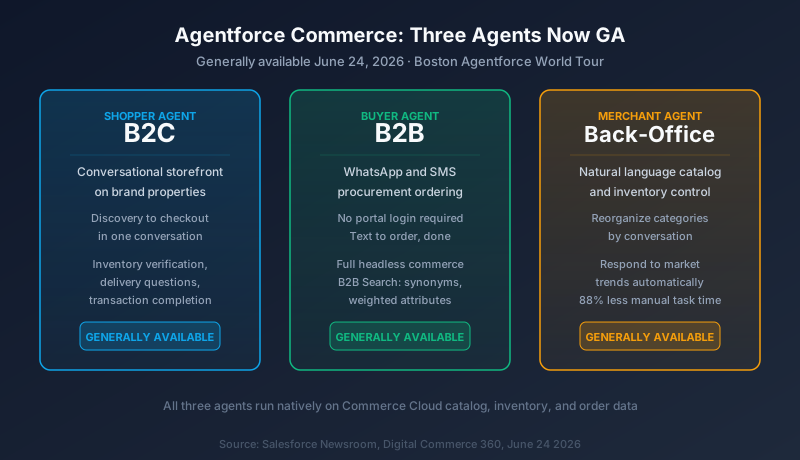
Agentforce Commerce ships with three distinct agents, each pointed at a different part of the selling motion.
The Shopper Agent handles B2C. It guides consumers through discovery, product questions, and checkout on a brand's own properties. Think conversational storefront, not a chatbot bolted onto a corner of the page.
The Buyer Agent handles B2B. This is the one that breaks the usual mold, and we will come back to it.
The Merchant Agent runs back-office work. It uses natural language to organize catalogs, manage inventory, and react to market trends. A merchandiser can tell it to reorganize a category or adjust to a demand spike and let it do the assembly.
All three are GA now, not beta, not pilot. That distinction matters because Salesforce has a long habit of announcing things that ship "soon." This time the agents are live.
The ChatGPT integration is the headline
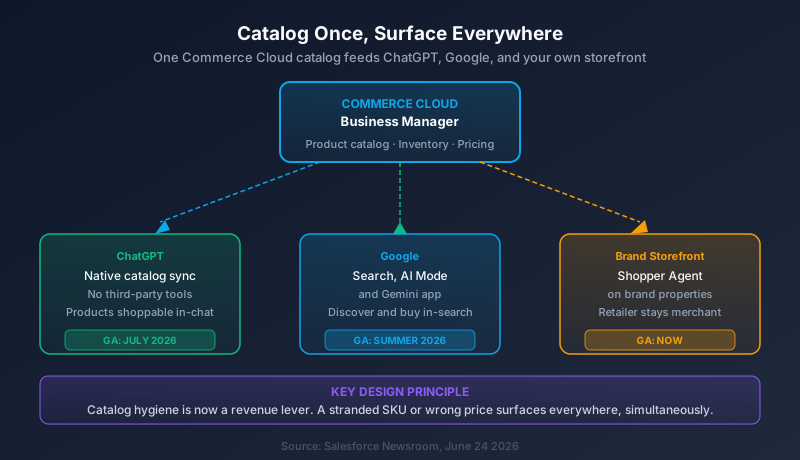
The piece getting the most attention is native ChatGPT integration. Salesforce can now sync product catalogs directly from Business Manager into ChatGPT. No third-party connectors, no middleware, no scraping. The catalog you already maintain becomes shoppable inside the assistant where a growing share of buyers start their search.
This is the part worth slowing down on. For years the gap between "my catalog" and "the place customers ask questions" required glue code or a vendor. Salesforce is collapsing that into a first-party sync. If you run Commerce Cloud, your products can appear in ChatGPT responses without you building anything. That feature reaches GA in July 2026.
The strategic logic is straightforward. If shoppers are asking an assistant what to buy, the brand whose catalog is structured and synced gets surfaced. The brand that is not, does not. This pushes catalog hygiene from a nice-to-have to a revenue lever.
Retailers remain merchants of record throughout. Order management, loyalty, service, and marketing all stay unified behind the scenes. The agent is the new storefront surface, not a separate transaction system.
Google, too
Salesforce is not betting on a single assistant. The Google integration lets shoppers discover and buy across Google Search, including AI Mode, and the Gemini app. That reaches GA in summer 2026.
Put the two together and the play is clear. Salesforce wants your catalog present in both major consumer AI surfaces, fed from one source of truth in Commerce Cloud. The brand maintains one catalog. The agents distribute it to ChatGPT, to Google, and to the brand's own storefront.
That is a different architecture than the one most Commerce Cloud customers built against. The old model was storefront first, everything else secondary. The new model is catalog first, surfaces everywhere.
The B2B angle deserves more credit than it will get
The Buyer Agent is quietly the most interesting release here. It works over WhatsApp and SMS. A business buyer can place an order by text, no portal login, no password reset, no clicking through five screens of a procurement interface.
Anyone who has used a B2B commerce portal knows the friction. Reorders that should take ten seconds take ten minutes. The Buyer Agent removes the portal from the reorder loop entirely. You text your order, the agent handles it.
Salesforce also brought full headless commerce capability and a reworked B2B Search: synonym management, weighted attributes, and predictive discovery. Headless matters for teams that want commerce logic behind their own front end without being locked to a Salesforce-owned display layer. The search upgrades matter because B2B catalogs are messy, and "the customer typed the wrong synonym" is a real lost sale.
For B2B operators, the combination of WhatsApp reordering plus better search is worth evaluating before the holiday build season begins.
The numbers behind the bet
Salesforce did not ship this on vibes. The data it cites is the actual argument.
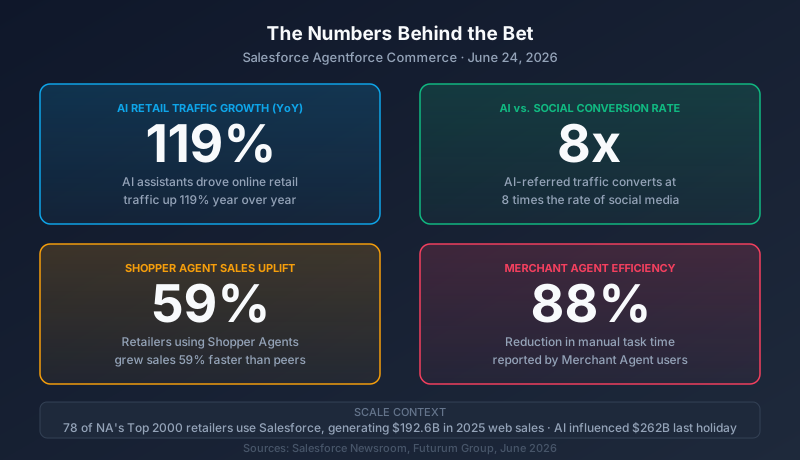
AI assistants grew retail traffic by 119% year over year. AI influenced 20% of global online sales during last holiday season, against a $262 billion total. Retailers already running Shopper Agents saw 59% faster sales growth than peers, averaging 6.2% year-over-year sales growth. AI-referred traffic converts at 8x the rate of social media channels.
That last figure is the one to sit with. 8x conversion versus social means the traffic an assistant sends is intent-loaded, not idle scrolling. On the operations side, merchants using the Merchant Agent reported up to 88% reduction in manual task time.
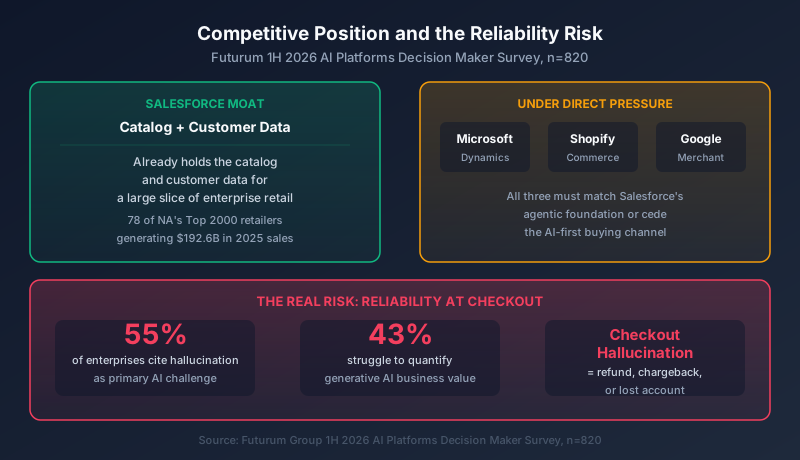
For scale context, 78 of North America's Top 2000 online retailers run Salesforce, and they generated $192.6 billion in 2025 web sales. This is not a startup experiment. It is Salesforce defending and extending an installed base that is already enormous.
The holiday projections are pointed as well. AI agents are on track to influence 21% of global orders this Cyber Week, up from 20% last season.
The competitive picture and the part nobody wants to discuss
This release puts direct pressure on Microsoft, Shopify, and Google, each of which wants to own the agentic commerce layer. Salesforce's edge is that it already holds the catalog and the customer data for a large slice of enterprise retail. Owning the data plumbing is a real moat.
Now the uncomfortable part. Agentic commerce only works if the agent is right. The Futurum Group 1H 2026 AI Platforms Decision Maker Survey (n=820) found 55% of enterprises cite reliability and hallucination management as their primary AI adoption challenge. Another 43% struggle to quantify the business value of generative AI.
Read that against this launch. An agent that confidently recommends a discontinued product, quotes a wrong price, or invents a spec does not just annoy a customer. It transacts the error. A hallucination in a marketing email is embarrassing. A hallucination at checkout is a refund, a chargeback, or a lost account.
Salesforce says the agents are "wired natively into your catalog, inventory, and orders from the first day." That is the right design principle. A grounded agent that only asserts what the catalog says is materially safer than one that freelances. But grounding is not a guarantee. Testing under adversarial conditions, before the 2026 shopping season goes live, is not optional.
Futurum's Keith Kirkpatrick, VP and Research Director, put the broader shift plainly: "agentic AI is no longer speculative, but a measurable force in retail growth." Measurable cuts both ways. The wins are measurable, and so are the failures.
What to do now
Nitin Mangtani, EVP and GM of Agentforce Commerce, drew the line plainly: "The brands that win will have their Shopper Agent live on their own properties for the 2026 shopping season." That gives you a deadline, not a someday.
Here are the specific steps, in order of dependency:
1. Audit your catalog now. The ChatGPT and Google sync is only as good as the data underneath it. Clean product titles, accurate attributes, correct pricing, no zombie SKUs. Do this before you activate any agent sync, because the agents surface whatever you feed them.
2. Stand up the Shopper Agent in a sandbox and test it adversarially. Ask it about discontinued products. Ask trick pricing questions. Find the hallucinations before your customers do. Set explicit guardrails on what the agent is permitted to assert about pricing, availability, and specifications.
3. If you run B2B, pilot the Buyer Agent on one high-frequency reorder account. WhatsApp and SMS reordering either delights buyers or confuses them. Learn which category your buyers fall into on a single account before rolling any wider.
4. Instrument AI-referred conversion from day one. The 8x-versus-social figure is a benchmark, not a guarantee. Track your own numbers from the first week. If AI traffic is converting at 2x, not 8x, you want to know that before you have cut your social budget in response to a press release.
The catalog work is the gating item. Everything else, the agent deployment, the ChatGPT sync, the Google integration, depends on the catalog being clean and accurate. Start there.
About the Author
Dipojjal Chakrabarti is a B2C Solution Architect with 29 Salesforce certifications and over 13 years in the Salesforce ecosystem. He writes and edits salesforcedictionary.com, published by KineticBit Inc., to help admins, developers, architects, and cert/interview candidates sharpen their fundamentals. More about Dipojjal.
Share this article
Sources
- As AI Agents Transform Commerce, Salesforce Unleashes Its Biggest Agentforce Commerce Release Yet (Salesforce Newsroom)
- Salesforce Unveils Agentforce Commerce Capabilities as AI Assistants Grow Retail Traffic Volumes by 119% (Salesforce Newsroom)
- Salesforce releases AI agents among B2B ecommerce updates (Digital Commerce 360)
- Salesforce's Agentforce Commerce Pushes Agentic AI From Hype to Retail Revenue Reality (Futurum Group)
- Salesforce Launches Agentforce Commerce: A New Era for Small Business Solutions (BizSugar)
Related dictionary terms
Practise it
Five questions on Agentforce Specialist
Exam-style questions with an explanation after each one. No account needed, and your answers build a weak-topic map once you have one.
More news

Salesforce Buys Contentful for Agentforce
Salesforce signed to acquire Contentful on June 1, adding a headless content layer to Headless 360 and Agentforce. The Berlin-founded CMS serves 4,800 brands. Reported price: $1B to $1.5B, half its 2021 peak. Closes Q3 FY2027.
Agentforce Operations Goes Live
Salesforce shipped Agentforce Operations to GA, pushing agents from CRM into back-office workflows. Digital blueprints convert process docs into agent instructions. The pitch: 70% faster cycle times, 80% fewer manual tasks.

Salesforce Q1 FY27: Agentforce $1.2B
Salesforce beat Q1 FY27 estimates on every major metric: $11.13B revenue, $3.88 non-GAAP EPS, $33.6B cRPO at 14% growth. Agentforce ARR crossed $1.2B at 205% growth. Then Benioff revealed engineers haven't been hired in two years.
Comments
No comments yet. Start the conversation.
Sign in to share your take on this article. Your account works across every page.