
Salesforce Buys Contentful for Agentforce
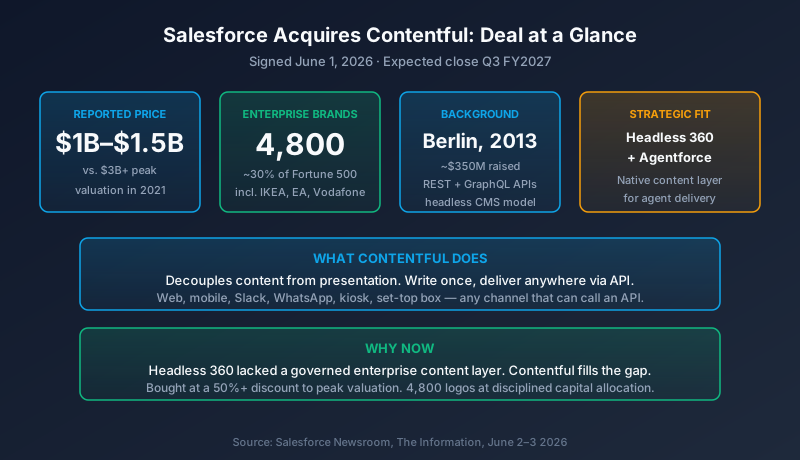
Salesforce signed a definitive agreement on June 1 to acquire Contentful, the Berlin-founded composable content platform, to add a native content layer under Headless 360 and Agentforce. Reported price: roughly $1B to $1.5B.

Salesforce signed a definitive agreement on June 1 to buy Contentful, the Berlin-founded headless content platform used by roughly 4,800 brands. The price was not officially disclosed, but The Information reports a figure of $1 billion to $1.5 billion. That is a bargain by the standards of 2021, when Contentful raised at a valuation north of $3 billion. Here is what Salesforce actually bought, where it slots into the Agentforce stack, and the awkward overlap nobody at Salesforce wants to talk about yet.
What Contentful is
Contentful is a composable content platform. Headless CMS, in plain terms. It was founded in Berlin in 2013 by Sascha Konietzke and Paolo Negri, and it decouples content from presentation. You write and store content once, in structured fields, then deliver it anywhere through REST and GraphQL APIs: web, mobile, kiosk, set-top box, whatever consumes the call.
That is the opposite of a traditional CMS, which bolts content to a specific front end. Contentful does not care what renders the page. It just serves structured content on request. The customer list is the real asset: IKEA, Vodafone, Electronic Arts, DoorDash, and close to 30 percent of the Fortune 500. The company raised about $350 million across five rounds before this deal.
So Salesforce is not buying technology it could not build. Headless CMS is a known pattern. It is buying 4,800 enterprise logos, an API-first architecture that is already battle-tested at scale, and the team that runs it. Build-versus-buy math, and Salesforce chose buy at a discount.
Where it fits: Headless 360 and Agentforce
The strategic anchor is Headless 360, the product Marc Benioff has been pushing since the Q1 FY27 earnings call. Headless 360 projects Salesforce data and logic into surfaces Salesforce does not own: WhatsApp, Slack, ChatGPT, Claude. Benioff said Anthropic-driven usage of it grew fivefold. The pitch is that Salesforce becomes a system of action behind other people's interfaces, not just a system of record you log into.
The gap in that story was content. Headless 360 could move records and trigger logic, but it had no enterprise-grade way to assemble the actual stuff a customer sees. Forrester analyst Chuck Gahun, quoted by The Register, put it bluntly: Headless 360 lacked "the enterprise-grade content layer to drive the customer facing digital experiences." Contentful fills that hole.
Jujhar Singh, president of C360 Applications and Industries, framed it the same way in the official announcement: "With Contentful, we complete that picture by adding a native, headless, composable content layer."
The Agentforce angle is where this gets interesting. The plan is to wire Contentful into Data 360 so agents pull approved, governed content instead of improvising. An agent handling a renewal could assemble a 1:1 message using the right offer, the right language, the right channel, all from structured content that legal and brand already signed off on. Salesforce calls this dynamic content orchestration: building experiences on the fly based on context, channel, language, and business rules.
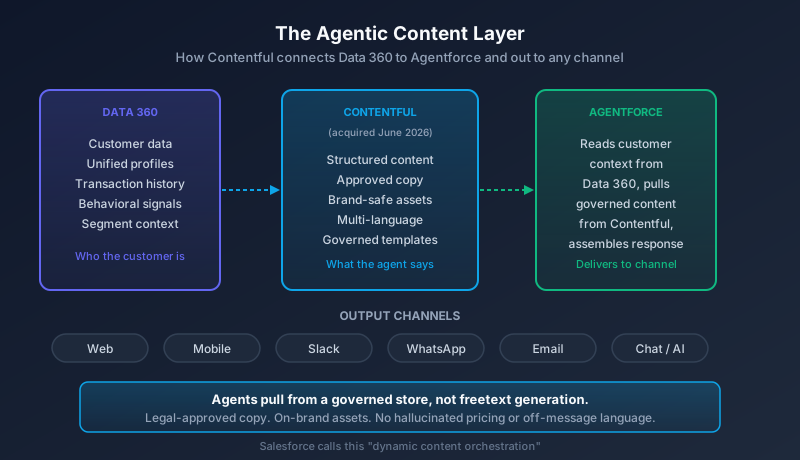
That is a real problem worth solving. The weak point of agent-generated content is that it hallucinates, goes off-brand, or quotes pricing nobody approved. A structured content layer with governance is a sane answer. Pull from a vetted store, do not freelance. Whether the integration delivers that cleanly is the open question, and integrations are where Salesforce acquisitions either pay off or rot.
The overlap problem
Here is what the press release skips. Salesforce already owns Salesforce CMS and Experience Cloud, both of which manage and serve content. So what happens to them?
Salesforce CMS is hybrid. It can run headless through API delivery, and it can also serve content into Experience Cloud sites and other Salesforce surfaces. It is decent for content that lives inside the Salesforce world. It has never been a credible competitor to Contentful for big, omnichannel, multi-front-end enterprise content operations. Different weight class.
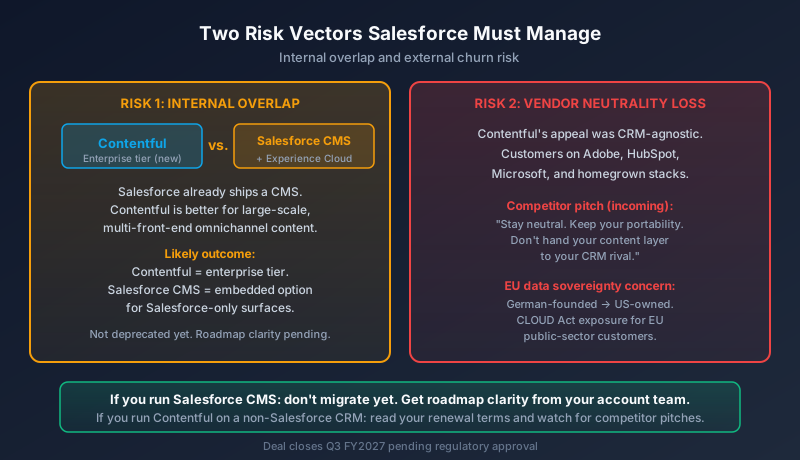
The honest read is that Contentful becomes the enterprise tier and Salesforce CMS stays the embedded option for customers who only publish inside Salesforce-controlled experiences. Salesforce has not said that. Until it does, customers on Salesforce CMS or Experience Cloud should expect ambiguity about roadmap priority. When a vendor buys a stronger version of something it already ships, the older product rarely gets the investment it used to.
If you run content on Salesforce CMS today, do not panic and do not migrate on speculation. Nothing is deprecated. But put a note in your architecture review to ask your account team where CMS sits relative to Contentful once the deal closes.
The risk to Contentful's own base
The flip side is sharper. A large share of Contentful's 4,800 brands run on CRMs that are not Salesforce. Adobe, HubSpot, Microsoft, or homegrown stacks. Headless CMS sells on neutrality. The whole point is that it plugs into anything. Once Contentful belongs to Salesforce, that neutrality is gone, at least in perception.
Competitors will pitch hard on exactly that. Contentstack, Sanity, Strapi, and others get an easy line: stay vendor-neutral, keep your multi-CRM portability, do not hand your content layer to your CRM vendor's biggest rival. Expect churn attempts aimed squarely at Contentful accounts running competing CRMs over the next year.
There is also a sovereignty wrinkle. Contentful is German-founded, and a chunk of its base is European, including public sector. An acquisition by a US company brings it under US legal reach, including the CLOUD Act. European data-sovereignty advocates flagged this within hours of the announcement. For some EU public-sector customers, that alone is a reason to re-evaluate.
The bigger pattern
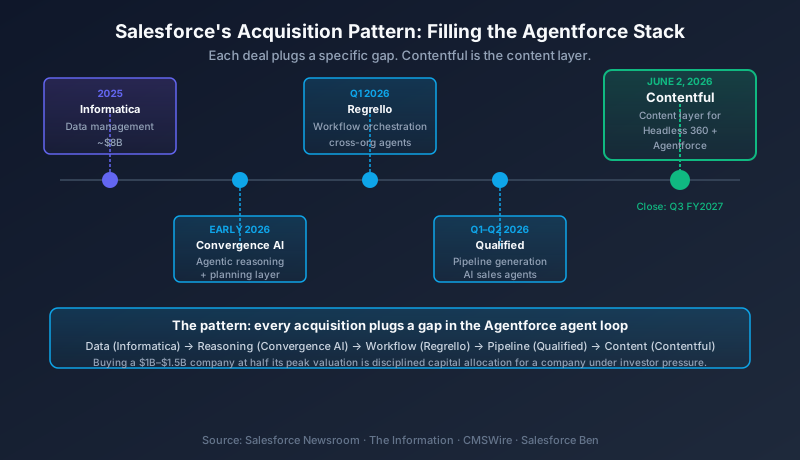
This is not a one-off. Salesforce has been on a steady buying run: Informatica, Convergence AI, Bluebirds, Regrello, Qualified, Cimulate, Momentum, and now Contentful. Each one plugs a specific hole in the Agentforce and Data 360 story. Informatica brought data management. Contentful brings content. The thread is consistent: assemble every input an enterprise agent needs to act, governed and at scale.
It also lands in a specific market moment. CRM stock has been volatile, swinging on AI monetization doubts and then on the Anthropic stake windfall. A roughly $1 billion to $1.5 billion deal for a real revenue-generating asset with 4,800 enterprise logos reads as disciplined capital allocation, not a moonshot. Buying a 2021 unicorn at half its peak valuation is the kind of move that plays well when investors are nervous about spend.
The deal is expected to close in Q3 of Salesforce's fiscal 2027, subject to regulatory approval. EU merger review is plausible given Contentful's European footprint, so the timeline could slip.
What to do now
If you are a Salesforce architect, treat Contentful as the future enterprise content layer for Headless 360 and Agentforce, and start thinking about how governed structured content would feed your agent use cases. If you run Salesforce CMS or Experience Cloud content, do not migrate yet, but get clarity from your account team on roadmap positioning before you commit new investment. If you are a Contentful customer on a non-Salesforce CRM, read the renewal terms and watch for competitor pitches, because they are coming. The deal will not close until Q3 FY27, so you have time to plan rather than react.
Watch the Summer '26 release notes and any follow-on Agentforce announcements for the first concrete signs of how the Contentful integration will actually surface. That is where the real product story, beyond the press release, will show up.
About the Author
Dipojjal Chakrabarti is a B2C Solution Architect with 29 Salesforce certifications and over 13 years in the Salesforce ecosystem. He writes and edits salesforcedictionary.com, published by KineticBit Inc., to help admins, developers, architects, and cert/interview candidates sharpen their fundamentals. More about Dipojjal.
Share this article
Sources
- Salesforce Signs Definitive Agreement to Acquire Contentful (Salesforce Newsroom)
- Salesforce Acquires Contentful in Latest Move to Boost AI (The Information)
- Contentful is a shot in the arm for Salesforce's headless bet, analyst says (The Register)
- Salesforce Buys Contentful, Adds Headless CMS For Agentforce (CMSWire)
- A New Chapter for Contentful: Scaling Our Vision with Salesforce (Contentful Blog)
Related dictionary terms
Practise it
Five questions on Agentforce Specialist
Exam-style questions with an explanation after each one. No account needed, and your answers build a weak-topic map once you have one.
More news

Salesforce's $5B Anthropic Windfall
Bloomberg valued Salesforce's Anthropic stake at about $5 billion on June 1, after Anthropic raised $65 billion at a $965 billion valuation and filed confidentially for an IPO. CRM jumped nearly 10 percent on a roughly 100x paper return.

Salesforce Q1 FY27: Agentforce $1.2B
Salesforce beat Q1 FY27 estimates on every major metric: $11.13B revenue, $3.88 non-GAAP EPS, $33.6B cRPO at 14% growth. Agentforce ARR crossed $1.2B at 205% growth. Then Benioff revealed engineers haven't been hired in two years.
Comments
No comments yet. Start the conversation.
Sign in to share your take on this article. Your account works across every page.