
Salesforce Q1 FY27: Agentforce $1.2B
Salesforce reported record Q1 FY27 results on May 27 with revenue of $11.13B, Agentforce ARR crossing $1.2 billion at 205% growth, and cRPO hitting 14% right on guidance. Then Benioff said engineers aren't being hired.

The cRPO landed at $33.6 billion, up 14 percent. That is the exact number the May 25 earnings preview flagged as the one metric that mattered, and it came in right on the guided rate. Salesforce reported record Q1 FY27 results on May 27, beat consensus on revenue and earnings, and crossed a billion dollars in Agentforce ARR. The stock is still down 33 percent on the year. Here is the full picture, and why a clean beat did not fix the problem the market actually cares about.
The headline numbers
The quarter beat on every top-line metric. Per the Q1 FY27 press release, revenue came in at $11.13 billion, up 13 percent year over year, ahead of the $11.05 billion consensus. Non-GAAP EPS hit $3.88 against a $3.12 estimate, a $0.76 beat. That is not a rounding-error beat. That is a comfortable margin.
Current remaining performance obligation, the metric analysts treat as the cleanest read on forward demand, reached $33.6 billion at 14 percent growth. cRPO measures contracted revenue expected to land in the next twelve months, so it leads reported revenue and is harder to game. Hitting the guided 14 percent exactly is the bull case: demand is not falling off a cliff, and the booked pipeline is intact.
Operating cash flow was $6.7 billion for the quarter. Salesforce raised full-year FY27 guidance to a range of $45.9 to $46.2 billion. It also returned $27.5 billion to shareholders, including $27.1 billion in share repurchases, retiring 103 million shares, roughly 11 percent of the float. That is an enormous buyback, and it tells you what management thinks of the current price.
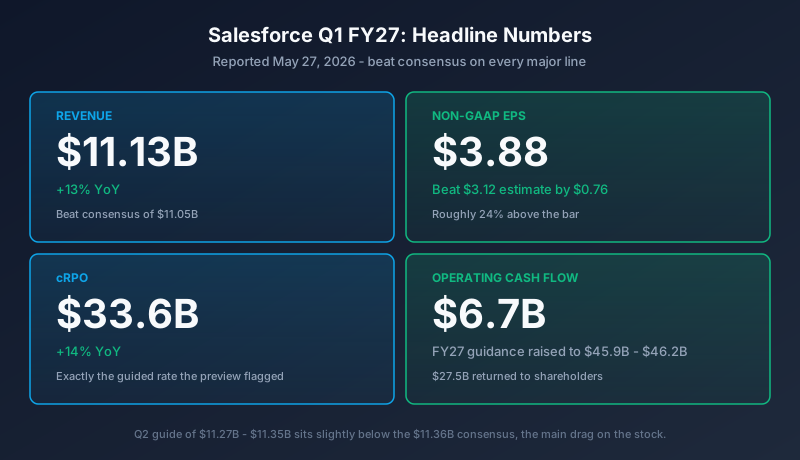
There was one soft spot, and it did the damage. Q2 guidance came in at $11.27 to $11.35 billion, slightly below the $11.36 billion consensus. A miss at the top of a guidance range is small. The market is not in a mood to forgive small.
Agentforce crosses $1 billion
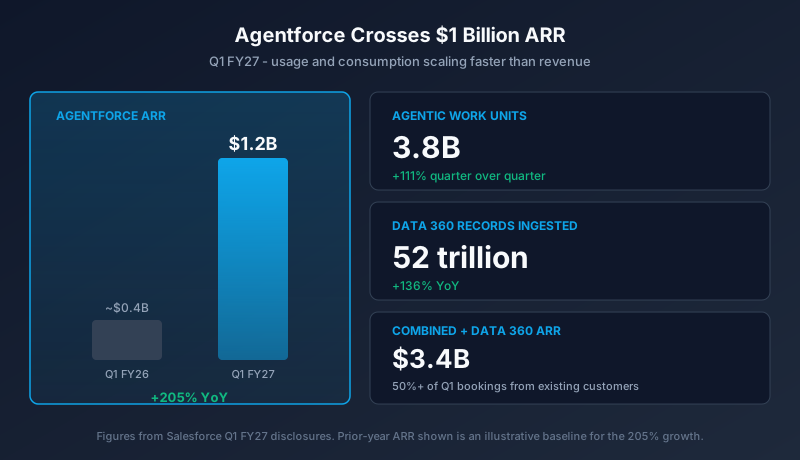
This is the number Salesforce wanted you to see. Agentforce ARR reached $1.2 billion, up 205 percent year over year, crossing the billion-dollar threshold this quarter. Combined Agentforce and Data 360 ARR hit $3.4 billion. For a product line that barely existed eighteen months ago, that is a fast ramp.
Two figures underneath the headline tell you whether the growth is real usage or shelfware. Salesforce processed 3.8 billion Agentic Work Units in the quarter, up 111 percent quarter over quarter. An Agentic Work Unit is a discrete piece of agent work, so a number that more than doubled in three months means agents are actually running, not sitting idle in a sandbox. Data 360 ingested 52 trillion records, up 136 percent year over year. Agents are only as good as the data they reach, and that volume is the fuel.
The most important detail is who is buying. More than half of Q1 Agentforce bookings came from existing customers expanding their footprint. Expansion revenue is cheaper to win and stickier to keep than net-new logos. It also signals that customers who tried Agentforce are coming back for more, which is the opposite of the pilot-and-abandon pattern that has haunted enterprise AI all year.
Set this against the BofA downgrade from May 18, which argued Salesforce could not monetize AI fast enough to justify the multiple. The 205 percent ARR growth and the expansion-driven bookings are the direct counterargument. Whether it is enough depends on the structural question below.
Headless 360 and the MCP push
Quieter but strategically significant: Salesforce expanded what it calls Headless 360. The platform now exposes more than 60 Model Context Protocol (MCP) tools and over 30 coding skills. MCP is the open standard for connecting AI models to external tools and data, and exposing the platform through it means developers can wire Salesforce capabilities into agents that do not live inside Salesforce.
That is a real shift in posture. The old model assumed every interaction happened in a Salesforce UI. Headless 360 accepts that agents, including ones built on other vendors' models, will call Salesforce as a backend service. Salesforce would rather be the system of record those agents query than fight to own the interface. The 30-plus coding skills point at the same idea: meeting developers where they already work instead of dragging them into a console.
Benioff says he is not hiring engineers
The earnings call produced the line that traveled furthest. On the May 28 call, Marc Benioff said engineering headcount has been flat at roughly 15,000 for about two years. Fortune reported his words plainly: "We're not hiring more engineers, we're not hiring more GA," referring to general and administrative roles. The one place Salesforce is adding people is sales. "We're mostly growing in Miguel's area: in sales," Benioff said, naming Chief Revenue Officer Miguel Milano, with plans to add 1,000 to 2,000 sales staff.
The reason is AI eating its own product category. Benioff said internal AI tools have lifted developer productivity by 30 percent, and pointed at "new coding agents" delivering "even more dramatic capabilities." Salesforce has committed $300 million to Anthropic tokens in 2026, the spend covered in the May 19 piece on the CRM rally. The story now has a clean shape: buy the AI, hold engineering flat, push the freed-up budget into the sales motion that sells more AI.
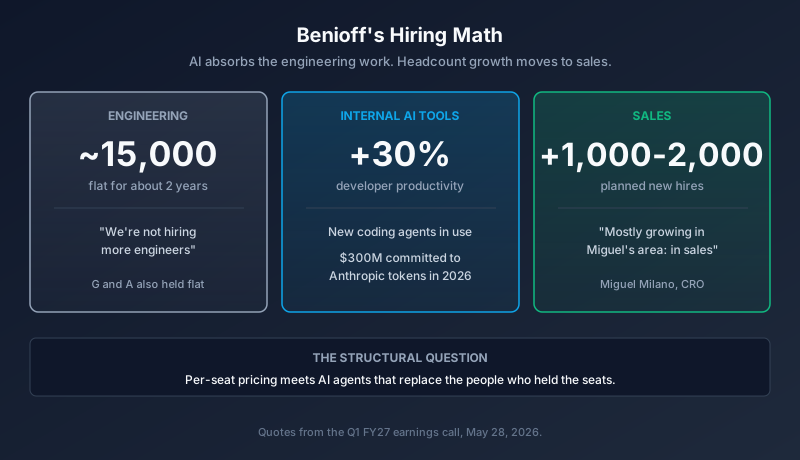
It is a confident message and a risky one. A company telling Wall Street it can grow revenue without growing its most expensive headcount is exactly what margin-focused investors want to hear. A company telling its own engineers that the org chart is frozen for the third straight year is a retention problem waiting to surface. Both things are true at once.
Why the stock is still down 33 percent
A clean beat, a raised full-year guide, a billion-dollar AI product, and a $27 billion buyback. The stock fell after hours and sits down 33 percent year to date, somewhere around $177 to $192. The slightly soft Q2 guide drove the immediate selling, but that is the symptom, not the disease.
The disease is the business model. Salesforce charges per seat. AI agents are sold partly on their ability to do work that used to require a person in a seat. If an agent replaces five support reps, the customer needs fewer support licenses. So the better Agentforce performs, the more it threatens the per-seat revenue that built the company. Investors have not seen a clean answer to how those two lines reconcile, and 205 percent ARR growth on a small base does not yet outrun the question on a 13 percent core.
The valuation reflects the fear, not optimism. Salesforce trades at roughly 13 times forward earnings, against about 22 times for the S&P 500 average and a historical Salesforce average closer to 48 times. The market is pricing this as a no-growth software business, not an AI leader. BofA kept its Underperform rating with a $160 target. The Motley Fool's read and the TIKR deep-dive both land in the same place: the numbers are good, the multiple says nobody believes they will stay that way.
There is a bull case hiding in the pessimism. If Agentforce keeps compounding and the expansion bookings hold, a 13x multiple on a company growing AI revenue triple digits is cheap. The buyback says management is taking that bet with the balance sheet. The market wants another two or three quarters of proof before it follows.
What to do next
If you run a Salesforce org, the practical move is to model your own seat exposure before your next renewal. Map which user licenses sit on workflows Agentforce could absorb, and decide whether you would cut seats or redeploy those people, because your account team will be sized up by 1,000 to 2,000 reps and they will be selling consumption. Get a consumption estimate tied to your real volumes, not the 205 percent growth headline. If you are watching the stock, the metric to track next quarter is not revenue. It is whether Agentforce ARR keeps its triple-digit pace while cRPO holds 14 percent. That is the pair that tells you the AI revenue is replacing the seat risk instead of cannibalizing it.
About the Author
Dipojjal Chakrabarti is a B2C Solution Architect with 29 Salesforce certifications and over 13 years in the Salesforce ecosystem. He writes and edits salesforcedictionary.com, published by KineticBit Inc., to help admins, developers, architects, and cert/interview candidates sharpen their fundamentals. More about Dipojjal.
Share this article
Sources
- Salesforce Delivers Record First Quarter Fiscal 2027 Results
- As AI slashes white-collar jobs, Salesforce CEO Marc Benioff says almost no one is being hired (Fortune)
- Down More Than 30% This Year, Could Salesforce Be an Underrated AI Stock to Buy? (Motley Fool)
- Salesforce Beat Q1 Earnings by $0.76 a Share. Here's Why the Stock Is Still Down 33% (TIKR)
- Salesforce FY27 Q1: Agentforce Crosses $1.2 Billion ARR (Shashi)
Related dictionary terms
Practise it
Five questions on Agentforce Specialist
Exam-style questions with an explanation after each one. No account needed, and your answers build a weak-topic map once you have one.
Comments
No comments yet. Start the conversation.
Sign in to share your take on this article. Your account works across every page.