
Agentforce Operations Goes Live
Salesforce rolled out Agentforce Operations, a back-office automation layer built on its Regrello acquisition. It turns process documents into agent-run blueprints and targets a 70% cut in cycle times. Here is what it actually does and where the claims need scrutiny.

A finance team closes the books every month by chasing invoices across email, an ERP, three spreadsheets, and a Slack channel where someone always forgets to approve the last line item. Salesforce now wants an agent to run that whole loop. The company has moved Agentforce Operations to general availability, pushing Agentforce out of the front office and into the plumbing where most enterprise work actually stalls. Here is what shipped, where the numbers come from, and what you have to weigh before you buy the pitch.
What Agentforce Operations actually is
Agentforce Operations is a back-office automation product. Instead of handling chat deflection or sales prospecting, it targets the slow, multi-step processes that span systems nobody likes to touch: invoice auditing, vendor onboarding, compliance checks, approval routing, purchase order rescheduling. According to Salesforce's announcement, specialized agents perform this work autonomously across disconnected systems, from email to ERP, and produce audit-ready output.
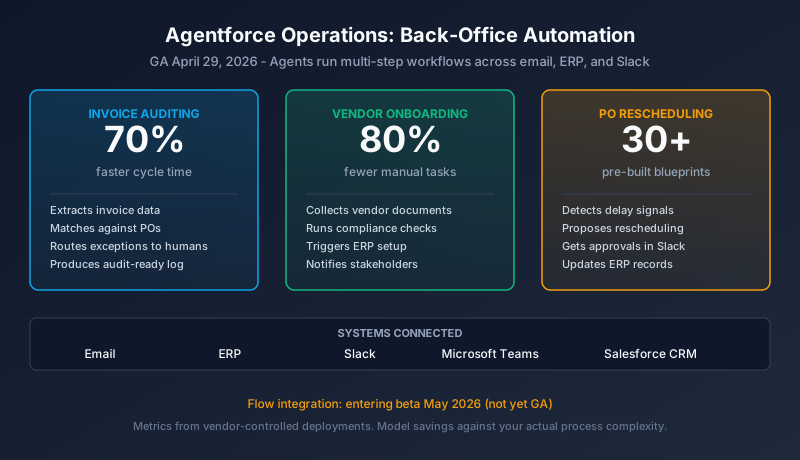
The headline claims are aggressive. Salesforce says cycle times for processes like auditing and onboarding can drop by 50 to 70 percent, and that up to 80 percent of manual tasks such as data entry can be eliminated. MarTech reports the same range. Treat those as vendor figures from controlled deployments, not a guarantee for your org. They are useful as a ceiling, not a baseline.
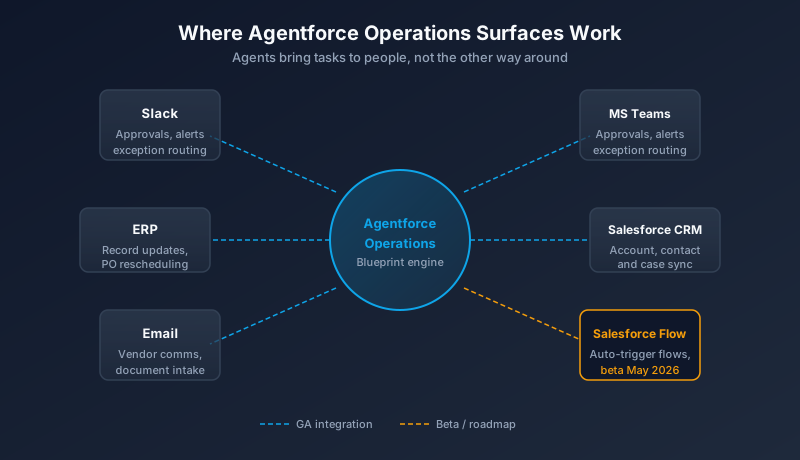
The product reached general availability on April 29, 2026. Ecosystem integration features, including auto-syncing data and triggering actions through Salesforce Flow, are entering beta this month. So the GA you can buy today is the agent layer. The deep wiring back into the rest of the platform is still maturing.
Digital blueprints are the core idea
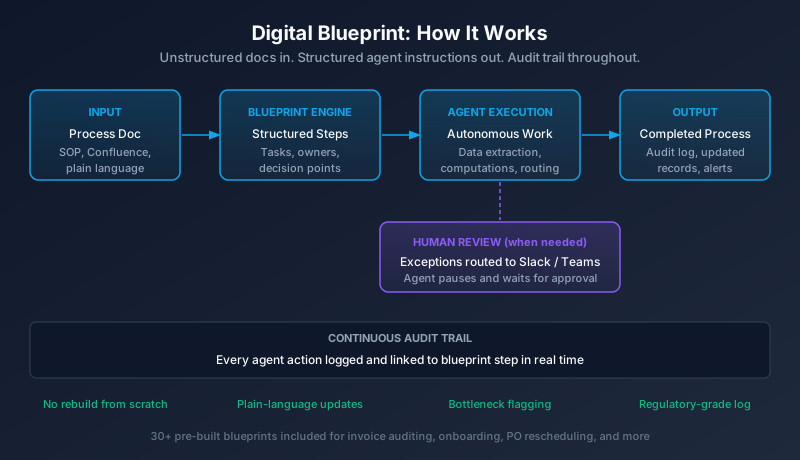
The mechanism worth understanding is the digital blueprint. You feed the system unstructured process documentation: a standard operating procedure, a flow diagram, a Confluence page describing how onboarding works. Agentforce Operations converts that into a structured set of instructions, the blueprint, which becomes the single source of truth for what each agent and each human is supposed to do.
That is a meaningful design choice. Most automation tools make you rebuild the process from scratch in their canvas. This one ingests the documentation you already have. You can also author blueprints in plain language. And if you have no documented process at all, Salesforce ships more than 30 pre-configured blueprints out of the box for common patterns like invoice auditing, onboarding, and PO rescheduling, with more promised.
The blueprint is also the audit artifact. Every action an agent takes is logged and linked back to the blueprint, which gives you a real-time trail instead of a forensic reconstruction after something breaks. For regulated industries that detail matters more than the speed claims.
The three pillars
Salesforce frames the product around three pieces. Constellation Research lays them out cleanly.
First, intelligent operations. Agents coordinate tasks and timelines and step in to do work that would otherwise require a person. They extract data from complex documents, run computations, update credit models, and flag compliance gaps. The work surfaces where people already are, routing into Slack and Microsoft Teams rather than forcing everyone into a new console.
Second, adaptability. This is the part Salesforce keeps hammering, and the reasoning is sound. Most automated processes calcify because changing them requires developers. Here, business users can update a process in plain language. The system also flags bottlenecks, like a delayed approval, before they cascade into a missed deadline.
Third, visibility. Every agent action is logged and tied to its blueprint, producing a continuous audit trail you can review as it happens.
If those pillars sound familiar, that is intentional. They map onto the same control, adaptability, and observability themes Salesforce pushed with Agentforce 3 and the Command Center. Agentforce Operations applies that framework to back-office process work specifically.
The Regrello foundation
Agentforce Operations is not built from nothing. It runs on technology from Regrello, the supply chain automation company Salesforce acquired in October 2025. Regrello had already deployed its platform across complex manufacturing and logistics operations, which is where multi-step, multi-party workflows live in their most painful form.
That pedigree is the most credible part of the launch. Salesforce did not invent a back-office orchestration engine in six months. It bought one that had survived real manufacturing and logistics environments, then wrapped it in the Agentforce brand and extended the same agentic process automation into financial services, insurance, and healthcare.
It also explains the timing. The acquisition closed in October, GA hit at the end of April, and the platform integration into Flow is only now reaching beta. That is the sequence of integrating an acquired product, not shipping a clean-sheet build. Worth keeping in mind when you assess how tightly this sits inside your existing Salesforce stack today versus how tightly it will sit in a few releases.
How this fits the bigger Agentforce push
Agentforce Operations does not arrive in isolation. The Summer '26 release, announced earlier this month, leans hard into multi-agent orchestration, agents in Flow Builder, and Agentforce Self-Service. Operations is the back-office counterpart to all of that front-office agent work.
The strategic read is straightforward. Salesforce has spent two years selling agents for customer-facing tasks: service deflection, sales prospecting, self-service portals. Those use cases are crowded and easy to comparison-shop. The back office is harder to displace, stickier once embedded, and far less contested. Owning the invoice-auditing workflow is a deeper hook than owning a chat widget.
There is a competitive angle too. By moving agents into ERP-adjacent and operations work, Salesforce is wading into territory occupied by workflow and process-mining vendors and the broader RPA market. The blueprint-from-documentation approach is the differentiator it is betting on. Whether that holds up against entrenched process automation incumbents is the open question.
Where to apply skepticism
The metrics deserve a hard look. A 50 to 70 percent cycle-time reduction and 80 percent manual-task elimination are real numbers Salesforce is putting in writing, but they describe best-case process types under conditions Salesforce controls. Your invoice-auditing process probably has edge cases, exception handling, and a compliance reviewer who will not be automated away. Model the savings on your worst processes, not the demo.
The Flow integration being in beta is the other practical caveat. If your value calculation depends on agents triggering Salesforce Flows and auto-syncing data back into your CRM, you are buying a roadmap promise, not a shipped capability. The standalone agent layer is GA. The tight platform binding is not.
Pricing is the third unknown. Salesforce has not published Agentforce Operations pricing publicly, and general Agentforce pricing runs on consumption-based Flex Credits, conversation-based pricing, or per-user licensing depending on deployment. Back-office process work that runs continuously across many steps could rack up consumption in ways that customer-facing deflection does not. Get a usage estimate tied to your actual process volumes before you commit, because a process that runs thousands of agent actions a day prices very differently from a chatbot.
One more consideration: this is an acquired engine being absorbed into a much larger platform. Acquired products carry integration debt. Expect the seams to show in the first couple of releases, especially around identity, data residency, and how agent actions reconcile with your existing automation in Flow and Apex.
The timing against earnings
The launch lands days before Salesforce reports Q1 FY27 results, scheduled for May 27. The market has been pressing one question all year: can Salesforce convert Agentforce hype into durable, monetizable revenue. Agentforce Operations is an answer aimed at that question. Back-office automation is a larger and more defensible spend category than front-office chat, and a sticky one once a customer routes core processes through it.
That does not mean the revenue is here yet. A GA launch on April 29 contributes essentially nothing to a quarter that closed the next day. The signal is directional, not financial. It tells you where Salesforce thinks the next leg of Agentforce growth comes from, and it gives the sales motion a story for the enterprise buyers who were never going to get excited about another service bot.
What to do next
Pull your three slowest multi-step workflows and document where they currently stall. Bring those to a Salesforce conversation and ask for a consumption estimate tied to your real volumes, not the marketing percentages. Then confirm exactly which Flow integration features are GA versus beta for your use case before you scope anything. The blueprint-from-documentation model is genuinely useful, but the savings and the platform binding both depend on specifics Salesforce has not published. Make them put it in writing.
About the Author
Dipojjal Chakrabarti is a B2C Solution Architect with 29 Salesforce certifications and over 13 years in the Salesforce ecosystem. He writes and edits salesforcedictionary.com, published by KineticBit Inc., to help admins, developers, architects, and cert/interview candidates sharpen their fundamentals. More about Dipojjal.
Share this article
Sources
- Salesforce Launches Agentforce Operations to End Back-Office Bottlenecks
- Salesforce launches Agentforce Operations to automate back-office work (MarTech)
- Salesforce launches Agentforce Operations (Constellation Research)
- Salesforce Launches Agentforce Operations to Eliminate Back-Office Bottlenecks (Demand Gen Report)
- Salesforce acquires Regrello to boost automation in Agentforce (CIO)
Related dictionary terms
Practise it
Five questions on Agentforce Specialist
Exam-style questions with an explanation after each one. No account needed, and your answers build a weak-topic map once you have one.
Comments
No comments yet. Start the conversation.
Sign in to share your take on this article. Your account works across every page.