
Wall Street Splits on Salesforce
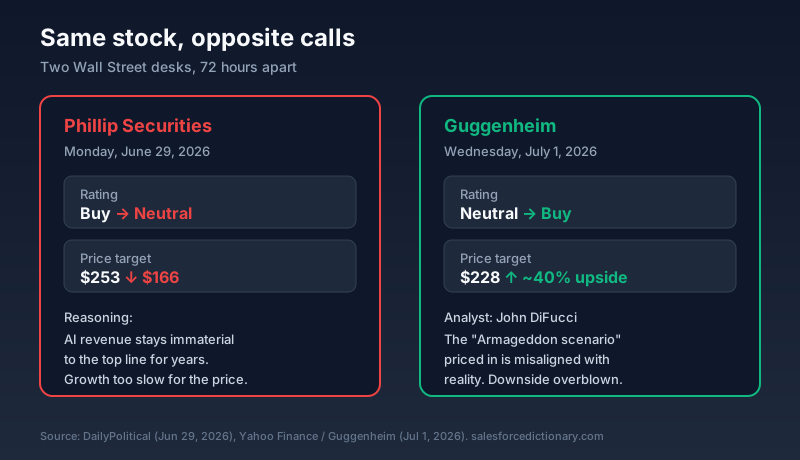
Phillip Securities cut Salesforce to Neutral on June 29 and slashed its target to $166. Two days later, Guggenheim upgraded the same stock to Buy at $228. Same company, same numbers, opposite calls.

On Monday, June 29, 2026, Phillip Securities cut Salesforce to Neutral and took its price target down from $253 to $166. Forty-eight hours later, on Wednesday, July 1, Guggenheim went the other way, upgrading the exact same stock from Neutral to Buy with a $228 target. Two research desks, one company, one trading week, opposite conclusions.
Neither firm had new information the other lacked. Both were looking at the same drawdown, the same Agentforce numbers, and the same question hanging over the whole software sector: does generative AI eat Salesforce, or does Salesforce sell it? They just answered it differently.
What Phillip Securities did and why
Phillip Securities moved first. The firm downgraded Salesforce from Buy to Neutral and pulled its target from $253 all the way to $166, per DailyPolitical's June 29 report. That is not a rounding error. The old target implied a stock worth over $250. The new one sits right at where CRM was actually trading, which is another way of saying the analyst no longer sees a gap between price and value.
The reasoning is worth reading closely, because it is not a doom call. Phillip's view is that legacy SaaS stays resilient. Salesforce is mission-critical software. Companies do not rip out their CRM the way they cancel a streaming subscription. That part of the business is safe.
The problem is growth. Salesforce got an early lead in enterprise AI and has not converted it into the kind of revenue acceleration that would justify a premium multiple. Phillip's specific concern: AI revenue contribution is likely to stay immaterial to total revenue for several years. Some peers are already seeing meaningful AI-driven monetization show up on the top line. Salesforce, in this reading, is not, at least not yet at a scale that moves the consolidated number.
So the downgrade is really a statement about timing. The AI money is coming, but slowly, and the stock does not deserve to be priced for speed it cannot show. Neutral, target $166, wait and see.
What Guggenheim did and why
Two days later, Guggenheim analyst John DiFucci took the opposite side. He upgraded Salesforce from Neutral to Buy with a $228 target, which the outlets covering it pegged at roughly 40 to 46% upside from where the stock sat. Call it around 40%.
DiFucci's argument is not that the bears are wrong about AI risk. It is that the market has priced a version of that risk far more severe than anything reality supports. His line, quoted across the coverage: "the Armageddon scenario currently priced into the stock is misaligned with reality."
Unpack what that means in numbers. Guggenheim's framing is that CRM's current price implies Salesforce revenue effectively declines in perpetuity. Not slows. Declines, forever. For a company that grew fiscal 2026 revenue roughly 10% and still throws off enormous free cash flow, that is an extreme thing to bake into a valuation. DiFucci's position is that AI is a real risk to Salesforce, worth taking seriously, but not the existential one the stock is discounting. Buy the gap between the fear and the fundamentals.
That is the whole disagreement in one frame. Phillip says the AI upside is too slow to pay for the current price. Guggenheim says the AI downside is too overblown to justify the current price. Both can point at the same spreadsheet.
One caveat on the Guggenheim call
Before anyone reads the upgrade as a pure Salesforce conviction call, note the context. Guggenheim upgraded ServiceNow the same day, as part of the same research note and the same broader theme: AI fears across enterprise software are overdone. This was a sector call as much as a company call.
That matters for how much weight to put on it. A single-name upgrade where an analyst does the work on one company and stakes out a contrarian view is a stronger signal than a two-name upgrade that says the whole group has been oversold. Guggenheim may well be right about both Salesforce and ServiceNow. But "software got too cheap" is a different, softer claim than "Salesforce specifically is mispriced." Read the upgrade as a bet on the category first and Salesforce second.
How the stock reacted
The market liked the upgrade in the moment. On July 1, CRM rose as much as 5.4% intraday, after climbing roughly 4% in premarket trading. That is a real pop for a megacap on an analyst note, which tells you how beaten down sentiment had become and how many people were waiting for a reason to buy.
The follow-through was calmer. Salesforce closed July 2, 2026 at $166.11, up 1.76% on the day, per stockanalysis.com. So the stock held most of the enthusiasm but did not run away with it.
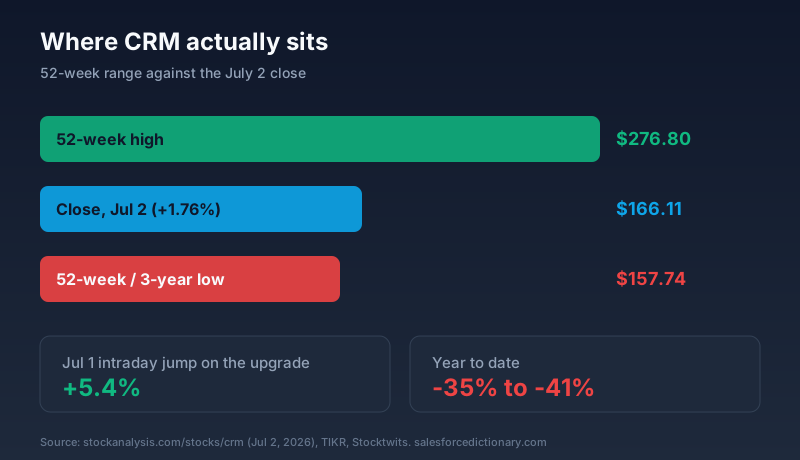
Put that close in context. Salesforce is down roughly 35 to 41% year to date, depending on where you start the clock, and it has been trading near a three-year and 52-week low of $157.74. The 52-week high was $276.80. The stock has given back a huge chunk of its value, which is exactly why a $166 close and a $228 target can both look reasonable to different people. One number is the market's current verdict. The other is a bet on where reality lands.
Why two respected desks can disagree this hard
The split is not sloppiness. It comes straight out of a real tension in Salesforce's numbers, one this site has covered through the June 12 piece on the 52-week low and the June 29 piece on the Russell Top 50 exit.
Here is the tension. In Q1 FY27, reported May 27, 2026, Agentforce reached $1.2 billion in annual recurring revenue, growing 205% year over year. Add Data 360 and the combined figure passes $2.9 billion in ARR. Those are excellent numbers for a young product line. If you look only there, Salesforce is winning the AI transition.
Now widen the lens. Salesforce did about $41.5 billion in fiscal 2026 revenue. A $1.2 billion product growing 205% is thrilling in isolation and still small against a $41 billion base. It has to keep compounding for years before it dominates the top line. Meanwhile consolidated revenue growth has settled into the high single digits to around 10%. That is the gap the whole argument lives in.
Phillip Securities looks at that gap and sees years of waiting before AI matters to the total. Guggenheim looks at the same gap and sees a company the market has written off as if that AI ramp will never arrive. The Agentforce ARR line is the bull's evidence. The consolidated growth line is the bear's evidence. Same company, two honest readings.
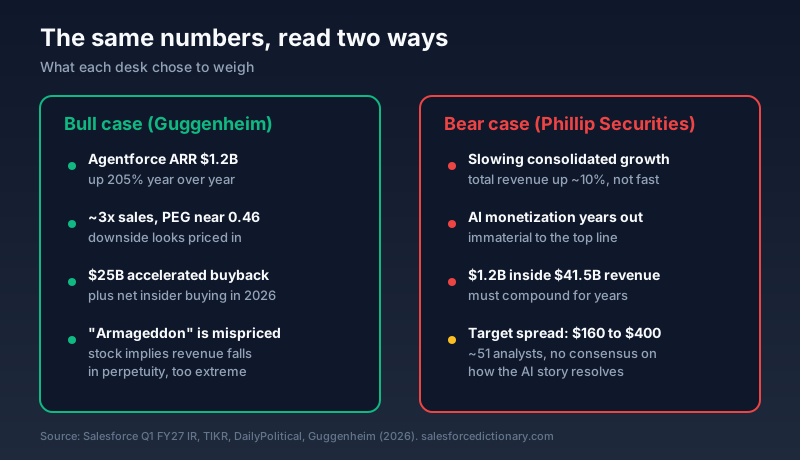
The rest of the street has not resolved it either. Across roughly 51 analysts, the average price target sits around $246 to $255 with an overall Buy lean, but the spread runs from about $160 to $400. That is an enormous range for a company this large and this scrutinized. When the high target is more than double the low one, the honest summary is that nobody knows.
There is bull-case color underneath the ratings too. According to TIKR's analysis, CRM trades around 3x sales with a PEG ratio near 0.46, and Salesforce is running an active $25 billion accelerated share buyback alongside more insider buying than selling in 2026. Treat that as one outlet's framing rather than settled fact, but it is the kind of detail that lets a firm like Guggenheim argue the downside is already priced.
What to actually do with this
If you build on Salesforce, admin it, architect on it, or study it for a certification, the practical takeaway is not a trade. It is a reframe.
The loudest narrative right now is that Salesforce is a dying platform that AI will hollow out. That narrative is not settled by the people whose full-time job is to settle it. Two respected desks read identical facts three days apart and reached opposite conclusions. When the professionals split this evenly, treat anyone selling you certainty in either direction with suspicion. The "SaaS is dead" takes and the "generational buy" takes are both louder than the evidence supports.
So watch the two dates that will actually move the argument, not the analyst notes that restate it.
The first is Q2 FY27 earnings, expected in late August 2026. That report is the real test. The bull case needs consolidated revenue growth to tick up, not just Agentforce ARR climbing on its own. If total growth accelerates and management raises the full-year outlook, Guggenheim's read gets stronger. If growth stays soft while Agentforce keeps sprinting in isolation, Phillip's timing concern gets stronger. Either way, that print tells you more than any rating change.
The second is Dreamforce 2026, September 15 to 17 in San Francisco. Expect roadmap detail and fresh Agentforce customer numbers. Dreamforce moves narrative more than fundamentals, but in a year where the narrative is the whole fight, watch what customers say they are actually deploying, not just what Salesforce announces.
For your day job, none of this changes the roadmap. Agentforce, Data 360, and the Slack-centered agentic stack ship on their own schedule regardless of where CRM trades. Keep building, keep certifying, and let the August earnings call, not the July analyst crossfire, tell you how the AI story is really going.
About the Author
Dipojjal Chakrabarti is a B2C Solution Architect with 29 Salesforce certifications and over 13 years in the Salesforce ecosystem. He writes and edits salesforcedictionary.com, published by KineticBit Inc., to help admins, developers, architects, and cert/interview candidates sharpen their fundamentals. More about Dipojjal.
Share this article
Sources
- Guggenheim Just Upgraded Salesforce Stock. Here's Why. (Yahoo Finance)
- Salesforce (CRM) Upgraded to Buy with $228 Target Amid AI Concerns (GuruFocus)
- Guggenheim Upgrades Salesforce Stock to Buy After 41% Year-to-Date Selloff (TIKR)
- CRM Stock Lost Over 25% In June, But This Analyst Says AI 'Hallucination' Is Creating A Buying Opportunity (Stocktwits)
- Phillip Securities Downgrades Salesforce (NYSE:CRM) to Neutral (Daily Political)
- Salesforce (CRM) Stock Price & Overview (StockAnalysis.com)
- Salesforce Delivers Record First Quarter Fiscal 2027 Results (Investor Relations)
Related dictionary terms
Practise it
Five questions on Agentforce Specialist
Exam-style questions with an explanation after each one. No account needed, and your answers build a weak-topic map once you have one.
More news

Salesforce Stock Hits 52-Week Low
Salesforce stock set a new 52-week low of $163.31 on June 11, 2026, down roughly 37% this year, while Agentforce ARR surged 205% to $1.2 billion. The disconnect explained.
Salesforce Exits the Russell Top 50
Salesforce exited the Russell Top 50 Index in the June 2026 reconstitution, effective June 26 with first trading June 29. The stock is down 45% from its high while Agentforce ARR grows 205%.

BofA Cuts Salesforce to Underperform
BofA reinstated Salesforce at Underperform on May 18 with a $160 target. With 23,000 of 200,000+ customers on paid Agentforce deals and CRM down 35% YTD, the monetization debate peaks nine days before Q1 FY27 earnings.

Salesforce Q1 FY27: Agentforce $1.2B
Salesforce beat Q1 FY27 estimates on every major metric: $11.13B revenue, $3.88 non-GAAP EPS, $33.6B cRPO at 14% growth. Agentforce ARR crossed $1.2B at 205% growth. Then Benioff revealed engineers haven't been hired in two years.
Comments
No comments yet. Start the conversation.
Sign in to share your take on this article. Your account works across every page.