
BofA Cuts Salesforce to Underperform
Bank of America reinstated an Underperform on CRM with a $160 price target on May 18, arguing that Agentforce monetization is too slow to justify the valuation. Here is what the bear case says, what the bulls miss, and what it means heading into the May 27 earnings call.

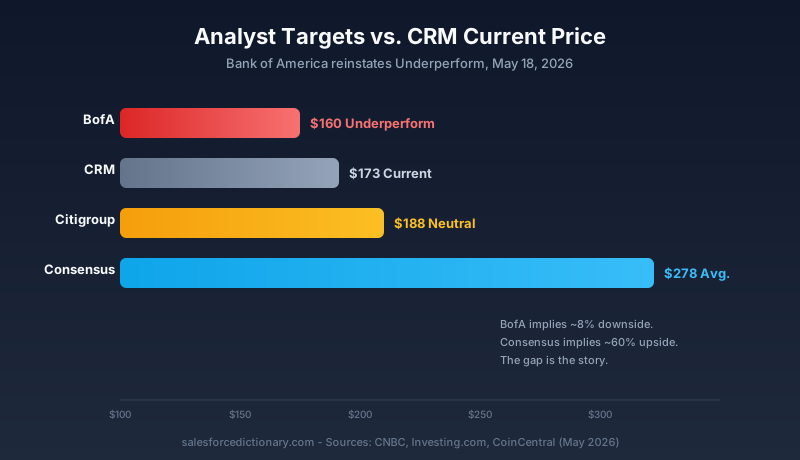
Bank of America reinstated an Underperform rating on Salesforce (CRM) this morning with a $160 price target. The stock was trading around $173 at the time of writing, which means BofA is calling roughly 8% additional downside from here, and the word "reinstated" matters, because it signals conviction, not a first pass.
The core argument is not that Agentforce is bad. It is that Agentforce monetization has not moved fast enough to close the gap between what Salesforce is charging for AI and what the stock is already pricing in. Nine days before Q1 FY27 earnings, that is the bear case in print.
Here is how the numbers read, what the analyst disagreement looks like, and what to watch when Marc Benioff takes the call on May 27.
What BofA actually said
The BofA thesis has three parts.
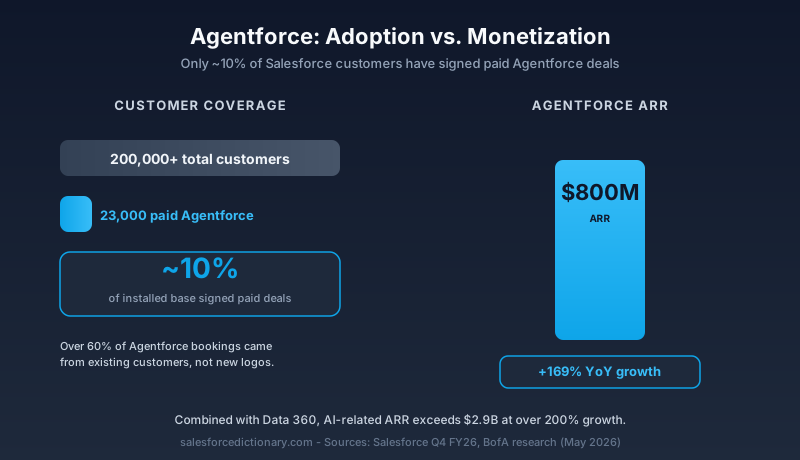
Part one: the customer penetration number is small. Salesforce has over 200,000 customers. As of the most recent disclosure, approximately 23,000 have signed paid Agentforce deals. That is roughly 10% of the installed base. BofA reads that as slow adoption, not fast. The bull case requires the other 90% to follow quickly. BofA does not believe they will, at least not before the stock needs it.
Part two: monetization lags the growth narrative. Agentforce ARR is approximately $800 million, growing at 169% year over year. Combined with Data 360, AI-related ARR exceeds $2.9 billion at over 200% growth. Those are genuinely large numbers. BofA's counter is that $800 million in Agentforce ARR, while real, is a small fraction of Salesforce's roughly $38 billion in total revenue. The question is whether the growth rate compounds fast enough to matter at the top line before investors lose patience. BofA says no.
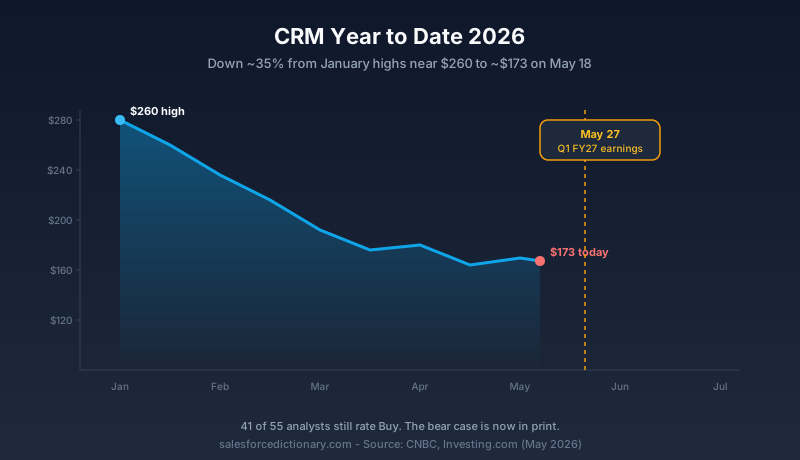
Part three: the valuation does not have room for a miss. CRM is down approximately 35% year to date. From a January high near $260, the stock has fallen to around $173. BofA's $160 target implies the stock still has room to fall even after that decline. The argument is that consensus targets (which average around $278 across 55 analysts) are baking in an AI monetization ramp that has not yet shown up in the numbers. If Q1 FY27 fails to show clear acceleration, the repricing could extend.
The gap between BofA and the street is not subtle
BofA at $160 is not a minor underweight call. The street consensus is $278. Citigroup, which issued a Neutral earlier this year, is at $188. BofA is the most bearish name on the board by a significant margin.
Of 55 analysts tracked by the major aggregators, 41 still rate CRM a Buy. The median price target is well above $250. The BofA note is an outlier, and the market knows it: CRM did not collapse on the news. But outlier bear cases from bank analysts with large institutional distribution matter nine days before an earnings call. They give institutional portfolio managers permission to reduce ahead of a potential miss.
The question is not whether BofA is right. The question is whether BofA is early.
The Agentforce numbers in context
The 23,000 paid Agentforce customer figure deserves more context than most coverage gives it.
First, over 60% of Agentforce bookings have come from existing customers, not new logos. That is a meaningful detail. It means Salesforce is successfully upselling the installed base, which is the expected playbook for a platform-layer AI product. What it does not yet show is whether Agentforce is winning net-new deals that Salesforce would not have won without the agent story.
Second, the $800 million ARR figure for Agentforce standalone, and the $2.9 billion when combined with Data 360, represents a product category that did not exist as a revenue line eighteen months ago. The growth rate is real. BofA's objection is to the pace relative to the stock's pricing, not to the growth itself.
Third, Salesforce's May 1 revenue reporting change disaggregated AI-related revenue in a way that made the segment harder to compare quarter to quarter. Some of the analyst skepticism on the street in the past three weeks is a function of that confusion, not a fundamental deterioration in the business. BofA's note may be partly absorbing that uncertainty.
Why the timing matters
Two things make the May 18 date significant.
The first is the proximity to earnings. Q1 FY27 reports on May 27. A downgrade from a major bank nine days before a print is not routine housekeeping. BofA is signaling that they expect the quarter to either miss expectations or guide in a way that does not validate the bull case on Agentforce monetization. If the quarter is clean, the note looks wrong quickly and the analysts who issued it have to walk it back. That is a high-conviction move.
The second is the Missionforce context. Salesforce announced a $72 million Air Force deal on May 13, which the market read as positive but small. The stock gained roughly 4% in the three days after the announcement. BofA is effectively saying that a $72 million defense ELA does not change the underlying monetization story for a company with a $38 billion revenue base. The bear case is that government contract announcements are not a substitute for enterprise AI ARR acceleration.
The automation paradox buried in the BofA note
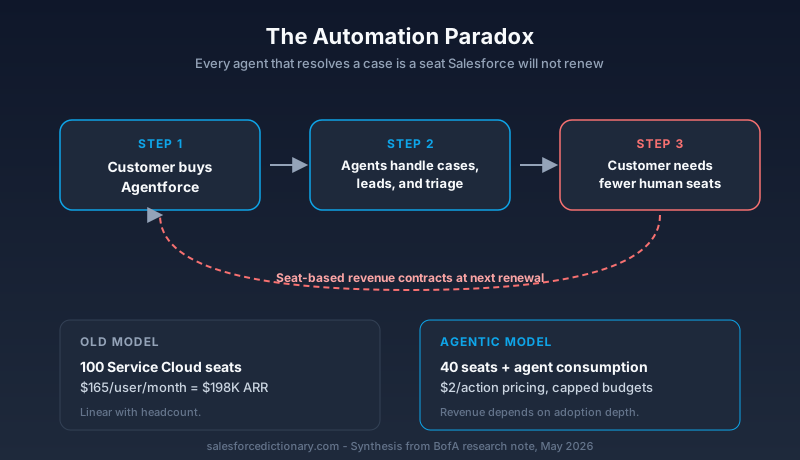
There is a structural argument inside the BofA downgrade that most of the coverage missed. It is not just that Agentforce monetization is slow. It is that Agentforce, if it works as advertised, creates a headwind for Salesforce's seat-based revenue model.
The logic runs as follows. A company buys Agentforce. Agents automate case resolution, lead qualification, and triage work that previously required human agents sitting in Service Cloud and Sales Cloud seats. At the next renewal, the customer needs fewer seats. Salesforce's seat-based ARR contracts even as consumption-based Agentforce revenue grows. The question is whether the consumption revenue replaces the seat revenue faster than the seat revenue declines.
The numbers in the chart are illustrative but directionally correct. A 100-seat Service Cloud deployment at $165 per user per month generates roughly $198,000 in ARR. If Agentforce handles 60% of that workload, the customer renews at 40 seats and adds a $2-per-action consumption budget. Whether that consumption budget reaches $198,000 depends entirely on how aggressively the customer runs agents and whether they expand the use case beyond the original deployment. BofA's view is that consumption budgets get capped conservatively in year one and grow slowly. The bull case requires them to compound quickly.
This is not a Salesforce-specific problem. Every SaaS company building AI automation on top of a seat-licensed base faces the same structural question. Salesforce's answer is that the consumption model expands total revenue per customer over a three-to-five year horizon even if it compresses it in year one. BofA's answer is that the horizon is too long to price in today at current multiples.
What the bulls need on May 27
If you are long CRM or building a practice on Salesforce's AI roadmap, the May 27 call has three specific things to watch.
Agentforce customer count and ARR trajectory. The 23,000 paid customer number needs to show sequential growth, and that growth needs to look like acceleration, not a flat plateau. If the number moves to 28,000 or 30,000 with a clear explanation of deal velocity, the BofA thesis starts to look early. If it stays flat or the company avoids the metric, BofA looks prescient.
Revenue attribution clarity. The May 1 reporting change created confusion that has not fully resolved. Benioff and CFO Amy Weaver need to walk through the new segment structure clearly enough that analysts can model the AI business independently from the base CRM subscription. If they do, the $2.9 billion combined AI ARR figure becomes a credible forward story. If the call is muddy on this, the bears control the narrative into summer.
Guidance tone on enterprise deal velocity. The Q4 FY26 call in late February was the call where Agentforce paid customer count was first disclosed. If Q1 FY27 shows a comparable sequential jump in the number of enterprise-scale deals (not just SMB free-tier conversions), the monetization-lag narrative collapses. That is the single data point that resolves the BofA call most directly.
What this means for practitioners
If you are building on Salesforce's AI platform, the analyst disagreement is not noise. It signals two things about where the product investment is actually going.
Monetization pressure accelerates the product. When a major bank publishes a bear case tied specifically to the pace of paid adoption, Salesforce's product organization gets pulled toward features that close deals faster. Expect more aggressive Agentforce packaging, lower entry-point pricing, and faster time-to-value tooling in H2 FY27. That is good for architects who are trying to sell Agentforce internally.
The 90% of customers not yet on paid Agentforce is your opportunity. The BofA note frames 90% non-penetration as a problem. For a Salesforce consultant or architect, it is a pipeline. The companies that have not yet signed paid Agentforce deals are not lost. They are undecided. The Q1 FY27 call will likely produce a renewed push from Salesforce's field team to convert that base. If you are positioned to help those companies build a business case, the next six months are active.
The analyst split is not a reason to slow your AI roadmap. Forty-one of fifty-five analysts still rate CRM a Buy. BofA is the outlier, not the consensus. The disagreement is about timing and pace, not about whether Agentforce is a real business. Build as if the bull case is the working assumption, because it probably is, just on a longer timeline than Salesforce's marketing implied in calendar year 2025.
Bottom line
BofA just put a $160 Underperform on CRM with nine days until earnings. The bear case is specific: 10% paid adoption, $800 million Agentforce ARR that is real but not yet big enough relative to a $38 billion revenue base, and a stock that still has room to fall even after a 35% year-to-date decline.
The bull case has 41 out of 55 analysts and a $278 average price target behind it. The resolution happens on May 27.
Watch the Agentforce customer count, watch the revenue attribution detail, and watch whether Benioff frames the 90% unpenetrated base as a near-term pipeline or a longer-term conversion story. The answer to that framing tells you whether the monetization pace question gets answered this quarter or gets pushed to Q2.
About the Author
Dipojjal Chakrabarti is a B2C Solution Architect with 29 Salesforce certifications and over 13 years in the Salesforce ecosystem. He writes and edits salesforcedictionary.com, published by KineticBit Inc., to help admins, developers, architects, and cert/interview candidates sharpen their fundamentals. More about Dipojjal.
Share this article
Sources
Related dictionary terms
Practise it
Five questions on Agentforce Specialist
Exam-style questions with an explanation after each one. No account needed, and your answers build a weak-topic map once you have one.
Comments
No comments yet. Start the conversation.
Sign in to share your take on this article. Your account works across every page.