
Trailhead's Popularity Problem
Salesforce Ben asked on Friday what happened to Trailhead's popularity, and the numbers in its own reporting answer the question awkwardly. Trailhead has more than 11 million learners and 66.1% of surveyed architects still name it their upskilling tool of choice, ahead of every alternative. The complaint underneath those figures is not traffic. It is depth, and it arrives in the same month Salesforce cut the team behind the platform, demoted superbadges out of the credential column and put an agent where the navigation used to be.
Salesforce Ben published a piece on Friday asking what happened to Trailhead's popularity. The data inside it answers a different question than the headline poses.
Nothing happened to Trailhead's popularity. Something happened to what people think it is for.
More than 11 million learners are on the platform. In Salesforce Ben's architect survey, 66.1% of respondents said they still use Trailhead to upskill, which put it first, ahead of self-study, ahead of release notes, ahead of learning on the job. By any traffic measure you can get at from outside the company, Trailhead won its category and is still winning it.
The criticism landing on it this week is not that people stopped showing up. It is that the people who show up increasingly finish a module and still cannot do the thing.
The Scoreboard Trailhead Is Winning
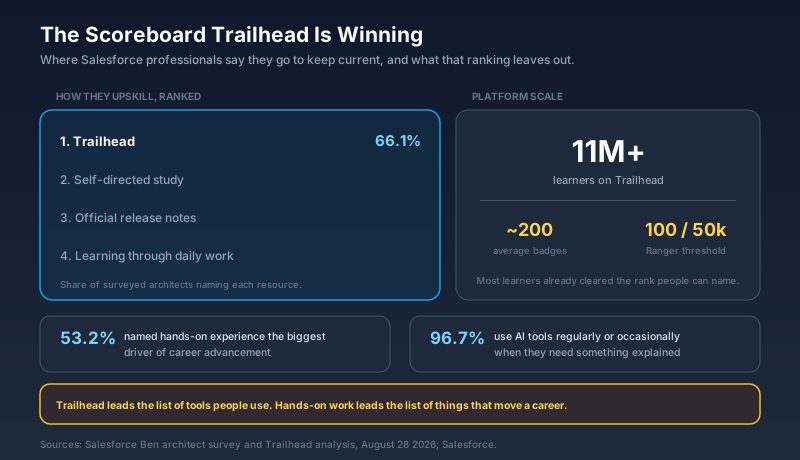
Start with the figures, because the argument only makes sense once you accept them.
Salesforce reports more than 11 million learners on Trailhead. The average Trailblazer sits at roughly 200 badges. Ranger, the rank most people can name, is 100 badges and 50,000 points, which means the average learner passed the milestone the ecosystem still treats as an achievement and kept going.
Against that, 66.1% of surveyed architects said Trailhead is part of how they keep current. No other single resource in that survey came close.
Now put the second number from the same survey next to it. When those architects were asked what actually advances a career, 53.2% named hands-on experience. Trailhead leads the list of tools people use. Hands-on work leads the list of things that change outcomes. Those are two different lists, and the gap between them is the whole story.
The Complaint Is Depth, Not Traffic
Three criticisms show up repeatedly, and none of them is about whether Trailhead is worth opening.
The first is navigation. The catalogue has grown for a decade without a corresponding pruning, and a beginner landing on it now faces a maze of modules with no obvious order. Salesforce Ben's phrasing was that the platform has become difficult to move through, which is a polite way of saying the index is worse than the content.
The second is depth. Trailhead is very good at telling you a feature exists and roughly where the button is. It is much weaker on implementation nuance, on the decisions that separate a working org from a fragile one, and on why the obvious answer is often wrong at scale. Salesforce MVP Daryl Moon's read, quoted in the piece, is that it works best for junior professionals exploring an unfamiliar feature and runs out of road when you need genuine expertise.
The third is competition, and it is newer. A module that introduces a feature in twenty minutes now competes with an AI assistant that explains the same feature in twenty seconds, in the context of your actual org, and will keep answering follow-up questions. In that survey, 96.7% of architects said they use AI tools regularly or occasionally. The explanation layer stopped being scarce.
That last point deserves to be stated carefully, because it cuts both ways. AI is very good at the part of learning Trailhead built its brand on: the guided introduction. It is much worse at the part Trailhead never solved: supervised practice in a real environment with real consequences.
Superbadges Left The Credential Column
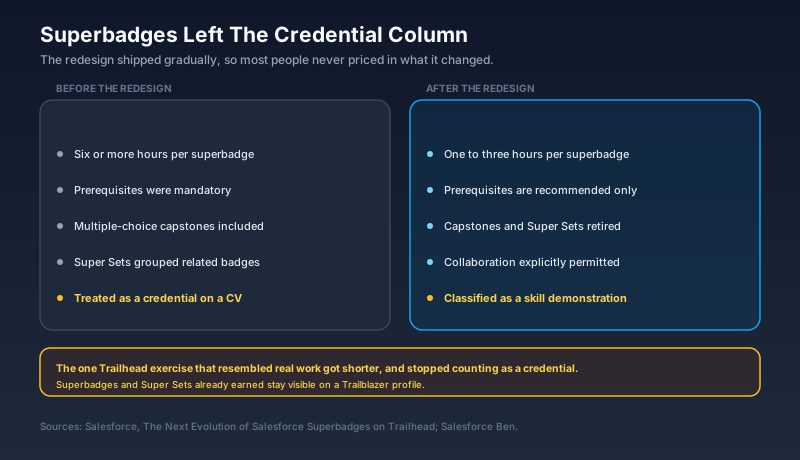
The superbadge redesign is the part of this most people have not fully priced in, because it rolled out gradually rather than as a single announcement.
A superbadge used to be the closest thing Trailhead had to real work. You got a scenario, a sandbox-like challenge org, and six or more hours of building, and the thing either passed the automated check or it did not. Candidates listed them. Some recruiters asked about them.
The redesigned version runs one to three hours. Prerequisites became recommendations rather than requirements. Super Sets and the multiple-choice capstones were retired. Collaboration is now explicitly permitted under an updated security policy. And Salesforce reclassified superbadges as hands-on skill demonstrations rather than credentials.
Every one of those changes is defensible on its own. Shorter exercises finish. Optional prerequisites remove a wall in front of people who already know the material. Retiring a multiple-choice capstone from a hands-on assessment is straightforwardly correct.
Taken together, though, they moved the one Trailhead artifact that resembled real work further away from real work, and removed the reason to put it on a CV, in the same period the platform is being told it lacks depth. Previously earned superbadges and Super Sets still show on a profile, so nobody lost anything they had. What changed is what the next one is worth.
An Agent Where The Guidance Used To Be
Salesforce's own answer to the navigation complaint is the Trailhead learning agent, which recommends content based on your stated goal and experience level rather than making you find your way through the catalogue by hand.
That is the correct fix for the problem it addresses. It is also a notable choice of fix. The complaint was that the library is hard to search and thin in places. The response was a better retrieval layer over the same library.
Alongside it sits Agentblazer, the AI skill track that behaves differently from everything else on the platform. Agentblazer status is earned per calendar year rather than once, so Champion, Innovator and Legend reset and have to be re-earned annually. It is the only major recognition on Trailhead with an expiry date attached, and it exists specifically for the product line Salesforce most wants adoption on.
Read those two together and the direction is clear enough. The platform is being reorganised around agents, both as the subject you learn and the mechanism you learn through.
The Month This Landed In
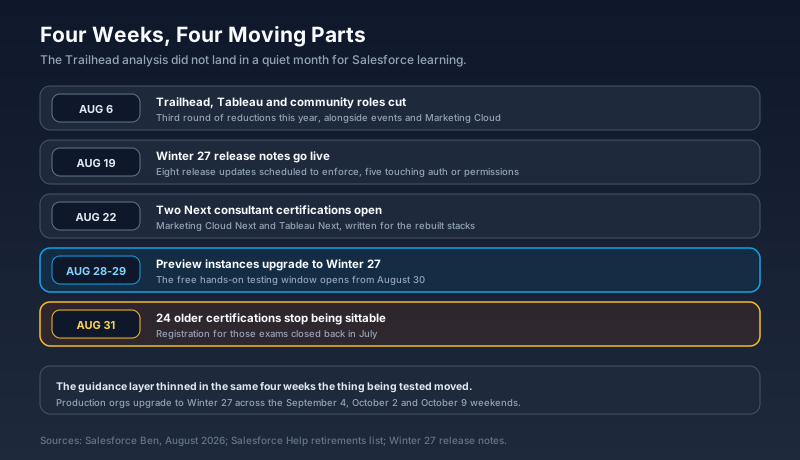
Context matters here, because this analysis did not land in a quiet month.
On August 6, Salesforce cut roles across Tableau, Trailhead, community advocacy, events, Marketing Cloud and Industries Cloud, the third round of reductions this year. The people who wrote and maintained the content now being called shallow were part of that.
On August 19, the Winter '27 release notes went live with eight release updates scheduled to enforce, five of them touching authentication or permissions. On August 22, registration opened for the first two "Next" consultant certifications, written for the rebuilt marketing and analytics stacks.
Over Thursday and Friday, preview instance sandboxes upgraded to Winter '27, which opens the real hands-on window from August 30. And on Monday, August 31, 24 older certifications stop being sittable.
So the guidance layer thinned in the same four weeks that the platform being tested moved, the credential map was redrawn, and the only free environment where you can practise the new release opened for business. That is not a conspiracy. It is a scheduling collision, and it is yours to manage.
What The Data Actually Recommends
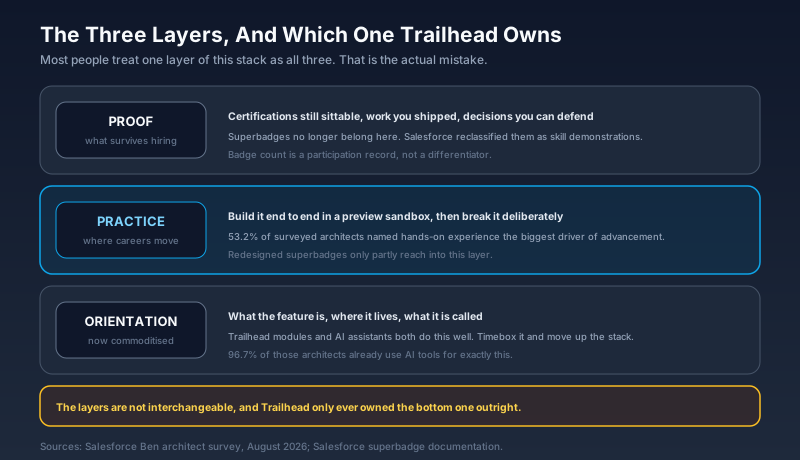
The useful conclusion is not that Trailhead is finished. It is that Trailhead occupies one layer of a stack that has three, and most people are treating it as all three.
Orientation is the bottom layer: what does this feature do, where does it live, what is it called. Trailhead is good at this, AI assistants are now equally good at it, and the honest planning assumption is that this layer is commoditised. Spend less time here than you used to, not more.
Supervised practice is the middle layer, and it is the one the survey points at. Building something end to end in an environment where you can break it, then breaking it deliberately to see what happens, is what 53.2% of architects named as the thing that actually moved their career. Superbadges used to reach into this layer. The redesigned ones only partly do.
Proof is the top layer: a certification that is still sittable, work you shipped in a real org, and your ability to explain in writing why you made a particular choice. That is what survives a hiring conversation.
The mistake worth naming is treating badge count as proof. The average Trailblazer holds around 200 badges. A number that most participants clear is a participation record, not a differentiator, and any hiring manager who has interviewed more than a dozen candidates already knows this.
What To Do This Week
Four things, in order, and the first one has a deadline of Monday.
Check the retirement list before August 31. If a certification on your plan is in the group that stops being sittable, the plan needs rewriting today, not in October. Salesforce's active product and feature retirements page is the authoritative list.
Claim a preview sandbox window while it is open. Preview instances upgraded to Winter '27 over Thursday and Friday, and production orgs follow across the September and October weekends. Between now and then you have a free environment running the version your org will be on, which is the single best practice surface available to you and it costs nothing.
Timebox orientation, then build. Give any new feature one Trailhead module or one good AI explanation, not four. Then open the sandbox and build the smallest end-to-end version of it you can, including the failure path. If you cannot make it fail on purpose, you do not understand it yet.
Rebalance what you put in front of employers. Move superbadges out of the credentials line on your CV and into a projects or skills line, because that is now what Salesforce calls them. Put shipped work and current certifications in the credentials line, and be ready to explain one architectural decision you made and one you would reverse.
Trailhead is still the best free front door in enterprise software, and 11 million learners did not choose it by accident. It just stopped being the whole building, and the pace of change on the platform this month is the clearest evidence yet that nobody should be treating it as one.
About the Author
Dipojjal Chakrabarti is a B2C Solution Architect with 29 Salesforce certifications and over 13 years in the Salesforce ecosystem. He writes and edits salesforcedictionary.com, published by KineticBit Inc., to help admins, developers, architects, and cert/interview candidates sharpen their fundamentals. More about Dipojjal.
Share this article
Sources
- What Happened to Trailhead's Popularity? (Salesforce Ben, August 28 2026)
- Introducing the Next Generation of Salesforce Superbadges on Trailhead (Salesforce Ben)
- The Next Evolution of Salesforce Superbadges on Trailhead (Salesforce)
- Everything You Need to Know About Salesforce Agentblazer Status (Salesforce Ben)
- Be an Agentblazer: Gain AI Agentforce Skills on Trailhead (Salesforce)
- Salesforce Winter '27 Release Date and Preview Information (Salesforce Ben)
- Salesforce Active Product and Feature Retirements (Salesforce Help)
- Do You Have More Trailhead Badges Than the Average Trailblazer? (Salesforce Ben)
Related dictionary terms
Practise it
Five questions on Platform Developer I
Exam-style questions with an explanation after each one. No account needed, and your answers build a weak-topic map once you have one.
More news
Two 'Next' Certifications Go Live
Salesforce opened registration on Friday for Marketing Cloud Next Consultant and Tableau Next Consultant, its first consultant exams for the rebuilt stacks, ten days before 24 older certifications stop being sittable.

The August 31 Certification Cliff
August 31 is the last day anyone can sit one of the 24 retiring Salesforce certifications, and registration already closed on July 24. Here is what retirement actually costs and where the hiring demand went.

Architects Price In Platform Risk
Salesforce Ben published its 2026 salary report and its architect career-risk breakdown on the same day. Senior architect medians run $165,000 to $210,000, and a quarter of architects now rank the platform losing its lead as their top risk.

Salesforce Cuts Trailhead and Events
Salesforce cut roles across Tableau support, Trailhead, community advocacy and events on August 6. Half the North America Tableau support team was reportedly hit. Tech layoffs passed the full 2025 total with four months left in the year.

Salesforce Architects Are Thriving
Salesforce Ben's 2026 Architect Survey shows only 10.2 percent of architects are dissatisfied and 97 percent now use AI. But ChatGPT and Claude beat Agentforce among Salesforce's own architects, and the talent shortage explains the calm.
Comments
No comments yet. Start the conversation.
Sign in to share your take on this article. Your account works across every page.