
Architects Price In Platform Risk
Two Salesforce Ben reports published on Wednesday point in opposite directions. Median pay for senior technical roles is holding near record levels, and a quarter of architects now name the platform losing its dominance as the biggest threat to their career. Last year that answer scored zero.

Salesforce Ben published two reports on Wednesday. One says the median senior technical architect in the United States is paid $165,000, and recruiter data puts the same seat as high as $210,000. The other says 24.8 percent of architects now rank the Salesforce platform losing its dominance as the biggest risk to their career.
In the 2025 edition of that survey, not a single respondent picked that answer.
Both numbers came out of the same population on the same morning, and neither is wrong. Put together they describe a market that is paying well for a bet a growing number of its own senior practitioners have started to hedge.
The Risk That Scored Zero Last Year
The career-risk breakdown comes out of Salesforce Ben's 2026 Architect Survey, the same dataset behind the satisfaction figures we covered in July. The top three answers this year land within six tenths of a percentage point of each other.
Salesforce losing its position as a leading platform takes 24.8 percent. Keeping up with rapidly changing technology ties it at 24.8 percent. The growing number of professionals competing for the same work takes 24.2 percent. AI replacing architects sits far behind at 13.2 percent.
The ranking matters less than the shape of it. In 2025, one answer dominated: 57.2 percent of architects named keeping up with the technology as their biggest risk, and everything else trailed. This year that same answer has been cut by more than half, and the worry it used to hold has spread across three roughly equal concerns.
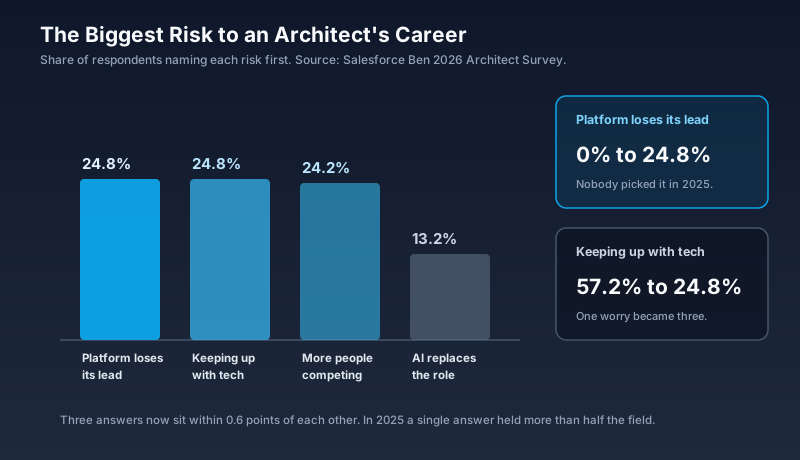
One of those three did not exist as a concern twelve months ago. Going from zero to a first-place tie in a single survey cycle is not gradual drift. It is a group of senior people who spent the year watching their customers evaluate alternatives and decided the question is now live.
There is a second number in the same report that explains a lot of it. Fifty-seven percent of respondents agreed that the Salesforce platform is becoming increasingly difficult to work with. That is not a complaint about a missing feature. It is the people who know the platform best saying the cost of knowing it has gone up.
Where the Doubt Is Coming From
Nothing in the survey points at a single cause, so treat what follows as reading rather than reporting.
The platform surface has been changing faster than most teams can absorb. Agentforce moved builders twice inside a year, the legacy agent builder retired in July, and Winter '27 ships a redesigned Flow Builder canvas with a new element menu and two new Split elements. Every one of those is defensible on its own. Stacked into eighteen months, they turn hard-won platform fluency into a depreciating asset, which is exactly what a career-risk survey measures.
The architecture conversation has also moved outward. Headless 360 made the API, CLI and Model Context Protocol surfaces the first-class way to build, which is good engineering and also an admission that Salesforce is now one component in a composed stack rather than the whole stack. An architect who spends the year wiring Salesforce into other systems through open protocols gets a clear view of how replaceable each piece is, including this one.
Then there is what architects use when they work. The same survey put ChatGPT at 62 percent and Claude at 52 percent among architects, with Agentforce fourth at 33 percent. Confidence in AI-powered solutions did rise year over year, from 54.4 percent to 61.7 percent. The confidence went up. It did not go to the native product.
The Pay Ladder Did Not Move
Set against that, the salary report is calm. It draws on 2,316 responses to the Salesforce Ben survey plus 2026 recruiter data from Mason Frank and Stott and May, reports medians rather than averages this year, and covers United States compensation only.
The senior medians from the community survey read as follows. Admin $109,000. Business analyst $107,500. Functional consultant $126,000. Developer $140,000. Technical consultant $145,000. Solution architect $165,000. Technical architect $165,000.
The steps below those are just as useful for anyone planning a move. An admin runs $78,000 junior, $92,000 intermediate, $109,000 senior. A developer runs $94,500, $120,000, $140,000. Both architect tracks sit at $150,000 intermediate before the senior step.
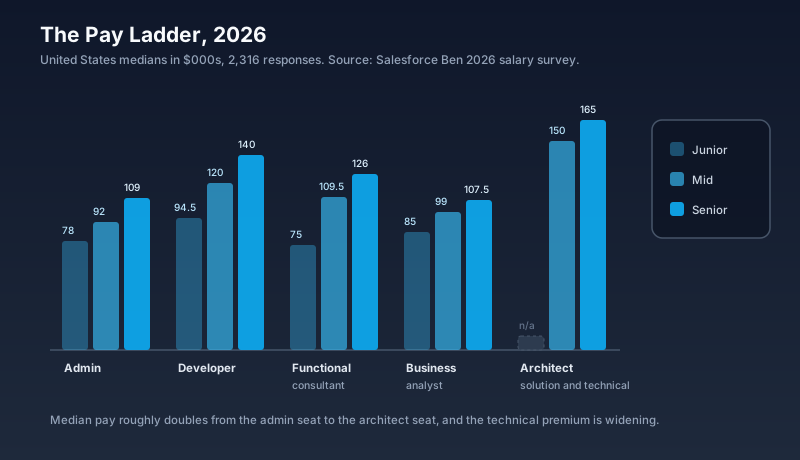
Two things stand out. Median pay roughly doubles from the admin seat to the architect seat, so the ladder still rewards the climb. And the gap between technical and functional roles at the same level is widening rather than closing, which is the opposite of what two years of predictions about AI flattening technical work would suggest. Whatever AI is doing to this market, it is not compressing the top of the technical track yet.
Recruiters and the Community Do Not Agree
The report puts three datasets next to each other, and the spread between them is the most practical thing in it.
For a senior admin, the community survey says $109,000, Mason Frank says $110,000, and Stott and May says $120,000. For a developer, $140,000, $150,000 and $140,000. For a technical architect, $165,000 from the community, $182,500 from Mason Frank, and $210,000 from Stott and May.
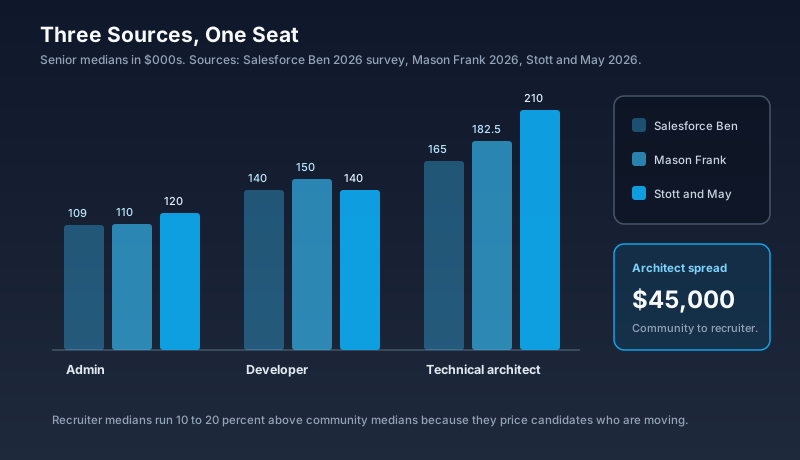
Recruiter figures run 10 to 20 percent hotter than the community figures, and the report is direct about why: agency data reflects candidates actively being placed, not the full working population. People who are being recruited right now are, by definition, the people the market wants right now.
That has a practical use. The community median is a fair read of what the seat pays across everyone sitting in it, including people three years into the same job. The recruiter median is closer to what the seat pays if you move. On the technical architect line, the distance between those two readings is $45,000. If you are preparing a case for a raise, that gap is the case.
Price Held. Duration Is the Open Question.
A salary is a spot price on scarce skills. A career risk is a claim about the next five years. The two reports are not in conflict, they are measuring different horizons, and reading them together gives the clearer picture.
Pay is holding at the top because senior supply is genuinely thin. Below that line the arithmetic is less comfortable: demand grew 8 percent last year while supply grew 27 percent, which is the pressure the 24.2 percent competition answer is describing. Squeezed juniors and well-paid seniors is a familiar shape in a maturing market.
What is new is that the people at the top of that market, the ones being paid the most to commit to the platform, are the ones naming platform decline as their leading risk. That combination shows up before a shift in where talent invests, not after it. Salaries are the last indicator to move.
What To Change In Your Skill Plan
None of this argues for leaving. It argues for changing what you count as your asset.
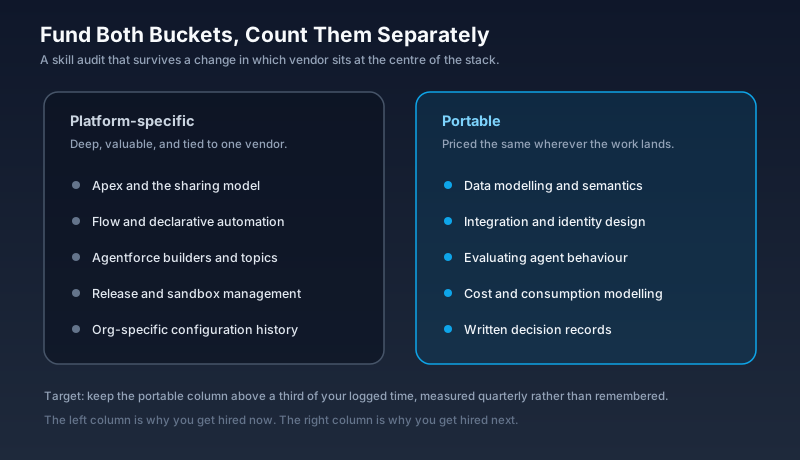
Split your skills into two buckets and keep both funded. The platform-specific bucket is Apex, Flow, the sharing model, the release cycle, whatever your org runs. The portable bucket is data modelling, integration and identity, evaluation of agent behaviour, cost modelling and the ability to write a decision record other engineers can act on. Nothing in the first bucket transfers cleanly. Everything in the second one does, and the second bucket is what a composed stack keeps asking for.
Then do the boring maintenance. Track your own median against all three published sources, not the one that flatters you. Take at least one project a year where Salesforce is a participant in a larger architecture rather than the centre of it. And treat the difficulty number as a design instruction: if 57 percent of architects find the platform harder to work with, the documentation you leave behind is worth more to your successor than another certification is to you.
Also This Week
Winter '27 pre-release org signups open on Thursday, August 13. Release notes publish August 19, sandbox preview opens August 28, and production upgrades begin the weekend of September 4. Preview orgs have been live since Monday, so the release-readiness work can start before the notes land.
Salesforce reports second quarter fiscal 2027 results after the close on Wednesday, August 26, with guidance set at $11.27 billion to $11.35 billion. Dreamforce follows on September 15 to 17 at Moscone.
The two-day Virtual Community Sprint for nonprofit and education builders wrapped on Wednesday, with Declarative Lookup Rollup Summaries among the assets worked on. That project has been maintained by community sprints for years, which is a reasonable answer to anyone who asks what the ecosystem is still worth.
What To Do Next
Open your calendar and list every piece of work you did in the last 90 days. Mark each item as platform-specific or portable, then total the two columns. If the portable column is under a third of your time, pick one item on next quarter's plan and deliberately do it at the integration layer instead of inside Salesforce. That single change is what keeps your salary a spot price rather than a bet on one vendor.
About the Author
Dipojjal Chakrabarti is a B2C Solution Architect with 29 Salesforce certifications and over 13 years in the Salesforce ecosystem. He writes and edits salesforcedictionary.com, published by KineticBit Inc., to help admins, developers, architects, and cert/interview candidates sharpen their fundamentals. More about Dipojjal.
Share this article
Sources
- The State of Salesforce Salaries in 2026 (Salesforce Ben, August 12 2026)
- 3 Biggest Risks to a Salesforce Architect's Career in 2026 (Salesforce Ben, August 12 2026)
- SF Ben Salesforce Architect Survey Results 2026 (Salesforce Ben)
- How AI Is Making Salesforce Architects More Satisfied (Salesforce Ben)
- Are Salesforce Professionals Leaving the Ecosystem? Here's the Data (Salesforce Ben)
- Salesforce Winter '27 Release Date and Preview Information (Salesforce Ben)
- Admin Release Countdown: Get Ready for Winter '27 (Salesforce Admins)
- Salesforce Announces Date of Second Quarter Fiscal 2027 Earnings Release and Webcast (Salesforce Investor Relations)
- August 11, 2026: Salesforce opens two-day Virtual Community Sprint for nonprofit and education builders (Martech Notes)
Related dictionary terms
Practise it
Five questions on Platform Developer I
Exam-style questions with an explanation after each one. No account needed, and your answers build a weak-topic map once you have one.
More news

Salesforce Pros Are Going Agnostic
A quarter of respondents to Salesforce Ben's 2025-26 salary survey are looking at non-Salesforce tech roles and 11 percent are weighing an exit from tech. Demand grew 8 percent last year. Supply grew 27 percent. The gap is the whole story.

Flow Builder's Winter '27 Rewrite
Winter '27 redraws the Flow Builder canvas, moves the element menu, adds Split by Field Value and Split by Date, ships version edit history, and puts Test mode in beta. Preview lands August 28. Sandbox refreshes close the evening before.

Salesforce Architects Are Thriving
Salesforce Ben's 2026 Architect Survey shows only 10.2 percent of architects are dissatisfied and 97 percent now use AI. But ChatGPT and Claude beat Agentforce among Salesforce's own architects, and the talent shortage explains the calm.
Comments
No comments yet. Start the conversation.
Sign in to share your take on this article. Your account works across every page.