
The August 31 Certification Cliff
Twenty-four Salesforce certifications stop being sittable on August 31, and registration for them closed on July 24. Salesforce Ben's careers guide landed the same week with the supply and demand numbers that decide whether any of them are still worth the seat.

Open Trailhead Academy, click through to your scheduled exams, and look at what is actually booked. If one of the 24 retiring certifications is not sitting there with a date attached, the decision has already been made for you. Registration closed on July 24.
That detail has been getting lost in the coverage, and it changes what this month is about. August 31 is widely reported as the deadline, and it is: it is the last day anyone can sit one of the retiring exams. But you cannot buy a seat now. The only people with a shot at those credentials are the ones who registered nine days ago or earlier, and they have four weeks to pass.
For everyone else, the useful question stopped being "should I take it" and became "what do I do with the badge I already hold, and where should the study time go instead."
Three Dates, Not One
The retirement runs on a sequence, and each date does something different.
July 24, 2026 closed registration for all 24 retiring exams. The same date brought the 16 certification renames into effect, which is why Sales Cloud Consultant now reads Agentforce Sales Consultant on the catalog and [Service Cloud](/terms/service-cloud) Consultant reads Agentforce Service Consultant.
August 31, 2026 is the last day to sit any of the retiring exams. Pass on or before that date and the certification is awarded normally.
February 1, 2027 is the formal retirement. On that date the 24 credentials leave the active catalog.
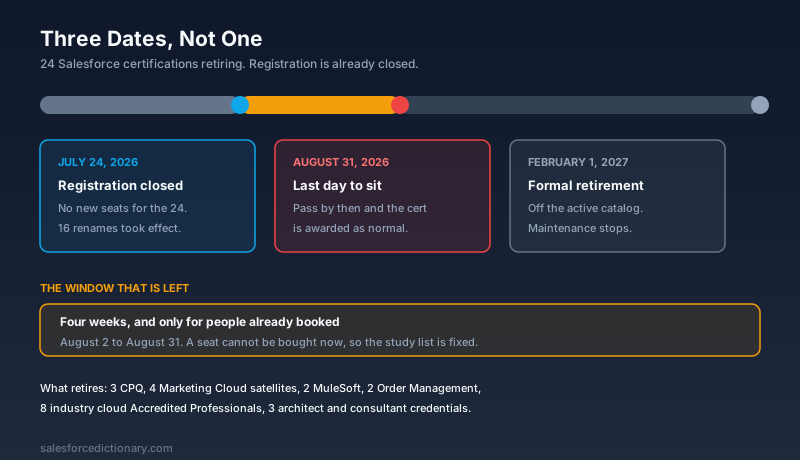
We covered the full list of 24 and all 16 renames when the announcement landed in June. The short version is that it hits CPQ hardest, takes four Marketing Cloud satellite credentials, two MuleSoft credentials, both Order Management Accredited Professionals, eight industry cloud APs, and three architect and consultant credentials including B2B Solution Architect.
What "Retired" Actually Costs
Salesforce has been consistent on the reassuring half of this. From its own certification lifecycle post: "A retired certification is still a valid certification. It demonstrates your knowledge of the product and your commitment to building expertise in that area." The credential is not revoked, and it stays on your Trailblazer profile.
Read the same post a little further and there is a line that gets quoted less often. Retired certifications remain on the profile but will not appear on the certification verification page.
That is the part that matters in a hiring process. The Trailblazer profile is what you show someone. The verification page is what a recruiter, a partner ops team, or a customer procurement reviewer checks when they want proof that the badge on your profile is real. After February 2027, a retired credential is a claim you make rather than a fact someone can look up in thirty seconds.
Maintenance stops too. Certifications stay active through annual Trailhead maintenance badges released against each of the three yearly releases, and a retired certification has no maintenance module to complete. So the credential freezes at the product version you passed on, permanently, with no mechanism to show it is current.
None of that makes a retiring exam worthless if you are already booked. A CPQ Administrator badge earned in August 2026 still proves you can configure a product that thousands of orgs are running right now. It means the badge has a shelf life, and you should plan for the day the verification link stops resolving rather than be surprised by it.
The Demand Map Moved While Everyone Was Studying
Salesforce Ben published its Definitive Guide to Salesforce Careers in 2026 on July 31, and it is the right document to read next to the retirement calendar. It answers the question the retirement raises: if the study time is going somewhere else, where.
The headline condition is oversupply. Global demand for Salesforce talent recovered 8 percent in 2025 after a 37 percent collapse the year before, but supply now runs roughly three to one against demand. Eighty-nine percent of job seekers found the market harder than before, and 41 percent of people who changed roles took a pay cut to do it. One number goes the other way: 38 percent found a role inside four weeks, up from 22 percent, so the market is slow to enter and quicker to close once you are in it.
Underneath that average, the roles have split hard.
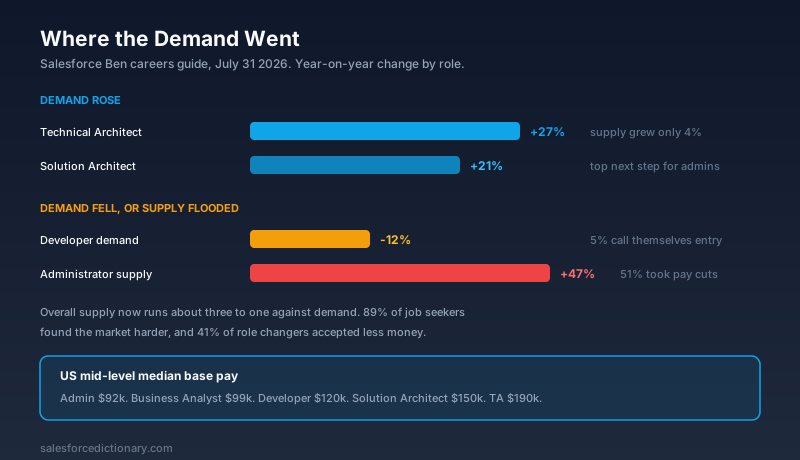
Technical Architect demand rose 27 percent against 4 percent supply growth, and the role is about 1 percent of global talent supply. Solution Architect demand rose 21 percent, and it is the most popular next step for admins at 17 percent. Developer demand fell 12 percent. Administrator supply grew 47 percent while demand concentrated elsewhere, which is the mechanism behind the two most uncomfortable admin numbers in the report: 51 percent of admins who changed jobs took a pay cut, and 60 percent say they are likely to consider a non-admin role within two years.
The salary bands track the same split. US mid-level medians run $92,000 for admins, $99,000 for business analysts, $120,000 for developers, $150,000 for solution architects, and $190,000 at the technical architect median.
Set that against what is retiring. Three CPQ credentials, four Marketing Cloud satellites, two MuleSoft credentials, and eight industry cloud Accredited Professionals are specialist badges in a market that is paying for architecture and consolidation. B2B Solution Architect retiring is the odd one out, since solution architecture is the growth role, and the read there is that Salesforce wants that skill validated through the core architect track rather than a separate B2B credential.
The AI Credential Nobody Holds
One pairing in the careers guide deserves its own paragraph.
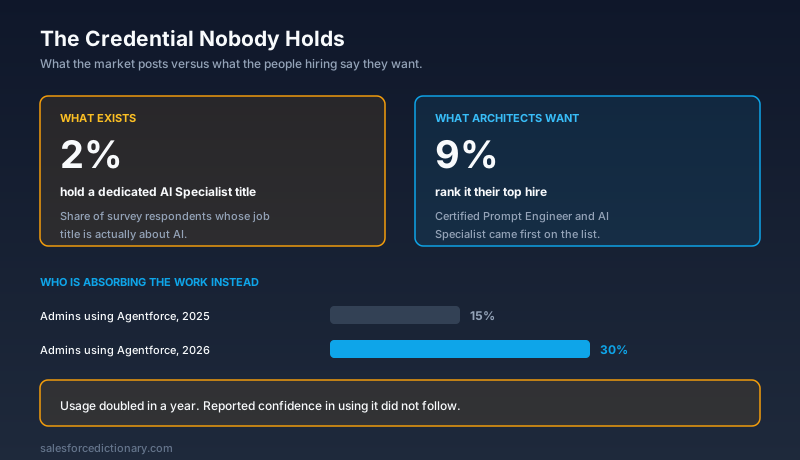
Dedicated AI Specialist job titles barely exist. They account for 2 percent of survey respondents, which matches what we found when the promised AI job titles failed to appear in the market data. Yet when architects were asked what they most want to hire, the certified Prompt Engineer and AI Specialist profile came top at 9 percent.
That is a gap between what companies post and what the people doing the hiring say they need. Agentforce usage among admins doubled year over year to 30 percent, and confidence in using it stayed low. The people who are already in the org are being asked to add the AI layer to the job they have, not to hand it to a specialist hired for the purpose.
So the study time that would have gone into a retiring specialist exam has an obvious destination. The Agentforce credentials are the ones the renamed catalog is built around, and they map to the skill architects say they cannot find.
August Is a Stack
The certification cliff is not standing alone. Four dates land inside five weeks, and three of them cost money or a sandbox.
August 20 is when Dreamforce registration steps up from $1,899 to the full $2,299, per Salesforce's own registration page. August 29 is the Winter '27 preview sandbox upgrade. August 31 is the exam cliff. Dreamforce itself runs September 15 to 17 in San Francisco, with the Trailblazer Bootcamp certification training running September 12 to 14 in front of it.
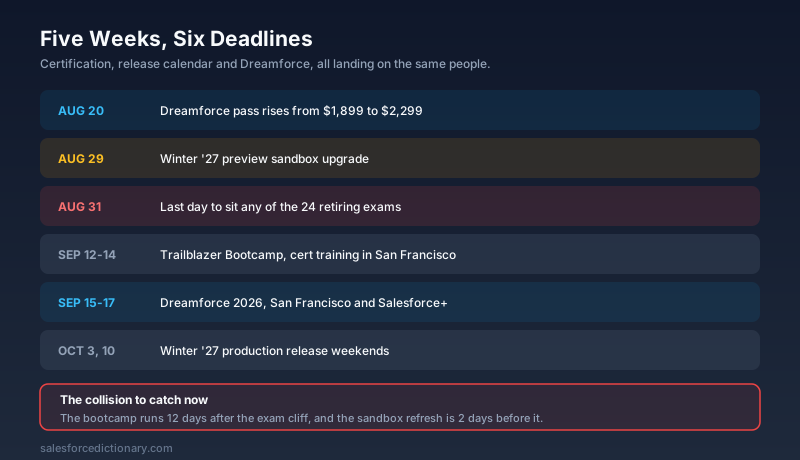
The sequencing has one genuinely awkward corner. The Trailblazer Bootcamp is accelerated certification training, and it runs twelve days after the last retiring exam can be sat. Anyone planning to use Dreamforce week as their cert push will find that the 24 retiring credentials are already out of reach by the time they arrive. The bootcamp is for the catalog that survives.
The sandbox date is the one that quietly competes for the same people. Whoever on your team is booked for a retiring exam in the last week of August is likely also the person expected to refresh and validate the Winter '27 preview sandbox on August 29, ahead of the October 3 and October 10 production release weekends. Two demanding tasks, same week, same person. Our Winter '27 sandbox preview guide covers the refresh mechanics; the scheduling conflict is the thing to catch now, while there is still time to move one of them.
What To Do This Week
If you have a retiring exam booked, treat the next four weeks as fixed. Reschedules inside a closed registration window are not something to count on, so protect the date you have and study for the product version on the current exam guide rather than the newest release.
If you hold one of the 24 already, do the archival work now rather than in February. Download the certificate PDF, screenshot the verification page while it still resolves, and record the credential ID somewhere you control. When the verification link stops working, that record is the only evidence you keep.
If you were planning to sit one and missed the July 24 registration, stop treating it as a loss and reallocate the hours. Look at what the renamed catalog kept, because those names tell you where Salesforce is putting its exam investment, and check the demand split before picking. The architect track and the Agentforce credentials are where both the hiring data and the catalog are pointing.
And put August 29 and August 31 on the same calendar as your release plan today. Two hard dates, two days apart, competing for the same person is the kind of collision that only looks obvious after somebody misses one.
About the Author
Dipojjal Chakrabarti is a B2C Solution Architect with 29 Salesforce certifications and over 13 years in the Salesforce ecosystem. He writes and edits salesforcedictionary.com, published by KineticBit Inc., to help admins, developers, architects, and cert/interview candidates sharpen their fundamentals. More about Dipojjal.
Share this article
Sources
- Salesforce Is Retiring 24 Certifications: Here's What You Need to Know (Salesforce Ben)
- The Definitive Guide to Salesforce Careers in 2026 (Salesforce Ben, July 31 2026)
- The Salesforce Certification Lifecycle: How We Build, Maintain, and Evolve Our Certification Portfolio (Salesforce)
- Salesforce 2027 Certification Retirements: Everything You Need to Know (Apex Hours)
- Salesforce Certification Retirements and Renames Explained (Salesforce Time)
- Dreamforce 2026 (Salesforce)
- Salesforce Winter '27 Release Date and Preview Information (Salesforce Ben)
Related dictionary terms
 Our appAdWake up sharp. Not just awake.The alarm that rings through Silent and DND — free on iOS & Android.Get WakeSharp →
More news

Salesforce's AI Jobs Never Arrived
A 2025 study found 72 prompt engineer vacancies across 20,000 LinkedIn listings. Salesforce's operating margin hit 22 percent against a 14.2 percent five-year average. Those two facts are the same story.
Salesforce Retires 24 Certs
Salesforce is retiring 24 certifications by February 1, 2027 and renaming 16 more to include Agentforce. Registration closes July 24, 2026. Full list and action plan inside.


Comments
No comments yet. Start the conversation.
Sign in to share your take on this article. Your account works across every page.