
Slackbot, Agentforce Coworker, or Claude Tag: A Governance Framework for the AI Sprawl in Your Slack Workspace
Agent creation on Slack is growing 800% year over year, and admins now juggle three overlapping AI assistants in one workspace. Here is the framework for deciding who owns what, before your users decide for you.
You type the same question into three different chat boxes in the same Slack channel this week. Slackbot answers one way. The Agentforce Coworker agent your admin deployed answers another way, pulling from an Opportunity record the first assistant never touched. Then someone tags @Claude, and a third answer shows up, citing a doc neither of the first two ever read. Nobody planned this. It just accumulated, one GA release and one beta launch at a time, until three AI assistants were living in the same room and nobody had assigned seats.
That is where most Salesforce-Slack workspaces sit as of mid-2026. This is not a story about which assistant is best. It is a story about what happens when a platform ships AI capability faster than anyone writes the rulebook for using it, and what you can actually do about it this quarter.
What Is Actually Live in Your Workspace Right Now
Start with an honest inventory, because most admins cannot list what is already running.
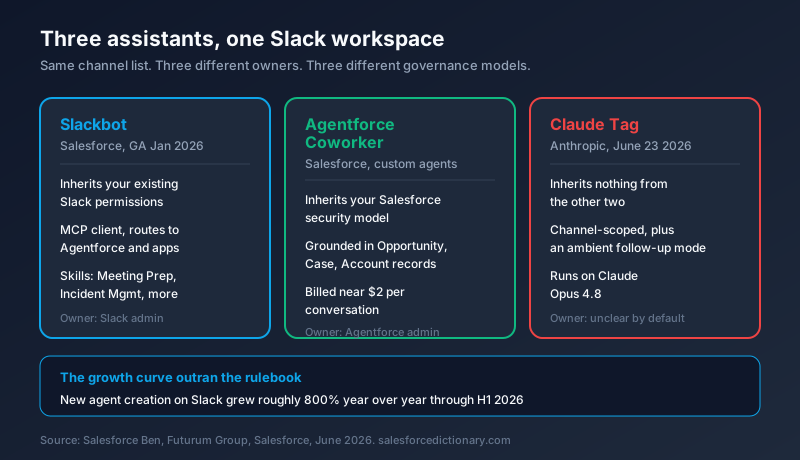
Slackbot reached general availability on January 13, 2026, rebuilt as a personal AI agent for work rather than the old typo-catching bot most people remember. It functions as an MCP client, routing requests to Agentforce and to thousands of connected apps, and Salesforce markets it as governed by default: it inherits whatever permissions your org already set in Slack, with no new access to configure (Salesforce). In March, it picked up more than 30 new AI capabilities, including reusable instruction sets called Skills. Daily Priorities, Meeting Prep, Research Synthesis, Incident Management: pick a Skill, and it runs the same routine every time someone invokes it (Vantage Point).
Agentforce Coworker is the custom-agent option: agents your team builds on the Agentforce platform, connected to your CRM data, deployed straight into Slack channels. This is the one grounded in Opportunities, Cases, and Accounts, the record data the other two assistants have to ask for. Customers can now choose between Slackbot, Agentforce Coworker, and Claude Tag inside the same workspace, which is precisely the choice nobody has written a policy for yet (Salesforce Ben).
Claude Tag is Anthropic's entry, and it is the newest and the strangest, because Salesforce does not own it and promoted it anyway. Launched June 23, 2026 for Claude Enterprise and Team customers, it lets anyone type @Claude in a permitted channel and get a coworker who reads the thread, does the work in the open, and posts the result back. It runs on Claude Opus 4.8. Admins scope it by channel and can toggle an ambient mode that lets it follow up on threads without being summoned. Rob Seaman, Slack's EVP and GM, put the pitch plainly: "Slack is the only layer in the AI stack where teams work together. Bringing Claude Tag into Slack is about making AI multiplayer." Existing users of the older Claude-in-Slack app get a 30-day migration window before it retires.
Three assistants. Three different owners. Three different governance models bolted onto the same channel list.
How You Ended Up With Three of Them
None of this happened by accident, and none of it happened slowly.
Salesforce spent 2026 opening Slack up on purpose. Slackbot went GA in January. In February, Salesforce and Anthropic shipped MCP Apps support, letting Claude search Slack conversation context and push drafts back into a channel, all while staying inside Salesforce's permission structure and virtual private cloud (Salesforce). Nick Johnston, Salesforce's SVP of Strategic Tech Partnerships, framed the logic at the time: AI agents can move work forward with confidence only when they are paired with the right context and the right governance. That line aged into an open question once Claude Tag arrived and did considerably more than search and draft.
Then came the Slack Agent Kit: a developer toolkit, open to every plan and every developer, that lets anyone stand up an agent on any backend and surface it inside Slack's native chat UI with a single slack create agent command. You do not need Agentforce to build an agent your whole team can talk to anymore. You need an afternoon.
The result shows up in the growth numbers. New agent creation on the Slack platform grew roughly 800% year over year through the first half of 2026, per Futurum Group's analysis of the Slackbot GA rollout (Futurum). That is not steady adoption. That is an explosion, and it happened while most IT teams were still writing the rollout plan for Slackbot alone.
Claude Tag landing on top of that growth curve is what turned quiet overlap into visible confusion. Salesforce employees reportedly described the functional gap between Slackbot and Claude Tag as "miniscule." Gaurav Kheterpal, a Salesforce Advisory Board member, said on LinkedIn that he was "genuinely excited... and confused by the Claude Tag announcement and how it fits the overall puzzle together with Slackbot" (Salesforce Ben). When a board member says that in public, the internal Slack channels are saying it louder.
The Governance Gap Nobody Closed
Here is the part that should worry you more than the branding confusion. Futurum's read on the Slackbot rollout named the real risk directly: the questions of who owns the agents in a shared workspace and who audits what they do are not settled. Any developer with the Agent Kit can deploy an agent into a channel your whole team reads. If governance lags behind that capability, the productivity gains get eaten by the risk of agents nobody vetted, quietly making decisions nobody is checking.
That gap is structural, not a rollout hiccup that a patch fixes. Slackbot inherits your existing Slack permissions, which sounds safe until you remember that most Slack permission schemes were designed for humans posting messages, not for autonomous agents calling internal APIs. Agentforce Coworker inherits your Salesforce security model, which is more mature but was never built with a third-party model provider two integrations away. Claude Tag inherits nothing from either. It is channel-scoped by design, governed by Anthropic's own controls, sitting inside a workspace whose other two AI systems it knows nothing about.
Three inheritance models. Zero shared ledger of who did what, when, and on whose authority.
A Practical Framework: Assign Ownership by Job, Not by Vendor
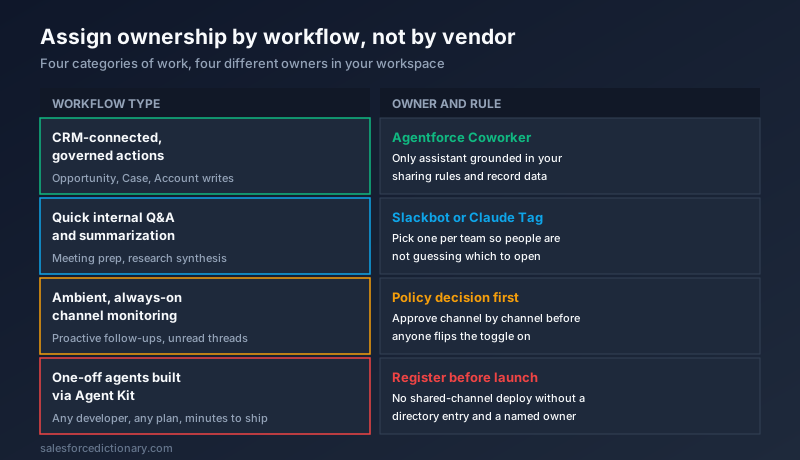
The instinct to pick a favorite and ban the other two will not survive contact with your users. People will use whichever assistant answers fastest in the channel they are already in. The workable move is to assign ownership by the shape of the work, then document it somewhere your team can find it.
CRM-connected, governed actions belong to Agentforce Coworker. Anything that reads or writes an Opportunity, Case, or Account should run through the assistant that already lives inside your data model and your existing sharing rules. Do not let a general-purpose assistant improvise a discount approval or a case status change just because it is faster to type.
Quick internal Q&A and summarization can go to Slackbot or Claude Tag. Meeting prep, thread summaries, research synthesis: this is low-risk, ungrounded-in-CRM work, and either assistant handles it fine. Pick one per team so people are not guessing, and use Slackbot's prebuilt Skills where a routine repeats every week.
Ambient, always-on monitoring is a policy decision, not a default. Claude Tag's ambient mode and Slackbot's proactive follow-ups both mean an assistant is reading a channel without being asked. Decide, channel by channel, whether that is welcome before someone enables it because the toggle was sitting right there.
One-off agents built through the Agent Kit need a leash before launch. Anyone can build one. That is the feature and the hazard in the same sentence. Require registration in a central directory before an Agent Kit build goes live in a shared channel, no exceptions for "it is just a small internal tool."
Write this down as an actual policy document, not a Slack thread that scrolls away. A one-page table naming the four categories above, with the assigned owner and the approver for exceptions, is enough to stop most of the ad hoc drift.
Set the Boundaries Before You Turn Anything On
Assigning ownership only works if the technical controls back it up. A few are already sitting in your admin console, unused.
Open the AI & Automation settings and check who can create custom Slackbot Skills. Governance there aligns with existing permissions, meaning a Skill cannot exceed the access of the person who built it, but that ceiling only helps if you have actually reviewed who holds Skill-creation rights in the first place (Vantage Point).
For Claude Tag, scope it channel by channel rather than granting workspace-wide access on day one. Set a token spending cap before your busiest channel adopts the @Claude habit and runs up a bill nobody approved. Confirm your 30-day migration window if you ran the older Claude-in-Slack app, because that clock does not pause for your rollout plan.
For Agentforce Coworker, model the cost before you scale it. Salesforce's Agentforce consumption pricing runs around $2 per conversation, and a coworker agent answering routine Slack questions all day adds up fast against a metered bill. Route the high-volume, low-stakes chatter elsewhere and save the metered agent for the work that actually needs CRM context.
For every Agent Kit build, treat the deployment step like a code review. It takes minutes to stand one up. It should not take minutes to approve one for a shared channel.
The Directory Fixes the Sprawl, If You Actually Use It
Salesforce's own answer to this mess is AgentExchange, paired with a consolidated agent browser inside Slack, both introduced around TrailblazerDX 2026 as the central, vetted place to discover and govern agents regardless of which platform built them. The idea is sound: one directory, one audit trail, one place an admin can see every agent with access to the workspace instead of piecing it together from memory and old approval emails.
The idea only works if you make registration mandatory rather than optional. A directory nobody is required to use just becomes a second, better-organized place where shadow agents also do not appear. Pair the directory with a standing review: monthly for a fast-growing team, quarterly at minimum for everyone else. Pull the list, check who owns each agent, and kill anything nobody can explain.
My Take: This Is a Policy Problem Wearing a Product Launch's Clothes
I do not think Slackbot, Agentforce Coworker, and Claude Tag overlapping in one workspace is a mistake Salesforce needs to apologize for. Marc Benioff has said the plan is for Slack to be the interface to AI, model-agnostic, the room where any assistant can show up. Read charitably, three assistants in one channel is the strategy working as designed.
But a strategy that produces genuine confusion among Salesforce's own advisory board is not a strategy your average admin should expect to navigate by instinct. The 800% growth in agent creation is the tell. Capability is compounding faster than any team's ability to track who is running what, and "it inherits your existing permissions" is not the same claim as "someone is watching what it does with them." Nobody outside your organization is going to write your governance policy for you, and every vendor involved has a commercial reason to prefer that you adopt first and sort out ownership later. Do not take that trade.
What to Do This Week
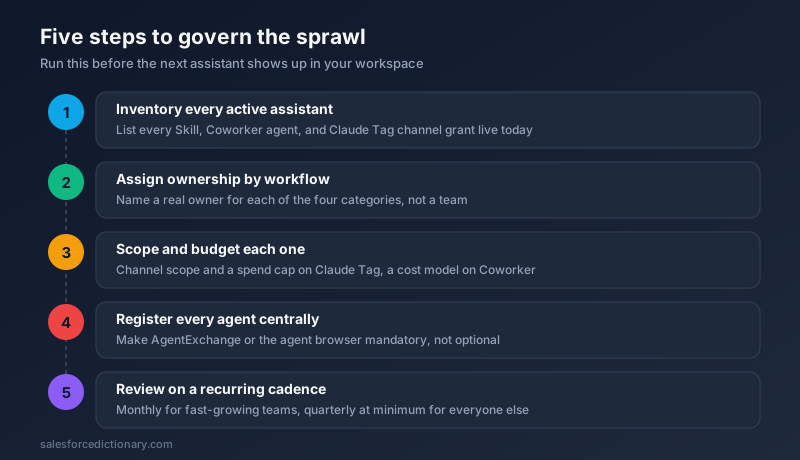
Pull the actual list. Open your Slack admin console and your Agentforce setup and write down every Slackbot Skill, every Agentforce Coworker agent, and every Claude Tag channel grant that is active today. Most teams have never done this in one sitting, and the list is usually longer than expected.
Assign the four categories from the framework above to a real owner with a name attached, not a team. Put it in a doc your admins can find in ninety seconds, not a pinned Slack message from March.
Set the boundaries this week, not next quarter: Skill-creation permissions in AI & Automation settings, channel scope and a spending cap on Claude Tag, and a cost model for every Agentforce Coworker agent running high-volume Slack traffic.
Then schedule the recurring review before you forget to. Thirty minutes on the calendar, every month, to pull the agent list and ask who owns each one. That single habit is the difference between governing this and discovering, a year from now, that you are running twelve agents nobody can name.
About the Author
Dipojjal Chakrabarti is a B2C Solution Architect with 29 Salesforce certifications and over 13 years in the Salesforce ecosystem. He writes and edits salesforcedictionary.com, published by KineticBit Inc., to help admins, developers, architects, and cert/interview candidates sharpen their fundamentals. More about Dipojjal.
Share this article
Sources
- Anthropic and Salesforce Announce New Claude to Slack Integration (Salesforce Ben)
- Claude Tag Raises a Bigger Question: What Is Agentforce For? (Salesforce Ben)
- Salesforce's Slackbot Goes GA: Is This the Real Test for Agentforce? (Futurum Group)
- Slackbot: The New Interface for the Agentic Enterprise (Salesforce)
- Salesforce and Anthropic Bring Trusted Business Context and AI Actions to Claude Through Slack and Agentforce 360 (Salesforce)
- Slack May 2026 Admin Update: Slackbot Skills, Agent Kit, and Deprecations (Vantage Point)
Related dictionary terms
Practise it
Five questions on Agentforce Specialist
Exam-style questions with an explanation after each one. No account needed, and your answers build a weak-topic map once you have one.
Keep reading
Slack as the Agentforce Front Door: The Complete 2026 Guide
Slack is now the conversational front door to Salesforce. This 2026 guide covers Slackbot GA, Salesforce Channels, Slack-First Sales, and the productivity shift for admins to plan for.
Salesforce Agent Fabric: The Complete 2026 Guide
Agent Fabric is Salesforce's answer to multi-vendor agent sprawl: a control plane that wraps every LLM call, authenticates every agent identity, and enforces governance at the seams where regulated actions fire. Here is the complete guide.
Salesforce Slack AI: The Complete 2026 Guide
You return from a week off, your Slack has 4,300 unread messages across 27 channels, and a customer call in 30 minutes. This is what Slack AI was built for: how it works, how Agentforce plugs in, and where it still gets things wrong.
Salesforce Paid $3.6B for Fin. Here's What Every Service Cloud Customer Needs to Know.
Salesforce bought Fin for $3.6B to fill the AI gap in Service Cloud. Here is what the deal means for admins, architects, and every org running customer service today.
Salesforce Multi-Agent Orchestration: The Complete 2026 Guide
In 2026, orgs run an average of 12 AI agents - half in isolated silos. Learn the primary-and-specialist architecture, Agent Fabric, and the A2A protocol that turn agent sprawl into coordinated enterprise AI.
Comments
No comments yet. Start the conversation.
Sign in to join the discussion. Your account works across every page.