
Salesforce Loyalty Management: 2026 Guide
A working guide to Salesforce Loyalty Management: the data model, the Ledger pattern, native integrations, and where Agentforce fits. Built for admins and architects who have to ship a points program, not just demo one.

A member emails support: "Your app says I have 4,200 points but the receipt from last week added 500 and I only see 3,700." You open her record. The points field reads 3,700. There is no way to tell what happened, because someone built the program with a single number field and an Apex trigger that overwrites it. The 500 points are gone, and so is any record of why. This is the most common way a Salesforce loyalty program goes wrong, and it is entirely avoidable.
Salesforce Loyalty Management exists so you never have to answer that email blind. This guide covers what the product is, how its data model is built, how it connects to the rest of the platform, where Agentforce changes the member experience, and when you should walk away and buy something else.
What Salesforce Loyalty Management Is
Loyalty Management is a Salesforce product that launched in 2020, originally positioned alongside Consumer Goods Cloud and now sold as a standalone offering inside the Salesforce Industries family. It is the platform's answer to the question every B2C brand eventually asks: how do we run a points-and-tiers program without bolting a third-party system onto our CRM and reconciling two sources of truth forever.
The product manages the full set of moving parts a real loyalty program needs. Programs, members, tiers, point currencies, reward catalogs, vouchers, partner programs, and a promotions engine all live as native Salesforce objects. Because they are native, a member's loyalty status sits in the same place as their cases, their orders, and their marketing engagement. That co-location is the entire pitch. Everything else follows from it.
You will not find Loyalty Management in a standard Salesforce edition. It requires its own license, which matters for budgeting and for the build-versus-buy decision later in this guide.
Core Components
A program is built from a small number of object types that nest inside each other. Understanding how they stack saves you from the classic mistake of modeling tiers as picklist values on the member record.
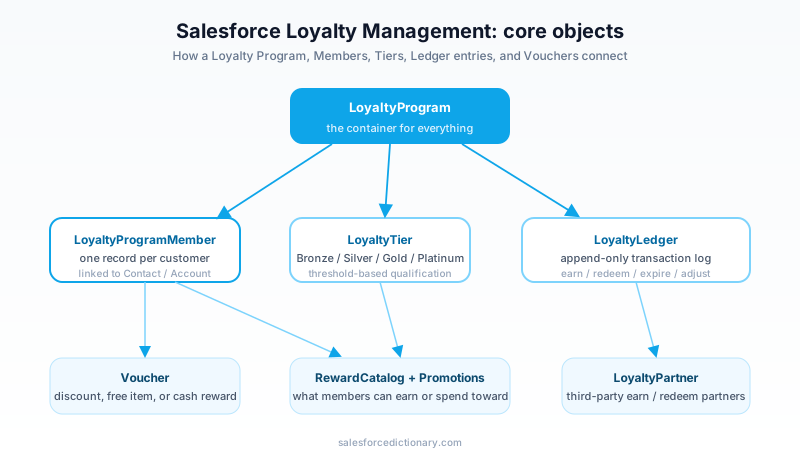
Loyalty Program is the container. One program holds its own rules, currencies, tier model, and members. Most organizations run a single program, but airlines and retail groups often run several (a flights program and a credit-card program, for instance) and link them.
Membership is the individual member record, stored as LoyaltyProgramMember. A person or account enrolled in the program gets one membership per program they join. This record carries their current tier, their enrollment date, and their point balances.
Tiers are the Bronze, Silver, Gold, Platinum pattern everyone recognizes. In Loyalty Management a tier belongs to a tier group, and the tier group defines how members move up or down. You set the qualifying threshold, the reset period, and the downgrade behavior. The engine handles promotion and demotion based on activity, so you are not writing tier math by hand.
Loyalty Currency is the unit you award. It can be points, miles, cashback dollars, or a non-monetary status currency that only counts toward tier advancement. A program can run more than one currency at once, which is how "spend points but earn status separately" programs work.
Reward Catalogs and Vouchers define what members get back. A catalog lists redeemable rewards; a Voucher is an issued, trackable instance of a reward assigned to a member, with its own status, expiration, and redemption tracking. Treat vouchers as real records, not coupon codes in a text field, because you will need to report on issuance and breakage.
Partner Program management lets you bring in external partners (a hotel chain, a rental-car brand) so members earn or burn currency across companies. The partner relationship and the currency exchange rules are modeled explicitly.
The Promotions engine is where earning rules live. A promotion says "double points on home goods in July" or "500 bonus points when you refer a friend." Promotions are evaluated against transactions, and this is also where you are most likely to meet governor limits, which we will get to.
The Data Model
The data model is the part most teams underestimate, and it is the part that decides whether your program survives an audit.

The key objects, per the Loyalty Management Object Reference:
| Object | What it holds |
|---|---|
LoyaltyProgram | The program container and its global settings |
LoyaltyProgramMember | One enrolled member per program |
LoyaltyLedger | An append-only record of every point movement |
LoyaltyPointsAggregate | Rolled-up balances summarized from the ledger |
Voucher | An issued, redeemable reward instance |
LoyaltyPartner | An external partner participating in the program |
The relationships are straightforward. A program has many members. Each member has many ledger entries. Aggregates summarize a member's ledger into usable balances. Vouchers attach to members. Partners attach to the program and to currency-exchange rules.
The object that deserves your attention is LoyaltyLedger. Every single point movement (earn, burn, expiration, manual adjustment) gets its own ledger row. The ledger is append-only by design. You do not update a balance; you write a new entry that adds or subtracts, and the aggregate reflects the new total. This is the same pattern accountants have used for centuries, and it exists for the same reason: when a member disputes a balance, you can show them every transaction that produced it.
Go back to the support email at the top. With a ledger, you open the member's LoyaltyLedger records, see the 500-point earn entry, see the adjustment that reversed it, and you have an answer in thirty seconds. The number field approach has no answer at all.
Integration With the Rest of the Platform
Native objects mean the integrations are real integrations, not connectors. This is the genuine advantage over running a separate loyalty platform.
Marketing Cloud reads loyalty tier and balance directly, so you can build a campaign that targets Gold members within 200 points of Platinum and send them a "you're almost there" message. The segment is the loyalty data; there is no nightly export to wait on.
Experience Cloud gives members a self-service portal where they check their balance, browse the reward catalog, and redeem vouchers without opening a case. We cover the portal side of this in the Experience Cloud guide.
Service Cloud handles the cases that do get opened, with the member's full loyalty context on the same record. An agent resolving a "missing points" case can see the ledger inline.
Data Cloud unifies the member into a single profile across every touchpoint, which is what makes personalization accurate rather than approximate. If you are standing up Data Cloud for this, the Data 360 implementation guide walks through the ingestion and identity-resolution work.
Commerce Cloud closes the loop at the point of purchase, awarding points on checkout and letting members redeem during the same transaction. That earn-and-burn-at-purchase flow is the moment loyalty becomes visible to the customer.
Agentforce for Loyalty Management
Loyalty programs generate a steady stream of repetitive, time-sensitive questions, which is exactly the workload Agentforce is built to absorb.
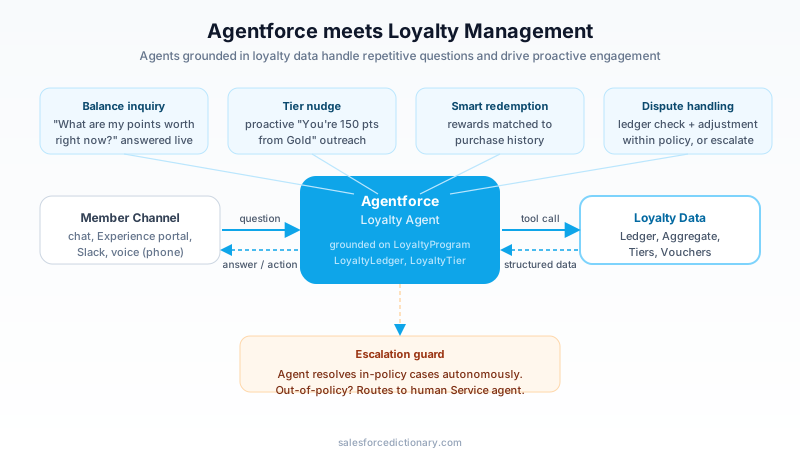
An Agentforce agent grounded in loyalty data can do several useful things in real time. It answers "what are my points worth right now?" by reading the aggregate and the current redemption rates, no human required. It watches activity and proactively tells a member they are 150 points from Gold, which is the kind of nudge that drives the incremental purchase. It suggests redemptions tuned to purchase history, so a frequent coffee buyer gets pointed at the rewards they will actually use rather than a generic catalog.
It also handles tier escalations and simple disputes on its own. When a member claims missing points, the agent can pull the ledger, confirm the transaction posted, and issue an adjustment within the rules you set, escalating to a human only when the situation falls outside policy. For a broader look at AI agents at the buying moment, see the Agentforce Commerce guide.
The agent is only as good as the data underneath it. This is another reason the ledger and aggregates matter: an agent reasoning over a single overwritten number field will give wrong answers confidently, which is worse than no agent at all.
Implementation Considerations
A few hard truths separate a Loyalty Management project that ships from one that stalls.
It is Industries territory. You need the Loyalty Management license; it is not part of standard Salesforce. Confirm the license before you scope anything, because the architecture assumes the managed package is present.
Complex promotions hit governor limits. The promotions engine evaluates rules against transactions, and a program with elaborate stacking rules running against high transaction volume will run into Apex and SOQL limits if you build naively. Design promotions to be evaluated in bulk, and load-test them. The governor limits cheat sheet covers the numbers to watch.
Never delete ledger records. The append-only contract is not a suggestion. Deleting a LoyaltyLedger row corrupts the aggregate and destroys your audit trail. Every correction is a new entry, even when the correction reverses a mistake.
Test with realistic volume. Loyalty programs reach millions of members, and behavior that is fine with 5,000 test records falls over at 5 million. Generate representative data and run your tier recalculations and point expirations against it before launch, not after.
The pitfall worth repeating: treat points as a ledger, never as a simple number. If you find yourself writing a trigger that sets Points__c = Points__c + amount, stop. That is the design that produced the support email at the top of this guide. Use the ledger for every adjustment and let the aggregate do the summing.
Loyalty Management Versus a Third-Party Platform
Salesforce Loyalty Management is not automatically the right answer. The native integration is the whole value, so the decision turns on how deep you already are in the Salesforce ecosystem.
If you are running Commerce Cloud, Marketing Cloud, and Service Cloud, the math is easy. Your loyalty data sits next to everything else, your agents and segments read it directly, and you avoid maintaining a second system of record. The cost of the license buys you integration you would otherwise build and own forever.
If you are not on that stack, the calculation shifts. Dedicated platforms like Antavo, Comarch, or Yotpo can be faster to stand up and may carry richer out-of-the-box loyalty features for teams whose CRM is not Salesforce. You give up the native co-location, but if you cannot use it anyway, you are paying for an advantage you will never collect.
| Choose Salesforce Loyalty Management when | Consider a third-party platform when |
|---|---|
| You already run Commerce, Marketing, and Service Cloud | Your core systems are not Salesforce |
| You want one system of record for the member | You need the fastest possible time-to-launch |
| Native Agentforce and Data Cloud access matters | Out-of-the-box loyalty features outweigh integration |
Be honest about which row you are in before you sign anything.
What To Do Next
Open a sandbox with the Loyalty Management package installed and build a one-currency, three-tier program end to end. Enroll a test member, award points through a transaction, watch the LoyaltyLedger write a row and the LoyaltyPointsAggregate update, then issue and redeem a voucher. Work through the Loyalty Management Basics module on Trailhead alongside it. Once you have seen the ledger update itself from a real transaction, you will understand why the number-field shortcut is a trap, and you will never build it that way.
About the Author
Dipojjal Chakrabarti is a B2C Solution Architect with 29 Salesforce certifications and over 13 years in the Salesforce ecosystem. He writes and edits salesforcedictionary.com, published by KineticBit Inc., to help admins, developers, architects, and cert/interview candidates sharpen their fundamentals. More about Dipojjal.
Share this article
Sources
Related dictionary terms
Practise it
Five questions on Agentforce Specialist
Exam-style questions with an explanation after each one. No account needed, and your answers build a weak-topic map once you have one.
Keep reading

Agentforce Commerce: The Complete 2026 Guide (Formerly Commerce Cloud)
Commerce Cloud is now Agentforce Commerce. This 2026 guide covers the unified B2C/D2C/B2B platform, Intent-Aware Search, ChatGPT catalog syndication, and the agentic-shopping rollout.

Salesforce Data 360: The Complete 2026 Implementation Guide
Data 360 is Salesforce's unified data platform for the agent era. This 2026 implementation guide walks data streams, identity resolution, segmentation, activations, and zero-copy federation.
Salesforce Experience Cloud: The Complete 2026 Guide (Sites, Portals & Agentic Customer Experiences)
Experience Cloud is no longer Communities. In 2026, it's an LWR-powered site runtime, a Digital Experience identity layer, and an Agentforce-first portal surface. Here's the complete admin, developer, and architect guide.
Comments
No comments yet. Start the conversation.
Sign in to join the discussion. Your account works across every page.