
Salesforce Retired Enterprise and Unlimited: What Core, Advanced, and Max Actually Cost You
The list-price arithmetic on all three new tiers, what the bundled Flex Credits really buy, and the one question that decides whether this bundle saves you money.

Your renewal quote arrives and it is shorter than last year's. Where you used to see six line items, there is one. The per-user number went up, the products underneath it got wider, and nobody on your side can tell whether that trade is good or bad without a spreadsheet.
That is the situation Salesforce created on September 3, 2026, when it replaced Enterprise, Unlimited, and Agentforce 1 with three new tiers called Core, Advanced, and Max. This post is the spreadsheet.
What actually changed
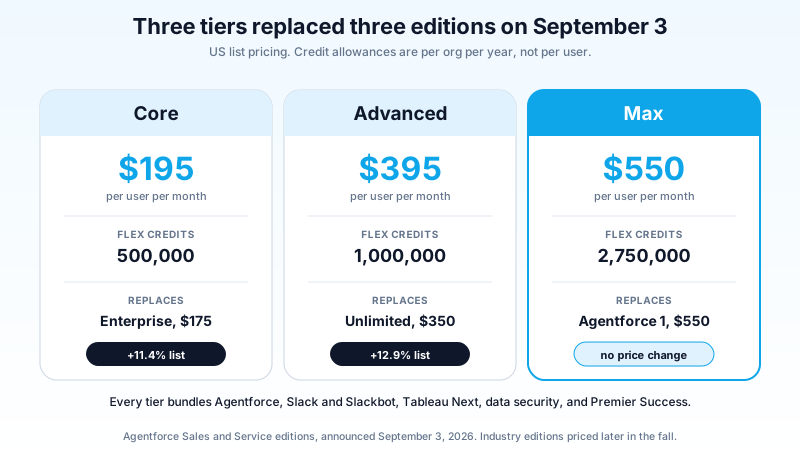
Salesforce collapsed its edition lineup for Agentforce Sales and Agentforce Service into three tiers. Agentforce Industry editions get the same treatment, with pricing landing later in the fall. Starter and Pro Suite were left alone.
Every tier now carries the same five things: Agentforce, Slack with Slackbot, embedded agentic analytics through Tableau Next, enterprise data security, and the Premier Success Plan. What separates the tiers is the price and the size of the Flex Credit allowance.
| New tier | Price per user/month | Flex Credits | Replaces | Old price |
|---|---|---|---|---|
| Core | $195 | 500,000 | Enterprise | $175 |
| Advanced | $395 | 1,000,000 | Unlimited | $350 |
| Max | $550 | 2,750,000 | Agentforce 1 | $550 |
Core is an 11.4 percent list increase. Advanced is 12.9 percent. Max held its price and grew its credit allowance.
Salesforce's own framing is that Core delivers "70% more value" than legacy Enterprise, Advanced "more than 50% more" than legacy Unlimited, and Max "nearly 60% more" than Agentforce 1. Those percentages are the sum of standalone list prices for things that are now included. Whether they mean anything to you depends entirely on how many of those things you were already buying.
The one question that decides everything
Before you argue about the increase, answer this: were you already paying for Premier Success?
Premier lists at roughly 30 percent of net license fees. It was bundled into Unlimited and sold separately to everyone on Enterprise. For an Enterprise org, it is comfortably the largest single item in the new bundle, and it dwarfs everything else in the stack.
Run 200 users through the arithmetic at list.
Legacy Enterprise: 200 x $175 x 12 = $420,000 a year in licenses. Premier on top of that is about $126,000. Total, if you bought Premier: roughly $546,000.
Core: 200 x $195 x 12 = $468,000 a year. Premier is included. Total: $468,000.
If you were buying Premier, Core saves you about $78,000 a year and hands you Slack, Tableau Next, and half a million Flex Credits on the way past. That is a genuinely good deal and you should say so out loud in the negotiation, because the reflex reaction to an 11 percent per-seat increase is to fight it.
If you were on the free Standard Success plan, the same move costs you $48,000 more a year for entitlements you did not ask for. Same edition, same price sheet, opposite conclusion.
Slack sits in second place. Business+ lists at $12.50 per user per month on annual billing, so 200 seats is another $30,000 a year if you were paying for it. Tableau Next Creator seats run about $40 per user per month, though almost nobody licenses analytics for every CRM user, so treat that line as partial credit rather than a full offset.
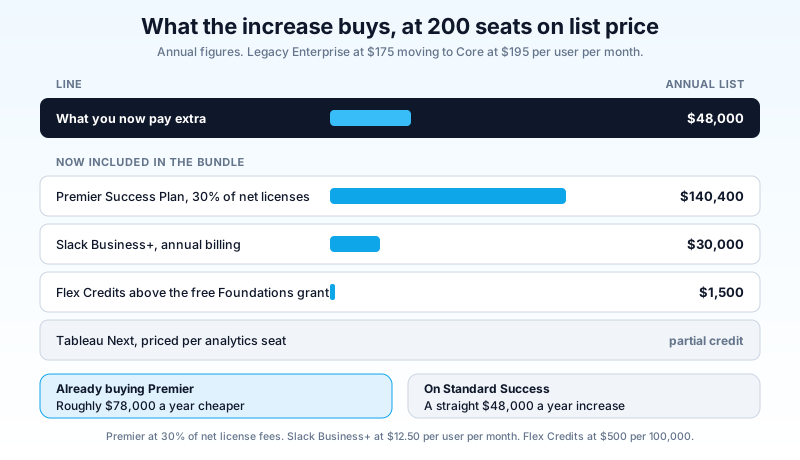
Work the same math for your own seat count before your first call with your account executive. The number that matters is not the percentage increase, it is the delta between the increase and the standalone cost of the things you were already buying.
Now the credits, which is where people get it wrong
The 500,000 Flex Credits attached to Core is the headline that reads best on a slide and holds up worst under arithmetic.
Two facts do most of the work here. First, the allowance is per org per year, not per user and not per month. Salesforce's own pricing page uses exactly that language for the Agentforce 1 editions. Second, from the published Flex Credits rate card dated April 21, 2026, a standard agent action costs 20 credits, and a Voice action costs 30. Credits themselves list at $500 per 100,000, which puts a standard action at ten cents.
So Core's allowance is 25,000 standard agent actions. For the whole org. For the whole year.
That is roughly 2,080 actions a month. If a resolved service conversation takes five actions, and five is optimistic once you count retrieval, record lookups, and a write-back, then Core buys you about 5,000 agent-handled conversations a year. A service desk deflecting 5,000 cases a month burns the entire annual allowance in a single month.
Advanced doubles it to 50,000 actions. Max, at 2.75 million credits, gets you 137,500. Every one of those is still an annual number for the org.
There is a wrinkle on the Max figure that is worth catching. Coverage of the announcement describes the increase as going from 1 million credits to 2.75 million, while Salesforce's own Agentforce pricing page has listed Agentforce 1 at 2.5 million credits per org per year. Those two starting points give you very different pictures of how big the improvement is, either 175 percent or 10 percent. The published sources genuinely disagree, and the number that governs your invoice is the one printed on your Order Form, not the one in a press release or on a product page. Go and read it before you quote a saving to your CFO.
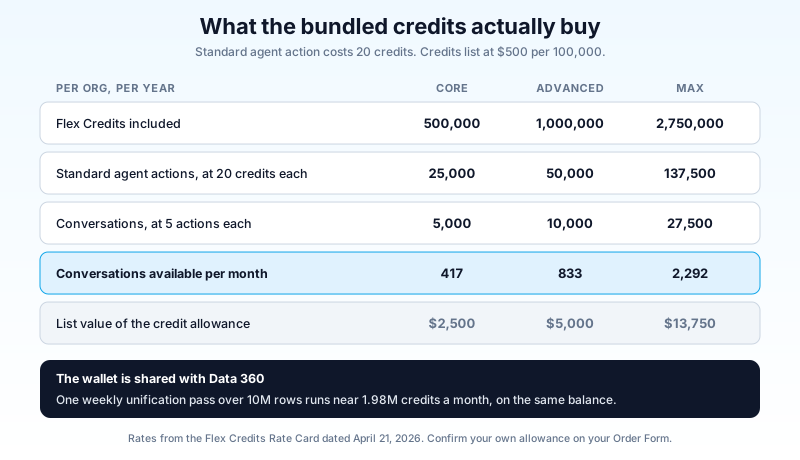
Then subtract what you already had. Every customer on Enterprise or above can turn on Salesforce Foundations for free, and the Foundations entitlement already includes 200,000 Flex Credits plus 250,000 Data 360 credits. So the marginal credit entitlement Core hands you over what you could have activated at no cost is 300,000 credits, which lists at $1,500. Against a $48,000 increase for a 200-user org, the credit line is a rounding error. The Premier line is the deal.
The shared wallet nobody mentions on the call
Here is the part that catches architects rather than procurement.
Flex Credits are one currency, and Data 360 draws from the same pool as Agentforce. One nightly identity resolution run and one agent conversation compete for the same balance. That merge happened on the April 2026 rate card, which added a full Data 360 section with eleven usage types to what had previously been an Agentforce-only document.
Unification bills at 75,000 credits per million rows at base tier. Run it weekly over a 10 million row profile set and you land near 1.98 million credits a month once the monthly volume tiers are applied. That single job burns four times Core's entire annual allowance every month.
Read that again if you are sizing a Core deal for an org with a real Data 360 footprint. The bundled credits are not an AI budget, they are a shared consumption float, and a data pipeline will drain it faster than any agent you deploy. The Data 360 Flex Credits breakdown has the full rate card and the five levers that actually move that number, and the Digital Labor Units guide covers the agent side of the same balance.
Two analysts quoted in CIO's coverage made the same point from different angles. Pareekh Jain warned that much of the bundled functionality and many of the credits go unused, which thins out the claimed savings. Manoj Chandra Jha flagged the opposite risk, that bundling reduces the line-item visibility CIOs relied on to compare vendors and to price components against each other.
Both are right, and they are describing the same design. A bundle is a bet that you will use enough of it to come out ahead. Salesforce is comfortable making that bet at scale because it knows the average customer will not.
What you lose when the line items disappear
The commercial cost of this repackaging is real and it is not on any price sheet.
When Premier, Slack, Tableau, and AI credits were separate SKUs, you could cut one. A flat year meant dropping Premier back to Standard, or trimming analytics seats, or pausing an AI pilot. Those were the levers your finance team pulled when the budget got tight.
Bundled into the per-seat rate, those levers are gone. Your only remaining lever is seat count, which means the next cost-reduction conversation is a headcount conversation. That is a worse conversation to be in, and it is a structural consequence of the change rather than an accident of it.
You also lose your benchmark. Comparing $195 against a competitor's per-seat number is not a like-for-like comparison any more, because the $195 carries a support plan, a collaboration platform, and an analytics tool inside it. Building the comparison now takes an unbundling exercise that most procurement teams will not have time to do properly, which is exactly why bundles work.
I think the bundling is defensible product strategy and a straightforwardly bad development for buyers with disciplined vendor management. Both things are true. Salesforce is selling an outcome, and the price of an outcome is that you stop being able to price the parts.
What happens to your existing contract
Nothing immediate. Customers on legacy Enterprise and Unlimited keep their current pricing, and renewals on those editions are not being repriced on announcement day.
That grace period is the useful part of this news. It gives you a planning window rather than a fire drill.
Existing Agentforce 1 customers get the cleanest outcome in the whole announcement. You move to Max at no additional cost, with a credit allowance that grew and a price that did not. Salesforce puts up to $500 of added value on that upgrade. If you are on Agentforce 1, take it and move on. There is no analysis to run.
The reason that upgrade is free is not generosity. Agentforce 1 was the tier bought by customers who had already committed to agents, and those are exactly the accounts Salesforce needs to keep consuming rather than re-evaluating. Handing them a bigger credit allowance at the same price removes the one thing that would push them to shop around at renewal, which is a bill that outran the forecast. Take the deal anyway. Understanding why it exists does not make it worse.
For everyone else, the decision tree is short.
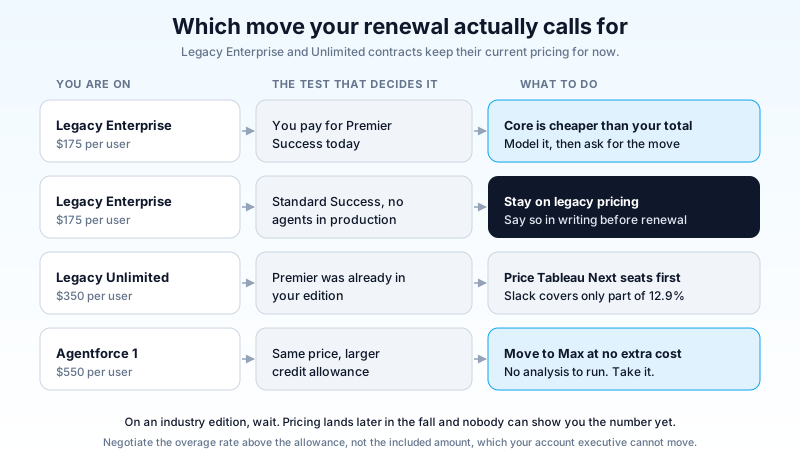
On legacy Enterprise, paying for Premier, and running or planning Agentforce. Core is very likely cheaper than your current total. Model it, then ask for the move rather than waiting to be moved.
On legacy Enterprise, on Standard Success, no AI in production. Stay where you are for as long as your contract allows. You are being asked to pay 11.4 percent more for a support tier you declined, a chat platform you may already have under a separate agreement, and 300,000 marginal credits worth $1,500. There is no version of that math that works in your favor today.
On legacy Unlimited. Premier was already included, so Advanced's incremental value is Slack, Tableau Next, and a million credits against a 12.9 percent increase. For 200 seats that is $108,000 a year more. Slack at list covers about $30,000 of it. The credits list at $5,000. You need the analytics entitlement to be genuinely worth the balance, so price Tableau Next seats properly before you agree.
Heavy Agentforce or Data 360 consumption already. Your decision is not about the bundle. It is about the credit ceiling and what happens above it, which is the next section.
On an industry edition. You are in the one segment with a legitimate reason to wait. Financial Services Cloud, Health Cloud, and the rest get the same three tiers, but Salesforce has said the pricing lands later in the fall and has not published the numbers. Anyone quoting you an industry edition figure today is extrapolating from the Sales and Service sheet. Ask for the published price in writing, and if your renewal falls inside that gap, push the date rather than sign against a number nobody can show you.
Model the overage before you sign, not after
Every one of these tiers is a floor with a meter behind it. Credits above the allowance bill at list unless you negotiated otherwise, and at $0.005 a credit the numbers scale in ways that surprise people who budgeted from the included figure.
Do this before signing:
- Pull your last 90 days of consumption from the Digital Wallet in Setup. Annualize it. If you are not live on Agentforce yet, estimate from a pilot rather than from a vendor calculator, because the vendor calculator does not know how many actions your grounding steps consume.
- Split the estimate between agent actions and Data 360 operations. They share the wallet but they scale on completely different drivers, and only one of them is visible to the team deploying agents.
- Compare the annualized number to your tier's allowance. If you land above 70 percent, you will exceed it inside the term. Plan for that now.
- Negotiate the overage rate, not the included amount. The included allowance is a fixed marketing number that your account executive cannot move. The rate above it is commercial, it is where a multi-year deal actually gets won or lost, and almost nobody asks about it.
- Ask what the true-up looks like at renewal. Sustained overage is the mechanism that walks you from Core to Advanced. Know the ramp before you are standing on it.
One more item for the security-minded. "Enterprise-grade data security" in the bundle description is not a defined SKU, and Salesforce has not published a component list. If you assumed it means Salesforce Shield, get that confirmed in writing on the Order Form before you cancel a Shield line. Platform Encryption, Event Monitoring, and Field Audit Trail are separate, expensive, and not obviously covered by a marketing phrase.
What to do this week
Open your Order Form and find three numbers: your current user license count and per-seat rate, your Success Plan tier and its annual cost, and your Slack and analytics spend if they sit on separate agreements. Add them up. Compare that total against seats times $195 times 12 for Core, or $395 for Advanced.
If the bundle comes in lower, take the move to your account executive before your renewal window opens, while it still reads as your idea. If it comes in higher, you have a documented reason to stay on legacy pricing for another term, and you should say so in writing now rather than during the renewal scramble.
About the Author
Dipojjal Chakrabarti is a B2C Solution Architect with 29 Salesforce certifications and over 13 years in the Salesforce ecosystem. He writes and edits salesforcedictionary.com, published by KineticBit Inc., to help admins, developers, architects, and cert/interview candidates sharpen their fundamentals. More about Dipojjal.
Share this article
Sources
Related dictionary terms
Practise it
Five questions on Agentforce Specialist
Exam-style questions with an explanation after each one. No account needed, and your answers build a weak-topic map once you have one.
Keep reading

Data 360 Flex Credits: Where the Credits Actually Go, and the Five Levers That Cut the Bill
Your Digital Wallet card says you burned 40 percent of the year's credits in one quarter. Here is the official Data 360 rate card, the operation that causes almost all of it, and the five levers that actually move the number.

Agentforce Digital Labor Units Explained: What You're Actually Buying in 2026
Agentforce switched from per-conversation pricing to Digital Labor Units. Here is how DLU consumption works, what counts as a billable interaction, and how to estimate costs before you commit.

Salesforce Foundations: The Free AI Bundle That Changes What Your Enterprise Org Can Do
Salesforce Foundations gives Enterprise+ orgs no-cost access to Agentforce, Data 360, Sales, Service, Marketing, and Commerce features. What's actually included, what's left out, and the activation steps most admins skip.
Comments
No comments yet. Start the conversation.
Sign in to join the discussion. Your account works across every page.