
Salesforce Foundations: The Free AI Bundle That Changes What Your Enterprise Org Can Do
What's included, what's not, how to activate, and why half of Enterprise orgs still haven't turned it on.

You're walking through your org's Setup menu and a banner appears: "Activate [Salesforce Foundations](/terms/salesforce-foundations) at no additional cost." You dismiss it and keep scrolling. You've just walked past roughly $150,000 worth of features.
That banner has been sitting in Enterprise orgs since late 2024, and as of mid-2026 a large share of those orgs still haven't clicked it. Some admins assume it's a sales upsell in disguise. Some assume "no additional cost" has an asterisk that bites later. Most just never had time to read the fine print. This guide reads the fine print for you: what Foundations actually gives you, where the limits bite, and whether you should activate today or wait.
What Salesforce Foundations Actually Is
Foundations is not a product you buy. It's an entitlement you add to an edition you already own. Think of it less like a new SKU and more like a switch Salesforce flipped to make a slice of every cloud available to existing customers.
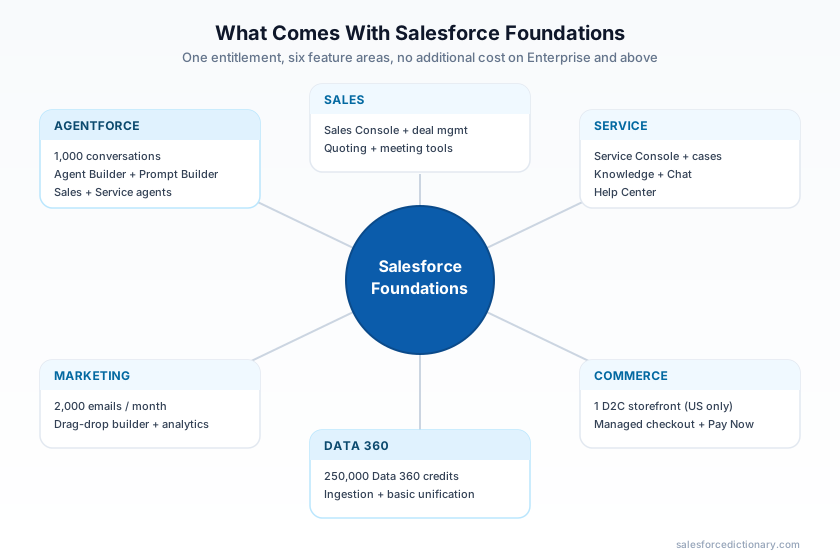
When you activate it, your org gains a curated set of features pulled from five clouds (Sales, Service, Marketing, Commerce, and Data 360) plus a metered allocation of Agentforce. You don't get the full version of any of those clouds. You get a working tier of each, enough to build something real, with hard usage caps that keep the free part free.
The strategic logic is obvious once you see it. Salesforce wants every Enterprise customer touching Agentforce and Data 360 before renewal season. The cheapest way to do that is to hand you a starter portion at no charge and let the usage limits create the upgrade conversation on their own Salesforce Foundations announcement.
That's the honest framing. It's a genuinely useful free upgrade and a funnel into paid consumption at the same time. Both things are true.
The technical detail worth internalizing early: activation provisions new managed objects, new tabs, and new setup nodes into your org. It is not a feature flag that quietly toggles a single screen. Your org's metadata footprint grows. That's why the preparation matters more than the click. The click takes a minute. Cleaning up after an unprepared activation can take a sprint.
Who Gets It
Foundations is available at no additional cost for Enterprise, Unlimited, Performance, and Einstein 1 editions, on either the Sales or Service track Salesforce Foundations editions.
If you're on Essentials or Professional, you don't get it. No workaround, no add-on path. The cutoff is intentional: Foundations is the carrot for the editions Salesforce most wants pulling toward Agentforce and Data 360. Smaller editions get a different pitch.
So before you do anything else, confirm your edition. In Setup, search for "Company Information" and check the Organization Edition field. If it reads Enterprise, Unlimited, Performance, or Einstein 1, you qualify. If it reads Professional, the rest of this guide is reference material for your next upgrade conversation, not your next afternoon.
What's Included: The Real Breakdown
Here's the part where most write-ups get vague. Let me be specific about each area, because "features from five clouds" can mean anything.
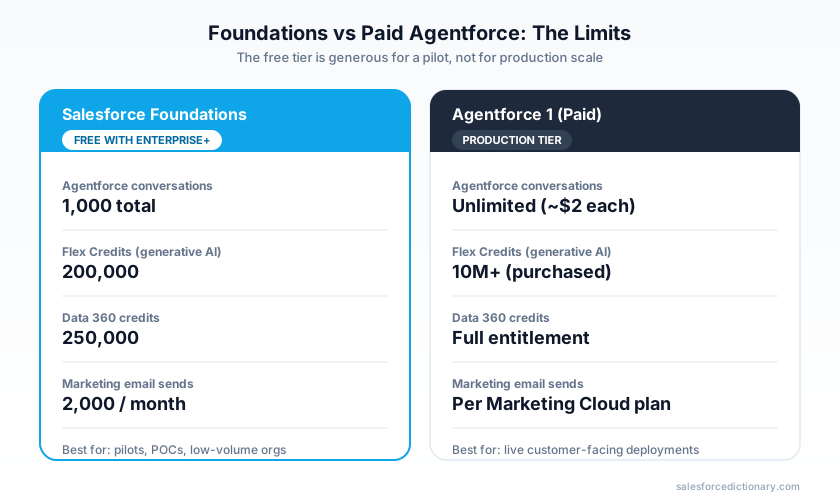
Agentforce. This is the headline. You get 1,000 Agentforce conversations, 200,000 Flex Credits for generative AI usage, and 250,000 Data 360 credits. More importantly, you get the build tools: Agent Builder and Prompt Builder, plus limited versions of the Agentforce Sales Agent and Service Agent. That means you can actually design, test, and run an agent, not just watch a demo. For most teams this is the first time Agentforce stops being a slide and starts being a thing in their own org Agentforce AI tools now free with Salesforce Foundations.
Sales. You get the Sales Console, deal management, quoting, and meeting tools. If your reps live in a basic list-view world today, this is a meaningful step up in workflow without touching your license count.
Service. The Service Console, Case Management, a Knowledge base, Chat, and a Help Center. This is enough to stand up a real support operation, and it pairs naturally with the Agentforce Service Agent for case deflection.
Marketing. A drag-and-drop email builder, built-in analytics, and 2,000 monthly email sends. Read that number twice, because it's the one that surprises people. More on that in the gotchas.
Commerce. One Direct-to-Consumer (D2C) digital storefront, US only, with managed checkout, merchandising tools, the Pay Now secure payment link, and Commerce Cloud analytics. A complete small storefront, with two firm boundaries: one store, one country.
Data 360. Your Customer 360 data surfaces automatically from connected apps, with data ingestion and basic unification. This is the Data Cloud tier that feeds your agents the context they need to answer real questions. Without it, Agentforce is guessing. This is also the piece most teams underestimate. An agent that can't see a customer's order history, open cases, or recent activity gives generic answers, and generic answers erode trust fast. Data 360 is what turns "a chatbot" into "an agent that knows who it's talking to."
The pattern across all six: you get a real, usable tier, capped hard enough that a production-scale deployment will hit a wall and trigger an upgrade. Which brings us to the caps.
One note for developers. Foundations does not change governor limits, and it doesn't hand you a different runtime. Anything you build on top of it (custom Apex actions, invocable methods that agents call, Flow that an agent triggers) runs under the same limits and the same security model you already work with. Foundations widens what's available to configure. It doesn't loosen the platform you build on.
The Spring '26 and Summer '26 Additions
Foundations isn't frozen. Salesforce has been adding to it, and the recent additions are the most interesting reasons to activate.
Agentforce for Flow went GA and is available with Foundations. You describe a flow in natural language and the AI drafts it for you. The detail that matters: it does not consume your generative AI credits Spring 2026 product release announcement. So you can use it freely without watching your 200,000 Flex Credits drain. For admins who build a lot of Flow automation, that's a real time saver attached to a free entitlement.
The Agentforce Panel in Lightning Experience is available with Foundations or Agentforce 1 editions. It puts an agent surface directly in the Lightning UI where your users already work, instead of a separate window.
Two more are landing in Summer '26. Troubleshooting and fixing Flow errors with Agentforce is in Beta: you describe a broken flow and the AI diagnoses design-time issues in plain language. If you've ever stared at a fault path trying to work out why a record update silently failed, you know the value. And Multi-Agent Orchestration support is arriving, which lets agents hand work off to one another instead of each operating in isolation.
The Flow capabilities are the quiet standout. They're useful to admins immediately, they don't burn metered credits, and they require nothing more than activating the free entitlement.
The Gotchas
Now the honest part. Foundations is good. It also has edges that will cut you if you walk into it expecting the full clouds.
1,000 conversations runs out fast. For a pilot, fine. For a medium-sized org running a customer-facing service agent, 1,000 conversations is roughly a busy afternoon. Production Agentforce runs about $2 per conversation, so when you exhaust the free pool, the next 1,000 conversations cost around $2,000. The free tier is a sandbox to prove value, not a production budget.
The email cap is the one that catches everyone. 2,000 sends per month sounds workable until you do the arithmetic. A single campaign to 5,000 contacts blows past your entire monthly allowance in one send. This is not Marketing Cloud Engagement. It's a starter email tool with a starter ceiling, and treating it like a real marketing platform will end badly the first time someone hits "send to all."
Commerce is US-only and single-store. One D2C storefront, United States only. If you're international or you need a B2B store or multiple brands, Foundations Commerce is a demo, not a deployment.
Flex Credits evaporate faster than the number suggests. 200,000 credits reads like a lot. In testing, a single complex Prompt Builder template can consume 1,000 or more credits per use case. Run a few elaborate prompts across a few scenarios and you've spent a meaningful chunk before you've shipped anything. Budget your credits the way you'd budget API calls, not the way you'd budget storage.
Activation rearranges your org. Turning Foundations on changes your Setup navigation and the app UI. Admins who flip it without warning find themselves hunting for menus they used yesterday. It's not broken, it's relocated, but a surprise reorg of your Setup menu is a bad way to start a Monday.
Cross-cloud permissions get messy. Features spanning five clouds mean new objects, new tabs, and new access decisions. If your profiles and permission sets aren't prepared, users either see things they shouldn't or can't reach things they need. Sort permissions before you flip features on, not after the support tickets arrive. A practical approach: build a dedicated permission set per Foundations feature you activate, assign it to a small pilot group first, and only widen access once you've confirmed the visibility is right. Resist the urge to grant everything through profiles, because unwinding over-broad profile access later is far more painful than adding a permission set now.
The throughline: Foundations gives you the basic tier of everything, not the full product of anything. It is not Marketing Cloud Engagement. It is not full Commerce Cloud. Go in with that expectation and you'll be pleased. Go in expecting the enterprise editions and you'll feel shortchanged.
How to Activate
The activation itself is short. The preparation around it is what separates a clean rollout from a help-desk spike.
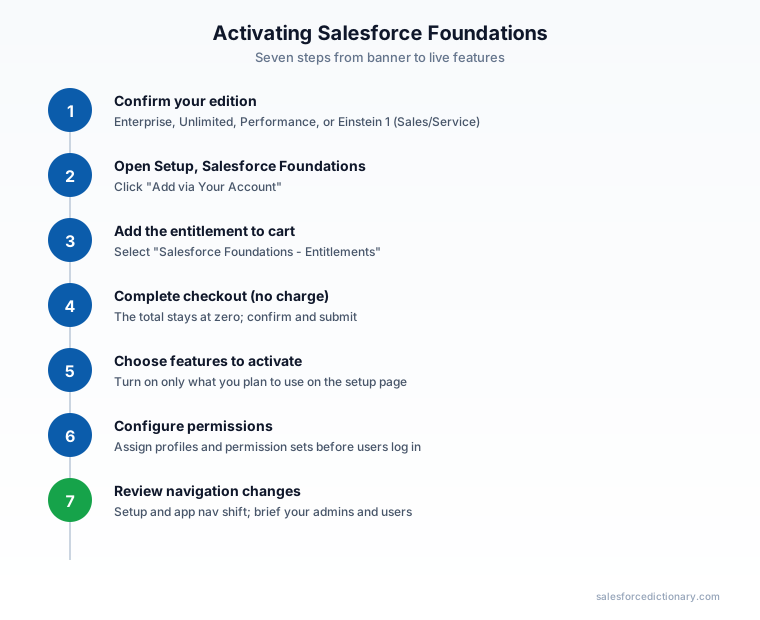
- Confirm your edition. Enterprise, Unlimited, Performance, or Einstein 1 (Sales or Service). Check Company Information in Setup first.
- Go to Setup, then Salesforce Foundations, and click "Add via Your Account."
- Select "Salesforce Foundations - Entitlements" and add it to your cart.
- Complete checkout. The total stays at zero. You're confirming an entitlement, not paying for one Salesforce Foundations setup (Help).
- Choose which features to activate on the Foundations setup page. Turn on only what you intend to use. There's no prize for switching on all six at once.
- Configure permissions for your users. Decide who sees the new consoles, the agent surfaces, and the Data 360 objects before anyone logs in.
- Review the navigation changes and brief your team. A two-line heads-up message saves a dozen "where did my menu go" pings.
Do this in a sandbox first if you have one. Watching the navigation shift in a safe org makes the production change far less jarring.
Who Should Activate Now vs Wait
Here's my actual opinion, not a hedge.
Activate now if you've been curious about Agentforce but couldn't justify the spend. This is the cleanest path to building a real agent in your real org with your real data, at zero marginal cost. Also activate now if you're an admin who wants the free Flow drafting and troubleshooting tools. Those alone justify the entitlement, and they don't touch your credit balance.
Activate now, carefully, if you want to pilot Data 360. The 250,000 credits and automatic Customer 360 surfacing let you prove the unification story internally before asking for a full Data 360 budget. Just keep the pilot scoped.
Wait if you have no permission strategy and no time to build one this quarter. The cross-cloud access mess is real, and activating into an unprepared security model creates cleanup work that outweighs the benefit. Wait, too, if your team is mid-migration or mid-release and a Setup navigation change would land at the worst possible moment.
Wait, too, if you're a heavily customized org with a fragile release pipeline. New managed objects and setup nodes can collide with naming conventions, automation, or managed packages in ways that are annoying to debug under deadline pressure. Sandbox-test the activation against your real customizations before it touches production. Ten minutes of testing beats an afternoon of triage.
What I would not do is dismiss the banner indefinitely. The features are real, the cost is genuinely zero to switch on, and the only true risk is activating without preparation. That risk is a planning problem, not a product problem. Every quarter you leave it off is a quarter your team isn't learning Agentforce on real data while the rest of the ecosystem is. When the upgrade conversation finally lands on your desk, you want to be the team that already piloted it, not the team starting from a cold demo.
Your Next Step
Open Setup right now and search "Company Information." Confirm your edition is Enterprise or above. If it is, spin up a sandbox, activate Foundations there following the seven steps, and spend thirty minutes building one small Agentforce agent or letting Agentforce for Flow draft an automation you've been putting off. You'll know within that half hour whether it belongs in production, and you'll have spent nothing to find out. Then bring permissions and a navigation heads-up to the production activation, and flip the switch you've been scrolling past.
About the Author
Dipojjal Chakrabarti is a B2C Solution Architect with 29 Salesforce certifications and over 13 years in the Salesforce ecosystem. He writes and edits salesforcedictionary.com, published by KineticBit Inc., to help admins, developers, architects, and cert/interview candidates sharpen their fundamentals. More about Dipojjal.
Share this article
Sources
Related dictionary terms
Practise it
Five questions on Agentforce Specialist
Exam-style questions with an explanation after each one. No account needed, and your answers build a weak-topic map once you have one.
Keep reading

Salesforce Data 360: The Complete 2026 Implementation Guide
Data 360 is Salesforce's unified data platform for the agent era. This 2026 implementation guide walks data streams, identity resolution, segmentation, activations, and zero-copy federation.

Salesforce Einstein Trust Layer: The Complete 2026 Guide to Secure AI
Your security team asks where the customer data goes when Agentforce processes it. Here is the full answer: how the Einstein Trust Layer's prompt journey, data masking, zero-data retention, and toxicity detection actually work.

Salesforce Prompt Builder: The Complete 2026 Guide for Admins & Developers
Prompt Builder is the no-code studio that connects your Salesforce data to any LLM — and in 2026, it's the foundation of every Agentforce Agent Action. Here's the complete guide for admins and developers.

What Is Agentforce 360? The Complete 2026 Guide for Salesforce Admins, Developers & Architects
Agentforce 360 is Salesforce's 2025 rebrand of its agentic-AI platform - built on the Atlas Reasoning Engine, Einstein Trust Layer, and Data 360. Here's the complete admin + dev + architect guide.
Comments
No comments yet. Start the conversation.
Sign in to join the discussion. Your account works across every page.