

Salesforce Summer '26 is 822 pages of release notes, organized across 23 product pillars, with one consistent message running through every section: this is the release where the agentic enterprise stops being marketing and starts being how the platform works. Sales Cloud is now Agentforce Sales. Service Cloud is now Agentforce Service. Slack channels replace Chatter as the default in new orgs. Apex enforces user-mode security by default. Voice agents route over SIP. Sandboxes can opt into a Dev channel that previews features weeks before GA.
If you only read the Top 10, you get the architectural decisions. This article is the wider map: every pillar, every meaningful feature, and what each one means for the way you build, sell, and operate Salesforce. The release was first published the week of April 20, 2026 and last updated May 10, 2026. Sandbox preview started May 2, 2026 and GA rolls out in waves starting June 13, 2026.
Salesforce Overall
The Overall section opens with the trust-layer changes every org needs to plan around. TLS certificate lifespans drop to 200 days for new public certificates as of March 15, 2026 (then to 100 days in 2027 and 47 days in 2029). Salesforce stops posting individual cert-rotation announcements through the Trailblazer Community on July 6, 2026. Domain Control Validation reuse drops the same way. mTLS users with certificates from a public CA in the Chrome Trusted Root List must transition to separate certificate hierarchies before March 15, 2027 when Google Chrome enforces the policy. IPv6 support begins rolling out, starting with Government Cloud in 2026 and other orgs no earlier than 2027.
Chatter is turned off by default in new orgs (Enterprise, Unlimited, Developer editions). Slack channels are the default collaboration surface, with a new Slack panel on record pages. Existing orgs are unaffected.
Three WCAG 2.2 release updates are enforced in Summer '26: page headers and modals at 200%+ zoom, date pickers and popovers and bottom utility bars and record headers, plus the cards/docked containers/menu lists/panels update which is enforced in Winter '27.
Salesforce Foundations gains two native marketing features that materially change mid-market stack decisions. People Scoring evaluates ICP fit and engagement behavior, assigns points by rule, and updates contact and lead records on a schedule you set. Web Tracking captures first-party visitor activity on Marketing Landing Pages and external sites via a website connector and embed code, then feeds high-intent segments and personalized campaigns. Together they close enough of the gap with Marketing Cloud Engagement for a meaningful slice of customers who needed lead scoring and landing pages but could not justify Pardot pricing.
Archive 2.0 keeps shipping. Three new activity statuses (Discarded, Interrupted, Max Interruptions) make archive jobs more precise. New settings let you import Heroku data directly, unarchive content in private libraries, and enable automatic retries for email validation. The legacy Own Archive managed package and Legacy Archive are scheduled for retirement (renewals end May 4, 2026 and February 2, 2027 respectively); contact your AE to start the Archive 2.0 migration if you haven't.
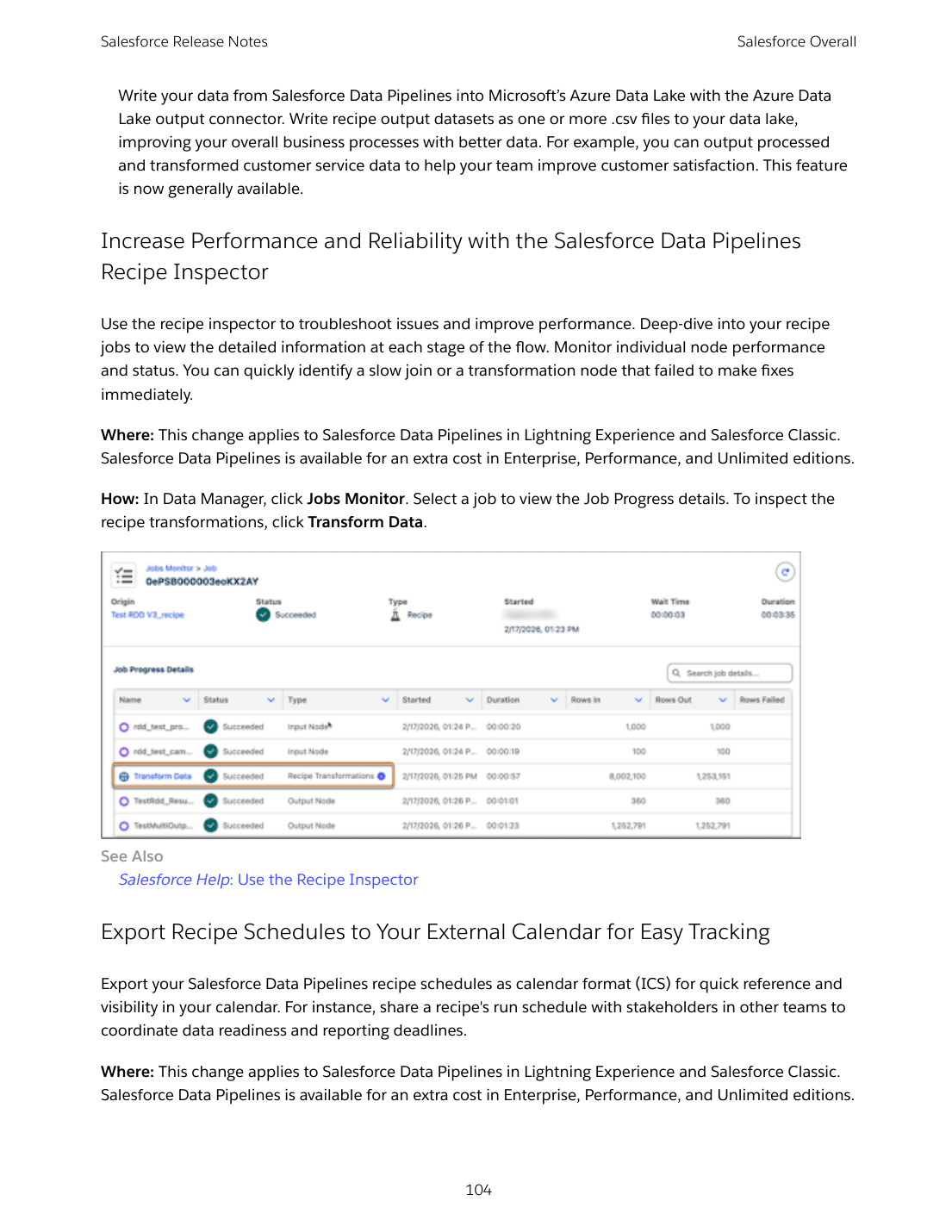
Salesforce Data Pipelines gets a Recipe Inspector for performance troubleshooting, calendar (ICS) export of recipe schedules, direct upload/download of recipe JSON from Data Manager, and GA support for optimized upsert/delete actions plus Azure Data Lake output.
Agentforce and Einstein
The Agentforce platform is where the agentic-enterprise positioning lives, and Summer '26 ships the composition primitives that make it real.
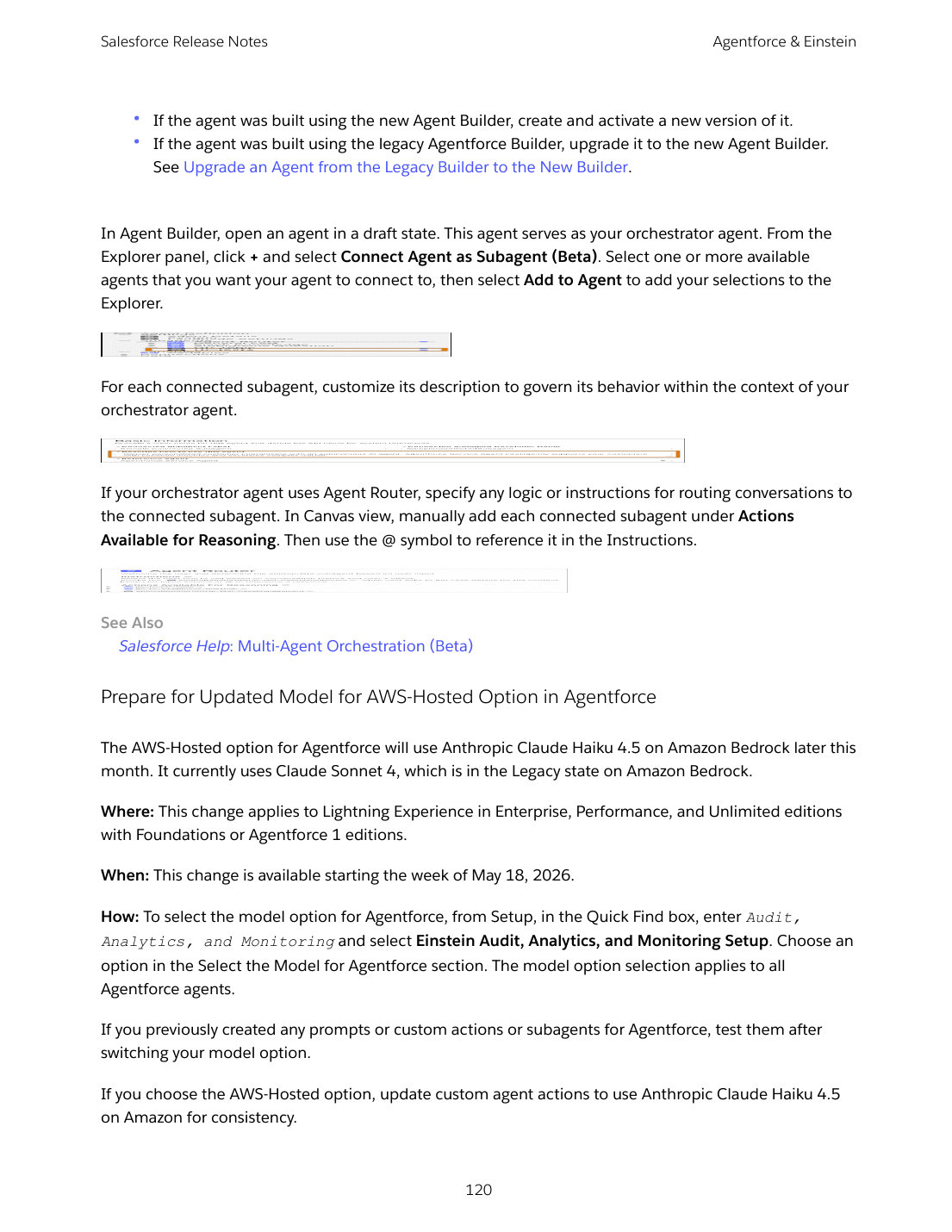
Multi-Agent Orchestration for Agentforce (Beta) lets you connect specialized subagents under a single orchestrator agent. Each subagent surfaces in Agent Builder via Connect Agent as Subagent, gets a custom description that governs delegation, and shows up in the Explorer panel as a connected resource. If your orchestrator uses Agent Router, subagents appear under Actions Available for Reasoning and you reference them with the @ symbol in routing instructions. This is the primitive that turns "agent" from a single bag of actions into a composable architecture.
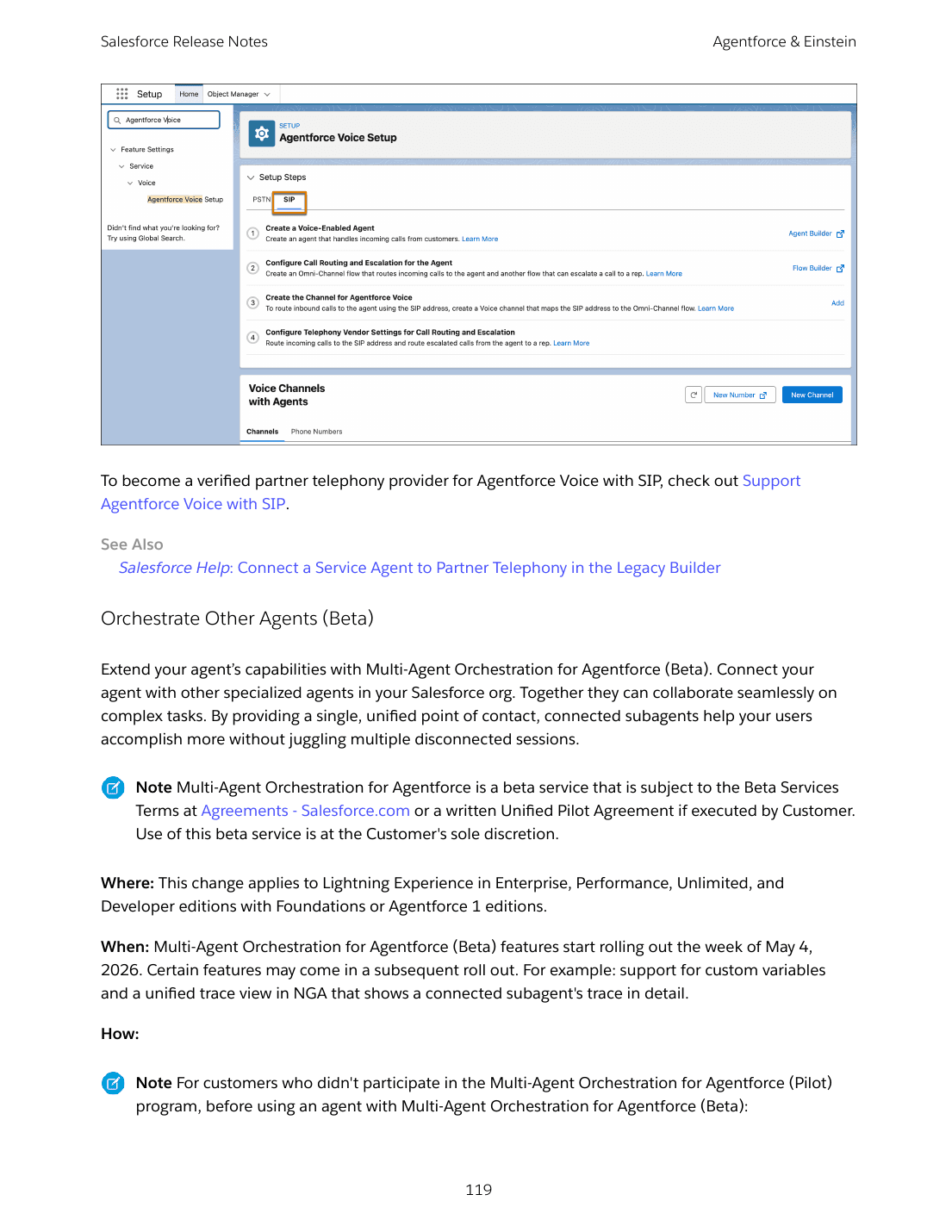
Agentforce Voice with SIP is GA. Calls now route to an Agentforce Service agent over Session Initiation Protocol instead of PSTN-only. SIP is cheaper, more flexible, and treats voice as just another channel on the Omni-Channel routing layer.
Easily Upgrade Agents from the Legacy Builder to the New Builder lets you upgrade in-place. You pick the agent and version, and Salesforce creates a new version in the new builder with all subagents, actions, system messages, settings, data, and connections converted to Agent Script. The migration also lets Agentforce optimize the agent automatically for reliability and performance once you upgrade.
Customize Managed Prompt Templates with Overrides finally fixes the package-immutability problem. Templates delivered through managed packages can now be marked as overridable. Subscribers create their own version that becomes the active template for that org while the publisher's version remains available through package upgrades. Govern Prompt Response Languages adds automatic and manual language controls, with allowed-language configuration and runtime language parameters that keep generated content fluent and reviewable.
OpenAI Search Provider in the Search the Web Agent Action is GA with an updated web search model since beta. Increase Trust with Citations in Bring Your Own Channel lets partners render inline citation markers or a dedicated sources section in BYOC outbound messages, with character offsets and source links in the payload. Manage Agentforce Data Libraries with ADL Connect API (Beta) lets developers programmatically create and manage data libraries for AI accuracy. Prepare for Claude Sonnet 4 Reroute Date flags that Claude Sonnet 4 requests are rerouted to Claude Sonnet 4.6 on May 26, 2026 because Sonnet 4 is in Legacy state on Amazon Bedrock; the AWS-Hosted Option for Agentforce moves to Claude Haiku 4.5 starting the week of May 18, 2026.
Sales (Agentforce Sales)
The Sales section opens with one note: "Sales Cloud is now Agentforce Sales. You may see references to Sales Cloud in Salesforce applications and documentation." The functionality, licensing SKUs, and underlying objects do not change. The product name does.
Agentforce Engagement improves the Inbound Lead Generation and Lead Nurturing agents. Boost Prospect Conversion with Group Calendar Availability lets the agent schedule meetings against a group's combined availability instead of just one user's calendar. Change Inbound Lead Generation and Lead Nurturing Agent Behavior Faster lets you create new versions or update existing versions in place from Salesforce Go. Continue Lead Engagement with Agent Handoff automates the Inbound-to-Nurture handoff when a prospect doesn't schedule a meeting. Qualify Contacts and Person Accounts with Agentforce extends qualification beyond Lead records so reps focus on high-potential deals. The Agent Control Center redesign shows Records Assigned, Active Outreach, Completed Outreach, and Incomplete Outreach with detailed sub-categories.
Agentforce Sales Agent for Gemini (Beta) lets sellers research leads, build account plans, and update Salesforce records inside Google Gemini. Available since April 22, 2026 in English only, with the Agentforce for Sales add-on on Enterprise, Performance, and Unlimited.
Sales Management gets streamlined permissions (the Sales Management User permission set group now includes Manage Unmetered Sales Management Users, removing a billing edge case), Control Which Fields Receive Autonomous Updates in the Process Field Update Suggestions flow, and Improve Sales Summary Quality with Enhanced Prompt Template Instructions which simplifies prompt templates for Lead/Contact/Deal summaries.
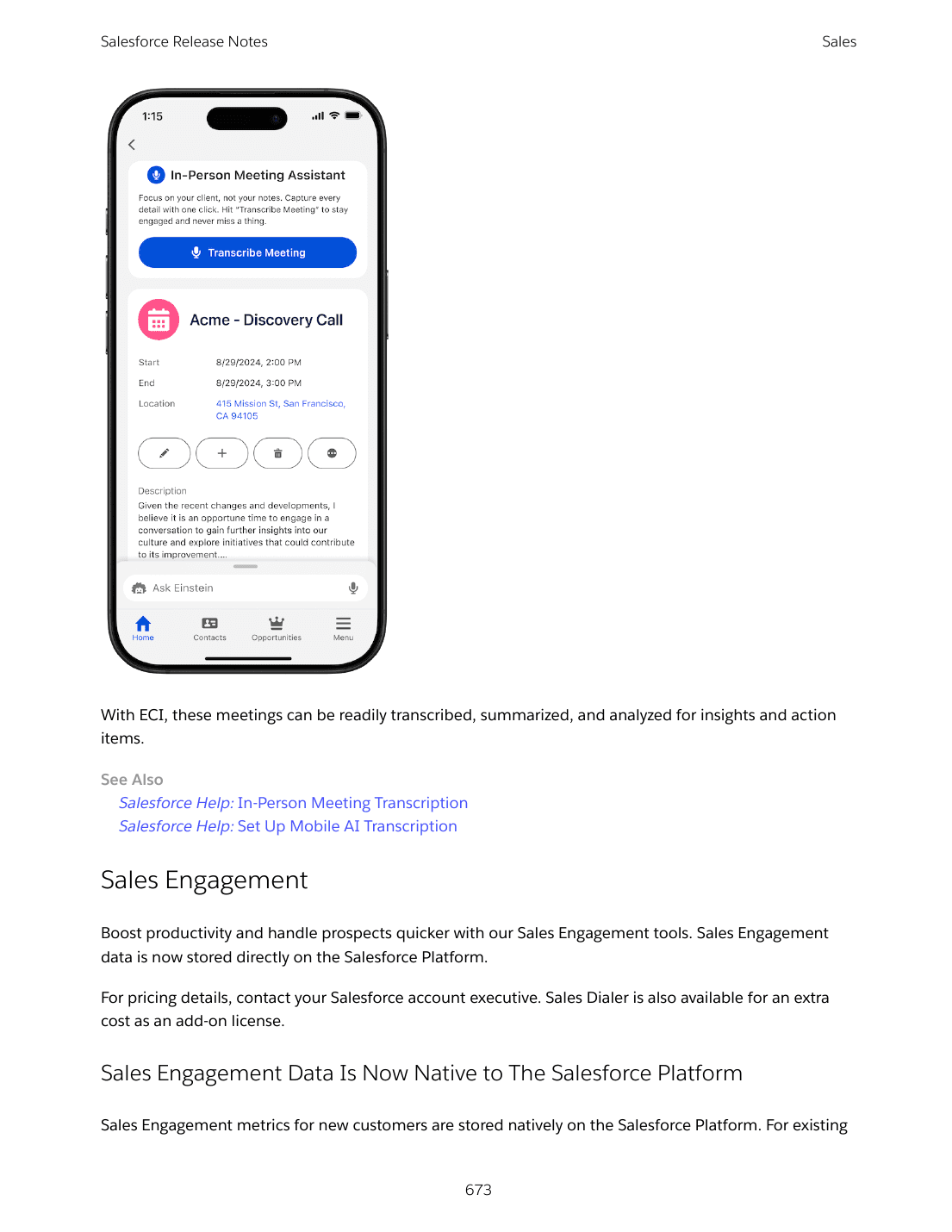
Einstein Conversation Insights moves to the Salesforce Platform. ECI data is now stored natively in standard Salesforce objects so you can reference it directly in Flow, Apex, and Prompt Builder. Use Call Transcripts from Gong ships ECI integration with Gong out of the box. Get Transcripts and ECI Features for In-Person Meetings captures meetings on a mobile device through the Salesforce mobile app, processed by ECI for transcription, summary, and signals.
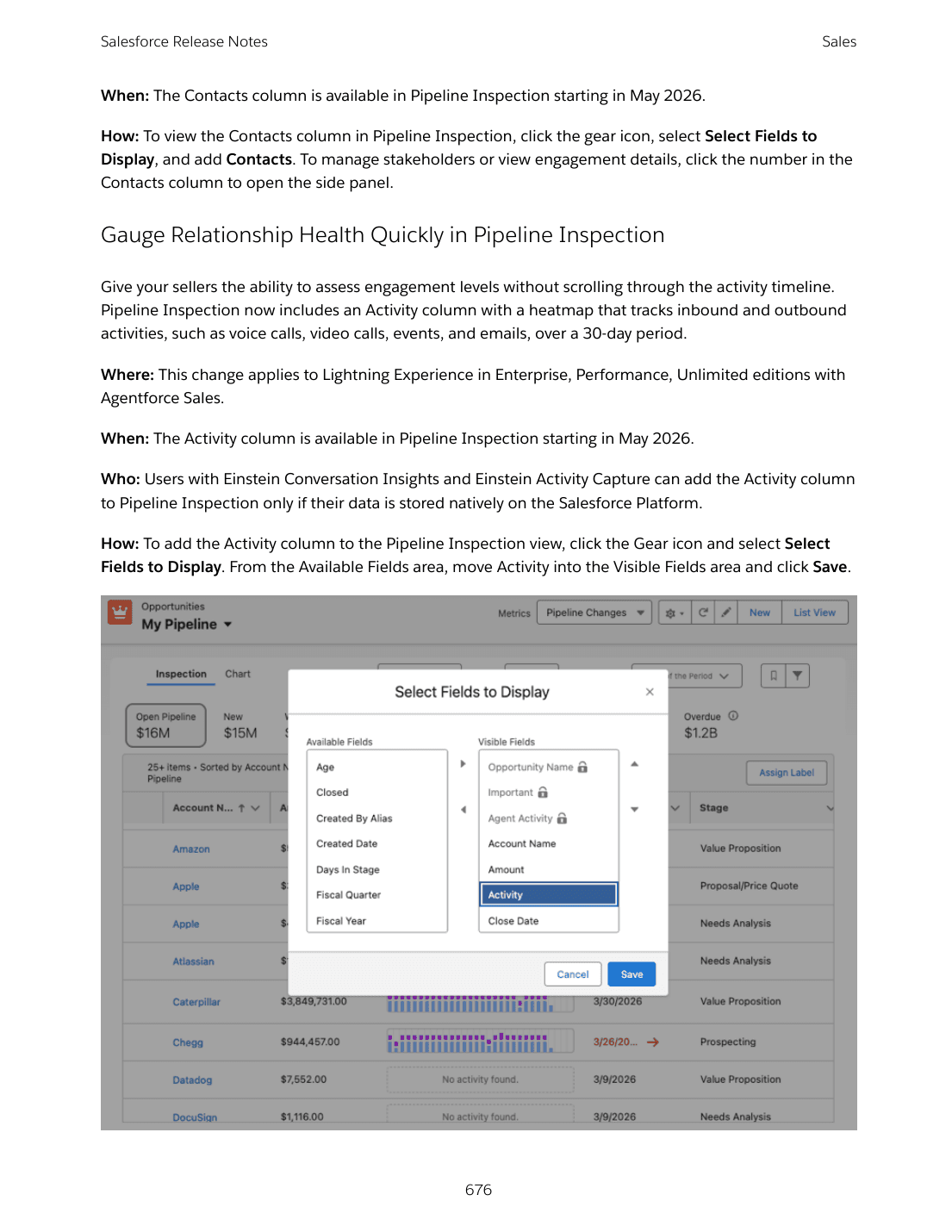
Pipeline Inspection adds a Contacts column (active people in the deal during the last 30 days) and a Gauge Relationship Health Quickly Activity column with a heatmap that tracks inbound and outbound activity over 30 days.
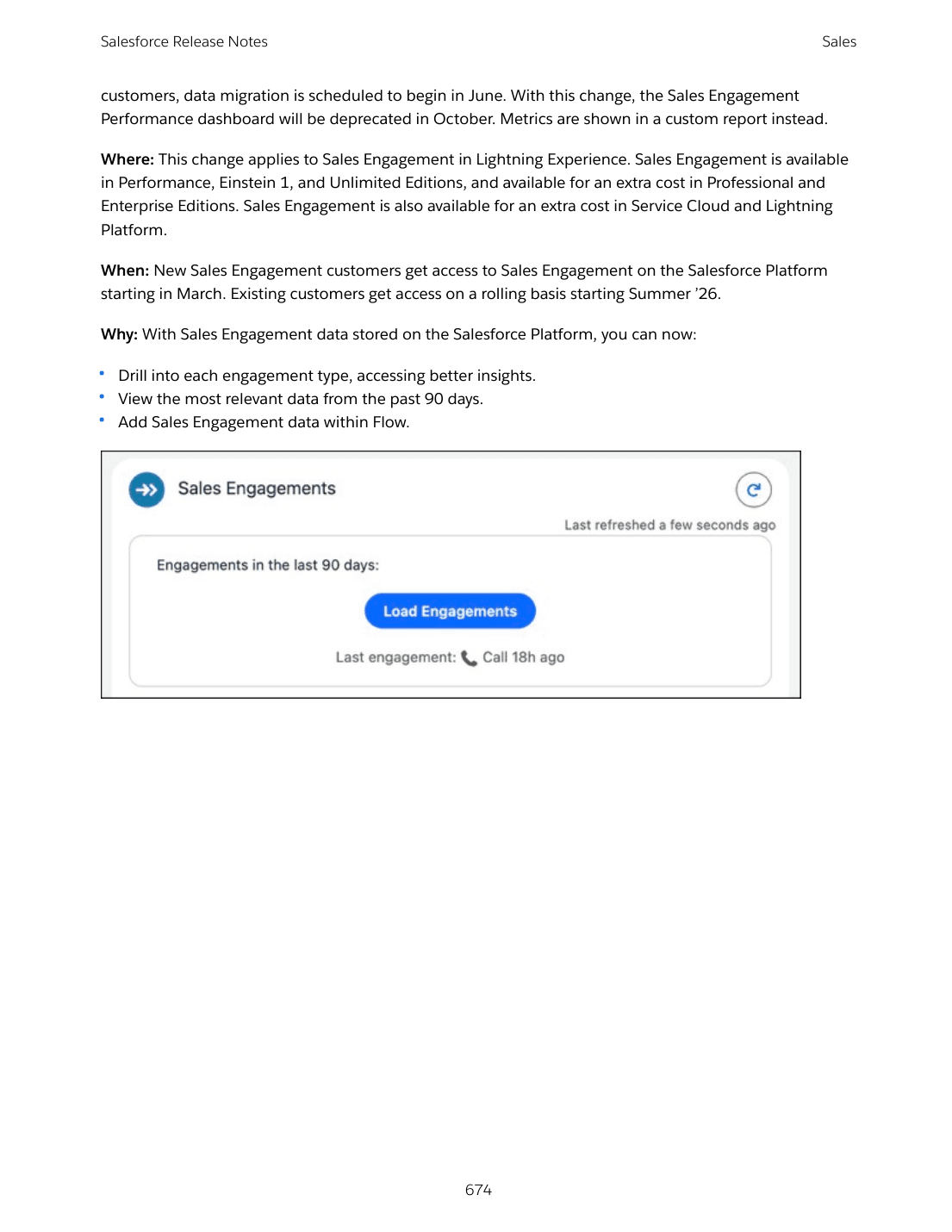
Sales Engagement is now native to the Salesforce Platform. New customers get access starting in March 2026; existing customers migrate on a rolling basis starting Summer '26. The Sales Engagement Performance dashboard is deprecated in October. Reps can drill into each engagement type, see the past 90 days, and add Sales Engagement data within Flow.
Personalize Sales Account Research with Custom Field Mapping lets Account Research save results to Text, TextArea, TextArea Encrypted, TextArea Long, or TextArea Rich custom fields on Accounts or Account Plans. Salesforce for Outlook is being retired in December 2027. Lightning Sync retirement is set for April 2027; migrate to Einstein Activity Capture.
Service (Agentforce Service)
Service Cloud is now Agentforce Service and Service Cloud Voice is now Salesforce Voice.
Agentforce Voice Native Telephony reaches parity with the third-party Telephony Provider model on almost every dimension. SIP routing GA is the headline. Headset support across Plantronics, Sennheiser, Jabra, Yealink, and VBeT now works on Native Telephony. Automatic Session Restoration recovers calls and softphone sessions through accidental browser reloads. Voicemail Drop and personalized voicemail greetings reduce manual rep effort. Eleven new IVR regional dialects with text-to-speech voice profiles. SLA-Based Routing prioritizes calls by acceptance due date. Last Support Rep Routing reconnects callers with the rep they spoke to last. Maintain Business Continuity with Effortless Voice Number Porting lets you submit a Letter of Authorization and schedule port-in for a specific date, no longer requiring a third-party.
Case Management gets agentic enhancements. Draft Contextual Case Comments Instantly with Agentforce uses generative AI to draft case comments grounded in the conversation. Find Case Experts Instantly with Agentforce Actions surfaces the right colleague based on case context. Assign Community Cases Automatically with Standard Assignment Rules finally extends standard assignment to community cases. Merge Unopened Duplicate Cases in Omni-Channel Queues (Beta) prevents the duplicate-case mess that comes with high inbound volume.
Entitlements and Milestones gains an Agentic Milestones (Beta) option where the Service Agent autonomously completes routine milestones like first responses, plus Proactive Risk Scoring that identifies cases nearing SLA breach based on real-time data.
HR Service undergoes a multi-feature refresh: Customer Community Plus migration to Unified Employee License, Unified Portal enhancements, a prebuilt service template library, flow connectors for HR access provisioning, and Put Agentic AI to Work on Common HR Tasks with a Prebuilt Agent Library.
Service Replies gets the Hide Post Button for refined moderation workflows, Translate Service Replies in more languages, and Get Instant Responses with Service Replies for Agentforce Service Assistant. Unified Knowledge is being retired in Summer '27; migrate to Salesforce Enterprise Knowledge well before then.
Self-Service Experience Cloud is heavily upgraded. Concierge Sidebar and Concierge Home Experience deliver a unified prompt bar, suggestion themes, dynamic content tiles, and AI assistance on record pages. Track User Engagement on Experience Cloud Site with Self-Service Analytics measures effectiveness and tunes recommendations. Configure Actions and Agents for Agentic Search on Your Experience Cloud Site turns search into an agent-driven experience.
Development
The Development section ships the most consequential default-security change in years plus a developer-tooling upgrade you can feel.
[Apex](/terms/apex) database operations run in user mode by default. Object-, field-, and record-level security of the running user are enforced. SOQL queries no longer support WITH SECURITY_ENFORCED because the enforcement is built in. New code is safe unless you explicitly request system mode with the as system clause. Existing Apex relying on quiet system-mode behavior to bypass permission checks will start raising INSUFFICIENT_ACCESS errors after the upgrade; plan the audit now.
Queueable and Future jobs get an elastic limit, multiline strings (triple single-quote) and string interpolation land as language features, and the Block Apex Anonymous Code Execution from Managed Packages release update is scheduled to enforce in Summer '27.
On the LWC side, LWC API v67.0 ships with <details> element grouping via the new name attribute and Hot Module Reloading performance improvements. Local Dev is now Live Preview, with Single Component Live Preview GA, Experience Sites Live Preview GA, and the Live Preview VS Code Extension GA (which also previews React components in beta via Agentforce Vibes). State Managers for LWC reach GA, letting pro-code developers decouple data logic from component presentation.
API Distortion Changes in Lightning Web Security add new distortions for many web APIs (Element, IDBFactory, MutationObserver, Selection, Range, Promise, etc.) and a HTMLAnchorElement.prototype.href distortion that blocks data: URI scheme to prevent the security risks of inline-data downloads. Use blob: instead.
Salesforce Release Manager (Beta) introduces a Dev channel that sandboxes opt into. Pilot, beta, limited-release, and developer-preview features appear in the Dev channel weeks before they reach the Standard channel. When the org is on Dev, the cloud logo flips to a DEV-branded variant.
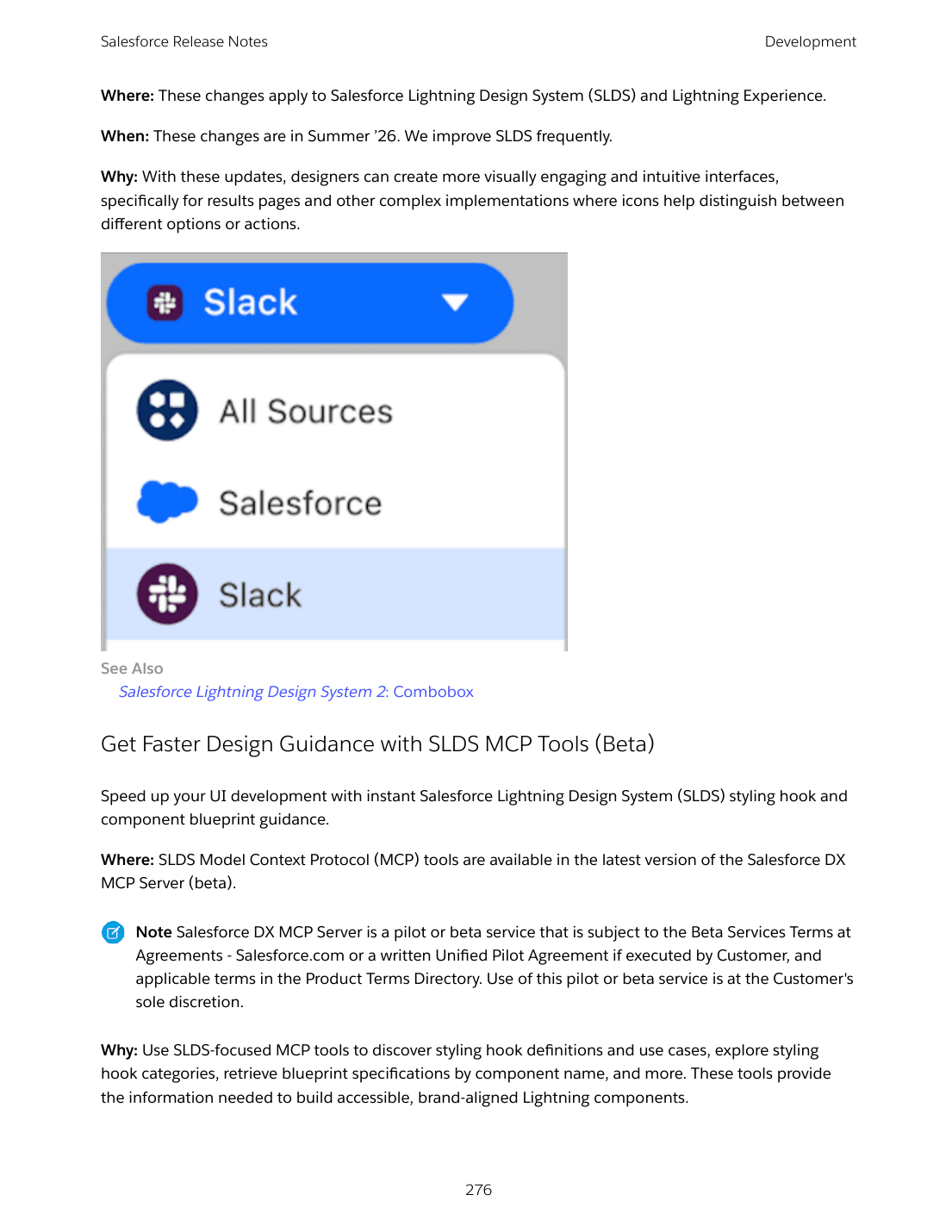
Lightning Types support custom data structures for Agentforce Mobile SDK responses with Build Mobile Experiences with Custom Lightning Types and Assign Custom Lightning Types to the Agentforce Mobile SDK. Salesforce Lightning Design System updates the lightning-combobox variant for button-like pill styling, adds Get Faster Design Guidance with SLDS MCP Tools (Beta) through the Salesforce DX MCP Server, and ships Use Dark Mode in More Editions and Features (Beta) for Performance and Unlimited.
Salesforce Functions is no longer available for purchase or renewal. AgentExchange Partners must update security controls in Connected Apps and ECAs before May 11, 2026, and the new AgentExchange marketplace unifies AppExchange, AgentExchange, and Slack Marketplace.
Automation
Flow Builder is more capable and more agent-aware in Summer '26.
Improve Performance with Batching for Scheduled Flows lets you specify a custom batch size from 1 to 200 directly on the Start element. Avoid Manually Fixing Email Template References After Deploying Flows Across Environments stores the email template as a persistent reference (name) instead of an ID, ending the long-standing deployment headache. Collapse Fault Paths to Focus on Your Main Flow is a small but welcome canvas improvement. Use Date Operators in Decision Logic adds operators like Is Today, Is Anniversary of Today, and Last Number of Days. Use Streaming DMO Activations, More Flow Elements, and Debug with Enhanced Activation-Triggered Flows lets streaming data model object events trigger a flow with collections in Decision and the Wait Until Event element.
Agentforce for Flow is now Beta. The capabilities to create, summarize, and evolve a flow with Agentforce moved from GA back to Beta after consistency issues at scale. The features stay available in Flow Builder while reliability work continues.
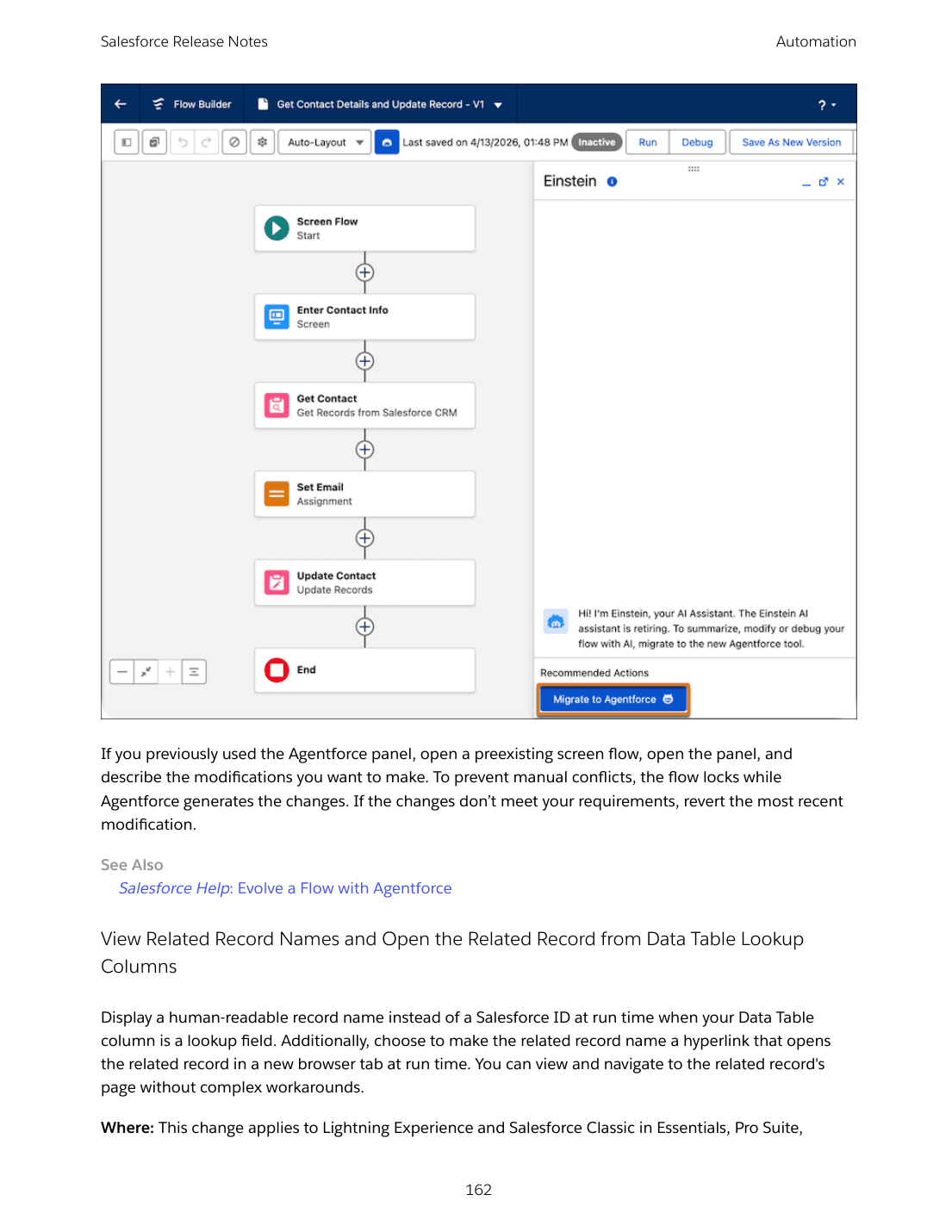
Update Screen Flows with Natural Language Prompts (Beta) lets you describe changes in natural language. View Related Record Names and Open the Related Record from Data Table Lookup Columns finally renders a human-readable name in Data Table rows instead of a Salesforce ID. Customize Screen Flows with Styling Overrides in More Components extends styling to Action Button, Address, Choice Lookup, Dependent Picklists, Email, Lookup, Name, Phone, Slider, Toggle, and URL. Save Screen Space with Radio Button Groups in Screen Flows is a long-requested option. Add Static Resource Images to Display Text Without Leaving Flow Builder GA removes the round-trip to the Static Resources page.
Flow Marketing Cloud Updates add email-personalization variables from Email Content Builder, flow history with version restore, the Exit from a Flow element, and richer marketing flow types. Agentforce Supply Chain introduces an Excel Agent (beta), a Document Reader Agent (beta), task list views with bulk completion, and CSV-bulk-start of up to 25,000 workflows simultaneously.
Data 360
Data 360 (rebranded from Data Cloud as of October 14, 2025) ships features monthly, and Summer '26 captures changes generally listed under June 2026.
Automatically Enable the Correct Permissions for Copy Field Enrichments removes the manual permission-assignment step for activating copy field enrichments. Use Multi-dimensional Aggregatable Calculated Insights Objects in Copy Field Enrichments lifts the prior single-dimension restriction. Troubleshoot Ingestion Errors with Problem Records DLOs automatically captures data that fails ingestion in a dedicated Problem Records Data Lake Object instead of dropping the records.
Enterprise Knowledge for Unified Content is generally available from April 2026. Knowledge harmonization standardizes content across CRM, Marketing, Documentation, and Support sources into a clean, modern schema viewable inside the new Content Viewer. PDFs get a dedicated viewer; unstructured HDMOs are enriched with AI-generated summaries and a Question and Answer section. New Harmonization Dashboard and Configuration Screen support both unstructured and structured connectors including Amazon S3 and Azure Blob.
Data Processing Engine gains Assign Data Model Object Categories for Downstream Compatibility, Select Writeback Operation Types for Data 360 Objects, and Validate Logic and Debug Faster with Data Preview for Data Cloud Runtime.
Analytics (Tableau Next and Lightning Reports)
Tableau Next is positioned as Salesforce's end-to-end agentic analytics experience, integrating the #1 analytics platform with Agentforce's context-aware AI and the Data 360 semantic layer. Analyze Data Lake Objects in Tableau Next explores DLOs and DMOs directly from Tableau Next workspaces. Tableau Next features release monthly throughout the season.
Lightning Reports and Dashboards add Ensure Consistent Branding Across Your Reports and Dashboards with Brand Color Palettes, Embed Custom Lightning Web Components in Dashboards for Interactive Data Views (GA), Expand Reporting Capabilities with More Row-Level Formulas (up to two per report), and Secure Excel Exports by Disabling Formulas which prepends a straight apostrophe to formula-trigger characters during export. Many accessibility improvements ship across reports and dashboards for screen readers and zoom.
Industries Cloud and Revenue Management
Agentforce Revenue Management (formerly Revenue Cloud) leads with new agents. Manage Collections with the Billing Employee Assistance Agent identifies billing insights from payment history, disputes, and outstanding balances, and recommends data-backed dunning strategies. Resolve Billing Inquiries with the Billing Service Assistance Agent handles common billing inquiries for customers, partners, and reps. View the Financial Impact of Customer Usage with Consumption Agent applies overage rates to usage data and calculates real-time monetary impact for the Consumption Agent to surface to sales reps.
Salesforce Document Generation picks up significant enhancements: Generate Documents with Hierarchical Bundles and Grouped Data via Context Services and the Data Processing Engine, Protect and Categorize Documents with Dynamic Watermarking, Navigate Complex Documents with an Automated Table of Contents for DOCX and PDF, Generate Documents from Record Pages and Flows via a new Generate Document Lightning Web Component, and Add Document Generation Process Requests to Active Batches without recreating batches.
Industries Common features evolve weekly (process multi-outcome decision tables, integration via Connect REST API, agentic enterprise quoting). Financial Services gains direct API ingestion into Financial Accounts via the Salesforce Integration User License. Insurance Policy Administration adds the billingRecord property. Salesforce Go ships new prebuilt solution templates for Transaction Dispute Management and Manage Complaints.
Security, Identity, and Privacy
Security Center with Agentforce (Beta) introduces three connected SecOps features starting May 11, 2026. Focus Security Investigations with Anomaly Triage (Beta) groups related anomalies from the same user session or activity within 24 hours into a single investigation. Follow Incident Timelines for Investigations (Beta) auto-correlates Event Monitoring data into a timeline of what the user did before, during, and after the anomaly. Get Remediation Plans for Security Incidents (Beta) generates step-by-step containment actions tailored to the detected anomaly.
Profile Filtering (the setting that prevents users from seeing profile names other than their own unless they have View All Profiles) is being enabled by default; assign View All Profiles to anyone whose role requires it before the enforcement. Modify Transaction Security Policy Permission carves out a dedicated user permission for TSP create/delete/update, removing the broad Customize Application requirement. OAuth 2.0 username-password flow for connected apps is being retired in Winter '27; migrate to OAuth 2.0 web-server or client-credentials flow. Update Instanced URLs in API Traffic is postponed to Winter '27 but the work to clean up integration endpoints should start now.
Adopt Authorized Email Domains (Release Update) is enforced in Winter '27 for orgs that previously worked with Support to disable email change verifications.
Shield Platform Encryption gets self-service background encryption on objects with up to 40 million records, ending the long previous limit. Security Center Alerts add new metrics (Manage Campaigns, Edit Marketing Consent, Manage Email Content, Manage SMS Messaging Setup, Activate/Deactivate Flows, Create/Edit/Delete/Run Flows, Data Space Access).
Mobile, Slack, and Experience Cloud
Agentforce Voice for Mobile is generally available for integration in your mobile apps via the Agentforce Mobile SDK. The Salesforce mobile app supports AI-powered meeting transcriptions through the In-Person Meeting Assistant. Mobile Publisher gets improved project management.
Salesforce for Slack Integrations ship the marquee default change: Slack channels are available by default in new orgs (Enterprise and Unlimited editions in Summer '26 and later), and the Slack panel on record pages gives a streamlined user experience inside Salesforce.
Experience Cloud gets malware scans for Salesforce Files (GA), up to 10 GB file uploads to Aura or LWR sites, AI-assisted Self-Service components, the ability to send email from public email services, and Chatter auto-enabled in new orgs that need Chatter-dependent features in Aura and LWR sites.
Hyperforce, MuleSoft, Omnistudio, Partner Cloud
Salesforce Advanced Cross-Region Continuity lands in the EU, with faster recovery times across all available regions. Salesforce B2C Commerce is available on Hyperforce in the US. Several products are newly available on Government Cloud Defense.
MuleSoft for Flow: Integration centralizes value-mapping management for translation lookups, improving flow stability with automatic handling of missing values and tracking updates across integrations. The Anypoint Platform suite continues to add connectors and operational improvements.
Omnistudio keeps shipping low-code services for industry-specific digital experiences. Partner Cloud expands secure record sharing and synchronization for partner connectivity and brand-compliant marketing content delivery in Experience Cloud sites.
Commerce
Commerce updates cover B2C Commerce, B2B Commerce, Omnichannel Inventory, Order Management, Salesforce Payments, and Point of Sale. The major direction is unifying agentic intelligence into shopper and order workflows so commerce sites can use the same agent surfaces that sales and service customers see.
What this release means in practice
Summer '26 is the moment Salesforce stops talking about the agentic enterprise and starts shipping the architecture that makes it real. The naming changes (Sales Cloud and Service Cloud to Agentforce Sales and Agentforce Service) are the visible signal. The composition primitives (Multi-Agent Orchestration), the native channel (Voice on SIP), the surface bet (Sales Agent for Gemini), the security floor (Apex user mode by default), the collaboration shift (Slack channels in new orgs), and the developer-experience upgrade (Release Manager + Live Preview + State Managers GA) are the platform changes underneath.
For an architect, the right way to read this release is by deciding which features change your reference architecture, which change your customer pitches, and which create hard deadlines. The trust-layer changes (TLS 200-day certs, IPv6, WCAG 2.2) are the hard deadlines. The agentic primitives are the architecture decisions. The Apex user-mode default is the migration. Plan the sandbox time accordingly. GA rolls out starting June 13, 2026, and you do not want to be debugging INSUFFICIENT_ACCESS errors in production on a Friday afternoon.
The next four articles in this series go deeper for each role: Admin, Developer, Architect, and Consultant. If you want the curated decision list, see the Top 10 Summer '26 Features.