
Salesforce's CISO Redraws The Line
Salesforce's chief information security officer published a post on 3 September saying the gap between a disclosed vulnerability and an attempted breach is now measured in hours, and describing four workstreams the company has rebuilt in response. Every one of them sits on Salesforce's side of the platform boundary. The half of the model that belongs to your org did not change, which is the part of this that should occupy your next eleven days.
Salesforce's chief information security officer published a post on Thursday with one number in it that matters more than the rest. The gap between a vulnerability becoming known and someone trying to exploit it is now measured in hours.
Iain Mulholland, EVP and CISO at Salesforce, wrote on 3 September that frontier AI has done something more consequential than making attacks convenient. In the hands of a capable adversary it changed the economics of exploitation itself. The post then lists what Salesforce has rebuilt in response, and it is a substantial list.
Read it once and it is reassuring. Read it twice and you notice that every commitment in it sits on Salesforce's side of the platform boundary.
The Timeline Salesforce Is Working From
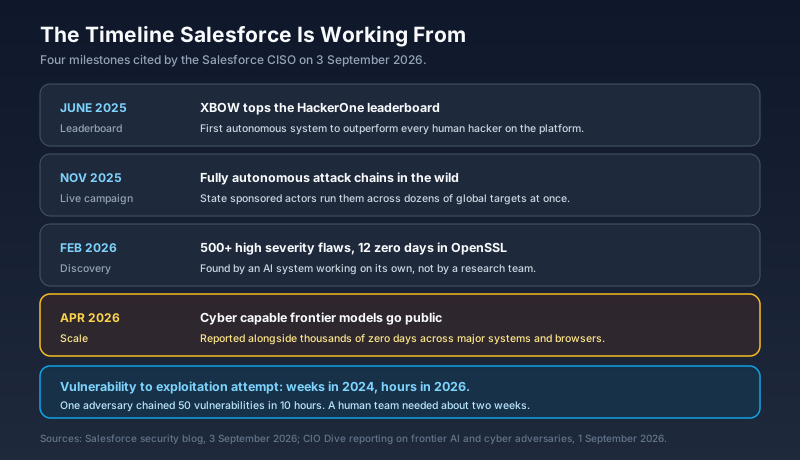
The post builds its case on four public events rather than on vendor anxiety, which is why it reads as credible.
In June 2025, XBOW topped the HackerOne leaderboard, the first autonomous system to outperform every human researcher on the platform. In November 2025, state-sponsored actors were running fully autonomous attack chains across dozens of targets at once. In February 2026, an AI system found more than 500 high-severity open-source vulnerabilities and 12 zero-days in OpenSSL without a research team steering it. By April 2026, cyber-capable frontier models were public, reported alongside thousands of zero-days across major operating systems and browsers.
Independent reporting from 1 September put a sharper edge on it. CIO Dive described an investigated incident in which a single adversary chained 50 vulnerabilities in 10 hours. Human attackers would have needed roughly two weeks for the same work. Sam Rubin of Palo Alto Networks Unit 42 described the industry as five months into a predicted window and starting to see the wave arrive.
That is the environment. Nothing in it is specific to Salesforce, and that is precisely the point.
What Salesforce Says It Changed
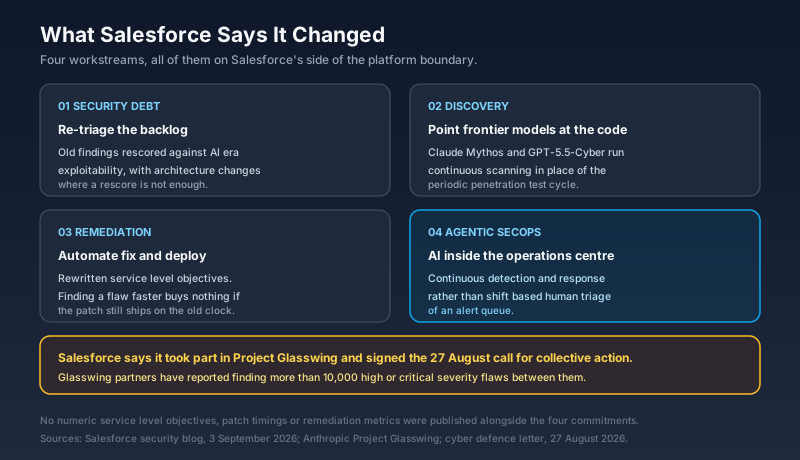
Four workstreams, described plainly.
Reduce known security debt. Every organisation of Salesforce's size carries a backlog of findings that were triaged as low priority because exploiting them required skill, time and patience. All three of those inputs just got cheaper. Salesforce says it re-triaged the backlog against AI-era exploitability and made architectural changes where a rescore was not sufficient. This is the least glamorous item on the list and probably the most valuable.
Accelerate vulnerability discovery. Salesforce is pointing frontier models at its own code, naming Claude Mythos and OpenAI's GPT-5.5-Cyber. The logic is symmetrical rather than clever: if attackers are scanning your codebase with these models, the only sane response is to scan it first. The post frames this as continuous scanning replacing the periodic penetration test.
Enable high-velocity remediation. Automated fix-and-deploy pipelines, and rewritten service level objectives to match. Finding a flaw in an hour buys nothing if the patch still ships on a two-week release train.
Agentic security operations. AI systems now sit inside the Salesforce Cybersecurity Operations Centre for continuous detection and response, in place of shift-based human triage of an alert queue.
Salesforce also states that it participated in Anthropic's Project Glasswing and signed the industry call for collective action on cyber defence published on 27 August, alongside more than 100 other companies including AWS, Google, Microsoft, CrowdStrike and Okta. Glasswing gives vetted organisations early access to Claude Mythos so they can find and close flaws in critical software before comparable capability spreads. Participants have collectively reported more than 10,000 high or critical severity findings.
The gap in the post is measurement. There are no published service level objectives, no patch timings, no remediation percentages. A CISO post is not a compliance artefact and nobody should expect a full metric set, but "we compressed our SLOs" is a claim you cannot verify from outside. Ask about it at Dreamforce.
The Sentence Aimed At You
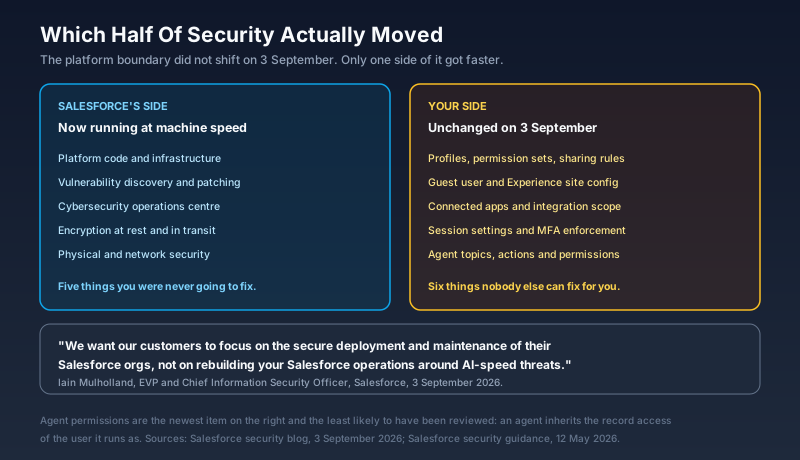
One line in the post is addressed directly to admins, and it is easy to read as reassurance when it is closer to an instruction.
"We want our customers to focus on the secure deployment and maintenance of their Salesforce orgs, not on rebuilding your Salesforce operations around AI-speed threats."
That is the shared responsibility model restated at a faster clock. Salesforce handles the platform: infrastructure, code, patching, encryption, the operations centre. You handle configuration: profiles, permission sets, sharing rules, guest user access, connected apps, session settings, field-level security on sensitive data.
The boundary did not move on 3 September. Only one side of it got faster. If your org has a permission set that grants View All on Contact to 400 users, no amount of machine-speed patching upstream touches that. The same attacker tooling that reads Salesforce's source code can read your Experience Cloud site, and it does not need a zero-day when a misconfigured guest user profile is sitting there.
The newest item on your side of the line is the one least likely to have been reviewed. An Agentforce agent inherits the record access of the user it runs as. Every topic you grant it, every action you wire to it, and every Flow it can invoke is now part of the surface. The Einstein Trust Layer provides prompt injection detection, data masking and zero data retention, and it is genuinely useful. It does not decide that an agent should not have been able to read the Opportunity in the first place. You decide that, in a permission set.
Why This Landed This Week
The timing is what makes this worth your attention rather than your bookmark.
Two days ago, Agentforce started enabling itself by default in orgs that had never switched it on, with the Setup toggle scheduled to disappear in Winter '27. Yesterday, the price list was rebuilt around Core, Advanced and Max, with agent capacity bundled into every tier. Today the CISO says the exploitation window is hours.
Put those together and the practical consequence is straightforward. The number of Salesforce orgs with an active agent is going up sharply, on a schedule set by Salesforce rather than by customers, at the exact moment reconnaissance got cheap. There is no evidence these were coordinated, and claiming otherwise would be lazy. They do not have to be coordinated to compound.
Dreamforce runs 15 to 17 September at Moscone Center. Eleven days.
The Rest Of The Week
A few other things moved that are worth knowing about.
CRM closed Thursday up 3.98% at $267.14, carried by the Q2 beat, Agentforce momentum, the Anthropic relationship and a run of target increases. Cantor Fitzgerald went to $300 from $250. Argus went to $300 from $290. The consensus across 56 analysts polled by S&P Global sits at Buy with an average target of $270.37, which tells you the bulls are running ahead of the room rather than the room having moved.
Salesforce Ben published a piece on Friday asking whether Anthropic's reassurance holds. Dario Amodei, speaking beside Marc Benioff on CNBC, said Anthropic is not interested in destroying anyone and described the opportunity as positive sum. The counterpoint in the article is simple arithmetic: the more work people can complete inside Claude, the less any individual SaaS interface matters. Amodei speaks at Dreamforce. That answer is worth eleven days of waiting.
Salesforce also published guidance on building a credit feedback loop for Data 360, covering how to cap build costs with data space filters, trace consumption to a single resource through the Digital Wallet data lake objects, and tune refresh cadence before a spike reaches the invoice. If you took a Flex Credits allocation in the new editions and assumed it was an operating budget, read that one.
What To Do Before Dreamforce
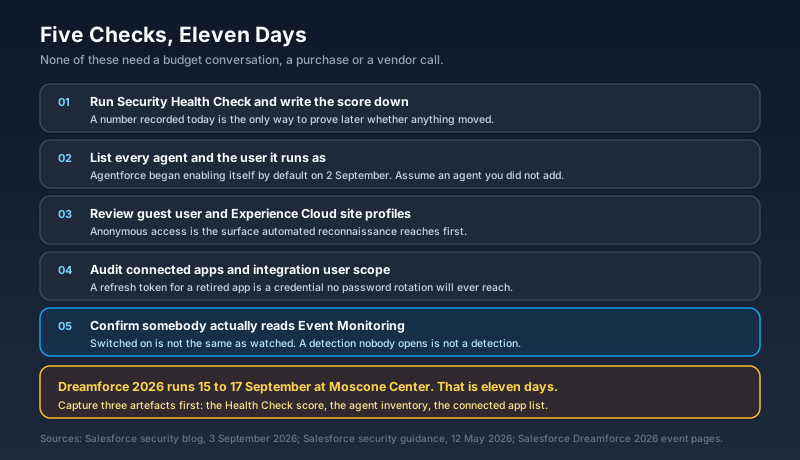
Five checks. None of them need a purchase order.
Run Security Health Check and write the score down today. Setup, Security, Health Check. The score matters less than having a dated number, because a number is the only way to prove in November that something actually moved.
List every agent in the org and the user it runs as. After 2 September, assume an agent exists that nobody on your team deliberately enabled. Check its topics, its actions, and the record access of its running user. If that user is a System Administrator, fix it this week.
Review guest user and Experience Cloud site profiles. Object permissions nobody granted on purpose accumulate there quietly, and anonymous access is the first thing automated reconnaissance reaches. This is the surface that has already burned people in the last twelve months.
Audit connected apps and integration user scope. Revoke refresh tokens for applications you no longer use. A stale token is a credential that no password rotation will ever reach, and it does not show up in a login history review because nobody is logging in.
Confirm somebody actually reads Event Monitoring or Security Center. Switched on is not the same as watched. If the answer is that the data lands somewhere and nobody opens it, you do not have detection, you have storage.
The post closes with Salesforce saying every capability it builds serves one goal, making Salesforce the most trusted platform in the world to run your business on. Take the claim seriously, because the four workstreams behind it are real work that customers could not do for themselves. Then read the sentence underneath it. Salesforce is telling you it has taken machine-speed responsibility for its half and is leaving yours where it has always been. The eleven days before Dreamforce are a good window to act like you heard that.
About the Author
Dipojjal Chakrabarti is a B2C Solution Architect with 29 Salesforce certifications and over 13 years in the Salesforce ecosystem. He writes and edits salesforcedictionary.com, published by KineticBit Inc., to help admins, developers, architects, and cert/interview candidates sharpen their fundamentals. More about Dipojjal.
Share this article
Sources
- Frontier AI Changed the Rules of Cyberattacks. Here's How We're Protecting You (Salesforce, Iain Mulholland)
- Frontier AI tips the scales toward cyber adversaries (CIO Dive)
- Project Glasswing: Securing critical software for the AI era (Anthropic)
- Anthropic shares Mythos with 150 more organizations (Cybersecurity Dive)
- OpenAI, Anthropic, Google and 100 other companies call for action to defend against rogue AI (TechCrunch)
- Strengthening Salesforce Security Against AI-Driven Threats (Salesforce)
- Build a Credit Feedback Loop for Data 360 (Salesforce)
- Anthropic Says It Won't Destroy SaaS, But Is Salesforce Safe? (Salesforce Ben)
- Dreamforce 2026 registration and dates (Salesforce)
Related dictionary terms
Practise it
Five questions on Agentforce Specialist
Exam-style questions with an explanation after each one. No account needed, and your answers build a weak-topic map once you have one.
More news
Agentforce Turns Itself On
Salesforce began auto-enabling the Agentforce platform in existing orgs this week and is removing the setting from Setup in Winter '27. Here is who is affected, which controls survive, and what to check today.
The Guest User Nobody Was Watching
Security firm Reco disclosed City-Forum, a 17-month collection campaign run from one IP against Salesforce Experience Cloud and ServiceNow portals. Salesforce says its platform is secure, and it is right. That is the problem.
Salesforce Rebuilds Its Price List
Salesforce replaced Enterprise and Unlimited with Core, Advanced and Max editions on 3 September. Here is the real arithmetic, what the bundled Flex Credits actually buy, and what to check before your renewal.
Comments
No comments yet. Start the conversation.
Sign in to share your take on this article. Your account works across every page.