
Claude Tag Lands in Slack
Anthropic dropped Claude Tag into Slack on June 23. Salesforce owns Slack, sells Agentforce, and holds a $5B stake in Anthropic. Here is the tension that creates.
Type @Claude in a Slack channel and a virtual coworker shows up. It reads the thread, does the work, and posts the result back to the team. That is Claude Tag, and Anthropic shipped it into Slack on June 23, 2026. The wrinkle: Salesforce owns Slack. It paid $27.7 billion for it. So a competitor's AI now lives inside Salesforce's flagship collaboration product, and Salesforce helped promote the launch.
This is not a small story dressed up as a big one. It sits on top of a $5 billion equity stake, a $300 million annual token bill, and a $1.2 billion Agentforce business that Salesforce needs to defend. Let us walk through what shipped, why it is awkward, and what enterprise admins have to decide now.
What Claude Tag actually does
Claude Tag is a beta feature for Claude Enterprise and Team customers who use Slack. Authorized users type @Claude in any permitted channel, and Claude joins the conversation. It runs on Claude Opus 4.8, Anthropic's current top model.
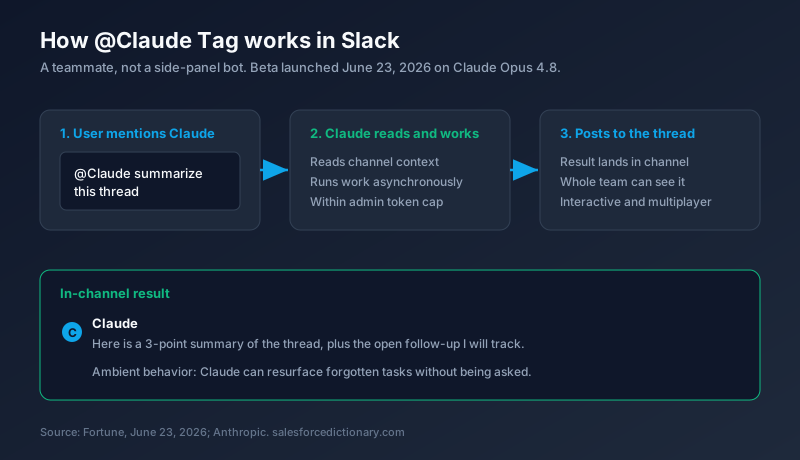
Cat Wu, Anthropic's head of product for Claude Code and Cowork, described it as "built to be interactive and multiplayer." That framing matters. This is not a private chatbot in a side panel. It works in the open channel where the team can see it.
The feature set is heavier than the old "Claude in Slack" app it replaces. The earlier app behaved like a bot you queried one message at a time. Claude Tag is meant to behave like a teammate who stays in the room. Existing customers get a 30-day window to migrate from the old app. Here is what is new:
- Contextual awareness. Claude learns company information over time and carries it across conversations.
- Proactive ambient behavior. It can follow up on tasks the team forgot about, rather than waiting to be summoned.
- Admin controls. Admins scope access by channel, so Claude is not loose across the whole workspace by default.
- Asynchronous workflow. It completes work in the background and posts back to the thread when done.
- Token spending limits. Admins cap spend so an enthusiastic team does not run up the bill.
Anthropic put numbers behind the pitch. Inside its own operation, Claude Tag now approves 65% of code changes submitted by the product team. Andrej Karpathy posted that "this is not a 'feature' like some crappy Slack bot," then deleted it. The deletion is its own small comedy, but the sentiment leaked anyway.
Why this is awkward for Salesforce
Salesforce already has AI in Slack. Two kinds, actually.
The first is Slackbot, which went generally available earlier in 2026 as the conversational AI front door inside Slack. The second is Agentforce, Salesforce's agent platform, which can deploy custom agents directly into Slack channels. Now there is a third option in the same workspace: Claude Tag, built by a company Salesforce is invested in but does not control.
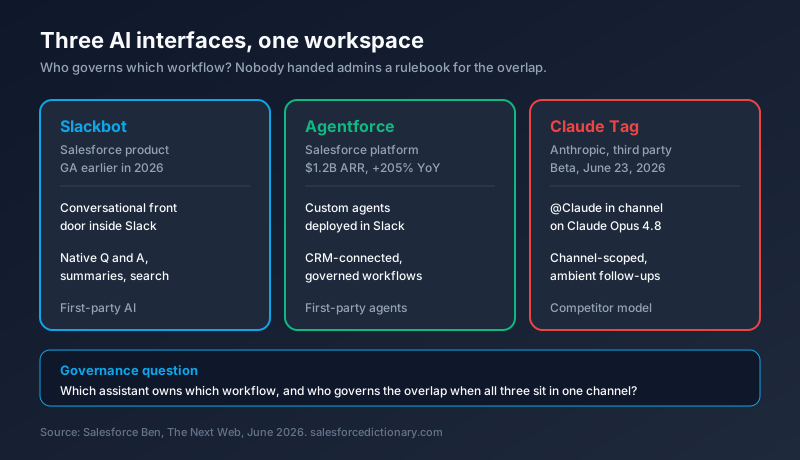
Salesforce did not block this. It promoted Claude Tag publicly on social media. That decision confused some of its own people. The Information reported on "Salesforce Employees Worry Over Anthropic's Invasion of Slack." Internally, some staff saw the gap between Slackbot and Claude Tag as "miniscule," which is exactly the kind of overlap that makes a product manager nervous.
Gaurav Kheterpal, a Salesforce Advisory Board member, said the quiet part on LinkedIn. He wrote that he was "genuinely excited [...] and confused by the Claude Tag announcement and how it fits the overall puzzle together with Slackbot." When an advisory board member is publicly confused about your product strategy, the strategy needs a clearer story.
Salesforce Ben framed the deeper question bluntly: if Claude Tag can do the work inside Slack, what is Agentforce for? That is the uncomfortable version. The generous version is that these tools serve different jobs. The honest version is that customers cannot yet tell.
The financial math underneath
The relationship is tangled because the money is tangled.
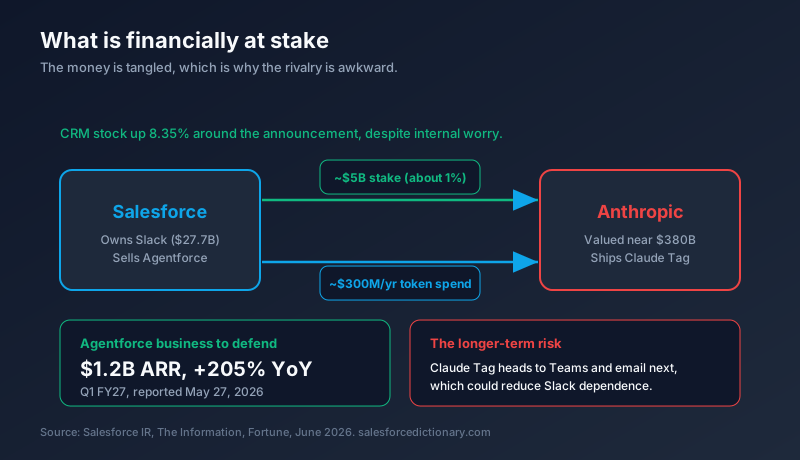
Salesforce holds roughly a $5 billion stake in Anthropic, about 1% of a company valued near $380 billion. It spends around $300 million a year on Anthropic tokens. It is deploying Claude Code across its own engineering org. So Salesforce profits when Anthropic grows, and Anthropic growing means more Claude inside more workplaces, including Slack.
On the other side of the ledger, Agentforce reported $1.2 billion in annual recurring revenue, growing 205% year over year, in the Q1 FY27 results released May 27, 2026. That is the business Claude Tag could undercut if customers decide a Slack mention is good enough.
The market did not flinch. CRM stock rose 8.35% around the Claude Tag announcement, despite the internal worry. Investors apparently read the equity stake and the token relationship as a hedge, not a threat. If Claude wins, Salesforce owns a slice of the winner and books the upside. For now, that logic holds.
There is a longer-term risk that the stock move does not price. If enterprise teams habituate to typing @Claude for everyday work, switching costs to Anthropic's broader ecosystem drop. And Anthropic has already signaled it will expand Claude Tag to Microsoft Teams and email. If Claude works everywhere, the value of working specifically inside Slack falls, which weakens the asset Salesforce paid $27.7 billion to own.
The co-opetition strategy, explained
Marc Benioff has a frame for this. He calls Slack "the interface to AI" and positions it as model-agnostic. In that view, Slack wins by being the place where any AI shows up, including Claude. The product is the room, not the assistant standing in it.
Vernon Keenan, in his June 29 analysis on SalesforceDevops.net, called the pattern by its proper name: co-opetition. "A firm can be your complementor and competitor at once." Keenan reached back to Jim Barksdale's 1995 line about the two ways to make money, bundling and unbundling, and argued the market is currently swinging toward unbundling and openness.
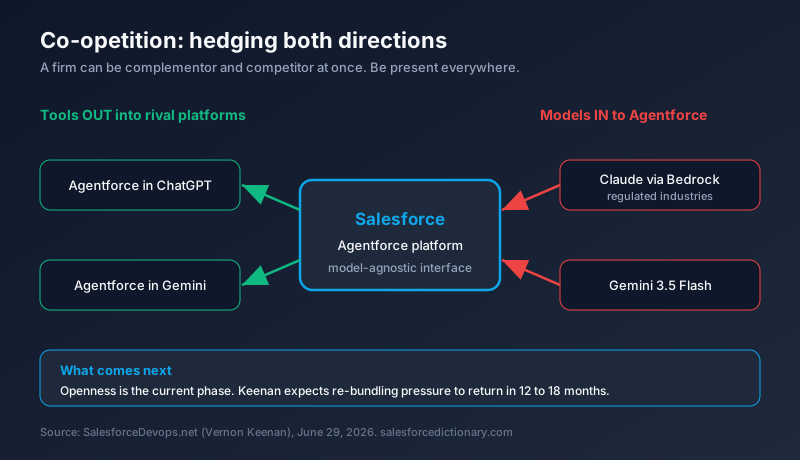
So Salesforce hedges in two directions at once. It pushes its own tools into rival platforms: Agentforce inside ChatGPT, Agentforce inside Gemini. And it pulls rival models into its own platform: Claude through Amazon Bedrock for regulated industries, Gemini 3.5 Flash inside Agentforce. The bet is that being present everywhere beats betting on one model or one interface winning.
The partnership history backs this up. In October 2025, Salesforce and Anthropic expanded their deal to bring Claude into Agentforce via Bedrock for regulated industries. On June 1, 2026, the $5 billion stake was reported. Claude Tag arriving in Slack on June 23 is the next move in a relationship that keeps deepening even as it overlaps.
Keenan's prediction is worth holding onto. He expects re-bundling pressure to return in 12 to 18 months, once a few market leaders emerge and customers tire of stitching tools together. Openness is the phase, not the destination.
What admins have to decide now
Strategy aside, the practical problem lands on whoever administers your Slack workspace. You may now have three AI interfaces in the same place: Slackbot, Agentforce agents, and Claude Tag. They overlap. Nobody handed you a rulebook for which one owns which workflow.
Here is the actionable next step. Do not wait for the overlap to sort itself out in your channels.
- Inventory what is already enabled. Check whether Claude Tag, Slackbot, and any Agentforce agents are active in your Slack instance today. Claude Tag is channel-scoped, so map which channels have access.
- Assign workflows on purpose. Decide which tool handles which job before users pick by habit. CRM-connected actions and governed agent workflows lean Agentforce. Quick Slack-native summaries and Q&A lean Slackbot or Claude Tag. Write it down.
- Set the token cap. Claude Tag has spending limits. Use them. An unbounded @Claude habit across a busy channel is a budget line nobody approved.
- Watch the 30-day migration clock. If you ran the old "Claude in Slack" app, the migration window closes fast. Confirm the cutover before it lapses.
The companies that come out ahead here are the ones that treat this as a governance decision, not a tooling default. Three assistants in one workspace is a policy question. Answer it before your users answer it for you.
About the Author
Dipojjal Chakrabarti is a B2C Solution Architect with 29 Salesforce certifications and over 13 years in the Salesforce ecosystem. He writes and edits salesforcedictionary.com, published by KineticBit Inc., to help admins, developers, architects, and cert/interview candidates sharpen their fundamentals. More about Dipojjal.
Share this article
Sources
- Anthropic releases Claude Tag, a virtual employee that works within Slack (Fortune)
- Claude Tag Raises a Bigger Question: What Is Agentforce For? (Salesforce Ben)
- Salesforce employees are confused about why the company is promoting a competitor inside Slack (The Next Web)
- Everything, Everywhere, All at Once (SalesforceDevops.net)
- Salesforce, Anthropic launch Claude Tag for Slack (Newsbytes.ph)
- Salesforce Employees Worry Over Anthropic's Invasion of Slack (The Information)
Related dictionary terms
Practise it
Five questions on Agentforce Specialist
Exam-style questions with an explanation after each one. No account needed, and your answers build a weak-topic map once you have one.
More news
Marketing Cloud MCP Server Goes GA
Salesforce's first-party MCP server for Marketing Cloud Engagement is now GA. AI agents like Claude, ChatGPT, Cursor, and Gemini can build data extensions, journeys, and automations in plain English. What it does and how to lock it down.
Salesforce Exits the Russell Top 50
Salesforce exited the Russell Top 50 Index in the June 2026 reconstitution, effective June 26 with first trading June 29. The stock is down 45% from its high while Agentforce ARR grows 205%.
Comments
No comments yet. Start the conversation.
Sign in to share your take on this article. Your account works across every page.