
CRM's 13-Day Slide to a 3-Year Low
Salesforce stock hit a 3-year low of $149.78 after 13 straight losing sessions, and here is what drove the slide and where it stands now.

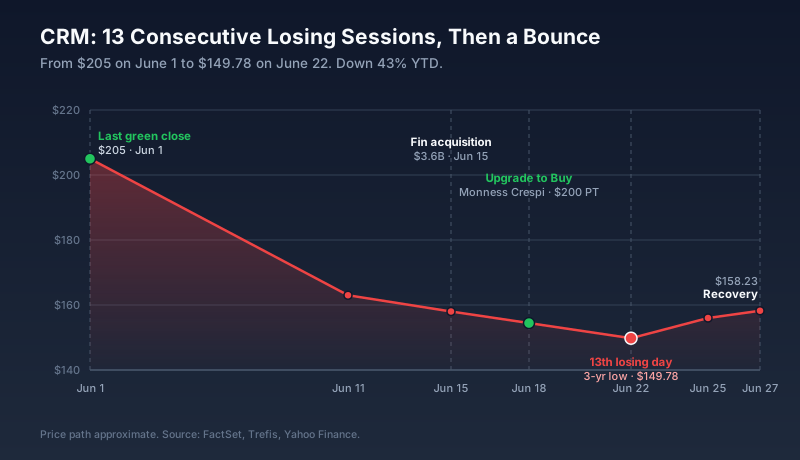
Salesforce stock closed at $149.78 on June 22. That is a 3-year low, a price not seen since early 2023. It came after 13 consecutive sessions of losses, the longest losing streak in the company's history.
The stock last closed green on June 1, right after a brief post-earnings bounce. Then it fell every trading day for the next three weeks. By June 22 it was down 27% from that June 1 level and down 43% for the year. This article picks up where our June 12 coverage of the 52-week low left off, when the stock sat at $163.31.
What Happened
The slide was steady rather than a single crash. Small daily losses stacked up over 13 sessions. Two catalysts turned an ordinary pullback into a record streak.
The first was an acquisition. On June 15, Salesforce announced a $3.6 billion all-cash deal for Fin, the product formerly known as Intercom. Investors read it as "buying growth" and sold. The worry: if organic demand were strong, why pay cash for another AI support tool? Our full breakdown of the Fin deal covers the terms.
The second was a narrative. A story investors have started calling the "SaaSpocalypse" went viral during the same window. By June 22, Trefis had summarized the damage bluntly in its headline, Salesforce Stock In Shambles: Down -27% With 13-Day Losing Streak. Thirteen straight red sessions is investors voting with their wallets.
The SaaSpocalypse Fear
Here is the fear in plain terms. AI coding agents are getting good enough that an enterprise could build its own software instead of renting it. If a company can point a coding agent at a problem and generate a custom CRM-like tool, why keep paying per-seat SaaS subscriptions?
Applied to Salesforce, the argument gets sharper. Customers could use coding agents to build their own Agentforce-style workflows. That would cut the vendor out of its own AI story.
The irony is hard to miss. Salesforce is the loudest proponent of agentic AI in enterprise software. The company built Agentforce, markets it aggressively, and reports its growth every quarter. The same technology it champions is the one the market now fears could hollow out the subscription model.
Some analysts call this an overreaction. They argue that governance, data security, integration, and support are exactly what large enterprises will not want to rebuild from scratch. Others see a real structural risk that deserves a lower multiple. The 13-session streak shows which side had the upper hand in June.
What the Numbers Say
The fundamentals told a different story than the tape. Salesforce reported Q1 FY2027 results on May 27, and they beat estimates across the board.
Revenue came in at $11.13 billion, up 13.3% year over year, ahead of the $11.05 billion consensus. Non-GAAP EPS was $3.88 against a $3.13 estimate. GAAP EPS was $2.42, up 52% year over year. Operating margin hit a record 34.8%. Free cash flow was $6.6 billion.
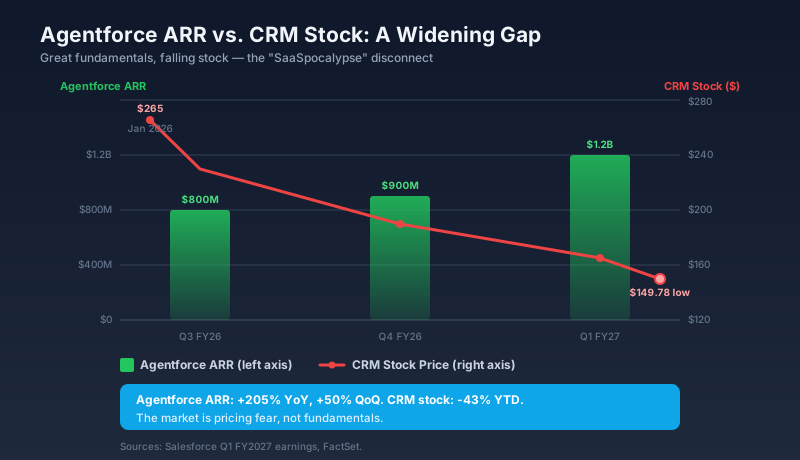
The AI numbers were the headline. Agentforce ARR reached $1.2 billion, up 205% year over year and up 50% from $800 million just one quarter earlier. Combined AI and Data Cloud ARR sat at $3.4 billion. The company said it had delivered 3.8 billion Agentic Work Units.
So the tension is clear. A business growing revenue at double digits, expanding margins to records, and generating billions in cash lost more than a quarter of its value in three weeks. The stock is down 58% from its peak.
The Analyst Picture
Wall Street mostly disagreed with the sellers. On June 18, in the middle of the streak, Monness, Crespi, Hardt analyst Brian White upgraded CRM from Neutral to Buy with a $200 price target, as reported by GuruFocus and Seeking Alpha.
White cited compelling valuation, strong free cash flow, a generous buyback, and an attractive margin profile. His target implied 31% upside at the time. He was candid about the pain, noting that Salesforce had earned the unflattering title as the second-worst performing stock in his coverage universe in 2026. MarTech Notes covered the flip to Buy on valuation and AI execution.
The broader picture stayed constructive. Per FactSet data, 40 of the 54 firms tracking CRM held Buy-equivalent ratings against just 2 at Underweight. Citigroup kept a Neutral with a $187 target from late May. The consensus price target sat near $244 to $257, roughly 55% to 60% above the current price.
Valuation is the crux of the bull case. CRM traded at a forward P/E near 12, against an industry average closer to 26. Motley Fool and CoinCentral both framed the 3-year low as a value question rather than a broken-business question.

Where the Stock Stands Now
The streak ended. By June 27, CRM had recovered to about $158.23, up roughly 5% to 6% off its $149.78 low. The daily range that session ran from $151.01 to $158.46.
Market cap sat near $136 billion. Institutional ownership held at 80.43%, so this is still a stock large funds own in size. The bounce is small next to the drop, and it does not settle the debate. It only says the forced selling paused.
What to watch from here: whether Agentforce ARR keeps its steep growth curve into the next quarter, whether management uses the low multiple to accelerate buybacks, and whether the SaaSpocalypse narrative cools or hardens. A single green streak would help sentiment more than any target revision.
What This Means for the Ecosystem
Stock moves rarely change day-to-day platform work, but this one carries signals worth reading.
For admins: Agentforce is where the company is spending and reporting. The $1.2 billion ARR figure means adoption is real, and internal budgets will follow it. Building fluency with Agent Builder, topics, and actions is a safe bet regardless of the share price.
For developers: the SaaSpocalypse fear is really a question about where custom logic lives. That makes integration skills, Apex, and API design more valuable, not less. If enterprises do build more in-house, they still need people who understand the Salesforce data model and how to connect to it.
For architects: the acquisition pace, Fin plus prior deals like M3ter, signals a broader platform surface to design around. Data Cloud, Revenue Cloud, and Service Cloud keep absorbing new capabilities. Plan for consolidation and licensing shifts.
For cert and interview candidates: expect questions about Agentforce, Data Cloud, and how AI features are priced and governed. The talking points on this page map directly to what hiring managers are asking about in 2026.
Actionable next steps: If you invest, treat the forward P/E near 12 and the consensus target near $244 to $257 as one input, not a signal, and do your own risk work. If you work in the ecosystem, spend this quarter getting hands-on with Agentforce and Data Cloud, since that is where the roadmap and the budget point. Bookmark our earnings and 52-week low coverage to track the next data point when Q2 FY2027 numbers land.
About the Author
Dipojjal Chakrabarti is a B2C Solution Architect with 29 Salesforce certifications and over 13 years in the Salesforce ecosystem. He writes and edits salesforcedictionary.com, published by KineticBit Inc., to help admins, developers, architects, and cert/interview candidates sharpen their fundamentals. More about Dipojjal.
Share this article
Sources
- Salesforce Stock In Shambles: Down -27% With 13-Day Losing Streak (Trefis)
- Salesforce (CRM) Upgraded to Buy with $200 Target, Predicting 31% Upside (GuruFocus)
- Monness upgrades Salesforce stock on valuation, AI gains; sees 31% upside (Seeking Alpha)
- Salesforce (CRM) Stock Down 41% in 2026: Is Now the Time to Buy? (CoinCentral)
- Salesforce Stock Is at a 3-Year Low. Should Investors Consider Buying? (Motley Fool)
- Monness Crespi Hardt flips Salesforce to Buy on June 18 (Martech Notes)
Related dictionary terms
Practise it
Five questions on Agentforce Specialist
Exam-style questions with an explanation after each one. No account needed, and your answers build a weak-topic map once you have one.
More news
Salesforce Buys m3ter, Cuts 86 Jobs
Salesforce acquires usage-billing platform m3ter for Agentforce Revenue Management while cutting 86 jobs across Agentforce, MuleSoft, and Marketing Cloud.
Salesforce Stock Hits 52-Week Low
Salesforce stock set a new 52-week low of $163.31 on June 11, 2026, down roughly 37% this year, while Agentforce ARR surged 205% to $1.2 billion. The disconnect explained.
Salesforce Buys Fin for $3.6B
Salesforce signed to buy Fin (formerly Intercom) for $3.6B all-cash on June 15. Fin's Apex model resolves 76% of tickets autonomously. Agentforce Help Agent launched at $2 per resolved issue. Closes Q4 FY2027.

Salesforce Q1 FY27: Agentforce $1.2B
Salesforce beat Q1 FY27 estimates on every major metric: $11.13B revenue, $3.88 non-GAAP EPS, $33.6B cRPO at 14% growth. Agentforce ARR crossed $1.2B at 205% growth. Then Benioff revealed engineers haven't been hired in two years.
Comments
No comments yet. Start the conversation.
Sign in to share your take on this article. Your account works across every page.