
Salesforce Buys Fin for $3.6B
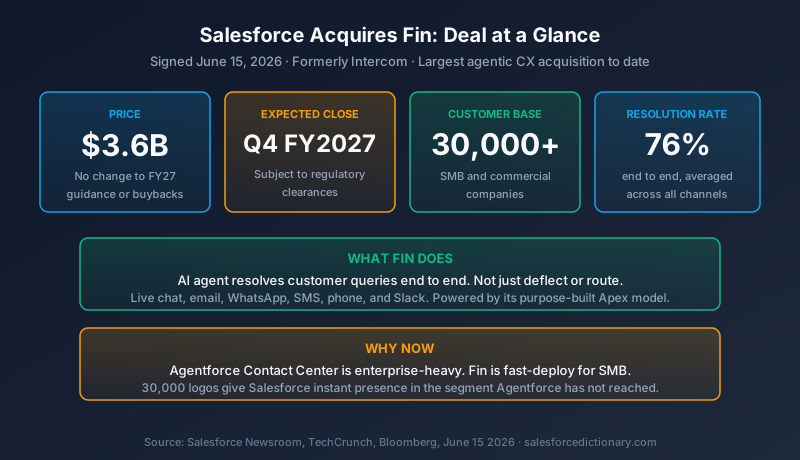
Salesforce signed a definitive agreement on June 15 to acquire Fin, formerly Intercom, for roughly $3.6 billion all-cash. The same week it launched the Agentforce Help Agent with pay-per-resolution pricing at $2 per resolved issue.
A customer messages your support line at 2am about a botched order. No agent is awake. An AI reads the message, pulls the order record, confirms the shipping error, issues a replacement, and updates the case. The customer never waits, and no human touches the ticket. That is the workflow Salesforce just paid $3.6 billion to own outright. On June 15, it signed a definitive agreement to acquire Fin, the company most of the industry still knows as Intercom. The same week, it launched its own Agentforce Help Agent priced at $2 per resolved issue. Two moves, one strategy. Here is what Salesforce bought, why it bought instead of built, and the question hanging over [Service Cloud](/terms/service-cloud).
What Fin actually is
Start with the name confusion, because it matters. The company was founded in Dublin in 2011 as Intercom, a business messaging and customer support platform. In May 2026, it rebranded the entire company to Fin, taking the name of its AI agent product. So Intercom the company became Fin the company. If you onboarded a support stack in the last decade, you have probably seen the Intercom messenger bubble in a corner of someone's website.
Today Fin serves more than 30,000 companies. The asset Salesforce is buying is not the legacy messenger. It is the AI engine underneath it.
That engine runs on a proprietary model Fin calls Apex. This is the part worth slowing down on. Apex is not a thin wrapper around a general-purpose frontier model. Fin built it specifically for customer support, tuned on support conversations and resolution patterns rather than general reasoning. The company claims Apex resolves roughly 76% of customer support interactions end-to-end, autonomously, with no human in the loop. That number is the whole pitch.
Apex operates across the channels customers actually use: chat, email, WhatsApp, SMS, phone, Slack, and live chat. Fin also ships an Operator Agent aimed at internal workflows rather than customer-facing tickets. And the company is not shy about its claim to the category. Fin says it invented Customer Agents nearly four years ago, before the current wave of AI support tools existed.
The deal terms
The price is approximately $3.6 billion, all-cash. This is Salesforce's fifth acquisition of 2026, landing in the same buying run that brought in Contentful earlier in the month. The deal is expected to close in Q4 of Salesforce's fiscal 2027, which is early calendar 2027, subject to regulatory approvals.
Leadership stays. CEO Eoghan McCabe is staying on after the acquisition, and Des Traynor continues to run R&D. McCabe's framing was deliberately low-drama. He said "little will practically change" operationally. That is the kind of line designed to keep 30,000 customers from getting nervous, and we will come back to whether it holds.
Marc Benioff put the strategic intent plainly: "We're thrilled to welcome Fin to Salesforce as we enable every company to become an agentic enterprise." Read past the phrasing and the logic is clear. Salesforce is buying a working, proven autonomous support engine and the install base that validates it.
Why buy instead of build
Salesforce already has Agentforce. It already has Einstein. So why spend $3.6 billion?
Because the gap between "we have an agent platform" and "we have an agent that resolves 76% of real support tickets in production across 30,000 companies" is enormous. The first is a capability. The second is a track record. Build-versus-buy math, and the proof points were on Fin's side.
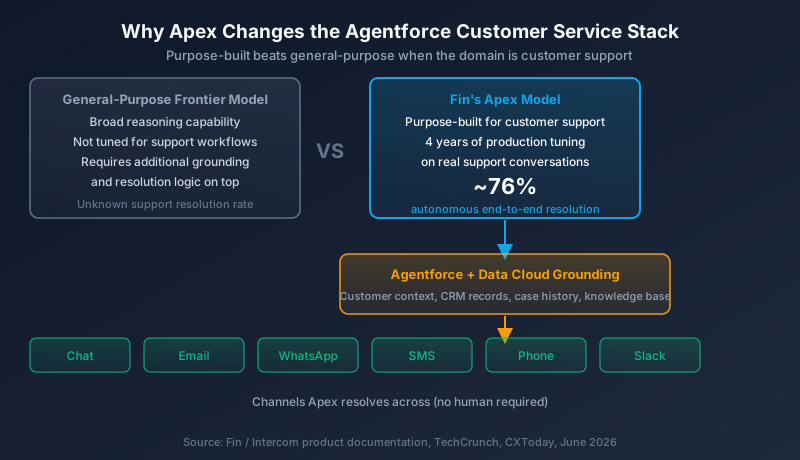
There is also the Apex model itself. A model purpose-built and battle-tested for support is hard to replicate from scratch, even for a company with Salesforce's resources. You can hire the talent. You cannot instantly manufacture four years of production tuning on real support conversations. That is the part of the $3.6 billion that is genuinely hard to buy anywhere else.
The strategic fit feeds directly into the Agentforce and Data Cloud story Salesforce has been telling all year. Apex resolves the conversation. Data Cloud supplies the grounded customer context. Agentforce becomes the orchestration layer. On paper, Fin slots in as the customer-facing engine that makes the "agentic enterprise" pitch concrete instead of aspirational.
The Agentforce Help Agent and pay-per-resolution
Here is the move that makes the same week interesting. Salesforce did not wait for the Fin deal to close. It launched its own Agentforce Help Agent, with general availability set for July 2026, and priced it on outcomes.
The pricing is the headline. The Help Agent costs $2 per autonomously resolved issue. No charge if the customer asks to escalate to a human. No charge if the customer leaves negative feedback. You pay when the agent actually solves something, and only then.
That is a meaningful shift from per-seat or per-conversation licensing. It ties Salesforce's revenue to outcomes the customer can verify. It also signals confidence: you do not price on resolution unless you expect to resolve.
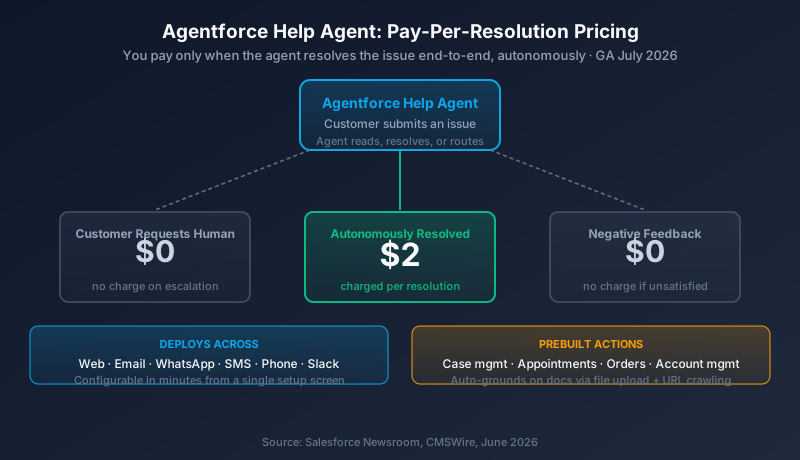
The Help Agent is built to deploy fast. Salesforce says it goes live in minutes across web, email, WhatsApp, SMS, phone, and Slack. It auto-grounds on existing support documentation through file uploads and URL crawling, so it learns your knowledge base without a manual training project. It ships with prebuilt actions: case management, appointment scheduling, order updates, and account management. The portal interface got reworked too, with a conversation-bar, dynamic cards, and real-time data integration.
Notice the channel overlap with Fin: web, email, WhatsApp, SMS, phone, Slack. Salesforce is building toward the same surface area Fin already covers. The acquisition is not a replacement for the Help Agent. It is reinforcement, and an accelerator for capabilities Salesforce was already chasing.
The competition is pricing the same way
Salesforce is not alone, and outcome-based pricing is not its invention. The direct competitors here are NICE, Zendesk, HubSpot, ServiceNow, and Microsoft. Several of them are moving the same direction at the same time.
Zendesk launched AI agents billed on verified outcomes. HubSpot did the same with outcome-based AI agent pricing. The industry is converging on the idea that you charge for the result, not the seat. That convergence is the real story. When competitors independently land on the same pricing model, it stops being a gimmick and starts being the market standard.
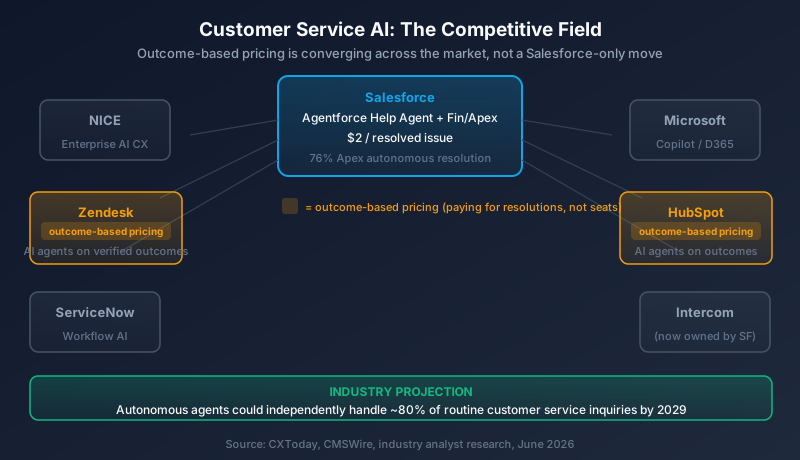
The forward-looking number frames the stakes. Industry research suggests autonomous agents could handle 80% of routine customer service inquiries by 2029. If that holds, the support-software market is being repriced around resolution, and the vendors who own the best resolution engine win. Salesforce just bought a 76% engine.
The awkward question: what about Service Cloud?
Here is what the press release skips. Salesforce already sells Service Cloud, its flagship customer service product, with Einstein and Agentforce already wired into it. Fin is, at its function, a customer service platform. So where does Fin sit relative to Service Cloud?
Salesforce has not said. The honest read, based on the Contentful playbook from two weeks earlier, is that Fin's Apex model and agent capabilities get absorbed into the Agentforce and Service Cloud stack rather than sold as a standalone competitor to it. Fin becomes the engine, Service Cloud stays the platform. But that is inference, not a roadmap commitment.
There is a customer-base wrinkle on Fin's side too. A large share of Fin's 30,000 companies do not run Salesforce. Intercom sold on neutrality and ease, plugging into whatever stack a company already had. Once Fin belongs to Salesforce, that neutrality is gone in perception, and competitors will pitch exactly that to Fin accounts running rival CRMs. McCabe's "little will practically change" is meant to calm that. Whether non-Salesforce customers believe it is a separate matter.
There is also the adoption gap nobody at Salesforce wants on the slide. Only about 12% of Salesforce customers currently use Agentforce. Buying a proven resolution engine is one way to read that number: Salesforce needs commercial acceleration, and a 76% autonomous engine plus outcome-based pricing is a sharper sales motion than the platform pitch alone has delivered so far.
What to do now
If you run Service Cloud, do not migrate anything on speculation. Nothing is deprecated, and the Fin deal does not close until Q4 FY27. But put a line in your next architecture review to ask your account team where Fin and Apex sit relative to Service Cloud and the native Agentforce agents once the deal closes.
If you are evaluating customer service AI right now, the Agentforce Help Agent goes GA in July 2026 at $2 per resolved issue. That pricing is testable. Run a scoped pilot on a single high-volume, low-complexity queue, measure your real autonomous resolution rate against the $2 charge, and compare it to your current cost-per-ticket before you commit anything broader.
If you are a Fin or Intercom customer on a non-Salesforce CRM, read your renewal terms and expect competitor pitches aimed at your neutrality concerns. You have until early 2027 before the deal even closes, so plan rather than react.
Watch the Summer '26 release notes and the first post-close Agentforce announcements for the concrete signal: how Apex gets exposed inside Agentforce, and what happens to the line between Fin and Service Cloud. That is where the real product story, beyond the press release, will show up.
About the Author
Dipojjal Chakrabarti is a B2C Solution Architect with 29 Salesforce certifications and over 13 years in the Salesforce ecosystem. He writes and edits salesforcedictionary.com, published by KineticBit Inc., to help admins, developers, architects, and cert/interview candidates sharpen their fundamentals. More about Dipojjal.
Share this article
Sources
- Salesforce acquires AI customer service platform Fin for $3.6B (TechCrunch)
- Salesforce to buy AI customer service platform Fin (CNBC)
- Salesforce signs definitive agreement to acquire Fin (Intercom/Fin Blog)
- Salesforce's $3.6BN Fin Acquisition Aims to Boost Agentforce AI Strategy (CXToday)
- Salesforce Debuts Help Agent with Pay-Per-Resolution AI (CMSWire)
- Salesforce Signs Definitive Agreement to Acquire Fin (Salesforce Investor Relations)
- Salesforce to Buy Irish-Founded Fin for $3.6bn (The Irish Times)
Related dictionary terms
 Our appAdWake up sharp. Not just awake.The alarm that rings through Silent and DND — free on iOS & Android.Get WakeSharp →
More news

Salesforce's $5B Anthropic Windfall
Bloomberg valued Salesforce's Anthropic stake at about $5 billion on June 1, after Anthropic raised $65 billion at a $965 billion valuation and filed confidentially for an IPO. CRM jumped nearly 10 percent on a roughly 100x paper return.

Salesforce Buys Contentful for Agentforce
Salesforce signed to acquire Contentful on June 1, adding a headless content layer to Headless 360 and Agentforce. The Berlin-founded CMS serves 4,800 brands. Reported price: $1B to $1.5B, half its 2021 peak. Closes Q3 FY2027.
Salesforce Q1 FY27: Agentforce $1.2B
Salesforce beat Q1 FY27 estimates on every major metric: $11.13B revenue, $3.88 non-GAAP EPS, $33.6B cRPO at 14% growth. Agentforce ARR crossed $1.2B at 205% growth. Then Benioff revealed engineers haven't been hired in two years.


Comments
No comments yet. Start the conversation.
Sign in to share your take on this article. Your account works across every page.