
Salesforce Buys m3ter, Cuts 86 Jobs
Salesforce signed a definitive agreement to acquire London-based usage billing platform m3ter for Agentforce Revenue Management. The same week, a California WARN notice revealed 86 layoffs across Agentforce, MuleSoft, and Marketing Cloud teams.

Salesforce signed a definitive agreement this week to acquire m3ter, a London-based usage-based billing platform, and plans to fold it into Agentforce Revenue Management. Within roughly 24 hours of that announcement, a California WARN notice surfaced showing 86 Salesforce employees losing their jobs, including people on Agentforce, MuleSoft, and Marketing Cloud teams. Two stories, one week, and they tell you more together than either does alone.
Here is what happened, why it happened, and what it means if you build on this platform for a living.
The m3ter Deal: What Salesforce Actually Bought
m3ter was founded in 2020 by Griffin Parry and John Griffin. If those names sound familiar, they co-founded GameSparks, the backend-as-a-service platform for game developers that Amazon acquired in 2017. So this is a second exit for the pair, and a second time selling infrastructure plumbing to a giant that needs it more than it wants to admit.
The product itself is unglamorous and useful, which is usually the best kind. m3ter ingests raw product usage data in near real-time, applies configurable pricing rules to it, and outputs billable charges that flow into whatever downstream system needs them: CRM, ERP, or invoicing platforms. In billing terminology, that middle layer is called mediation and rating. It is the machinery that turns "this customer's agents executed 4.2 million actions last month" into a line item on an invoice that finance will actually sign off on.
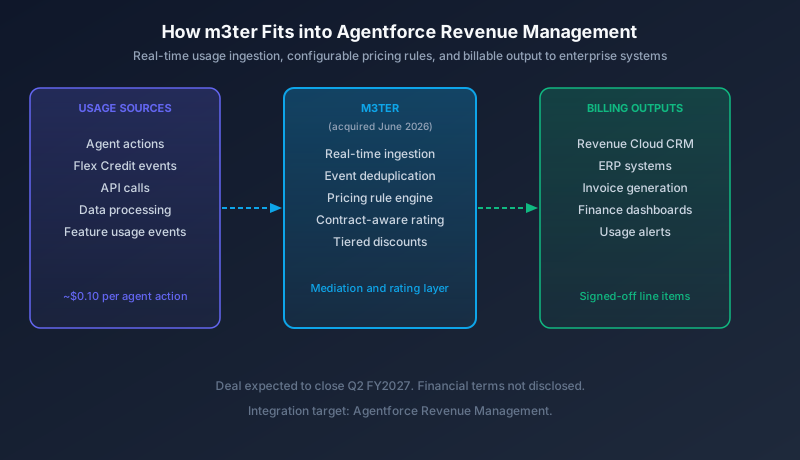
"Joining Salesforce allows us to bring our high-scale mediation and rating capabilities to the world's largest enterprise install base," Griffin Parry said in the announcement. Translation: m3ter built a high-throughput metering engine, and Salesforce has hundreds of thousands of customers who are about to need one.
Financial terms were not disclosed. The deal is expected to close in Q2 of Salesforce's fiscal year 2027, subject to customary closing conditions.
Why Salesforce Needs This Badly
For nearly three decades, Salesforce has sold software the same way: per seat, per month. A human logs in, a license gets paid for. Simple. Predictable. Easy to forecast, easy to renew.
Agentforce breaks that model, and Salesforce knows it.
Agentforce runs on Flex Credits, priced at roughly $0.10 per action an agent takes. The unit of value is no longer a person with a login. It is work performed by software, autonomously, at whatever volume the business throws at it. Now follow that to its logical end. If one AI agent does the work of ten employees, the ten-seat license model does not shrink gracefully. It collapses. The customer needs one seat, or zero, and Salesforce needs to get paid for the millions of actions that agent performed instead.
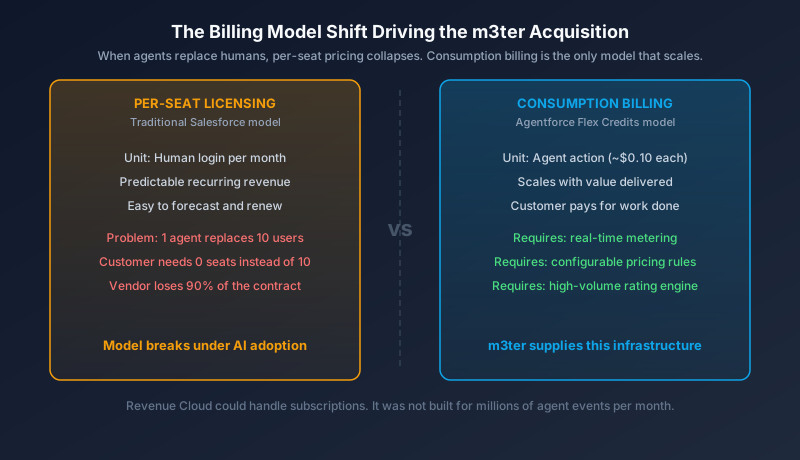
That is a consumption billing problem, and consumption billing at enterprise scale is genuinely hard. You need to capture every billable event without dropping any. You need to rate those events against pricing that varies by contract, by tier, by negotiated discount, by region. You need to do it fast enough that customers can see their spend before the invoice arrives, because nothing torches a renewal conversation like surprise overage charges discovered 30 days late.
Salesforce could have built this in-house. Revenue Cloud has billing capability today, but it was designed around subscriptions and one-time charges, not high-volume event metering. Building real-time mediation and rating from scratch takes years. Buying m3ter takes a signature and a Q2 FY2027 close date. For a company racing to make Agentforce the center of its growth story, that math is not close.
The Pattern: Plugging Holes in the Agentforce Stack
Step back and the m3ter deal stops looking like a one-off. It is the latest move in a deliberate sequence:
- Informatica: data management and integration, because agents are only as good as the data underneath them.
- Contentful (announced June 3): structured content infrastructure, so agents have governed content to work with.
- Momentum: conversation intelligence feeding the agent layer.
- Qualified: pipeline generation and buyer engagement.
- Cimulate: AI-driven commerce experiences.
Each acquisition fills a specific gap in what an autonomous agent platform needs to function end to end. Data, content, conversations, pipeline, commerce. The missing piece was monetization: how Salesforce itself, and eventually its customers, charge for agent-performed work. m3ter is that piece.
There is a second-order implication worth sitting with. Salesforce is not just buying m3ter to bill for Agentforce. Once consumption billing is native to Revenue Management, every Salesforce customer selling usage-priced products (API companies, fintech platforms, AI startups, anyone with a meter) becomes an addressable market for that capability. The Futurum Group analysis frames this as a bet on usage-based pricing becoming the default enterprise model. Whether or not that fully materializes, Salesforce just made sure it owns the toll booth either way.
The Layoffs: 86 Jobs, Familiar Names on the List
Now the harder story. A WARN notice filed in California, reported June 10, disclosed that Salesforce is cutting 86 positions. The affected teams include Agentforce, MuleSoft, and Marketing Cloud. Roles span sales, general administration, and technology and product functions. Washington state was also affected. The impacted California employees remain on payroll until August 7, 2026, per the notice.
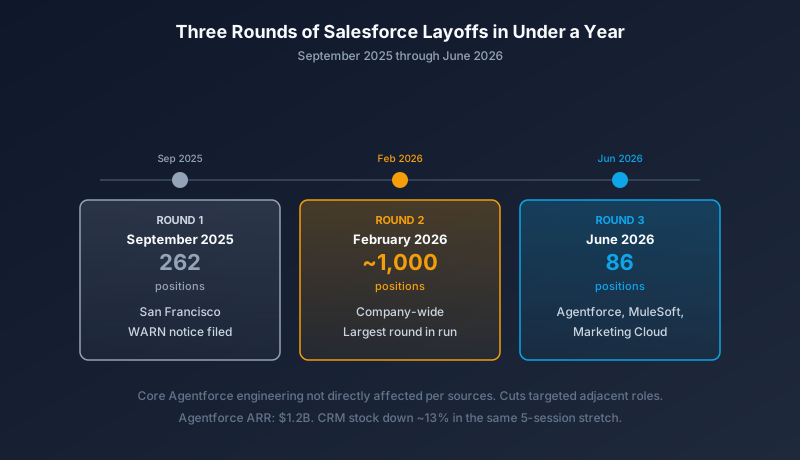
Eighty-six people is small against a workforce of Salesforce's size. The detail that matters is the cadence. This is the third round in under a year:
- September 2025: 262 positions cut in San Francisco.
- February 2026: roughly 1,000 roles eliminated.
- June 2026: 86 more, per this WARN filing.
Three rounds in ten months is not restructuring. It is a posture. Salesforce has been explicit that AI is absorbing internal work, and the company keeps demonstrating what that looks like in practice, one WARN notice at a time.
The Agentforce angle drew the obvious headlines: the company cutting people from the team building its AI agents. The reality is slightly less ironic. One source familiar with the cuts said the core Agentforce engineering team was not directly affected, and that the reductions targeted adjacent roles around the product rather than the people building it. That tracks with the role breakdown in the filing, which leans toward sales and administrative functions.
Still, the optics are what they are. Agentforce ARR just crossed $1.2 billion, the product is the centerpiece of every earnings call, and the teams around it are getting trimmed anyway. Growth in the product line no longer guarantees headcount stability anywhere near it. That is the actual lesson, and it applies well beyond Salesforce.
Wall Street has not exactly been soothed either. The stock dropped around 13 percent over five trading sessions in this stretch, a slide driven by broader questions about AI spending and software multiples, with the layoff news landing in the middle of it.
Reading Both Stories Together
The acquisition and the layoffs are the same strategy viewed from opposite ends.
m3ter exists because per-seat pricing dies when agents do the work. The layoffs exist, at least in part, because Salesforce is running that same playbook on itself: fewer humans in adjacent roles, more automation in the middle. The company is simultaneously building the billing infrastructure for a world with fewer seats and demonstrating, internally, why there will be fewer seats.
You do not have to like that to recognize it is coherent. Salesforce is positioning for a future where it gets paid per unit of work performed rather than per human logged in. Every move this quarter, from Contentful to m3ter to the WARN filings, points the same direction.
For customers, the near-term picture is mostly positive. Native consumption billing inside Revenue Management is a real capability gap getting filled, and m3ter is a credible team to fill it. The questions worth asking are the usual post-acquisition ones. How long until meaningful integration ships? What happens to m3ter's existing standalone customers? And does "native" end up meaning "works beautifully if you also own Revenue Cloud, Data Cloud, and a Flex Credits commitment"? History suggests asking early.
What to Do Now
If you run Revenue Cloud or CPQ: Start mapping where usage-based pricing could apply in your own product catalog. When m3ter's mediation and rating land in Revenue Management (realistically post-close, so FY2027 at the earliest for integrated features), customers with clean usage data models will adopt fastest. Inventory your billable events now.
If you administer Agentforce: Get serious about Flex Credit consumption monitoring. The m3ter deal confirms metered agent billing is the long-term model, not a transitional one. Build dashboards on agent action volume today so you are not guessing when finance asks what next quarter costs.
If you are an m3ter customer: Ask your account team about the standalone roadmap before the deal closes in Q2 FY2027. Acquired platforms usually keep running, but pricing and integration priorities shift toward the new parent. Get commitments in writing during renewal.
If you work in the ecosystem: Note where the cuts landed. Sales and administrative roles around AI products are getting squeezed even as those products grow. Skills tied to building, integrating, and governing agents are holding value. Skills tied to processes agents can absorb are not. Plan your certifications and your next role accordingly.
If you are tracking the M&A pattern: Watch for the next gap. Salesforce has now bought data, content, conversation intelligence, pipeline, commerce, and billing for the Agentforce stack. Observability and agent evaluation tooling are the most conspicuous holes left. Whoever fills those is probably already in a data room.
About the Author
Dipojjal Chakrabarti is a B2C Solution Architect with 29 Salesforce certifications and over 13 years in the Salesforce ecosystem. He writes and edits salesforcedictionary.com, published by KineticBit Inc., to help admins, developers, architects, and cert/interview candidates sharpen their fundamentals. More about Dipojjal.
Share this article
Sources
- Salesforce Signs Definitive Agreement to Acquire m3ter (Salesforce Newsroom)
- Salesforce Acquires m3ter to Add Consumption Billing to Agentforce (The Next Web)
- Salesforce Layoffs Hit Agentforce, MuleSoft, Marketing Cloud (Quartz)
- Salesforce Bets on Usage-Based Billing: m3ter Acquisition (Futurum Group)
- Salesforce Lays Off 86 Across Agentforce, MuleSoft Teams (The Bengal Story)
Related dictionary terms
Practise it
Five questions on Agentforce Specialist
Exam-style questions with an explanation after each one. No account needed, and your answers build a weak-topic map once you have one.
More news

Salesforce Buys Contentful for Agentforce
Salesforce signed to acquire Contentful on June 1, adding a headless content layer to Headless 360 and Agentforce. The Berlin-founded CMS serves 4,800 brands. Reported price: $1B to $1.5B, half its 2021 peak. Closes Q3 FY2027.

Agentforce Operations Goes Live
Salesforce shipped Agentforce Operations to GA, pushing agents from CRM into back-office workflows. Digital blueprints convert process docs into agent instructions. The pitch: 70% faster cycle times, 80% fewer manual tasks.

Salesforce Q1 FY27: Agentforce $1.2B
Salesforce beat Q1 FY27 estimates on every major metric: $11.13B revenue, $3.88 non-GAAP EPS, $33.6B cRPO at 14% growth. Agentforce ARR crossed $1.2B at 205% growth. Then Benioff revealed engineers haven't been hired in two years.
Comments
No comments yet. Start the conversation.
Sign in to share your take on this article. Your account works across every page.