
Salesforce x Databricks Partnership
At Data + AI Summit 2026, Salesforce and Databricks expanded their Zero Copy partnership to give Agentforce agents governed access to lakehouse data without moving it. Here is what is GA now and what is still a roadmap promise.
Salesforce and Databricks Expand AI Agent Partnership at Data + AI Summit 2026
An Agentforce agent gets asked to flag which open opportunities belong to accounts that a churn model scored as high-risk last night. The pipeline records live in Salesforce. The churn scores live in a Databricks notebook that never touches the CRM. Today, that agent answers with half the picture, because it can only see what already sits in Data 360. The partnership Salesforce and Databricks announced this week is aimed squarely at closing that gap.
Salesforce announced an expanded partnership with Databricks on June 16, 2026, at Databricks Data + AI Summit 2026 in San Francisco. The summit ran June 15 to 18 at Moscone Center and drew more than 30,000 data and AI professionals in person, with tens of thousands more virtual across 150-plus countries. The headline is simple to state. AI agents need trusted data, and most enterprises keep that data in two places at once.
The Problem This Solves
Enterprise data is split. Salesforce holds the CRM records: accounts, pipeline, cases, contacts, the operational system of record. Databricks holds the lakehouse: raw event data, ML models, custom feature sets, the analytical heavy lifting. These are not competing stores. They are two halves of the same enterprise, and they rarely talk to each other cleanly.
When an Agentforce agent runs, it works with whatever is in Salesforce Data 360. That is the constraint. If the answer requires a model output or a feature set that lives only in Databricks, the agent either guesses or asks a human to go look. Neither is acceptable at enterprise scale.
The expanded partnership builds on the existing Zero Copy link between Salesforce Data 360 and Databricks Unity Catalog. Zero Copy is the load-bearing idea. No ETL, no duplicate pipelines, no nightly sync jobs, no second copy of the data to secure and reconcile. The agent queries the data where it already lives. That removes both the engineering cost of moving data and the compliance risk of copying it.
Rahul Auradkar, President and GM of Data Foundations at Salesforce, framed it directly: "The challenge is no longer building more agents. It's giving agents the trusted data, business context, governance, and workflows required to operate safely at enterprise scale."
Andy Kofoid, President of Global Field Operations at Databricks, said the same thing from the data side: "Customers want AI agents to become a larger part of how work gets done. They need access to trusted data, business context, and governance controls wherever information lives."
Note the word both executives lean on: governance. That is the part of this announcement that actually matters, and it is the part that is least finished.
What Got Announced
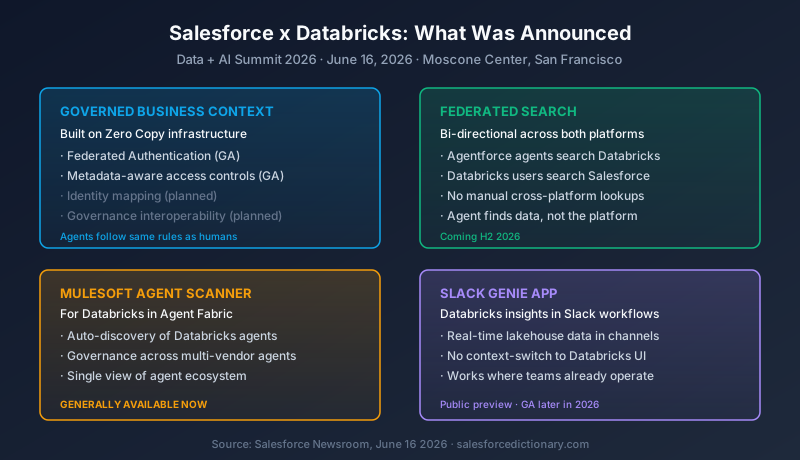
Five capabilities came out of the summit. They are at very different stages of maturity, so read the labels carefully.
Governed Business Context on Zero Copy infrastructure. This is the foundation layer. It includes federated authentication, metadata-aware access controls, and two pieces that are explicitly planned rather than shipped: identity mapping and governance interoperability. The goal is one consistent set of security and compliance controls that applies to both human users and AI agents across both platforms. The agent does not get a backdoor. It inherits the same rules a person would.
Federated Search. This one is bi-directional. Agentforce agents can search Databricks data, and Databricks users can search Salesforce. For an agent, that means surfacing the right record or feature without a manual cross-platform lookup first. The search finds the data; the agent does not have to know in advance which platform it sits on.
MuleSoft Agent Scanner for Databricks. This gives Agent Fabric automatic visibility into agents running on Databricks. It is the governance-at-scale piece for multi-vendor agent ecosystems, where you have agents from different platforms acting on the same data and someone has to keep track of all of them. This is GA now, which makes it the most concrete deliverable in the set.
Slack Genie App. This brings Databricks-powered insights into Slack, so a user gets real-time information from the lakehouse inside the channel where they already work. It is in public preview, with GA expected later in 2026.
Agentforce through Databricks Unity AI Gateway. This is the most forward-looking item. Salesforce and Databricks are exploring surfacing Agentforce agents through Databricks' Unity AI Gateway, with MCP-driven integrations under development. "Exploring" is the operative word. Treat this as direction, not product.
How an Agent Actually Reaches the Data
The mechanics are worth slowing down on, because the value of the whole partnership rests on them.
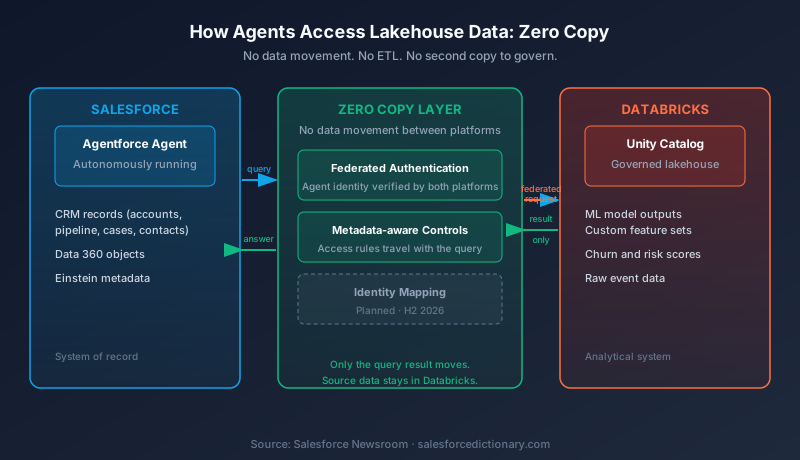
Start with the agent. It needs a model score that lives in Databricks. Instead of waiting for that score to be piped into Data 360 on some schedule, the agent issues a federated query through the Zero Copy connection into Unity Catalog. The data stays in Databricks. Only the result comes back. There is no copy created in Salesforce, so there is no second copy to govern, age out, or accidentally leak.
Now the governance layer. Federated authentication means the agent's request carries an identity that Databricks recognizes and can enforce against. Metadata-aware access controls mean the rules attached to that data, who can see which columns, which rows, under what purpose, travel with the query. If a human in that role would be blocked from a field, the agent is blocked from the same field. That is the whole point of extending controls to agents rather than giving them a privileged service account that sees everything.
This is where the honest caveat sits. Identity mapping and governance interoperability are the two pieces that make this airtight, and both are still on the roadmap. Federated authentication is here. The full bridge between the two platforms' identity and governance models is not. Until identity mapping ships, the consistency these executives describe is a target, not a guarantee. An architect planning around this should design for the GA primitives and treat the planned items as future work, not present capability.
Salesforce Won Partner of the Year, Too
Alongside the product news, Salesforce took home Databricks' ISV Business App Partner of the Year award at the summit. The citation credited "unmatched scale through deep collaboration on Tableau and Data 360 with Databricks." Databricks framed the work as having "enabled joint customers to unify, govern, and activate their data across platforms, accelerating AI-driven insights and outcomes."
Awards are awards. This one is mostly useful as a signal that the Tableau and Data 360 integration work is real and shipping at customer scale, not a slideware partnership. That track record is the reason to take the agentic roadmap seriously even where it is unfinished.
The Context You Should Carry
This is an expansion, not a debut. The original Salesforce and Databricks Zero Copy partnership predates 2026. BYO Model, which let teams bring a Databricks model into Salesforce Einstein, was an earlier piece of the same relationship. What is new in June 2026 is the specific focus on agentic workflows and on governing agents across two platforms at once.
That focus tracks where Salesforce has spent the year. Agent Fabric, the cross-vendor agent management layer, expanded in May. Agent Broker went GA on June 4. The MuleSoft Agent Scanner for Databricks is the same governance instinct applied to a partner's runtime: if agents are going to act autonomously across vendors, someone has to see all of them in one place. This announcement slots that thinking onto the Databricks lakehouse.
Availability and Roadmap
Here is the part to bookmark, because the gap between what is shipping and what is promised is wide.
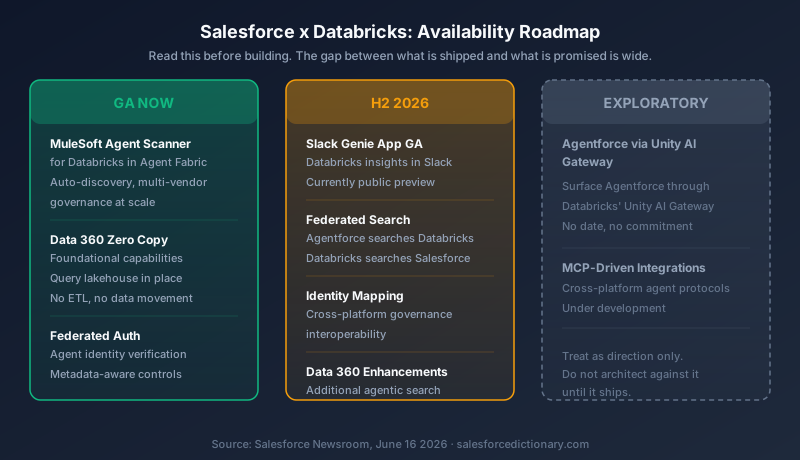
GA now: the MuleSoft Agent Scanner for Databricks, and the foundational Data 360 Zero Copy capabilities. These you can build on today.
Coming in H2 2026: Data 360 feature enhancements, Slack Genie App GA, agentic search expansion, MCP-driven integrations, and the two governance pieces that matter most, identity mapping and broader governance interoperability.
Exploratory: Agentforce surfaced through the Databricks Unity AI Gateway. No date, no commitment, just direction.
The shape of this is familiar. The plumbing that already existed, Zero Copy and the Tableau and Data 360 work, is GA. The genuinely new agentic governance, the part that justifies the announcement, is mostly H2 2026 or later. That is not a knock. It is the normal rhythm of a partnership announcement at a flagship conference, where the news has to land before all the product does. But it changes how you should act on it.
What to Do Now
If you run Agentforce against data that partly lives in Databricks, inventory exactly which agent use cases are blocked by the current Data 360 boundary. Those are the cases this partnership is built to unblock. Knowing them now means you can prioritize the moment federated search and identity mapping reach GA, rather than discovering the gaps later.
If you manage a multi-vendor agent estate, the MuleSoft Agent Scanner for Databricks is GA and worth wiring into Agent Fabric immediately. Visibility into agents running on Databricks is the prerequisite for governing them, and this is the one piece you do not have to wait for.
If you are an architect designing around this, build to the GA primitives only. Federated authentication and Zero Copy queries are real today. Identity mapping and governance interoperability are not, so do not assume consistent cross-platform controls until they ship. Track the Salesforce Newsroom announcement for GA dates and design your access model to tighten as the roadmap lands.
If you live in Slack, get the Genie App into your public-preview workflow now and test whether the Databricks insights it surfaces are accurate enough to act on. Public preview is the right time to find the rough edges, well before GA later this year.
About the Author
Dipojjal Chakrabarti is a B2C Solution Architect with 29 Salesforce certifications and over 13 years in the Salesforce ecosystem. He writes and edits salesforcedictionary.com, published by KineticBit Inc., to help admins, developers, architects, and cert/interview candidates sharpen their fundamentals. More about Dipojjal.
Share this article
Sources
- Salesforce and Databricks: A Shared Foundation for Human and Agent Work (Salesforce Newsroom)
- Salesforce and Databricks Expand Partnership to Govern AI Agent Workflows (ChannelE2E)
- Salesforce and Databricks Collaborate to Enhance AI Data Utilization (Hawkdive)
- Databricks Announces 2026 Global Partner Awards (Databricks Blog)
- Databricks Data + AI Summit 2026 (Databricks)
Related dictionary terms
 Our appAdWake up sharp. Not just awake.The alarm that rings through Silent and DND — free on iOS & Android.Get WakeSharp →
More news
Agent Fabric Expansion May 2026
Salesforce moved AI Gateway, MCP Bridge, and Trusted Agent Identity to GA this week, opened Agent Broker beta, and made Guided Determinism the new multi-vendor agent story. Here is what shipped.
Salesforce x FIFA World Cup 2026
Salesforce is the official AI backbone of FIFA World Cup 2026: Slack runs workforce operations across 16 host cities, and Agentforce 360 runs fan engagement at the 2027 Women's World Cup. The tournament is live. Here is what is deployed.
Agent Broker Hits GA, June 2026
Salesforce moves Agent Broker to GA in June 2026, shipping the visual authoring canvas, Agent Script, and Salesforce-model support. Guided Determinism is the production pattern for multi-agent orchestration. Here is what changed.


Comments
No comments yet. Start the conversation.
Sign in to share your take on this article. Your account works across every page.