
Salesforce Rewires the C-Suite
An 8-K filed on Wednesday moved Srini Tallapragada out of the engineering and customer success presidency after 14 years. Miguel Milano is the new COO, a Microsoft hire of two months now owns platform and engineering, and the chief trust officer leaves in October.

Salesforce filed an 8-K on Wednesday afternoon. It runs a few paragraphs, uses the phrase "transition agreement" twice, and says that as of August 6, Srini Tallapragada is no longer President and Chief Engineering and Customer Success Officer. He had held some version of that job for 14 years. The filing names no successor.
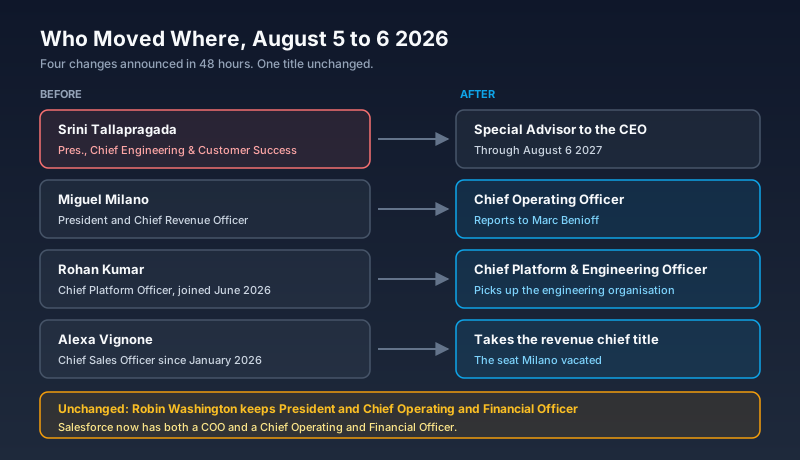
Three other moves landed in the same 48 hours, and read together they redraw the top of the Salesforce org chart more than anything since February 2025.
What the Filing Actually Says
Tallapragada becomes a Special Advisor to the CEO, effective August 6, 2026, running through August 6, 2027. The scope is transition of his duties, product and technology matters, business development, and customer matters. That is the standard hand-off language.
The compensation ladder is the part worth reading closely. Through January 31, 2027, which is the end of Salesforce's fiscal year, he keeps his current salary and his annual bonus. From February 1, 2027 to the end of the advisory term, the rate drops to $75,000 per year. Previously granted equity continues vesting on its existing schedule.
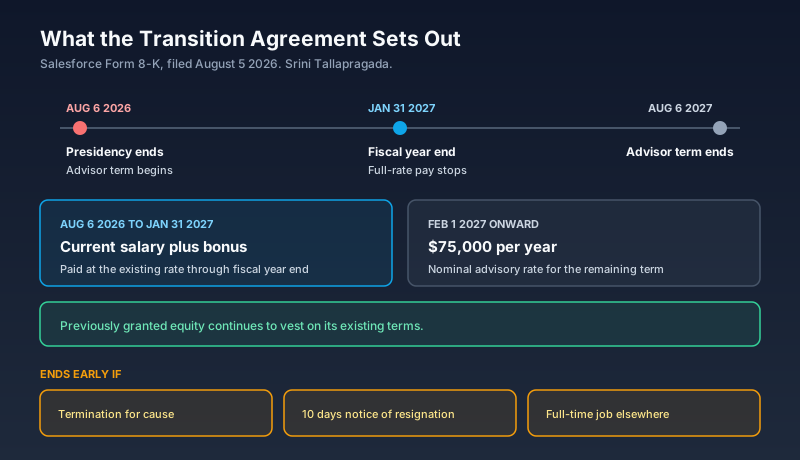
Three things end the arrangement early: termination for cause, ten days' written notice of resignation, or Tallapragada accepting full-time compensated employment somewhere else. There is a customary release of claims and a reaffirmation of his obligations under the employee inventions and proprietary rights agreement.
None of that is unusual for a departure at this level. What it does tell you is that the fiscal-year boundary was the planning unit. He is paid at full rate through the close of FY27 and at a nominal rate after, which is what a company writes when it wants the person reachable during a fiscal year it has already forecast.
Three Moves, Not One
Miguel Milano was promoted to Chief Operating Officer. He rejoined Salesforce as chief revenue officer in 2023 after a stretch at Oracle, and was the fourth-highest-paid Salesforce executive in fiscal 2026, behind Benioff, Robin Washington and Tallapragada.
Here is the wrinkle. Robin Washington keeps her title too. She has been President and Chief Operating and Financial Officer since February 2025, and she continues to run business strategy and operations, global finance, employee success, global strategic customers and partners, marketing, communications, and real estate. So Salesforce now has an executive whose title contains "Chief Operating and Financial Officer" and a separate Chief Operating Officer. The operating function has effectively been cut in two, with the revenue-facing half going to Milano.
Alexa Vignone, a ten-year Salesforce veteran who took the chief sales officer role in January, picks up the revenue chief title Milano is vacating.
Then the one that matters most for the platform. Rohan Kumar becomes Chief Platform and Engineering Officer. Kumar arrived in June 2026 as president and chief platform officer after 28 years at Microsoft, where he ran Azure Data as a partner general manager and finished as corporate vice president of Microsoft Security. He works out of Bellevue, Washington. Two months in, the engineering organisation Tallapragada was running now reports through him.
Two Months Is Not Long
The Kumar appointment is the one to watch, and not because it is a bad call. His background is a good fit for where Salesforce says it is going. Azure Data is large-scale platform infrastructure, which is what Data 360 and the Agentforce inference layer have become. Microsoft Security is governance at enterprise scale, which is the part of the agentic story customers keep asking about and Salesforce keeps having to answer.
The concern is calendar, not capability. Sixty days is not long enough to know which internal commitments are real, which roadmap dates are engineering estimates and which are keynote estimates, or which of the platform's older components are being held together by two people who have not been promoted in five years. That knowledge lives in the organisation Tallapragada spent 14 years building. It is now being transferred through a one-year advisory arrangement, which is a generous window by the standards of these agreements and still a thin one for a codebase this old.
Watch the Winter '27 release for the first read on this. Sandbox preview opens August 28 and general availability lands October 9 to 10. If dated features start slipping quietly out of the release notes between now and October, that is the transition showing up in the delivery calendar. If they hold, the engineering machine was more independent of its president than org charts suggest, which would be the better outcome and the likelier one.
The Departure List Is Longer Than One Name
This is not an isolated exit. Chief Trust Officer Vikram Rao is leaving after less than 18 months in the role, with an October 15 last day reported from an internal memo. Trust is the function that owns security posture and the customer-facing side of incident response, and it is turning over in a year that has already produced an OAuth-driven CRM data breach through a third-party integration and an MFA enforcement wave that broke a lot of integration users.
In May, Adam Evans left as EVP and GM of Salesforce AI and Madhav Thattai was promoted to run Agentforce development. We covered that reshuffle when it happened. Add Wednesday's filing and the picture for 2026 is four senior product, engineering and trust leaders replaced or reassigned inside six months.
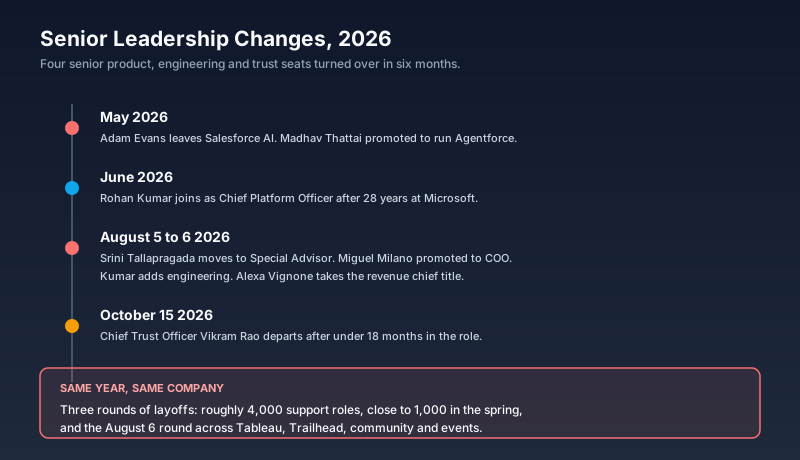
The context around it is not calm either. Salesforce cut roles across Tableau, Trailhead, community, events, Marketing Cloud and Industries Cloud on Thursday, the third round of 2026. CRM fell about 4 percent the same day in a broad software selloff over AI inference costs. Q2 FY27 earnings land on August 26.
Executive churn at a company of 70,000-plus is normal and mostly invisible to customers. Churn in engineering, trust and revenue leadership inside one quarter, during a year of three layoff rounds, while the company is asking customers to rebuild their support model on its agents, is worth tracking rather than shrugging at.
What This Changes For Your Org
Nothing today. Nothing this quarter, probably. Escalation paths, support contracts and roadmap commitments do not move when a president does, and anyone telling you to change platform strategy over an 8-K is selling something.
Three things are worth doing anyway.
If you have a Salesforce commitment that depends on a dated roadmap item, get the date reconfirmed by your account team in writing before the Winter '27 preview opens on August 28. Not because it will slip, but because the reconfirmation is free and the reference point is useful if it does.
If your security review is scheduled for Q4, move the Salesforce portion of it earlier. Trust leadership changes on October 15. The people who answer your architecture-review questions are not the chief trust officer, but the policies they answer from get rewritten when the seat turns over, and you want your answers timestamped before that rather than after.
And if you are mid-negotiation on a renewal, note that the revenue organisation now reports to a COO rather than a CRO, with a new chief sales officer moving into the revenue seat. New leaders inherit numbers they did not set. Fiscal year end is January 31.
Also This Week: Flow Gets Map Collections on the Roadmap
Away from the C-suite, the most useful thing published this week was a roadmap update most people missed.
Salesforce Ben reported on Friday that Henry Liu confirmed on the IdeaExchange in July that map collection support is coming to Flow. This is a request that has been open for roughly a decade. Every Flow builder who has written a loop-inside-a-loop to match child records against a parent collection has been asking for it, usually while watching an element count climb toward a governor limit.
The delivery order matters more than the headline. Retrieving related records from a collection without a loop comes first. Filtering collection items by field, including child record fields, comes next. Custom data types, described as Apex-defined types without the Apex, come after that. Get Related Records reaches general availability at that point. Full HashMap support, meaning arbitrary key-value storage, is last and is explicitly lower priority. Liu's framing was that HashMap functionality mattered but was not top-priority, because most use cases did not need it.
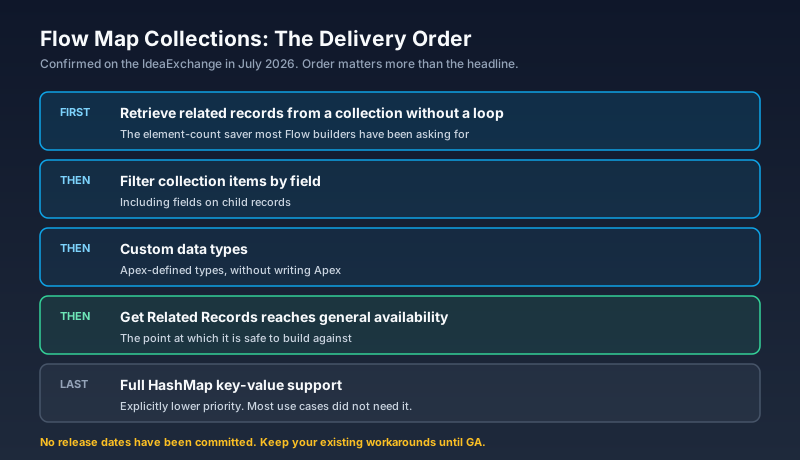
No release dates were committed to. Keep your current workarounds in place until something reaches GA, and resist rewriting working automation against a roadmap item. What this does change is design intent on new builds: if you are about to write a nested loop purely to correlate two collections, note in the flow description that the pattern is a placeholder, so whoever picks it up in 2027 knows it was a workaround rather than a decision.
Two more pieces landed the same day, both drawn from the Salesforce Ben architect survey. One asks whether the CTA has become a luxury credential, and the numbers behind it are hard to argue with: 4.7 percent of respondents hold it, the exam process runs around $6,000 before failed attempts, and 25.2 percent of those not pursuing it cite uncertain career return as the reason. The other found that 45.1 percent of an architect's working time is now spent outside Salesforce entirely, and concluded the identity problem sits with hiring managers rather than with architects.
Those two findings and this week's executive news point the same direction. The platform-specific senior role is being absorbed into a broader one, at the top of the company and at the top of the individual contributor track.
What To Do Next
Open your renewal and roadmap dependencies and put two dates next to them: August 28 for the Winter '27 preview, and August 26 for Q2 FY27 earnings. Confirm anything dated with your account team before the first, and read the earnings call transcript for how the operating split between Milano and Washington gets described. That description will tell you more about what actually changed this week than the 8-K did.
About the Author
Dipojjal Chakrabarti is a B2C Solution Architect with 29 Salesforce certifications and over 13 years in the Salesforce ecosystem. He writes and edits salesforcedictionary.com, published by KineticBit Inc., to help admins, developers, architects, and cert/interview candidates sharpen their fundamentals. More about Dipojjal.
Share this article
Sources
- Salesforce, Inc. Form 8-K, Srini Tallapragada transition agreement (filed August 5, 2026)
- Marc Benioff gets a new operating chief, as Salesforce promotes Miguel Milano (CNBC, August 5 2026)
- Salesforce president Srini Tallapragada steps down, becomes advisor (StreetInsider)
- Salesforce Engineering Chief Steps Down in Leadership Shuffle (The Information)
- Salesforce hires ex-Microsoft exec to lead Agentforce engineering amid string of departures (GeekWire)
- Salesforce Appoints Robin Washington as President and Chief Operating and Financial Officer (Salesforce, February 2025)
- Salesforce chief trust officer leaving less than 18 months in the role, BI says (TipRanks / The Fly)
- Map Collection Support in Salesforce Flow Is On the Roadmap (Salesforce Ben, August 7 2026)
- Is the Salesforce CTA Becoming a Luxury Credential? (Salesforce Ben, August 7 2026)
- The Great Salesforce Architect Identity Crisis (Salesforce Ben, August 7 2026)
Related dictionary terms
Practise it
Five questions on Agentforce Specialist
Exam-style questions with an explanation after each one. No account needed, and your answers build a weak-topic map once you have one.
More news

Salesforce Leadership Overhaul
Adam Evans is out, Madhav Thattai is in, around 1,000 employees have been let go, and 1,000 AI-native grads are being hired. Here is what Salesforce's May 2026 leadership overhaul means for the platform.

Agentforce Hits IL5 Without Claude
Agentforce 360 cleared DoD Impact Level 5 on August 5, and Army HRC is deploying it to 9.2 million people. The authorization came with Anthropic's models toggled off and GovSlack left behind at IL4.

Salesforce Cuts Trailhead and Events
Salesforce cut roles across Tableau support, Trailhead, community advocacy and events on August 6. Half the North America Tableau support team was reportedly hit. Tech layoffs passed the full 2025 total with four months left in the year.

Salesforce's AI Jobs Never Arrived
A 2025 study found 72 prompt engineer vacancies across 20,000 LinkedIn listings. Salesforce's operating margin hit 22 percent against a 14.2 percent five-year average. Those two facts are the same story.
Comments
No comments yet. Start the conversation.
Sign in to share your take on this article. Your account works across every page.