
Salesforce Marketing Cloud Growth Edition 2026: The Complete Guide
Where MCGE sits in Salesforce's marketing portfolio, what it's built on, how it compares to MCE and Account Engagement, and the gaps to know before you commit.

You inherit an org from a client who said they "do email marketing in Salesforce," and you brace yourself. You expect Marketing Cloud Engagement: the separate login, the Contact Builder, the SOAP API quirks. Instead you open the App Launcher and find Email, SMS, and a thing called Flow sitting right there next to Accounts and Opportunities. No second tab. No separate stack. This is Marketing Cloud Growth Edition, and if you came in expecting MCE, half of what you know still applies and half of it actively misleads you.
Let me walk through what MCGE actually is, where it fits, and when you should reach for it instead of the two products it sits between.
What Marketing Cloud Growth Edition Actually Is
Marketing Cloud Growth Edition (MCGE) is Salesforce's marketing automation product built natively on the Salesforce core platform, aimed at small and mid-market businesses. Salesforce previewed it at Dreamforce 2023 and brought it to general availability through 2024, with the major feature push landing around Connections 2024. By 2026 it has matured into a real third option in the marketing portfolio rather than a stripped-down preview.
The problem it solves is specific. Marketing Cloud Engagement is powerful and also a separate platform with its own data model, its own login, and a learning curve that eats consulting budgets. Account Engagement (the product everyone still calls Pardot) handles B2B lead nurture but was never built for high-volume B2C messaging or for transactional sends. MCGE targets the company that outgrew basic email tools, wants B2C-style campaigns, and does not want to staff a dedicated Marketing Cloud team to run them.
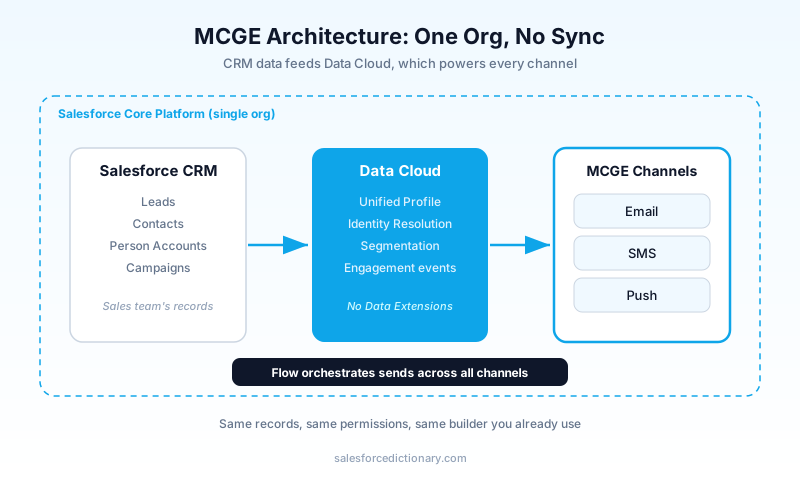
The defining characteristic: it lives inside your Salesforce org. Same data model. Same permissions. Same Flow builder you already use for automation. That single fact drives almost every difference you will care about.
The Data Cloud Foundation
Here is the part that trips up everyone coming from MCE. In Marketing Cloud Engagement, your audience lives in Data Extensions, keyed by a Subscriber Key, synced over from CRM through Marketing Cloud Connect. It is a separate world that you keep in step with the org.
MCGE does not work that way. It is built on Salesforce core and on Data Cloud. Your marketing audience is the same Lead, Contact, and Person Account data your sales team already touches. There is no sync job to babysit, because there is nothing to sync. The records are the records.
What does this mean in practice? A few concrete things.
You segment using Data Cloud. Audiences in MCGE are built as Data Cloud segments against the unified profile, which means you can combine CRM fields, engagement events, and ingested external data in one segment definition. If you have done MCE segmentation with SQL queries on Data Extensions, this is a different muscle. You are working with segment criteria and related attributes, not writing query activities.
The identity model changes too. MCE thinks in terms of the Subscriber Key and Contact Key. MCGE thinks in terms of the Salesforce Contact ID (or Lead ID, or the unified Data Cloud individual). When you map a sendable audience, you are pointing at standard objects, not at a Data Extension you provisioned. The upside is obvious: one source of truth. The thing to watch is that data quality problems in your CRM are now data quality problems in your marketing. A duplicate Contact is a duplicate recipient.
Practically, this also means Data Cloud is not optional. MCGE provisions with a Data Cloud allocation, and your segmentation, personalization, and engagement tracking all route through it. Treat Data Cloud setup as part of the MCGE setup, not as a later phase. The Data Cloud overview is worth reading before you provision, because the unified data model concepts carry straight into how your campaigns target.
Core Features in MCGE
The feature set covers the channels a mid-market team actually uses. The names differ from MCE, so here is the mapping.
Email. You build emails in Content Builder, the same drag-and-drop editor concept MCE users know, refreshed and embedded in the core UI. You get reusable content blocks, templates, and personalization that pulls from the merge fields of your unified profile. Personalization uses a merge-field and Handlebars-style approach rather than AMPscript. If you were expecting to drop in an AMPscript lookup, that habit does not transfer.
SMS and Push. MCGE includes SMS and mobile push as native channels. You configure them as part of the same campaign and Flow structure, not as a bolt-on with separate provisioning the way SMS often felt in MCE. Short codes and number provisioning still involve carrier lead time, so plan ahead.
Content Builder. Assets, images, templates, and email content all live in Content Builder. Reusable blocks behave the way you expect, and the editor is genuinely usable for marketers without a developer in the loop.
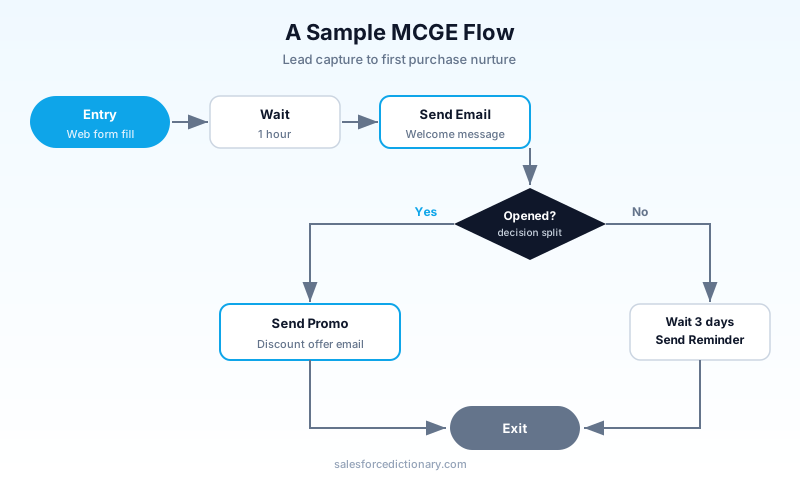
Flow for automation. This is the headline rename. What MCE calls Journey Builder, MCGE calls Flow. It is the same Salesforce Flow engine you already use for record automation, extended with marketing-specific elements: send an email, wait, branch on engagement, exit. If you build Flows for sales ops today, the marketing version will feel familiar fast. That is a real advantage and also a constraint, which I will come back to.
Analytics and Einstein. MCGE ships with engagement reporting through standard Salesforce reports and dashboards, plus Einstein features like send-time optimization and generative content assistance for drafting copy and subject lines. The analytics live where your other reports live, so the marketing team and the sales team look at the same dashboard surface.
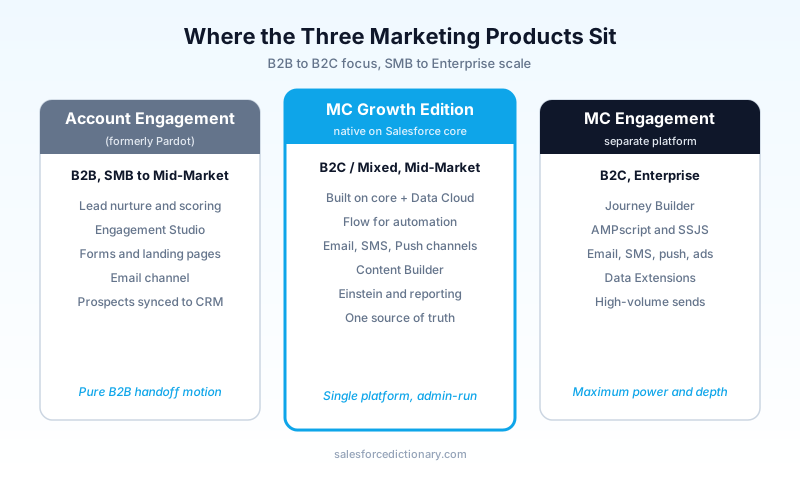
Who Should Choose MCGE vs MCE vs Account Engagement
This is the question every consultant fields in the first scoping call. The honest answer depends on volume, complexity, and how B2B or B2C the business is. Here is how I frame it.
| Factor | Account Engagement | MCGE | MCE |
|---|---|---|---|
| Best fit | B2B lead nurture | B2C / mixed, mid-market | High-volume, complex B2C |
| Data model | Prospects synced to CRM | Native CRM + Data Cloud | Data Extensions, separate |
| Channels | Email, forms | Email, SMS, push | Email, SMS, push, ads, in-app, more |
| Automation | Engagement Studio | Flow (native) | Journey Builder |
| Scripting | Limited | Merge fields / Handlebars | AMPscript, SSJS, GTL |
| Setup complexity | Low | Low to moderate | High |
| Team needed | Marketing ops | Admin plus marketer | Dedicated MC specialists |
| Lives in core org | Mostly | Yes | No |
The short version. Choose Account Engagement if you are pure B2B, your motion is form-to-MQL-to-sales handoff, and you live in lead scoring. Choose MCGE if you are B2C or mixed, mid-market volume, want a single platform, and value your admin team running marketing without a separate skill set. Choose MCE when you have high send volume, need channels MCGE does not cover, need AMPscript-level personalization logic, or run campaign complexity that exceeds what Flow comfortably models.
One trap to avoid: do not pick MCGE purely because it is cheaper or simpler if your real requirement is enterprise B2C complexity. You will hit the ceiling and a migration to MCE is not a weekend project.
Setup Sequence and Key Gotchas
Order matters here more than in most Salesforce products, because of the Data Cloud dependency.
Provision Data Cloud first. MCGE relies on Data Cloud for segmentation and unified profiles. Get Data Cloud enabled, get your data streams and data model object mappings sorted, and confirm identity resolution is producing sensible unified individuals before you start building audiences. If you build segments on top of a half-configured Data Cloud, your sends target the wrong people.
Account for provisioning time. This is not an instant turn-on. Provisioning MCGE and its Data Cloud allocation takes coordination, and any SMS short-code or sending-domain setup adds carrier and DNS lead time. Authenticate your sending domain (SPF, DKIM, DMARC alignment) early. Deliverability problems trace back to skipped domain setup more than anything else.
Mind the identity mapping. Because audiences resolve to Contact and Lead records, sort out your duplicate management and data hygiene before launch. A messy CRM produces messy sends, and there is no Data Extension layer to hide behind.
Set permissions deliberately. MCGE uses standard Salesforce permission sets. Marketers need the right Data Cloud and MCGE permission sets, and you should scope who can send to whom. In a shared org, a marketer with broad access can email your entire customer base. Treat send permissions like you treat data export permissions.
Do not assume MCE features exist. This is the recurring gotcha. Teams scope a project assuming AMPscript, assuming Journey Builder's wait-until-event granularity, assuming Data Extension imports. Confirm each required capability against the MCGE overview documentation before you commit a timeline.
What's Still Missing (and What's Coming)
I would rather you hear the gaps from me than discover them in week three of a build. MCGE is good, and it is also younger than MCE by more than a decade. That shows in a few places.
Automation depth. Flow handles linear and branched marketing automation well. It does not yet match the full depth of Journey Builder for very large, many-branch, event-driven campaigns with intricate wait-until and goal logic. For most mid-market use cases this is fine. For enterprise campaign design, you will feel the ceiling.
Scripting. There is no AMPscript equivalent. Personalization through merge fields and Handlebars-style syntax covers common cases, but the deep conditional content and runtime lookups that AMPscript and SSJS give you in MCE are not there. If your current emails are full of AMPscript blocks, budget for redesigning them, not porting them.
Advanced segmentation. Data Cloud segmentation is powerful, and it is a different model from SQL on Data Extensions. Some of the precise, query-driven audience carving MCE veterans rely on takes rethinking. Real-time and streaming segmentation continue to improve, so check current limits rather than trusting a 2024 blog.
Transactional messaging. High-volume transactional sends (order confirmations, password resets through a triggered API) are an MCE strength via Transactional Messaging API. Confirm MCGE's current transactional capabilities against your volume and latency needs before assuming parity.
ISV ecosystem. MCE has a deep AppExchange and partner ecosystem built over years. MCGE's third-party tooling is younger and growing. If you depend on a specific MCE partner integration, verify it exists for MCGE.
The trajectory is clearly upward. Salesforce has put MCGE on its main marketing roadmap and ships features on the regular release cadence. Many of these gaps are narrower in 2026 than they were at launch, and several will close further. Check the release notes and the Salesforce Trust page for current capabilities and service health rather than relying on launch-era summaries.
Your Next Step
If you are evaluating MCGE for an org, do this before anything else: list your top ten current or required marketing capabilities (every AMPscript block, every campaign branch, every integration, every transactional flow) and check each one against the MCGE overview documentation. The products differ most in the details, and a one-page capability audit will tell you in an afternoon whether MCGE fits or whether you need MCE. If MCGE clears that audit, spin up a Data Cloud sandbox and build one real segment against your actual CRM data. That single exercise teaches you more about whether MCGE works for you than any feature comparison table, including the one above.
About the Author
Dipojjal Chakrabarti is a B2C Solution Architect with 29 Salesforce certifications and over 13 years in the Salesforce ecosystem. He writes and edits salesforcedictionary.com, published by KineticBit Inc., to help admins, developers, architects, and cert/interview candidates sharpen their fundamentals. More about Dipojjal.
Share this article
Sources
Practise it
Five questions on Marketing Cloud Specialist
Exam-style questions with an explanation after each one. No account needed, and your answers build a weak-topic map once you have one.
Keep reading

Agentforce Marketing: The Complete 2026 Guide (Formerly Marketing Cloud)
Marketing Cloud is now Agentforce Marketing. This 2026 guide covers conversational email, real-time segments, brand settings, business units, and the rollout that does not stall in pilot.

Marketing Cloud Engagement vs Account Engagement (Pardot): The 2026 Decision Guide
Marketing Cloud Engagement and Account Engagement (Pardot) sound similar but solve different problems. Decision matrix by audience, channel, scale, pricing, and 2026 Agentforce integration.

Salesforce Data 360: The Complete 2026 Implementation Guide
Data 360 is Salesforce's unified data platform for the agent era. This 2026 implementation guide walks data streams, identity resolution, segmentation, activations, and zero-copy federation.
Comments
No comments yet. Start the conversation.
Sign in to join the discussion. Your account works across every page.