
Marketing Cloud Engagement vs Account Engagement (Pardot): The 2026 Decision Guide
B2B vs B2C, the studio stack, journey vs Engagement Studio, scoring & nurture, pricing reality, and the Marketing Cloud Growth tier - pick the right Salesforce marketing tool.
If you're picking a Salesforce marketing tool in 2026, you're navigating a confusing product landscape - multiple rebrands, a new Growth tier, deep integration with Data Cloud, and Agentforce overlays on every workflow. This guide is the decision matrix.
The naming chaos - what's what in 2026
Salesforce renamed the marketing portfolio in 2022–2024. The current lineup:
| Old name | 2026 name |
|---|---|
| ExactTarget | Marketing Cloud Engagement |
| Pardot | Marketing Cloud Account Engagement |
| Interaction Studio | Marketing Cloud Personalization |
| Datorama | Marketing Cloud Intelligence |
| (new) | Marketing Cloud Growth (lower-tier umbrella) |
Most practitioners still say "Pardot" and "ExactTarget." Documentation uses the new names. Both are correct.
Marketing Cloud Engagement (B2C)
Built for high-volume, multi-channel B2C campaigns. Think retail, consumer brands, media, travel - sending millions of emails per send, plus SMS, push, social, and ads.
The studio stack:
- Email Studio - the core. Email design, send, deliverability.
- Mobile Studio - SMS, push notifications, in-app messages.
- Social Studio - social listening and publishing (note: in maintenance mode as of 2024).
- Advertising Studio - synced audiences for Meta, Google, LinkedIn ads.
- Audience Studio (formerly Krux) - DMP for advertising audiences.
- Content Builder - central asset library across studios.
- Automation Studio - visual workflows for data import, segmentation, send.
- Journey Builder - orchestration across channels.
- Personalization (Marketing Cloud Personalization) - real-time web/email/app personalization.
Data model:
- Built on a separate platform (not the Salesforce Platform / Force.com).
- Uses Data Extensions (custom tables) instead of standard objects.
- Has its own contact model - Contacts and Subscribers - distinct from Salesforce CRM Contacts.
Strengths:
- Scale. Sends 100M+ emails per send. Handles enterprise B2C.
- Channel breadth. Email + SMS + push + social + ads + web - one platform.
- Deep personalization. Real-time inputs, AMPscript / SSJS for dynamic content.
- Robust journey orchestration for complex multi-step campaigns.
Weaknesses:
- Steep learning curve. AMPscript, SSJS, the studio sprawl - months to onboard.
- Separate from Sales Cloud. Integration via Marketing Cloud Connect; not native.
- Pricing. Enterprise tier; not casual investment.
Account Engagement (Pardot) - B2B
Built for B2B marketing automation: lead nurture, scoring, hand-off to sales.
Capabilities:
- Forms and landing pages for lead capture.
- Email marketing (per-lead, lower volume than Engagement).
- Engagement Studio - visual nurture journeys.
- Lead scoring - implicit scoring (engagement) + explicit grading (fit).
- Account-based marketing (ABM) - segment by account, not just lead.
- Salesforce sync - native, deep, real-time.
Data model:
- Built on the Salesforce Platform (since the Lightning rebuild).
- Uses standard Lead, Contact, Account, Campaign objects.
- Tightly coupled with Sales Cloud - no separate contact database.
Strengths:
- Native Sales Cloud integration. Lead scoring updates the Lead record. Campaign attribution flows to Opportunity. Reps see Pardot activity in the Salesforce UI.
- B2B fit. Long-cycle nurture, account orchestration, sales hand-off.
- Engagement Studio simplicity. Visual, no-code. Easier to learn than Engagement's automation toolset.
- Scoring + grading. Combined model for prioritizing leads.
Weaknesses:
- Lower volume ceiling. Designed for B2B lead volumes (thousands–hundreds-of-thousands), not B2C millions.
- Limited channel breadth. Email, forms, landing pages - minimal mobile/social/ads.
- Less personalization sophistication. No AMPscript-class dynamic content.
Marketing Cloud Growth (2024–2026)
The newer lower-tier offering. Built natively on the Salesforce Platform. Targets SMB-to-mid-market customers who outgrow native email but don't need full Engagement.
What it includes:
- AI-assisted email creation (Einstein-driven).
- Journey orchestration on the Salesforce Platform (not the legacy Engagement runtime).
- Native CRM integration (built-in, not Connect-bridged).
- Path Analyzer for journey optimization.
- Pricing well below Engagement.
What it doesn't include (vs Engagement):
- Mobile Studio scale (SMS at million-per-day level).
- Advertising Studio.
- Multi-channel orchestration breadth.
- The full automation toolkit.
When to consider Growth:
- You're on Sales Cloud and your needs exceed Pardot but don't justify Engagement.
- You're new to Salesforce marketing and want something modern and integrated.
- Your sends are in the thousands–millions range, not tens of millions.
The big comparison
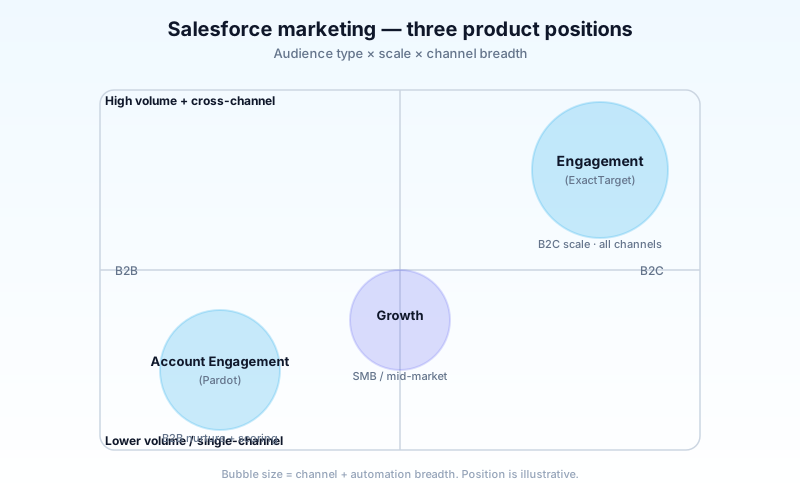
| Dimension | Engagement | Account Engagement (Pardot) | Growth |
|---|---|---|---|
| Primary audience | B2C consumer | B2B lead | B2B SMB / mid-market |
| Send volume | Millions+/send | Thousands–hundreds-of-thousands | Up to millions |
| Channels | Email, SMS, push, social, ads, web | Email + forms | Email + journey |
| Platform | Separate (legacy MC) | Salesforce Platform | Salesforce Platform |
| Data model | Data Extensions | Lead/Contact/Account | Lead/Contact/Account |
| Sales Cloud integration | Connect (sync) | Native | Native |
| Personalization | Deep (AMPscript, SSJS) | Limited | AI-assisted |
| Journey orchestration | Journey Builder | Engagement Studio | Path / Journey on Platform |
| Lead scoring | Custom | Built-in (score + grade) | Built-in |
| Learning curve | Steep | Moderate | Easy |
| Typical cost | Enterprise | Mid–enterprise | SMB–mid |
Decision matrix - pick by audience and scale
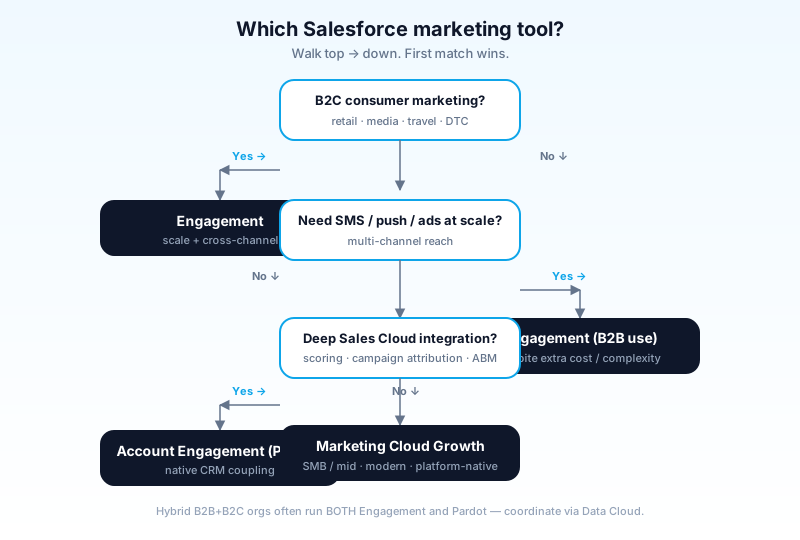
Profile 1: B2C consumer brand, large send volumes → Engagement. Nothing else handles the scale or channel breadth.
Profile 2: B2B with deep Sales Cloud integration needs → Account Engagement (Pardot). Native CRM coupling is the differentiator.
Profile 3: SMB / growth-stage on Salesforce, modern needs → Growth. Lower cost, modern UX, native platform.
Profile 4: B2B but needs SMS / social / ads at scale → Engagement despite the B2B context. Account Engagement can't deliver those channels.
Profile 5: Hybrid B2B and B2C (e.g., tech company selling both seats and consumer plans) → Often both Engagement and Account Engagement. Use Engagement for consumer; Account Engagement for B2B leads. Coordinate via Data Cloud.
Profile 6: Already on Pardot but feeling constrained → Evaluate Marketing Cloud Growth. Often the upgrade path now (rather than jumping to full Engagement).
Profile 7: New to Salesforce, modest marketing needs → Start with Growth or even native Salesforce Email + Campaigns. Don't over-buy.

Migration paths
Pardot → Engagement
The hardest migration. Different platforms, different data models, different toolsets.
- Plan 6+ months. Includes data migration, journey rebuild, integrations rewire.
- Run parallel. Don't cut over cold; pilot Engagement on one product line.
- Evaluate Growth first. Often a better fit than full Engagement for current Pardot customers.
Pardot → Marketing Cloud Growth
Easier than Pardot → Engagement. Both are on the Salesforce Platform.
- Data model is friendlier. Same Lead/Contact/Account.
- Journey Builder is similar concept to Engagement Studio.
- Lower learning curve for the existing Pardot team.
Engagement → Pardot or Growth
Rare but happens (B2B-only orgs over-bought). Painful - you're losing channels.
- Audit channel usage first. If 80% of value is email, the loss may be acceptable.
- Plan for SMS / push as separate tools if you need them.
Pricing - the real numbers
Salesforce doesn't publish exact pricing; it's quote-based. Rough public ranges in 2026:
| Product | Approximate annual cost (mid-market) |
|---|---|
| Pardot Growth | ~$15k+ |
| Pardot Plus / Advanced | ~$30k–$60k |
| Pardot Premium | ~$120k+ |
| MC Growth Edition | starts ~$15k–$50k |
| MC Engagement (Pro) | ~$60k–$120k |
| MC Engagement (Enterprise) | $250k–$1M+ |
Caveats:
- All scale heavily by send volume and contact count.
- Add-ons (Personalization, Intelligence, Mobile Studio) are typically separate.
- Multi-year deals reduce these numbers significantly.
- Discounts are real and negotiable, especially in Q4.
How Agentforce reshapes marketing (2026)
The 2026 layer reshapes both products' workflows.
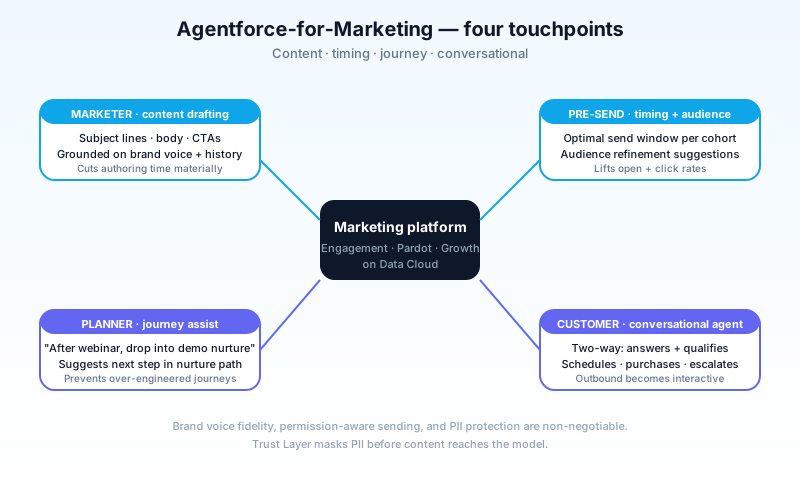
Content drafting agent
Marketers describe what they want; the agent drafts subject lines, body copy, and CTAs grounded in your brand voice and past performance. Works in both products.
Send-time and audience optimization
Agents recommend the optimal send time and segment for a campaign based on past behavior. Engagement integrates this deeply via Einstein.
Journey assistance
For a long nurture, the agent suggests the next step ("after a webinar registration, drop them into your demo nurture"). Works on Engagement Studio (Pardot) and Journey Builder (Engagement).
Customer-facing conversational agents
The shift in 2026: outbound marketing isn't only one-way email. Customers can converse with an agent that handles questions, qualification, and even purchasing for low-touch products.
Critical constraints:
- Brand voice fidelity. Generic AI output erodes brand. Train on your style guide; review every campaign.
- Permission-aware sending. Agent-driven sends honor opt-in / unsubscribe states. No exceptions.
- PII protection. Einstein Trust Layer masks PII in prompts. Customer email content cannot leak.
Common pitfalls
- Pattern 1: Picking by feature checklist instead of audience. Engagement has more features. That doesn't mean it's right. Pick by audience and scale.
- Pattern 2: Buying Engagement for B2B convenience. You'll fight the contact model and the lack of native CRM integration. Pardot/Growth fit B2B better.
- Pattern 3: Stale Pardot prospects piling up. Pardot syncs everything to Salesforce; ungoverned, you'll have hundreds of thousands of low-fit Leads. Implement scoring + retention.
- Pattern 4: Over-engineered journeys. A 22-step journey impresses no one if conversion drops at step 4. Start with 3-step journeys; iterate.
- Pattern 5: No suppression strategy. Sending the same email three times to a customer who already converted erodes trust. Build suppression lists; honor unsubscribes.
- Pattern 6: Treating Engagement and Pardot data as separate. Data Cloud (Data 360) unifies. Use it.
- Pattern 7: Custom Apex when Engagement Studio works. Custom code in marketing systems decays fast. Stay declarative where you can.
- Pattern 8: Ignoring Marketing Cloud Connect (Engagement → Sales Cloud). Even if you don't use it, the data flow it enables matters for sales-marketing alignment.
- Pattern 9: Buying Marketing Cloud without a marketing ops resource. It's powerful enough that you need someone driving it. Without one, ROI is zero.
- Pattern 10: Skipping deliverability hygiene. Engagement and Pardot don't auto-magic deliverability. Domain authentication, list quality, and engagement-driven sending all matter.
Frequently asked questions
Can I use both Engagement and Pardot? Yes - many enterprise orgs do. Use Engagement for B2C and Account Engagement for B2B. Coordinate via Data Cloud or shared Salesforce CRM data.
Is Pardot still being invested in? Yes - under the Account Engagement name, it gets regular updates. New investment is heavier on Growth and Engagement, but Pardot remains supported.
What replaced Social Studio? Salesforce put Social Studio in maintenance in 2024. Most customers migrated to Sprout Social, Hootsuite, or third-party platforms.
How does Marketing Cloud integrate with Data Cloud? Data Cloud unifies customer data from CRM, Marketing Cloud, web, and any source. Marketing Cloud Engagement consumes Data Cloud audiences for activation. Account Engagement is integrating progressively.
Does Account Engagement work without Sales Cloud? Technically yes - but you lose its main differentiator. Account Engagement standalone makes little sense.
Can Agentforce send marketing emails? Through configured agent actions, yes. The agent doesn't bypass send approvals or compliance rules.
Is Pardot's lead scoring still useful? Yes, especially when paired with grading. Most B2B teams find scoring + grading valuable; the data drives lead assignment and SLA enforcement.
What's the difference between Marketing Cloud Personalization and Engagement? Personalization is real-time (web, app, email-render-time). Engagement is the broader cross-channel platform. Personalization is often added to Engagement, not used standalone.
What to read next
- Pardot, Marketing Cloud Account Engagement, Marketing Cloud Personalization, Email Studio - the dictionary entries.
- Data Cloud Is Now Data 360 - the unification layer beneath modern marketing.
- What Is Agentforce 360? - the agent platform powering 2026 marketing copilots.
Pick by audience and scale, not feature checklist. B2C scale → Engagement. B2B precision → Account Engagement. Modern SMB / mid-market → Growth. Don't over-buy; marketing tooling outsizes its use far more often than it falls short.
About the Author
Dipojjal Chakrabarti is a B2C Solution Architect with 29 Salesforce certifications and over 13 years in the Salesforce ecosystem. He writes and edits salesforcedictionary.com, published by KineticBit Inc., to help admins, developers, architects, and cert/interview candidates sharpen their fundamentals. More about Dipojjal.
Share this article
Sources
Related dictionary terms
 Our appAdWake up sharp. Not just awake.The alarm that rings through Silent and DND — free on iOS & Android.Get WakeSharp →
Keep reading

Data Cloud Is Now Data 360: What Actually Changed (and Why It Matters)
Data Cloud became Data 360 in October 2025. Beyond the rename: Zero-Copy Federation, Tableau Semantics, the Lakehouse, and a new credit model. Here's the full picture.
What Is Agentforce 360? The Complete 2026 Guide for Salesforce Admins, Developers & Architects
Agentforce 360 is Salesforce's 2025 rebrand of its agentic-AI platform - built on the Atlas Reasoning Engine, Einstein Trust Layer, and Data 360. Here's the complete admin + dev + architect guide.


Comments
No comments yet. Start the conversation.
Sign in to join the discussion. Your account works across every page.